

안녕하세요! 매일한글 에디터입니다.
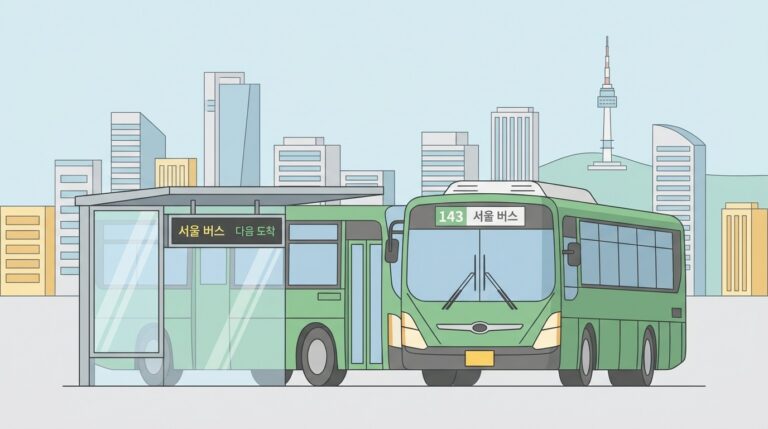
Have you ever stood in the middle of Seoul—maybe near Hongdae or Gangnam Station—watching giant blue and green buses flash past while your heart races? You look up at the electronic LED board. Glowing red and green Korean letters tick down: “2분 후 도착” (Arrives in 2 minutes). You look closely at the signs pasted across the bus shelter and feel that sudden pinch of panic: What if I hop on the wrong bus and end up across the Han River at 11 PM?
Take a deep breath! As someone who has spent over a decade helping curious travelers and K-culture lovers navigate the streets of South Korea, I have a fun secret for you: you already know dozens of Korean bus terms without realizing it. Because so many transit words in Korea are loanwords (English words adapted into the Korean alphabet), learning to spot and read them is like discovering a secret cheat code. With just a few basic Hangul building blocks, those intimidating bus stops suddenly turn into familiar, friendly signs. Let’s conquer the Korean bus stop together, step by step!
Phase 2: Core Expressions Deep Dive
1. 버스 (Beoseu)
- Pronunciation: [Beo-seu] (Think of “buss” with a short, soft “uh” at the end, like “buss-uh”)
- Meaning: Literal: Bus | Nuance: Public city bus or transit vehicle
- K-Culture Moment: In almost every romantic K-Drama, the female lead dashes to catch the blue city 버스 (beoseu), tapping her card right as the doors slide shut!
- Editor’s Insight: Notice that Korean has no isolated “s” sound at the end of a syllable without a vowel, so English “bus” gains the vowel ㅡ (eu) to become “beo-seu”. Once you spot this vowel rule, hundreds of loanwords suddenly make sense.
- Situation Spectrum: Casual: ✅ | Semi-formal: ✅ | Formal: ✅ (Universal noun)
- 🤔 Think About It: Why does Korean transform single-syllable foreign words into multi-syllable blocks? How does your native language handle words borrowed from other cultures?
2. 카드 (Kadeu)
- Pronunciation: [Ka-deu] (Sounds like “car” followed by a soft “duh”: “car-duh”)
- Meaning: Literal: Card | Nuance: Transit card (T-Money card) or payment card
- K-Culture Moment: You’ll hear the chime and automated voice say “카드를 다시 대주세요” (Please tap your card again) when someone fumbles their transit pass at rush hour.
- Editor’s Insight: You’ll see this everywhere: 교통카드 (Gyotong kadeu = Transportation Card), 신용카드 (Sinyong kadeu = Credit Card). When boarding, simply holding this up lets the driver know your payment method.
- Situation Spectrum: Casual: ✅ | Semi-formal: ✅ | Formal: ✅
- 🤔 Think About It: In many Western transit systems, paper tickets or mobile apps dominate. In Korea, physical contact tapping with re-loadable mascot cards remains an iconic cultural ritual. Why do cute physical cards stay so popular in a ultra-digital country?
3. 벨 (Bel)
- Pronunciation: [Bel] (Rhymes with “bell” in English, but with a lighter, crisper “L” sound made with your tongue flicking the roof of your mouth)
- Meaning: Literal: Bell | Nuance: The red “Stop” button on the bus wall or pole
- K-Culture Moment: In variety shows like Running Man, cast members scramble down the bus aisle yelling “벨 눌렀어요!” (I pressed the bell!) so the bus doesn’t skip their mission stop.
- Editor’s Insight: While English-speaking transit systems write “STOP” on buttons, Korean buses usually feature a red buzzer labeled either STOP or 벨 (Bel). You must press it before approaching the stop, or Korean drivers will glide straight past!
- Situation Spectrum: Casual: ✅ | Semi-formal: ✅ | Formal: ✅
- 🤔 Think About It: Pressing the bell early signifies respect for the collective flow of traffic. What signals are considered courteous on public transit in your home country?
Phase 3: Textbook Korean vs. Real Korean
Situation 1: Asking if the bus goes to your destination
- 📖 Textbook Korean: 이 버스는 홍대에 갑니까? (I beoseuneun Hongdaee gamnikka? / Does this bus go to Hongdae?)
- 🗣️ Real Korean: 이거 홍대 가요? (Igeo Hongdae gayo? / Does this go to Hongdae?)
- 💡 Why the difference? Textbook phrasing uses heavy, overly formal declarative endings. Real commuters keep questions short and punchy so the driver can answer with a quick nod without causing delays.
Situation 2: Informing the driver you are getting off right now
- 📖 Textbook Korean: 다음 정류장에서 내리겠습니다. (Daeum jeongnyujang-eseo naerigesseumnida. / I shall alight at the subsequent stop.)
- 🗣️ Real Korean: 저 이번에 내려요! (Jeo ibeone naeryeoyo! / I’m getting off this turn!)
- 💡 Why the difference? If the driver starts closing the rear exit doors because you were delayed behind a crowd, long grammatical endings take too long. A snappy, polite present tense sentence communicates your urgent need instantly.
Phase 4: K-Culture Deep Dive & Non-Verbal Manners
4-1. 눈치 (Nunchi) & Bus Gestures
Korean buses move swiftly! Here is your quick body language checklist:
1. Queue with Eye Contact: When your bus approaches the shelter, step near the curb and make brief eye contact with the driver. If you stay buried in your smartphone, the driver might assume you are waiting for a different line and drive by.
2. Hold the Handrail: Seoul bus drivers accelerate and corner dynamically. Grab the overhead handle immediately after tapping your card.
3. The Exit Tap: Always tap your transit card on the reader beside the back door right before you exit. This secures your transfer discount for your next ride!
4-2. Culture Code: The Rainbow Bus System
Seoul buses are color-coded, making navigation intuitive:
* Blue Buses (간선버스 – Ganseon beoseu): Major arteries connecting suburbs to downtown Seoul.
* Green Buses (지선버스 – Jiseon beoseu): Neighborhood branch lines connecting subway stations to residential pockets.
* Red Buses (광역버스 – Gwang-yeok beoseu): Express buses traveling between Seoul and satellite cities like Incheon or Bundang.
* Yellow Buses (순환버스 – Sunhwan beoseu): City center tourist circuits.
Phase 5: Real-World Roleplay Scenario
Setting: You are standing at a bustling bus shelter near Anguk Station in Seoul, holding your T-Money card. You want to take Bus 151 toward Myeongdong. An elderly local lady (Halmeoni) is standing next to you.
- You: 저기요, 이거 명동 가요? (Jeogiyo, igeo Myeongdong gayo?)
- “Excuse me, does this go to Myeongdong?”
🎭 Politely leaning forward and pointing toward the arriving blue bus.
- Halmeoni: 응, 151번 타면 돼. (Eung, baeko-sip-il-beon tamyeon dwae.)
- “Yeah, you can take number 151.”
🎭 Nodding with a warm, grandmotherly smile.
- You: 감사합니다! (Gamsahamnida!)
- “Thank you!”
🎭 Giving a polite 30-degree bow as the front doors hiss open.
- Bus Driver: 어서 오세요. (Eoseo oseyo.)
- “Welcome aboard.”
🎭 Looking at the ticket machine.
- You: [Card Beeps] 네! (Ne!)
- “Yes!”
🎭 Tapping card against the sensor screen which reads "카드".
- Automated Audio: 삑- 학생입니다. (Bbik- Haksaeng-imnida.)
- “Beep—Student fare applied.”
🎭 The sensor chimes clearly through the speakers.
- You: 저기 빈자리 있네. (Jeogi binjari inne.)
- “Oh, there’s an empty seat over there.”
🎭 Quickly grabbing the grab-strap as the bus pulls away.
- Automated Audio: 다음 정류장은 명동입구입니다. (Daeum jeongnyujang-eun Myeongdong-ipgu-imnida.)
- “Next stop is Myeongdong Entrance.”
🎭 Chime rings through the cabin.
🔀 Interactive Decision Point
The bus is approaching Myeongdong Entrance, but there are several people blocking the rear exit door. What do you do?
- Choice A: Yell loudly across the bus: “아저씨, 문 열어주세요!” (Ajeossi, mun yeoreojuseyo! / Mister, open the door!).
- Choice B: Press the red 벨 (Bel) on the wall immediately, gently shuffle toward the exit saying “잠시만요” (Jamsimanyo / Excuse me for a moment), and tap your card on the exit terminal.
- Choice C: Stay in your seat until the bus comes to a complete halt, then walk slowly to the exit.
Feedback:
- Choice A (Risk): Feasible if the driver accidentally forgets to unlock the back doors, but shouting before the bus even stops will surprise passengers and disturb the quiet bus ride.
- Choice B (Best!): Perfect! Pressing the 벨 alerts the driver beforehand. Saying “잠시만요” (Jamsimanyo) lets other commuters make room for you smoothly without bumping shoulders.
- Choice C (Bad): Dangerous and stressful! In Korea, buses stay stopped at curbs for only a few seconds. If you don’t stand near the back door when it arrives, the driver may assume no one is exiting and pull away.
Phase 6: 10-Second Emotion Shadowing Drill
Read these out loud using the emotion cues and rhythmic breath pauses (/)!
[😊 Friendly & Inquiring]
저기요, / 이거 / 홍대 가요?
(Jeogiyo, / igeo / Hongdae gayo?)
“Excuse me, / does this / go to Hongdae?”-
[⚡ Polite & Urgent]
잠시만요! / 저 / 이번에 내려요!
(Jamsimanyo! / Jeo / ibeone naeryeoyo!)
“Excuse me! / I am / getting off this stop!” -
[🙏 Grateful & Sweet]
감사합니다! / 안녕히 계세요.
(Gamsahamnida! / Annyeonghi gyeseyo.)
“Thank you! / Goodbye!”
Phase 7: K-Culture Mini Dictionary
- 버스 정류장 (Beoseu jeongnyujang) | Bus Stop / Shelter
- Everyday Usage: Look for signposts labeled 정류장. On street pavements or glass shelters, this sign will always feature route maps and bus arrival monitors.
- 교통카드 (Gyotong kadeu) | Transit Card (e.g., T-Money, Cashbee)
- Everyday Usage: Can be purchased and reloaded with cash at any convenience store (CU, GS25, 7-Eleven). Used for subways, city buses, and even taxis.
- 하차 (Hacha) | Alighting / Getting off
- Everyday Usage: You will spot this on the card reader screen: 하차단말기 (Hacha danmalgi = Exit card scanner). Tap your card here when leaving!
- 환승 (Hwanseung) | Transfer (Between bus & subway)
- Everyday Usage: When you tap out within 30 minutes and board another bus or subway line, the screen displays 환승 (Hwanseung), giving you a free or heavily discounted ride.
Phase 8: Traveler’s Survival Kit
Top 3 Survival Bus Expressions
- 카드 찍어주세요 (Kadeu jjigeojuseyo)
- Romanization: Ka-deu jji-geo-ju-se-yo.
- Pro Tip: If your card doesn’t register at the sensor, the driver will say this: “Please tap your card.”
- 잠시만 지나갈게요 (Jamsiman jinagalgeyo)
- Romanization: Jam-si-man ji-na-gal-ge-yo.
- Pro Tip: Say this when pushing past crowded commuters toward the rear door: “Passing through for a moment!”
- 막차 몇 시예요? (Makcha myeot siyeyo?)
- Romanization: Mak-cha myeot si-ye-yo?
- Pro Tip: Useful when partying late in Hongdae: “What time is the last bus?”
Editor’s Travel Note
- App Recommendation: Google Maps has limited walking directions in South Korea due to national map data laws. To get real-time bus arrivals down to the exact second, make sure to use Download Naver Map App or KakaoMap before your trip.
- Cashless Buses: Many metropolitan buses in Seoul are now completely cash-free (현금 없는 버스)! Always ensure your transit card has at least 5,000 KRW balance before hopping on.
Phase 9: “One Step Deeper” (Reflective Essay)
Korean public transit reflects the country’s famous 빨리빨리 (Palli-palli, “hurry-hurry”) culture, yet beneath that brisk pace lies an unspoken network of deep collective consideration. Buses run on strict time schedules to ensure millions reach work and school without delay. When passengers prepare to exit early, press the 벨 cleanly, and tap their cards in rhythmic succession, it isn’t just about rushing—it is a quiet social contract ensuring everyone’s journey remains smooth. Riding a Korean bus isn’t just transportation; it is an active participation in Korean civic harmony.
💬 Your Turn: Have you ever ridden public buses in another country where the unwritten rules felt totally different from home? What surprised you the most?
Phase 10: FAQ & Avoiding Misunderstandings
Q: Can I bring takeout drinks or bubble tea onto the bus?
A: No! Under Seoul metropolitan regulations, open takeout cups with drinks or food (such as iced coffee or tteokbokki) are banned on city buses to prevent spills. Sealed bottles with caps or firmly packed groceries in plastic bags are allowed.
Q: What should I do if I tap my card and hear “카드를 다시 대주세요”?
A: This automated voice means: “Please tap your card again.” Don’t panic! Simply hold your card flat against the middle of the sensor pad for one full second until you hear a clear “Beep”.
Q: Why are people standing up before the bus has come to a complete stop?
A: While signs say “내리실 때 손잡이를 잡으세요” (Hold handles when alighting), local commuters often move to the rear door during the slow deceleration into the bus stop so they can tap and step off quickly. As a beginner, prioritize safety: keep one hand firmly on the safety bar at all times.
🚨 Common Mistakes (Top 3) & Correct Action
- Mistake: Trying to board through the rear doors.
- Correct Action: Always board through the front door (앞문) by the driver and exit through the middle/rear door (뒷문).
- Mistake: Forgetting to tap your card when getting off.
- Correct Action: Tap your card on the exit reader every time you alight to avoid a penalty fare on your next journey.
- Mistake: Sitting in pink or yellow seats without checking.
- Correct Action: Pink seats are reserved for pregnant women (임산부 배려석), and yellow/red seats are for the elderly and disabled (교통약자석). Keep these open even if the bus is crowded.
Phase 11: Action Missions
- 🥉 Bronze Mission (Solo): Look up your favorite Korean drama bus stop scene on YouTube. Listen closely and identify whether you can hear the word 버스 (Beoseu) or the transit card chime!
- 🥈 Silver Mission (Social): Open Instagram or TikTok, find a video of a Seoul city bus, and leave a comment identifying whether it is a Blue (간선), Green (지선), or Red (광역) bus.
- 🥇 Gold Mission (Real Life): Next time you spot a Korean store or transit sign featuring a loanword (like 버스, 마트, or 카페), read it out loud without looking at the Romanized English text!
- 🎮 K-Culture Mission: Watch an episode of My Liberation Notes (나의 해방일지) and notice how the characters commute on the long-distance Red Bus every evening.
Phase 12: Interactive Quiz Challenge
1. Situational Judgment
You are on Bus 273 and want to get off at the next stop. What is the most appropriate action?
a) Walk up to the driver and tap his shoulder.
b) Press the red button labeled 벨 (Bel) and move carefully toward the rear exit door.
c) Shout “Stop please!” in English.
2. Fill-in-the-Blank
To pay your fare or receive transfer discounts, you must tap your transit ________ on the reader.
(Hint: Loanword for card in Korean alphabet: ㅋ _ ㄷ _ )
3. True or False
True or False: You are permitted to drink an open cup of iced Americano while riding a Seoul city bus as long as you hold it carefully.
👉 Click to reveal answers and explanations!
- Answer: b – Pressing the 벨 (Bel) button alerts the driver to open the rear exit doors at the upcoming stop.
- Answer: 카드 (Kadeu) – The Korean loanword for card is 카드 (Ka-deu).
- Answer: False – Open beverages in takeout plastic or paper cups are strictly prohibited on Seoul city buses for passenger safety.







