

Master Korea’s ‘All-in-One’ ISA Tax Shield: Save Millions on Stocks & ETFs
Phase 1: Empathy & Realistic Expat Dilemma
안녕하세요! It’s your Daily Hangul editor here. Imagine sitting at a bustling coffee shop in Yeouido—Seoul’s Wall Street—surrounded by finance professionals clutching iced Americanos, passionately debating ETF yields. Your Korean coworker leans in and whispers, “You’re still buying domestic dividend ETFs through a regular brokerage account? You’re giving away 15.4% in taxes! You need an ISA 만능 통장 (All-in-one tax-saving account) ASAP!”
You freeze. Can foreigners even open one? What is this magical account everyone swears by? Many expat investors assume tax shelters are reserved solely for Korean citizens, quietly leaving hundreds of thousands—or millions—of won on the table. The truth is that if you are a registered foreign resident living in Korea for tax purposes, you have the legal right to unlock up to 2–4 million won in completely tax-free profits, plus a low 9.9% separate tax rate on the excess. Based on real-world experiences navigating Korean brokerage counters and banking apps, this guide walks you through the exact intermediate Korean vocabulary, etiquette, and steps to claim your tax breaks with total confidence.
Phase 2: Core Expressions Deep Dive
1. 만능 절세 통장 (Man-neung jeol-se tong-jang)
- Pronunciation: [Mah-neung jeol-seh tong-jahng] (Think of ‘Man-neung’ sounding like a superhero’s ‘multi-purpose’ gadget, followed by ‘jeol-seh’ like ‘jewel-say’)
- Meaning: Literally “All-around Tax-Saving Bankbook” | Real Nuance: The holy-grail account that allows you to manage stocks, ETFs, and savings in one vehicle while slashing tax obligations.
- K-Culture Moment: You will hear this phrase constantly on Korean YouTube financial channels like Shuka World or in office dramas like Misaeng when junior employees discuss financial survival tactics.
- Editor’s Insight: The word 만능 (all-around/versatile) is attached to products Koreans consider indispensable game-changers, like ‘만능 간장’ (multi-purpose soy sauce) or ‘만능 열쇠’ (master key).
- Situation Spectrum: Casual: ✅ | Semi-formal: ✅ | Formal: ✅
- 🤔 Think About It: In many Western countries, tax-advantaged accounts have dry, acronymic names like Roth IRA or ISA. Why do Koreans affectionately brand financial tools with dramatic words like ‘만능’ (all-capable)? It reflects a collective drive for extreme efficiency and maximizing every single penny.
2. 비과세 한도 (Bi-gwa-se han-do)
- Pronunciation: [Bee-gwah-seh hahn-doh] (Sounds like ‘Bee’ + ‘Gwah’ + ‘Seh’, followed by ‘Hahn-doh’)
- Meaning: Literally “Non-taxation Limit” | Real Nuance: The maximum ceiling of net investment profits that the government cannot touch with taxes (usually 2 million won for general type, 4 million won for farmers/low-income tier).
- K-Culture Moment: In financial counseling scenes in K-dramas, a savvy advisor slides a tablet across the desk, tapping the screen and emphasizing: “비과세 한도까지는 무조건 챙기셔야죠.” (You must secure benefits up to the tax-free limit.)
- Editor’s Insight: ‘비’ (非) means ‘not/non’, and ‘과세’ means ‘taxation’. Combined with 한도 (limit/cap), it represents the holy perimeter every smart Korean investor aims to max out.
- Situation Spectrum: Casual: ⚠️ | Semi-formal: ✅ | Formal: ✅
- 🤔 Think About It: Contrast how you calculate taxes in your home country versus Korea’s netting system (손익통산), where losses cancel out gains before applying the 비과세 한도.
3. 분리과세 혜택 (Bun-ri-gwa-se hye-taek)
- Pronunciation: [Boon-ree-gwah-seh hyeh-taek] (Flows like ‘Boon-lee’ quickly sliding into ‘gwah-seh’)
- Meaning: Literally “Separate taxation benefit” | Real Nuance: Profit exceeding your tax-free quota is taxed separately at a concessionary 9.9% instead of the standard 15.4% dividend income tax or being lumped into your comprehensive global income tax bracket.
- K-Culture Moment: Mentioned when high-earning characters in dramas like Reborn Rich strategize how to protect high-yield dividend payouts from triggering massive financial income taxes.
- Editor’s Insight: For intermediate speakers, knowing 분리 (separation) versus 종합 (comprehensive/aggregated) marks the leap from a conversational tourist to an articulate financial navigator.
- Situation Spectrum: Casual: ⚠️ | Semi-formal: ✅ | Formal: ✅
- 🤔 Think About It: Why is 분리과세 such a buzzword for middle-class Koreans? Because crossing the 20 million won financial income threshold brings higher health insurance premiums and harsh progressive brackets.
Phase 3: Textbook Korean vs. Real Korean
Situation 1: Telling the bank teller you want to open an ISA
- 📖 교과서 한국어 (Textbook):
“ISA 계좌를 개설하고 싶습니다.” (I would like to establish an ISA account.) - 🗣️ 진짜 한국어 (Real-life Native):
“중개형 ISA 하나 트려고 하는데요, 외국인도 비대면이나 창구에서 바로 가능한가요?”
(Jung-gae-hyeong ISA ha-na teu-ryeo-go ha-neun-de-yo, oe-guk-in-do bi-dae-myeon-i-na chang-gu-e-seo ba-ro ga-neung-han-ga-yo? / I’m looking to crack open a brokerage-type ISA; can a foreigner set it up right away at the counter or online?) - 💡 왜 다를까? (Why the difference?):
Textbooks teach ‘개설하다’ (to establish), but real natives often say ‘계좌를 트다’ (to open/break ground on an account). Furthermore, specifying 중개형 (brokerage/direct-trading type) proves you know exactly what you want, as banks push fee-heavy ‘신탁형’ (trust-type) accounts unless you specify.
Situation 2: Asking if your gains qualify for the lower tax bracket
- 📖 교과서 한국어 (Textbook):
“초과 이익에 대해 세금이 감면됩니까?” (Is tax reduced for excess profits?) - 🗣️ 진짜 한국어 (Real-life Native):
“비과세 한도 넘는 수익은 9.9%로 분리과세 바로 적용되는 거죠?”
(Bi-gwa-se han-do neom-neun su-ik-eun gu-jeom-gu-pro-ro bun-ri-gwa-se ba-ro jeok-yong-doe-neun geo-jyo? / Profits exceeding the tax-free limit automatically get the 9.9% separate tax applied, right?) - 💡 왜 다를까? (Why the difference?):
Natives use direct numbers and confirmatory endings like ‘~인 거죠?’ to verify bottom-line financial benefits rather than speaking in vague generalities.
Phase 4: K-Culture Deep Dive & Non-Verbal Manners
4-1. Nunchi & Branch Etiquette (눈치와 매너)
Visiting a Korean securities branch (증권사) like Mirae Asset, NH, or Korea Investment requires specific unspoken etiquette:
* Bring Physical Paperwork Without Being Asked: Foreigners rarely get approved for online (비대면) financial accounts without a prior track record. Arrive with your Alien Registration Card (ARC / 외국인등록증), Certificate of Alien Registration (외국인등록사실증명), and Proof of Income (소득금액증명원) printed from Hometax within the last 30 days.
* Two-Handed Document Exchange: When sliding your ARC or residency slips across the counter, hand them with both hands or with your right hand supported at the forearm by your left hand. It signals earnest respect to the bank clerk processing complex foreign resident compliance.
* Active Affirmation (끄덕임과 맞장구): Korean branch tellers talk rapidly through regulatory clauses. Nod firmly and interject with gentle affirmations like “네, 확인했습니다” (Yes, I have confirmed that). Glazing over or looking impatient signals you don’t understand the financial terms, which might cause them to decline your account due to regulatory compliance.
4-2. The ‘Donghak Ant’ Movement & Jaetekeu Craze
In South Korea, retail investing is not a hobby—it is a cultural movement known as 재테크 (Jaetekeu – Financial Technology/Wealth Building). Ordinary citizens who banded together to invest in the domestic market are dubbed 동학개미 (Donghak Ants), referencing a historical peasant rebellion. When young Koreans meet over pork belly and soju, the discussion naturally drifts to dividend yields, index ETFs, and ISA tax accounts. By opening an ISA, you aren’t merely saving a few won; you are actively participating in the defining contemporary ritual of Korean modern life.
Phase 5: Real-Life Roleplay Scenario
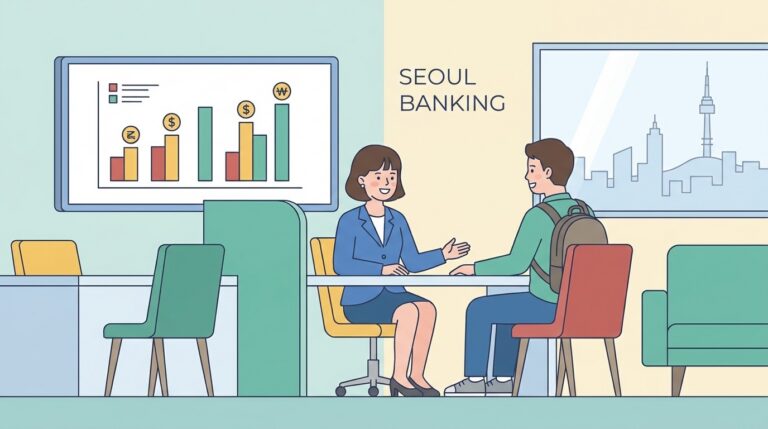
Setting: Yeouido branch of a major Korean securities firm. Alex, an expat software engineer in Seoul, sits before Minji, a sharp and professional investment consultant.
Turn 1: Alex
* Korean: “안녕하세요! 한국 거주자용 중개형 ISA 계좌를 트러 왔어요.”
* Romanization: An-nyeong-ha-se-yo! Han-guk geo-ju-ja-yong jung-gae-hyeong ISA gye-jwa-reul teu-reo wat-eo-yo.
* English: “Hello! I came in to open a brokerage-type ISA account for Korean tax residents.”
* 🎭 Action: Slides ARC and foreign residency registration across the desk with both hands.
Turn 2: Minji (Advisor)
* Korean: “아, 중개형 ISA요? 직전 연도에 한국에서 근로소득이나 사업소득 신고 내역 있으실까요?”
* Romanization: A, jung-gae-hyeong ISA-yo? Jik-jeon yeon-do-e han-guk-e-seo geun-ro-so-deuk-i-na sa-eop-so-deuk sin-go nae-yeok it-eu-sil-kka-yo?
* English: “Ah, a brokerage ISA? Do you have reported earned income or business income in Korea from the previous year?”
* 🎭 Action: Types quickly on the keyboard and smiles attentively.
Turn 3: Alex
* Korean: “네, 홈택스에서 소득금액증명원 떼왔어요. 일반형으로 개설되나요?”
* Romanization: Ne, hom-taek-seu-e-seo so-deuk-geum-aek-jeung-myeong-won tte-wat-eo-yo. Il-ban-hyeong-eu-ro gae-seol-doe-na-yo?
* English: “Yes, I printed my Proof of Income Certificate from Hometax. Can it be opened as a General Type?”
* 🎭 Action: Unfolds a neatly organized document folder and presents the certificate.
Turn 4: Minji (Advisor)
* Korean: “서류 완벽하시네요! 일반형은 순이익 200만 원까지 비과세이고요, 초과분은 9.9%로 분리과세 됩니다.”
* Romanization: Seo-ryu wan-byeok-ha-si-ne-yo! Il-ban-hyeong-eun sun-i-ik i-baek-man won-kka-ji bi-gwa-se-i-go-yo, cho-gwa-bun-eun gu-jeom-gu-pro-ro bun-ri-gwa-se doem-ni-da.
* English: “Your documents are flawless! The general type gives tax exemption on net profits up to 2 million won, and excess profits are separately taxed at 9.9%.”
* 🎭 Action: Stamps the application paper and highlights the tax deduction rates.
Turn 5: Alex
* Korean: “손익통산도 되죠? 다른 국내 상장 ETF에서 손실이 나면 이익이랑 상쇄되나요?”
* Romanization: Son-ik-tong-san-do doe-jyo? Da-reun guk-nae sang-jang ETF-e-seo son-sil-i na-myeon i-ik-i-rang sang-swae-doe-na-yo?
* English: “Loss netting applies too, right? If I incur a loss on another domestically listed ETF, does it offset gains?”
* 🎭 Action: Leans forward slightly, pointing to the terms and conditions.
Turn 6: Minji (Advisor)
* Korean: “그럼요! 계좌 내 손실과 수익을 합산해서 순이익에 대해서만 세금을 매겨요. 단, 의무 가입 기간 3년은 유지하셔야 혜택을 받으실 수 있어요.”
* Romanization: Geu-reom-yo! Gye-jwa nae son-sil-gwa su-ik-eul hap-san-hae-seo sun-i-ik-e dae-hae-seo-man se-geum-eul mae-gyeo-yo. Dan, ui-mu ga-ip gi-gan sam-nyeon-eun yu-ji-ha-syeo-ya hye-taek-eul bad-eu-sil su it-eo-yo.
* English: “Of course! We aggregate losses and profits inside the account and only tax net gains. However, you must maintain the account for the mandatory 3-year period to retain benefits.”
* 🎭 Action: Circles the number ‘3년’ on the customer summary form.
Turn 7: Alex
* Korean: “납입 한도는 연간 2,000만 원까지 맞죠? 안 채운 한도는 이월되나요?”
* Romanization: Nab-ip han-do-neun yeon-gan i-cheon-man won-kka-ji mat-jyo? An chae-un han-do-neun i-wol-doe-na-yo?
* English: “The contribution limit is up to 20 million won per year, correct? Does unused quota roll over?”
* 🎭 Action: Nods knowingly while preparing his signature on the digital pad.
Turn 8: Minji (Advisor)
* Korean: “네, 최대 1억 원까지 이월됩니다. 전자 서명 세 군데만 해주시면 계좌 개설 완료됩니다!”
* Romanization: Ne, choe-dae il-eok won-kka-ji i-wol-doem-ni-da. Jeon-ja seo-myeong se gun-de-man hae-ju-si-myeon gye-jwa gae-seol wan-ryo-doem-ni-da!
* English: “Yes, it rolls over up to a maximum of 100 million won. Just sign electronically in three spots and your account setup is complete!”
* 🎭 Action: Hands the digital stylus to Alex with a delighted nod.
🔀 Interactive Decision Point
If the clerk says: “외국인은 온라인 비대면 가입이 전산상 막혀 있어서 창구 개설만 가능한데, 수수료가 조금 다를 수 있습니다.” (Online non-face-to-face registration is system-blocked for foreigners, so only counter opening is possible, which may have slightly different fees.) How should you respond?
- Choice A: “왜 외국인만 차별해요? 당장 인터넷이랑 똑같은 수수료로 해주세요!” (Why discriminate against foreigners? Give me the online fee rate right now!)
- Feedback (Bad): Accusatory and aggressive. The teller has no control over national financial verification security laws. Creates tension and risks uncooperative service.
- Choice B: “창구에서 개설하더라도 모바일 앱(MTS)으로 거래하면 매매 수수료는 모바일 기준 적용되는 것 맞죠?” (Even if I open it at the counter, if I trade via mobile MTS app, mobile transaction fee rates apply, right?)
- Feedback (Best): Shows high financial literacy! You clarify that account-opening channel fees do not dictate your daily trading fees.
- Choice C: “그럼 그냥 다음에 올게요.” (Then I’ll just come back next time.)
- Feedback (Risk): You waste a trip and delay your 3-year mandatory period countdown clock, forfeiting compound tax savings.
Phase 6: 10-Second Emotion Shadowing Drill
Train your mouth and tone to sound like a sophisticated resident investor. Match the rhythm slashes (/) for natural breath control!
- [😊 자신감 있고 당당하게 – Confident & Polished]
중개형 ISA 계좌로 / 국내 상장 배당 ETF 위주로 / 굴려보려고 합니다.
(Jung-gae-hyeong ISA gye-jwa-ro / guk-nae sang-jang bae-dang ETF wi-ju-ro / gul-ryeo-bo-ryeo-go ham-ni-da.)
“I intend to roll this account into a brokerage ISA, focusing on domestically listed dividend ETFs.” -
[🤔 꼼꼼하고 예리하게 – Analytical & Inquiring]
만기 3년 채우면 / 순이익 200만 원까지 / 비과세 혜택 확실히 받는 거죠?
(Man-gi sam-nyeon chae-u-myeon / sun-i-ik i-baek-man won-kka-ji / bi-gwa-se hye-taek hwak-sil-hi bat-neun geo-jyo?)
“If I complete the 3-year maturity, I’m definitely guaranteed tax exemption up to 2 million won in net gains, right?” -
[🤝 감사하며 시원시원하게 – Courteous & Decisive]
초과 수익 9.9% 분리과세면 / 세금 부담이 정말 크게 줄겠네요. / 개설 진행해 주세요!
(Cho-gwa su-ik gu-jeom-gu-pro bun-ri-gwa-se-myeon / se-geum bu-dam-i jeong-mal keu-ge jul-get-ne-yo. / Gae-seol jin-haeng-hae ju-se-yo!)
“With 9.9% separate taxation on excess earnings, the tax burden shrinks remarkably. Please proceed with opening it!”
Phase 7: K-Culture Mini Dictionary
| Term (Hangul + Romanization) | English Meaning | Expat Context & Real Usage |
|---|---|---|
| 손익통산 (Son-ik-tong-san) | Netting Profits & Losses | Calculating tax solely on net gain. If ETF A gains 5M won and ETF B loses 3M won, you are only taxed on 2M won. Regular Korean brokerage accounts do not allow this for foreign dividend ETFs! |
| 의무 가입 기간 (Ui-mu ga-ip gi-gan) | Mandatory Holding Period | The required minimum lockup (strictly 3 years for ISA). You can withdraw your principal early without penalties, but closing prior to 3 years forfeits tax cuts. |
| 국내 상장 해외 ETF (Guk-nae sang-jang hae-oe ETF) | Domestically Listed Overseas ETF | US tech or index ETFs traded in Won on the Korea Exchange (e.g., TIGER 미국S&P500). Perfect for an ISA to eliminate the standard 15.4% dividend tax. |
| 금융소득종합과세 (Geum-yung-so-deuk-jong-hap-gwa-se) | Comprehensive Financial Income Tax | The feared tax bracket applied when annual interest and dividends exceed 20 million won. An ISA shields your gains from triggering this threshold. |
Phase 8: Expat Financial Survival Kit
🧰 Top 3 Urgent Desk Phrases
- “일반형과 서민형 중 제가 어디에 해당하는지 조회해 주실 수 있나요?”
(Il-ban-hyeong-gwa seo-min-hyeong jung je-ga eo-di-e hae-dang-ha-neun-ji jo-hoe-hae ju-sil su it-na-yo?)
Pro Tip: If your gross income was under 50 million won (or total income under 38 million won), you qualify for 서민형 (Low-income tier), doubling your tax-free limit from 2 million to 4 million won! - “계좌 만기 시점에 연금저축펀드로 전환하면 추가 세액공제 되나요?”
(Gye-jwa man-gi si-jeom-e yeon-geum-jeo-chuk-peon-deu-ro jeon-hwan-ha-myeon chu-ga se-aek-gong-je doe-na-yo?)
Pro Tip: Rolling your maturing ISA into an individual pension account yields an extra 10% tax credit (up to 3 million won)! Ask this to show next-level mastery. - “원천징수 영수증 발급은 앱에서 직접 출력 가능한가요?”
(Won-cheon-jing-su yeong-su-jeung bal-geup-eun aep-e-seo jik-jeop chul-ryeok ga-neung-han-ga-yo?)
Pro Tip: Use this to ask for your withholding tax receipts for your home-country tax declarations.
📱 Editor’s Expat Note
Before heading to the branch, visit the national tax agency portal to generate your documents: find the official 국세청 홈택스 (National Tax Service Hometax) income verification certificate portal to print out your 소득확인증명서 (Income Verification Certificate for ISA). Also, download your brokerage’s official trading app—search your app store for “KB증권 M-able”, “미래에셋 m.Stock”, or “한국투자증권” ahead of time so the representative can pair your mobile OTP immediately.
Phase 9: 한 발 더 깊이 (A Step Deeper)
In South Korea, wealth management is deeply communal. Colleagues openly discuss their portfolio rebalancing over lunch, and KakaoTalk chatrooms are filled with friends sharing tax reduction spreadsheets. This collective financial mindfulness stems from Korea’s rapid economic development and the reality of planning for retirement without relying entirely on state welfare. When you sit with a Korean banker and speak with precision about 비과세 and 분리과세, you transcend the foreign tourist bubble. You demonstrate respect for Korean economic realities and signal that you are building your future alongside them.
💬 Your Turn: What surprised you most about Korea’s 3-year ISA tax setup compared to investment accounts in your home country? Drop your thoughts or questions in the comments below! 계좌 개설 경험을 공유해 주세요! (Share your account opening stories!)
Phase 10: FAQ & Common Mistakes
Q: Can any foreign national residing in Korea open an ISA?
A: No. You must be a Korean tax resident (거주자), meaning you have resided or held employment in Korea with a registered address for at least 183 days during the tax year. Furthermore, you must not have been subject to Comprehensive Financial Income Taxation (금융소득종합과세) in the past three years.
Q: Can I buy individual US stocks like Apple or Tesla inside a Korean ISA?
A: No. You cannot purchase foreign-listed stocks directly inside an ISA. However, you can buy 국내 상장 해외 ETF (Domestically Listed Overseas ETFs) such as those tracking the S&P 500 or Nasdaq 100 traded in Korean Won. This avoids the 15.4% dividend tax you would normally owe.
Q: What happens if I move out of Korea before the 3-year mandatory period ends?
A: If you withdraw your funds and cancel the account prior to the 3-year maturity mark, you will lose the tax-exempt status. Your accumulated earnings will be subjected to the standard 15.4% dividend income tax retroactively. However, you can withdraw your initial deposited principal at any time without paying penalties.
🚨 Common Mistakes Alert Board
- Mistake 1: Choosing a Trust-type (신탁형) or Discretionary (일임형) account at a bank.
- Correct Action: If you want to pick your own ETFs and dividend stocks without management fees, explicitly demand a 중개형 ISA (Brokerage-type ISA) at a securities firm.
- Mistake 2: Walking in without an ARC issued with a 13-digit registration number.
- Correct Action: Passports or short-term visa stamps are not accepted. Only an official Foreign Registration Card proves tax residency.
- Mistake 3: Believing your tax-free profit resets every year.
- Correct Action: The 2–4 million won exemption applies to the cumulative net profit across the entire 3-year contract period, not on an annual reset basis.
Phase 11: Action Missions
- 🥉 Bronze Mission (Solo Practice): Read the 3 sentences in Phase 6 out loud three times. Record your voice on your smartphone and check whether your pronunciation of 분리과세 (Boon-ri-gwah-seh) sounds fluid.
- 🥈 Silver Mission (Digital Exploration): Log into the 국세청 홈택스 (National Tax Service Hometax) portal using your digital certificate (공동인증서/간편인증) and check if you can issue the ISA 가입용 소득확인증명서.
- 🥇 Gold Mission (Real World Application): Visit a nearby securities branch or call their English helpline to ask: “외국인도 대면 창구에서 중개형 ISA 개설 가능한가요?” Take notes on their specific branch requirements!
- 🎮 K-Culture Mission: Watch an episode of a modern Korean business drama (such as Start-Up or Numbers). Look out for how characters discuss capital preservation (원금 보장) versus tax avoidance (절세).
Phase 12: Interactive Quiz Challenge
Test your intermediate vocabulary and financial know-how!
Quiz 1. Situational Judgment
You have made 5 million won in profits trading Korean index ETFs inside your general brokerage ISA over 3 years, with no losses. How will your earnings be taxed upon maturity?
* A) The entire 5 million won is taxed at 15.4%.
* B) 2 million won is completely tax-free (비과세), and the remaining 3 million won is taxed at 9.9% (분리과세).
* C) The entire 5 million won is completely tax-free.
* D) 4 million won is tax-free, and 1 million won is taxed at 20%.
Quiz 2. Fill-in-the-Blank
“ISA 계좌에서는 이익과 손실을 합산하여 순이익에 대해서만 과세하는 ( ) 혜택이 적용된다.”
(Hint: The financial term for netting profits against losses)
Quiz 3. True or False
- “Foreigners on valid E-7 or F-series visas with verified domestic tax income can qualify for the 4 million won tax-free ‘서민형 (Low-income tier)’ ISA if their gross income is under 50 million won.”
- [True / False]
👉 Click to reveal answers & detailed explanations!
Answers & Explanations:
1. Answer: B
* Explanation: Under the General Type (일반형) ISA, the first 2 million won is exempt from tax (비과세). The remaining 3 million won benefits from a 9.9% separate tax (분리과세), amounting to just 297,000 won in tax instead of 770,000 won (15.4%) in a standard account!
2. Answer: 손익통산 (Son-ik-tong-san / Netting of profits and losses)
* Explanation: This feature protects you from paying taxes on winning trades when your total portfolio broke even or lost money.
3. Answer: True
* Explanation: If you submit your official Proof of Income Certificate showing your prior year’s earned income falls beneath 50 million won, you are registered as 서민형, unlocking the doubled 4 million won 비과세 limit regardless of nationality!







