

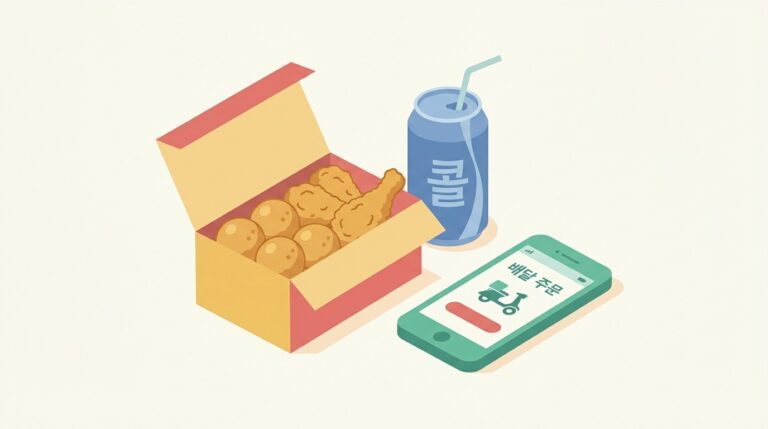
Craving Midnight Korean Chicken? How to Master the Minimum Delivery Order Like a Local
Phase 1: 공감 (The Midnight Chimaek Dilemma)
안녕하세요! 매일한글 에디터입니다. (Hello! I’m your Daily Hangul editor.)
Imagine this: It is 11:30 PM in Seoul. You have spent the entire day exploring the bustling streets of Hongdae, your feet are completely exhausted, and your stomach is rumbling. You kick off your shoes, flop onto your hotel bed, and decide it is finally time for the legendary Korean midnight ritual: Chimaek (fried chicken + cold beverage). You open up a delivery app or stop by the neighborhood chicken pub counter just down the alley. You point to a mouthwatering box of crispy garlic soy chicken and wait for the magic to happen.
Suddenly, the screen flashes a bright warning, or the kind staff smiles apologetically and says: “최소 주문 금액이 만 오천 원이에요” (Choeso jumun geumaegi man o-cheon won-ieyo).
You freeze. What does man mean? What is choeso? Are they refusing your order? Panic sets in, and you end up settling for a plain cup noodle from the convenience store downstairs.
We have all been there! Food delivery in Korea is an art form, but its specific vocabulary—especially dealing with minimum amounts and numbers—can intimidate even the most eager beginner. Based on real feedback from hundreds of our beginner learners, this single phrase is the #1 stumbling block when trying to eat like a real Seoulite. Master this guide today, and you will never go to bed hungry in Korea again.
Phase 2: 핵심 표현 3선 심층 분석 (Top 3 Key Expressions)
1. 최소 주문 금액 (Choeso jumun geumaek)
- Pronunciation: [Choe-so ju-mun geu-maek] (Sounds like “chway-so zoo-moon goo-make”)
- Meaning: Literal: “Minimum order sum of money” | Real Nuance: “The base amount your cart must reach before the store will accept your order.”
- K-Culture Moment: In almost every modern K-Drama apartment scene, when characters sit on the living room floor tapping their phones to order late-night snacks, this is the red pop-up text they grumble about before adding an extra side dish!
- Editor’s Insight: 최소 (choeso) means “minimum”, 주문 (jumun) means “order”, and 금액 (geumaek) means “monetary amount”. You will see this on every single delivery app in Korea (Baemin, Yogiyo, Coupang Eats).
- Situation Spectrum: Casual: ✅ | Semi-formal: ✅ | Formal: ✅ (Universal term across apps and receipts)
- 🤔 Think About It: In many Western countries, delivery fees simply scale up if an order is small, but in Korea, orders below the 최소 주문 금액 are often physically rejected by the system. Why do you think Korean shops prefer setting hard minimums rather than charging infinite micro-fees?
2. 만 오천 원이에요 (Man o-cheon won-ieyo)
- Pronunciation: [Man-o-cheon-wo-ni-e-yo] (Sounds like “Mahn-oh-chun-won-ee-eh-yo”)
- Meaning: Literal: “It is ten-thousand five-thousand won” | Real Nuance: “It comes out to 15,000 won.”
- K-Culture Moment: Hearing the street food vendor or chicken shop owner total up your bill while neatly wrapping pickled radish and dipping sauces into a plastic bag.
- Editor’s Insight: Korean numbers shift into units of 10,000 (만 / man). 15,000 is literally 만 (10,000) + 오천 (5,000) won! Don’t let the extra zeros intimidate you—just spot the 만.
- Situation Spectrum: Casual: ⚠️ (Use 만 오천 원이야 with close peers) | Semi-formal: ✅ (만 오천 원이에요 is polite and natural) | Formal: ✅ (만 오천 원입니다)
- 🤔 Think About It: English groups large numbers by thousands (comma every 3 zeros: 10,000), while Korean groups them by ten-thousands (4 zeros). How does shifting your counting unit change how you perceive big numbers?
3. 사이드 메뉴 추가할게요 (Saideu menyu chugahalgeyo)
- Pronunciation: [Sa-i-deu me-nyu chu-ga-hal-ge-yo] (Sounds like “Sigh-deu meh-new choo-gah-hahl-geh-yoh”)
- Meaning: Literal: “I will add a side menu item.” | Real Nuance: “I’m going to add a side dish (like cheese balls or fries) to hit that minimum amount!”
- K-Culture Moment: An essential phrase when you are 2,000 won short of the delivery minimum, and your Korean friend immediately shouts: “치즈볼 추가해!” (Add cheese balls!).
- Editor’s Insight: 추가 (chuga) means “addition/add”. Combine it with ~할게요 (~halgeyo, “I will do~”) to sound delightfully polite and decisive.
- Situation Spectrum: Casual: ⚠️ | Semi-formal: ✅ (Perfect for restaurants, phone orders, and takeout counters) | Formal: ✅
- 🤔 Think About It: Adding a side is seen as a fun bonus rather than an annoying expense in Korea. It turned cheese balls (치즈볼) into a billion-won culinary sensation!
Phase 3: 교과서 한국어 vs 진짜 한국어 (Textbook vs. Real-Life Korean)
Situation 1: Asking what the minimum order amount is
- 📖 교과서 한국어: 배달을 위한 최소 금액은 얼마입니까? (Baedareul wihan choeso geumaegeun eolma-imnikka? / “What is the minimum sum for delivery?”)
- 🗣️ 진짜 한국어: 여기 최소 주문 얼마예요? (Yeogi choeso jumun eolmayeyo? / “What’s the minimum order here?”)
- 💡 왜 다를까? Native speakers drop clunky particles and words like 금액 (monetary amount) in speech, shortening the whole concept into punchy phrases like 최소 주문 (minimum order).
Situation 2: Asking to add an item to meet the threshold
- 📖 교과서 한국어: 기준 금액을 충족하기 위하여 음료수를 더 주문하겠습니다. (Gijun geumaegeul chungjokhagi wihayeo eumryosureul deo jumunhagetseumnida. / “I will order more beverages to satisfy the baseline amount.”)
- 🗣️ 진짜 한국어: 콜라 하나 더 넣을게요! (Kolla hana deo neoheulgeyo! / “I’ll add one more cola!”)
- 💡 왜 다를까? Nobody speaks like a legal contract when ordering food! Using 넣다 (to put in / insert into the cart) is vivid, natural, and friendly.
Phase 4: K-Culture 딥다이브 & 비언어적 매너 (Nunchi & Cultural Codes)
4-1. 눈치 (Nunchi) & Ordering Etiquette
When dealing with delivery couriers (기사님 / gisanim) or takeout counters in Korea, speed and clarity are prized above all.
* The Two-Hand Handoff: When handing over your credit card or receiving your bag of chicken, always support your right forearm with your left hand, or hold the bag with both hands while slightly bowing your head (about 15 degrees). This non-verbal gesture shows immense respect.
* App Notification Etiquette: When ordering via an app to your hotel lobby, watch the map tracker! Koreans pride themselves on meeting the delivery rider at the lobby door right as the bike pulls up, preventing the rider from waiting in the cold.
4-2. The Golden “Chicken Math” Culture
Korean fried chicken shops are competitive powerhouses. Because single-person households (1인 가구) have skyrocketed, the 15,000 won to 18,000 won minimum order threshold creates a national dilemma: standard single orders sometimes sit just 1,000 won below the limit!
To counter this, chicken brands invented irresistible sides: 치즈볼 (chewy mozzarella cheese balls), 소떡소떡 (sausage and rice cake skewers), and 웨지감자 (wedge potatoes). Buying a side dish is considered the ultimate self-care move rather than a corporate trap.
Phase 5: 실전 롤플레이 시나리오 (Real-World Roleplay)
- Setting: A cozy neighborhood fried chicken joint in Mapo-gu, Seoul. 10:45 PM. Rain is drizzling outside.
- Characters:
- You (A1 Korean Learner): Hungry traveler craving chicken.
- Staff (Min-ho): Warm, quick-moving chicken shop owner wearing a red apron.
— Dialogue Start —
1. You: 저기요, 양념치킨 포장돼요? (Jeogiyo, yangnyeom-chikin pojang-dwaeyo? / Excuse me, can I get seasoned fried chicken for takeout?)
* 🎭 행동 지문: You stand by the counter, holding your menu politely with both hands.
2. Staff: 네, 손님! 포장 가능해요. 단품으로 드릴까요? (Ne, sonnim! Pojang ganeunghaeyo. Danpumeuro deurilkkayo? / Yes, valued guest! Takeout is available. Just the single item?)
* 🎭 행동 지문: Min-ho wipes down the counter with a cloth and smiles brightly.
3. You: 네! 만 삼천 원 맞아요? (Ne! Man sam-cheon won majayo? / Yes! Is it 13,000 won?)
* 🎭 행동 지문: You pull out your card, pointing at the menu board item.
4. Staff: 아, 배달이나 포장 할인 적용 시 최소 주문 금액이 만 오천 원이에요! (A, baedarina pojang harin jeokyong si choeso jumun geumaegi man o-cheon won-ieyo! / Ah, when applying takeout discount or delivery, the minimum order amount is 15,000 won!)
* 🎭 행동 지문: Min-ho taps the notice attached beside the card machine gently.
5. You: 아! 최소 주문 금액이 만 오천 원이에요? (A! Choeso jumun geumaegi man o-cheon won-ieyo? / Ah! The minimum order amount is 15,000 won?)
* 🎭 행동 지문: Your eyes widen as you realize you need 2,000 won more.
6. Staff: 네, 2천 원 더 고르시면 돼요. 사이드 메뉴 추천해 드릴까요? (Ne, i-cheon won deo goreusimyeon dwaeyo. Saideu menyu chucheonhae deurilkkayo? / Yes, you just need to pick 2,000 won more. Shall I recommend a side dish?)
* 🎭 행동 지문: He gestures toward the glowing side menu board with an open palm.
7. You: 사이드 메뉴 추가할게요! 치즈볼 주세요. (Saideu menyu chugahalgeyo! Chijeubol juseyo. / I’ll add a side menu! Cheese balls, please.)
* 🎭 행동 지문: You smile with relief and point at the golden cheese balls picture.
8. Staff: 탁월한 선택이십니다! 15분만 기다려 주세요. (Takworhan seontaeg-isimnida! Sibo-bun-man gidaryeo juseyo. / Excellent choice! Please wait just 15 minutes.)
* 🎭 행동 지문: Min-ho types on the POS machine and hands you a numbered receipt with both hands.
— Dialogue End —
🔀 인터랙티브 분기점 (Interactive Choice!)
What do you say after Min-ho mentions the 15,000 won minimum at Turn 4?
* Choice A: “안 돼요? 그냥 치킨만 줘요!” (An dwaeyo? Geunyang chikin-man jwoyo! / No? Just give me chicken!)
* 🚫 Feedback (Bad): Overly blunt, drops honorifics, and sounds demanding. Min-ho will feel awkward!
* Choice B: “사이드 메뉴 추가할게요! 치즈볼 주세요.” (Saideu menyu chugahalgeyo! Chijeubol juseyo.)
* 🌟 Feedback (Best!): Polite, proactive, solves the problem instantly, and scores you delicious cheese balls.
* Choice C: “죄송합니다, 돈이 없어요. 갈게요.” (Joesonghamnida, doni eopseoyo. Galgeyo. / Sorry, I have no money. I will leave.)
* ⚠️ Feedback (Risk): You walk away hungry into the cold rain just because of a minor misunderstanding!
Phase 6: 10초 감정 섀도잉 드릴 (10-Second Emotional Shadowing Drill)
Read these lines aloud, matching the punctuation marks (/ = brief pause) and emotions:
[😮 약간 당황하며 / Slightly surprised]- 최소 주문 금액이 / 만 오천 원이에요?
- (Choeso jumun geumaegi / man o-cheon won-ieyo?)
[😋 신나고 결단력 있게 / Excited & decisive]- 그럼 / 치즈볼 하나 / 추가할게요!
- (Geureom / chijeubol hana / chugahalgeyo!)
[🙏 다정하고 공손하게 / Warm & polite]- 콜라 큰 걸로 / 바꿔 주세요!
- (Kolla keun geollo / bakkwo juseyo! / Please upgrade my cola to a large!)
Phase 7: K-Culture 미니 사전 (Mini Delivery Dictionary)
- 배달비 (Baedal-bi): Delivery fee. Often separate from the minimum food order amount.
- 반반 (Ban-ban): Literal “half-half”. The ultimate Korean compromise: half original crispy chicken (후라이드) and half sweet spicy sauce chicken (양념).
- 치즈볼 (Chijeu-bol): Fried glutinous dough balls stuffed with molten sweet mozzarella. The most popular item used to reach order minimums.
- 품절 (Pum-jeol): Sold out. If your favorite flavor shows this red icon on an app, pivot immediately!
Phase 8: 여행자를 위한 생존 키트 (Traveler’s Survival Kit)
서바이벌 표현 TOP 3
- 얼마 더 채워야 해요? (Eolma deo chaewoya haeyo?)
- Meaning: “How much more do I need to fill up the minimum?”
- Pro Tip: Use this when math with large numbers makes your head spin.
- 무 많이 주세요! (Mu mani juseyo!)
- Meaning: “Please give me lots of pickled radish!”
- Pro Tip: Pickled white radish (치킨무) cuts through the grease. Most places will give you an extra pack if you ask nicely.
- 문 앞에 두고 가 주세요. (Mun ape dugo ga juseyo.)
- Meaning: “Please leave it in front of the door.”
- Pro Tip: The golden standard for contactless delivery when ordering to an Airbnb.
Editor’s Travel Note 💡
- Ordering Apps without a Korean Alien Registration Card (ARC): Standard apps often require Korean mobile verification. Instead, use English-friendly alternatives like Shuttle Delivery or the web-based English version of Yogiyo. If you want to use the native app to browse menus, check out the 네이버 지도 앱 다운로드 (Naver Map App Download) to find nearby chicken joints and view their takeout menus before walking in!
Phase 9: “한 발 더 깊이” (Cultural Reflection)
In Western delivery culture, individual portions dominate; ordering food is often a solitary, transactional transaction. In Korea, even though solo living has grown exponentially, the delivery culture still carries the DNA of the Jeong (정) and Uri (우리 – We/Us) sharing mindset. Fried chicken was traditionally bought by a parent in a brown paper bag on payday to share with the whole family around a low wooden table. Minimum order amounts reflect this communal baseline—food is fundamentally meant to be plentiful and shared.
💬 Your Turn: What is your ultimate comfort food to order late at night, and what side dish would you gladly add to hit the minimum order amount? Share your answer in the comments below!
Phase 10: FAQ & 오해 방지 (FAQ Schema)
Q: Does “최소 주문 금액” include the delivery fee (배달비)?
A: No! This is the most common trap for visitors. The minimum order amount applies strictly to the food and beverages in your cart. The delivery fee is added on top afterward.
Q: What if I only want to spend 10,000 won? Can I ask them to deliver anyway?
A: Unfortunately, Korean delivery apps have automated software barriers. If your cart is 14,900 won and the minimum is 15,000 won, the checkout button will physically remain disabled until you add at least 100 won more.
Q: How do I pronounce “원” (Won) smoothly with numbers?
A: When combined with 오천 (5,000), 오천 ends with an ‘n’ sound (ㄴ), so 오천 원 flows together naturally like [오-처-nwun / O-cheon-won] without an awkward stop between words.
🚨 Common Mistakes Warning Board
- Mistake: Confusing 만 (10,000) with 천 (1,000).
- Correct Action: Remember that 15,000 won is roughly $11-$13 USD. If you hear 만, think of two paper bills (one 10,000 bill + one 5,000 bill), not fifteen single thousands.
- Mistake: Handing money with one hand while looking at your smartphone.
- Correct Action: Keep eye contact, offer a slight nod, and use both hands when handing your card or cash.
- Mistake: Forgetting to specify bone (뼈) vs. boneless (순살).
- Correct Action: If you prefer boneless chicken for easy eating in bed, always say: “순살로 변경해 주세요” (Sunsallo byeongyeonghae juseyo / Please change to boneless). Usually costs an extra 1,000 to 2,000 won—which also helps you reach the minimum amount!
Phase 11: 액션 미션 & 참여 유도 (Action Missions)
- 🥉 Bronze Mission: Stand in front of your mirror and practice saying: “만 오천 원이에요” three times with the correct flowing pronunciation.
- 🥈 Silver Mission: Take a screenshot of a Korean menu or delivery app page, circle the words 최소 주문, and share it in your Instagram/X stories tagging @DailyHangul!
- 🥇 Gold Mission: Walk into a local Korean restaurant or food counter, ask “최소 주문 얼마예요?”, and successfully add a side dish to your order in Korean.
- 🎮 K-Culture Mission: Watch any Korean drama apartment scene this week (like Hospital Playlist or Business Proposal) and spot the yellow or brown chicken box on the table. Listen closely for whether they say 양념 (sauce) or 후라이드 (fried)!
Phase 12: 인터랙티브 퀴즈 챌린지 (Interactive Quiz Challenge)
1. 상황 판단 (Situational Judgment)
You want to order chicken priced at 13,000 won, but the shop sign reads: “최소 주문 금액: 15,000원”. What is the smartest way to order?
* (A) Give the cashier 13,000 won and run away with the chicken.
* (B) Say “치즈볼 (3,000원) 추가할게요!” and pay 16,000 won.
* (C) Complain loudly that you do not want to eat cheese balls.
👉 Click to view answer & explanation
Correct Answer: (B)
Explanation: Adding a 3,000 won side item brings your total to 16,000 won, exceeding the 15,000 won threshold cleanly. You get extra food and avoid any awkward friction!
2. 빈칸 채우기 (Fill in the Blank)
Complete the phrase: “The minimum order amount is 15,000 won.”
* “최소 주문 금액이 _____ _____ 원이에요.”
👉 Click to view answer & explanation
Correct Answer: 만 오천 (man o-cheon)
Explanation: 10,000 is 만 (man), and 5,000 is 오천 (o-cheon). Put them together to get 15,000!
3. True / False 문화 퀴즈 (True or False)
In Korea, the delivery fee (배달비) counts toward the 최소 주문 금액 (minimum order amount).
* [ True / False ]
👉 Click to view answer & explanation
Correct Answer: False
Explanation: Minimum order amounts only count food items in the cart. The delivery fee is calculated separately at checkout!






