

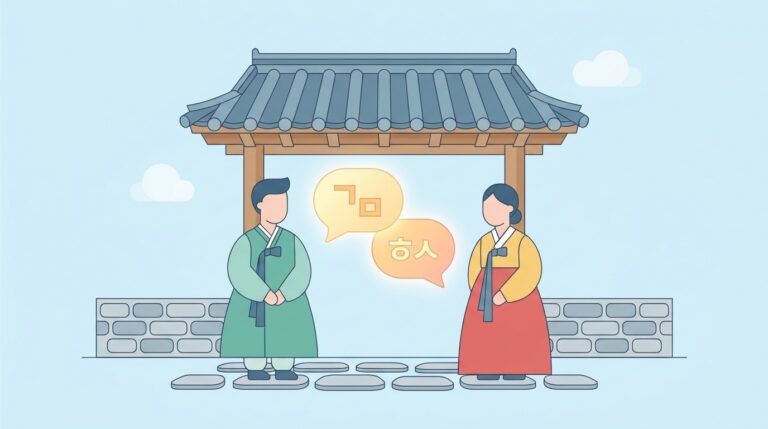
The Linguistic Mirror: Master the Korean Golden Rule of Communication
Phase 1: Empathy — When Words Build or Break Bridges
안녕하세요! 매일한글 에디터입니다. (Hello! I’m your Daily Hangul editor.)
Imagine this scenario straight out of an episode of Misaeng (미생): You have worked tirelessly on a joint project, but your Korean partner missed a critical deadline. Frustrated and stressed, you draft an email directly demanding immediate accountability. When you meet them face-to-face in the conference room in Yeouido, the atmosphere feels like ice. Their answers turn curt, their posture rigid, and what could have been a simple five-minute fix turns into days of passive resistance and stonewalling. You wonder: Did I say something offensive? I just asked for what was agreed upon!
Here lies one of the most transformative realizations for advanced Korean learners: In Korean society, communication is never just transactional—it is deeply relational and acoustic. What you project into the social space reverberates right back to you with pinpoint accuracy. The timeless proverb “가는 말이 고와야 오는 말이 곱다” (Ganeun mari gowaya oneun mari gopda) is not just a polite moral taught in elementary schools; it is a masterclass in Korean social diplomacy, negotiation tactics, and interpersonal psychology (처세술).
By mastering this concept at a C1 level, you will stop hitting invisible walls in professional and personal relationships, unlock genuine warmth from even the toughest native speakers, and handle difficult negotiations with effortless elegance. Let’s explore how to turn this ancient proverb into your sharpest communication tool.
Phase 2: Core Expressions Deep Dive
1. 가는 말이 고와야 오는 말이 곱다 (Ganeun mari gowaya oneun mari gopda)
- Pronunciation: gah-neun mah-ree go-wah-yah oh-neun mah-ree gohp-dah (Think of the rhythm: ga-neun mal / o-neun mal like two balanced pendulums)
- Meaning: Literal: “Only when the outgoing words are lovely will the incoming words be lovely.” / Nuance: Respectful reciprocity. You must proactively invest warmth and respect if you expect to receive collaboration and grace.
- K-Culture Moment: In legal and corporate dramas like Vincenzo or Hyena, you will frequently hear an elder diplomat or seasoned negotiator sigh this exact phrase when an arrogant executive demands cooperation without showing baseline courtesy.
- Editor’s Insight: Notice the conditional connective -아야/어야 (-aya/eoya). It establishes an absolute prerequisite. In Korean communicative logic, you cannot demand civility as a response to hostility; the caller sets the emotional frequency of the entire exchange.
- Situation Spectrum: Casual ✅ | Semi-formal ✅ | Formal ✅ (Widely quoted across all registers)
- 🤔 Think About It: In English, we often say “Respect is earned.” Does the Korean proverb suggest that respect is an investment made upfront rather than an earned status?
2. 말 한마디로 천 냥 빚을 갚는다 (Mal hanmadiro cheon nyang bijeul gamneunda)
- Pronunciation: mahl hahn-mah-dee-roh cheon nyahng bee-jeul gahm-neun-dah (cheon nyang rhymes loosely with “sun young”)
- Meaning: Literal: “A single spoken phrase can pay off a debt of a thousand nyang.” / Nuance: Impeccable tact, genuine apology, or a brilliantly timed word can resolve an insurmountable conflict or crisis.
- K-Culture Moment: In historical sageuk dramas like Under the Queen’s Umbrella, an astute adviser saves their family from political ruin not with an army, but with an exquisite, humble turn of phrase before the King.
- Editor’s Insight: A nyang was an enormous sum of money in the Joseon dynasty. This proverb stresses that linguistic prudence is tangible social currency. A sincere, well-crafted Korean apology or compliment is literally worth thousands of dollars in social capital.
- Situation Spectrum: Casual ✅ | Semi-formal ✅ | Formal ✅
- 🤔 Think About It: Can you recall a moment in your career where an apology or a graceful phrase defused a conflict faster than cold logic?
3. 아 다르고 어 다르다 (A dareugo eo dareuda)
- Pronunciation: ah dah-reu-goh uh dah-reu-dah (Vowel contrast between bright “A” and deep “Eo”)
- Meaning: Literal: “‘Ah’ is different from ‘Eo’.” / Nuance: The slightest variation in intonation, particle choice, or nuance changes the entire message.
- K-Culture Moment: On variety shows like You Quiz on the Block, hosts often bring up this phrase when dissecting how a misunderstood comment sparked unnecessary gossip.
- Editor’s Insight: Korean is an agglutinative language with dozens of subtle sentence-ending suffixes (-거든요, -잖아요, -네, -지요). Changing just one final vowel can shift an utterance from sincere empathy to sarcastic condescension.
- Situation Spectrum: Casual ✅ | Semi-formal ✅ | Formal ⚠️ (Often used as a critique or reminder among peers)
- 🤔 Think About It: In your native language, does shifting a single vowel sound completely alter the emotional warmth of a sentence?
Phase 3: Textbook Korean vs. Real Native Korean
At a C1 level, relying on textbook commands sounds unnatural and confrontational. Here is how native speakers soften and negotiate with elegance:
Scenario 1: When someone speaks abrasively or dismissively to you in a meeting
- 📖 Textbook Korean: 예의 바르게 말씀해 주십시오. (Yeeui bareuge malsseumhae jusipsio.) — “Please speak politely.”
- 🗣️ Real Native Korean: 팀장님, 말씀 그렇게 서운하게 하지 마시고요, 저희 차분히 맞춰 가요. (Timjangnim, malsseum geureoke seounhage haji masigoyo, jeohui chabunhi matchwo gayo.) — “Team Leader, please don’t say it so discouragingly; let’s stay calm and find common ground.”
- 💡 Why It Differs: Demanding politeness directly creates an immediate challenge to the other person’s 체면 (chaemyeon – social face). By framing your reaction as 서운하다 (feeling a bit hurt/sad) rather than angry, you activate their empathy without provoking defensive aggression.
Scenario 2: Reminding a negotiating partner that courtesy goes both ways
- 📖 Textbook Korean: 당신이 친절하면 저도 친절하겠습니다. (Dangsini chinjeolhamyeon jeodo chinjeolhagesseumnida.) — “If you are kind, I will also be kind.”
- 🗣️ Real Native Korean: 가는 말이 고와야 오는 말이 곱다고 하잖아요. 서로 조금씩만 배려해 주시면 좋겠습니다. (Ganeun mari gowaya oneun mari gopdago hajannayo. Seoro jogeumssikman baeryeohae jusimyeon jokessumnida.) — “As the saying goes, kind words outgoing bring kind words incoming. I’d appreciate it if we showed a little mutual consideration.”
- 💡 Why It Differs: Invoking a collective proverb using the quotative marker ~고 하잖아요 (-go hajannayo) depersonalizes the critique. You aren’t scolding them; you are both appealing to an established cultural truth.
Phase 4: K-Culture Deep Dive & Non-Verbal Manners
4-1. Nunchi (눈치) & The Acoustic Mirror
In Korean communication, words do not exist in a vacuum. Tone, eye contact, and bodily resonance dictate whether your “good words” (가는 말) are received as genuine or manipulative:
1. Vocal Register Modulation: Lower your pitch slightly when addressing sensitive matters. High-pitched, clipped speech sounds impatient or accusatory.
2. The Cushion Pause: Before rejecting an offer or raising a counterargument, always pause for 1 to 2 seconds and sigh gently with “아… 네, 무슨 말씀이신지 충분히 이해합니다만…” (Ah… yes, I completely understand your point, but…).
3. Physical Softening: Keep your hands resting loosely clasped on the table. Pointing fingers or gesturing emphatically with a pen breaks the harmony and triggers instinctual defensiveness.
4-2. The Cultural Architecture: Face-Saving (체면) & Emotional Interconnection (정)
Korean negotiation philosophy is built around preserving the other party’s 체면 (chaemyeon – social prestige/dignity). When you use harsh words, you strip them of their face, leaving them with no choice but to fight back to protect their honor. However, if you cushion your words with honorific subtlety (존칭), you give them a graceful exit ramp. Reciprocity is not weakness in Korea—it is the highest form of tactical maturity.
Phase 5: Real-World Roleplay Scenario
Setting: A conference room in Seoul. Alex (a foreign senior consultant) is renegotiating an unreasonable project timeline with Team Leader Han (a pressured Korean partner who initially speaks defensively).
- 한 팀장: 이번 일정 단축 건, 본사 결정이라 더 이상 조정 못 해 드립니다. 그냥 진행하시죠. (Ibeon iljeong danchuk geon, bonsa gyeoljeong-ira deo isang jojeong mot hae deurimnida. Geunyang jinhaenghasijyo.)
🎭 Leaning back, crossing arms defensively.
(This schedule reduction was decided by headquarters, so we cannot adjust it further. Just proceed with it.) - Alex: 팀장님, 마감 압박 때문에 본사 상대하시느라 정말 고생이 많으십니다. (Timjangnim, magam apbak ttaemune bonsa sangdaehasineura jeongmal gosaengi maneusimnida.)
🎭 Nodding with sincere empathy, keeping hands clasped softly on the desk.
(Team Leader Han, you must be under immense stress dealing with HQ regarding this deadline.) - 한 팀장: …알아주시니 다행이네요. 하지만 저희도 방법이 없어요. (…Arajusini dahaeng-ineyo. Hajiman jeohuido bangbeobi eopseoyo.)
🎭 Shoulders visibly relaxing, tone softening slightly.
(…I appreciate you recognizing that. But our hands are tied too.) - Alex: 가는 말이 고와야 오는 말이 곱다고 하잖아요. 저희가 서로 입장 난처하게 만들려는 건 아니니까요. (Ganeun mari gowaya oneun mari gopdago hajannayo. Jeohuiga seoro ipjang nancheohage mandeullyeoneun geon aninikkayo.)
🎭 Making warm, steady eye contact, offering a gentle half-smile.
(As the old saying goes, kind words outgoing bring kind words incoming. Neither of us wants to put the other in an awkward bind.) - 한 팀장: 그렇죠. 저도 솔직히 무리한 일정인 거 압니다. (Geureochyo. Jeodo soljiki murihan iljeong-in geo amnida.)
🎭 Uncrossing arms and leaning forward onto the table.
(That’s true. Honestly, I know this schedule is unreasonable too.) - Alex: 네, 팀장님 입장을 살려드리면서 품질도 지킬 수 있는 대안을 몇 가지 정리해 봤습니다. (Ne, timjangnim ipjang-eul sallyeodeurimyeonseo pumjildo jikil su inneun daeaneul myeot gaji jeongnihae bwasseumnida.)
🎭 Sliding a memo across the table with both hands.
(Yes, so I’ve prepared a few alternatives that protect your standing with HQ while maintaining our quality standards.) - 한 팀장: 오, 그래요? 한번 검토해 봅시다. Alex 님하고는 대화가 통해서 참 다행입니다. (O, geuraeyo? Hanbeon geomtohae bopsida. Alex nimhagoneun daehwaga tonghaeseo cham dahaeng-imnida.)
🎭 Picking up the document attentively.
(Oh, really? Let’s take a look. It’s such a relief that communication works so well with you, Alex.) - Alex: 배려해 주셔서 감사합니다. 함께 좋은 결과 만들어 보시죠. (Baeryeohae jusyeoseo gamsahamnida. Hamkke joeun gyeolgwa mandeureo bosijyo.)
🎭 Slight nod of respect, closing the interaction gracefully.
(Thank you for your consideration. Let’s create a great outcome together.)
🔀 Interactive Choice Point
What should Alex do if Team Leader Han remains openly dismissive even after the initial polite phrase?
* Option A: Say, “계약서대로 법적 조치하겠습니다.” (I will take legal action according to the contract.)
* Assessment: 🚫 Bad. Instant destruction of 라포 (rapport) and triggers corporate retaliation. You will win the argument but lose the partnership.
* Option B: Say, “팀장님, 말씀 중에 언짢으신 부분이 있다면 죄송합니다. 다만 저희가 파트너로서 상호 존중하며 풀어나가길 바랍니다.” (Team Leader, I apologize if anything I said caused discomfort. However, as partners, I hope we can resolve this with mutual respect.)
* Assessment: ✅ Best. Models high-level diplomatic firmness (외유내강 – gentle on the outside, strong inside).
* Option C: Say nothing, sigh loudly, and walk out of the room.
* Assessment: ⚠️ Risk. Passive-aggressive non-verbal behavior permanently damages your professional reputation in Korea.
Phase 6: 10-Second Emotion Shadowing Drill
Practice these lines focusing on intonation breaks (/) and emotional resonance:
[🤝 차분하고 진정성 있게 / Calm and Sincere]
가는 말이 / 고와야 / 오는 말이 / 곱다고 하잖아요.
(Ganeun mari / gowaya / oneun mari / gopdago hajannayo.)-
[🕊️ 공감하며 긴장 완화하기 / Empathetic and De-escalating]
팀장님 입장을 / 충분히 이해하니까요 / 저희 서로 / 무리하지 않는 선에서 / 맞춰 봐요.
(Timjangnim ipjang-eul / chungbunhi ijehahannikkayo / jeohui seoro / murihaji anneun seoneseot / matchwo bwayo.) -
[⚖️ 품격 있고 단호하게 / Dignified yet Firm]
말 한마디로 / 천 냥 빚도 갚는다는데 / 서로 배려하면서 / 말씀해 주시면 / 감사하겠습니다.
(Mal hanmadiro / cheon nyang bitdo gamneundaneunde / seoro baeryeohamyeonseo / malsseumhae jusimyeon / gamsahagesseumnida.)
Phase 7: K-Culture Mini Dictionary
- 처세술 (Cheosesul) | The art of social life / worldly wisdom
- The practical intelligence needed to navigate complex office politics, family expectations, and hierarchical relationships in Korea without friction.
- 말실수 (Malsilsu) | A slip of the tongue / verbal faux pas
- In Korean culture, a 말실수 is rarely brushed off as a mere accident; it is often perceived as a glimpse into one’s subconscious attitude toward others.
- 역지사지 (Yeokjisaji) | Putting oneself in the other person’s shoes
- A Sino-Korean four-character idiom (사자성어) representing the philosophical core of “가는 말이 고와야 오는 말이 곱다.”
- 온화하다 (Onhwahada) | Mild, gentle, genial in disposition/speech
- A highly praised personality trait in Korean leadership, contrasting with aggressive dominance.
Phase 8: Survival Kit for Travelers
When minor conflicts arise during your travels in Korea (e.g., street markets, hotel counter disputes, taxi routes):
- 사장님, 기분 상하게 해 드렸다면 죄송해요. 좋게좋게 해결하고 싶어요.
(Sajangnim, gibun sanghage hae deuryeotdamyeon joesonghaeyo. Jokeojoke haegyeolhago sipeoyo.)- Pro Tip: The repetitive idiom 좋게좋게 (harmoniously/pleasantly) instantly melts commercial friction.
- 제가 한국말이 서툴러서 그런데, 조금만 친절히 설명해 주실 수 있나요?
(Jega hangungmari seotulleoseo geureonde, jogeumman chinjeolhi seolmyeonghae jusil su innayo?)- Pro Tip: Acknowledging your own linguistic limitation disarms the other party immediately.
- 말씀 예쁘게 해 주셔서 정말 감사합니다!
(Malsseum yeppeuge hae jusyeoseo jeongmal gamsahamnida!)- Pro Tip: Use this to reward service workers or elders who were warm to you; it brings beaming smiles.
- Editor’s Travel Note: If a dispute over directions or payments occurs, keep your cool. Before arguing, open your Naver Map navigation app to visually verify route details, or check your reservations directly via the Korail Talk official booking platform. Using verifiable data combined with a courteous tone is the ultimate formula for smooth travel in Korea.
Phase 9: “One Step Deeper” — The Acoustic Ecology of Hangul
Language in Korea is viewed not as an individual emission, but as an ecological loop. When you speak, your words don’t travel in a straight vector; they circle the communal space and settle back upon your shoulders. This reflects centuries of Confucian ethical training where verbal restraint was considered the supreme metric of personal nobility (군자의 덕). When a Korean reminds someone that “가는 말이 고와야 오는 말이 곱다,” they are not just demanding manners; they are inviting you to co-create a peaceful ecosystem where both individuals can preserve their dignity.
💬 Your Turn: Does your native language have an equivalent proverb? Is communication in your home country expected to be direct and assertive, or empathetic and reciprocal? Share your perspective in the comments below!
Phase 10: FAQ & Common Mistakes
Q: Can I use “가는 말이 고와야 오는 말이 곱다” directly to my boss or professor?
A: Be careful! While the moral is universal, quoting the proverb directly to a superior can sound like you are lecturing or reprimanding them (가르치려 드는 뉘앙스). Instead, use the principle implicitly by softening your own language first, or quote it humorously about a third-party situation.
Q: What is the difference between “가는 말이 고와야 오는 말이 곱다” and “아 다르고 어 다르다”?
A: “가는 말이 고와야…” focuses on reciprocal intent and attitude (kindness breeds kindness). “아 다르고 어 다르다” focuses on micro-linguistic precision (the danger of poor phrasing or clumsy nuances sparking misunderstanding).
Q: If someone is rude to me in Korean, should I switch to informal speech (반말) to defend myself?
A: Absolutely not. The moment you drop honorifics (반말), you lose moral high ground (도덕적 우위). In Korea, the person who stays calm and articulates their boundary using polite, ice-cold honorifics (냉철한 존댓말) completely dominates the conflict socially.
🚨 Common Mistakes Board
- Mistake 1: Translating “You need to respect me” directly as “저를 존중해야 합니다”.
- Fix: Reframe with reciprocity: “서로 존중하는 태도로 이야기 나누면 좋겠습니다.”
- Mistake 2: Using blunt declarative endings (-요 / -다) when asking for favors.
- Fix: Attach hedging markers like “-해 주실 수 있으실까 해서요…” (I was wondering if you might be able to…).
- Mistake 3: Raising your voice volume to project authority.
- Fix: Lower your pitch, slow down your cadence, and pause purposefully. In Korea, true authority is calm, deliberate, and composed.
Phase 11: Action Missions
- 🥉 Bronze Mission: Stand in front of a mirror and recite the three Core Expressions in Phase 2 with relaxed facial muscles and a gentle eye expression.
- 🥈 Silver Mission: Next time you comment on a Korean creator’s YouTube video or Instagram post, start with: “항상 좋은 콘텐츠 감사합니다. 말씀 하나하나가 큰 힘이 되네요!”
- 🥇 Gold Mission: In your next real conversation with a Korean native, deliberately use a softening hedge like “혹시 가능하시다면…” instead of a direct request, and observe the immediate change in their warmth.
- 🎮 K-Culture Mission: Watch an episode of a workplace K-drama (like Misaeng or Agency) and write down 2 examples of how managers soften bad news before delivering it.
Phase 12: Interactive Quiz Challenge
1. Situational Judgment
You are dealing with a landlord who is reluctant to refund your full deposit. Which of the following approaches best demonstrates “가는 말이 고와야 오는 말이 곱다”?
* (A) “법대로 할 테니 계좌로 당장 입금하세요.” (I will do this legally, deposit it right now.)
* (B) “사장님, 그동안 편하게 잘 살다 갑니다. 서로 기분 좋게 마무리할 수 있게 보증금 정산 부탁드려요.” (Landlord, I’ve had a comfortable stay here. Let’s wrap this up on good terms; please settle the deposit.)
* (C) 아무 말 없이 문자를 매 시간마다 보낸다. (Send texts every hour without saying anything.)
🔍 Click to Reveal Answer & Feedback
Correct Answer: (B)
* Why: Option B acknowledges the relationship, leaves room for goodwill (기분 좋게 마무리), and encourages reciprocity. Option A will cause the landlord to inspect every microscopic flaw to deduct money, and Option C is harassment.
2. Fill-in-the-Blank
Complete the proverb:
“말 한마디로 ( ) 빚을 갚는다.”
🔍 Click to Reveal Answer & Feedback
Answer: 천 냥 (cheon nyang)
* Explanation: A single tactful word can settle a historical debt of “one thousand nyang.”
3. True / False Cultural Check
In Korean corporate meetings, expressing harsh criticism directly without hedging expressions is celebrated as “efficient honesty.”
🔍 Click to Reveal Answer & Feedback
Answer: False
* Explanation: Direct confrontation without relational cushioning damages 체면 (face) and creates long-term operational resistance. True corporate mastery in Korea requires delivering tough feedback wrapped in courtesy (외유내강).







