

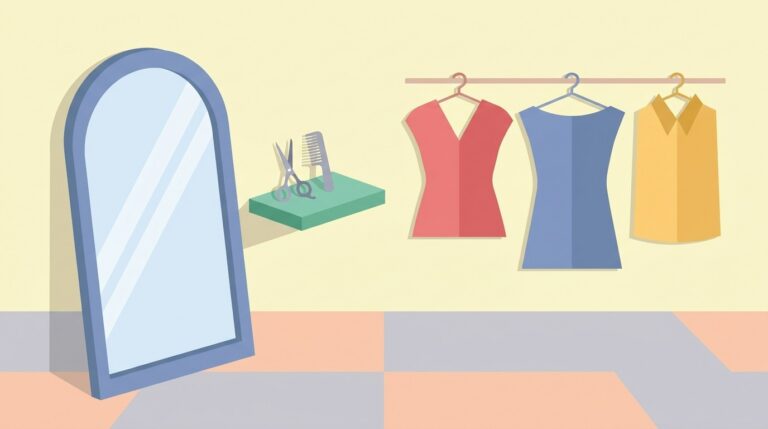
Phase 1: 공감 (Story Opening)
안녕하세요! 매일한글 에디터입니다. Have you ever walked into a trendy hair salon in Hongdae or Seongsu clutching a photo of your favorite K-drama lead, only to freeze when the stylist asks how you want it tailored to you? In Korea, beauty is rarely about blindly copying an idol’s look. Instead, it revolves around intelligent 자기관리 (self-care)—specifically understanding your own bone structure, face shape, and frame.
True styling mastery in Seoul means knowing how to balance your proportions so your natural charm shines through. Today, we’re decoding the exact expressions locals use to collaborate with stylists and fashion consultants. Based on feedback from hundreds of learners who felt overwhelmed during salon consultations, this lesson will give you the vocabulary and cultural intuition to express exactly what flatters your frame.
Phase 2: 핵심 표현 3선 심층 분석 (Core Expressions)
1. 단점을 보완하다 (Danjeomeul bowanhada)
- Pronunciation: [Dan-jeom-eul bo-wan-ha-da] (Think: “dahn-jum” like jumping, then “bo-wahn” like a bowing wand)
- Meaning: Literally “to supplement a defect,” but used naturally as “to flatter or soften an insecurity/flaw.”
- K-Culture Moment: You will hear beauty creators on YouTube say, “광대가 부각되지 않게 사이드뱅으로 단점을 보완했어요 (Gwangdaega bugakdoeji anke saideubaengeuro danjeomeul bowanhaesseoyo / I softened the prominent cheekbones with side bangs to flatter my face).”
- Editor’s Insight: In Korean aesthetic culture, “단점” doesn’t mean you are broken. It simply refers to areas you prefer to de-emphasize, such as a sharp jawline or short neck.
- Situation Spectrum: Casual ✅ | Semi-formal ✅ | Formal ✅
- 🤔 Think About It: In English, we often say “camouflage” or “hide.” How does the Korean word “보완하다 (supplement/balance)” create a more positive, constructive perspective on personal features?
2. 장점을 살리다 (Jangjeomeul sallida)
- Pronunciation: [Jang-jeom-eul sal-li-da] (Think: “jahng-jum” followed by “sal-lee-dah”)
- Meaning: Literally “to bring an advantage to life,” meaning “to accentuate or highlight one’s best assets.”
- K-Culture Moment: Stylists frequently tell actors, “목선이 예쁘니까 넥라인을 터서 장점을 살려볼게요 (Mokseoni yeppeunikka nekraineul teoseo jangjeomeul sallyeobolgeyo / You have a pretty neckline, so let’s open up the collar to accentuate your best asset).”
- Editor’s Insight: Combining “살리다” (to revive/enliven) with “장점” (strength) reflects the Korean philosophy of harmony: styling should bring out what is already good about you.
- Situation Spectrum: Casual ✅ | Semi-formal ✅ | Formal ✅
- 🤔 Think About It: Why does modern Korean self-care focus equally on “장점을 살리다” rather than only hiding flaws?
3. 어울리는 넥라인을 찾다 (Eoullineun nekraineul chatda)
- Pronunciation: [Eo-ul-li-neun nek-ra-in-eul chat-da] (Think: “uh-wool-lee-neun” like wool, “neck-line-eul”, “chaht-dah”)
- Meaning: Literally “to find a matching neckline,” meaning “to discover a collar cut that flatters one’s chest and neck proportions.”
- K-Culture Moment: During personal color and body-frame consultations (골격 진단), consultants often advise: “상체가 발달한 체형은 브이넥으로 어울리는 넥라인을 찾는 게 중요해요 (Sangchega baldalhan chehyeongeun beuinegeuro eoullineun nekraineul chatneun ge jungyohaeyo / For a fuller upper body, it is essential to find an open V-neckline that flatters your silhouette).”
- Editor’s Insight: “어울리다” is one of the most versatile words in Korean beauty; it denotes natural harmony between the garment and the wearer’s physical traits.
- Situation Spectrum: Casual ✅ | Semi-formal ✅ | Formal ⚠️
- 🤔 Think About It: How does clothes shopping shift when you focus on matching your physical lines rather than chasing seasonal trends?
Phase 3: 교과서 한국어 vs 진짜 한국어 (Textbook vs. Real Korean)
Situation 1: Asking a hairstylist to match your face cut
- 📖 교과서 한국어 (Textbook Korean):
제 얼굴 모양에 맞는 헤어스타일을 원합니다.
(Je eolgul moyange matneun heeoseutaireul wonhamnida. / I desire a hairstyle appropriate for my facial shape.) - 🗣️ 진짜 한국어 (Real Native Korean):
제 얼굴형 단점은 좀 커버하고, 장점 살리는 스타일로 추천해 주실 수 있나요?
(Je eolgulhyeong danjeomeun jom keobeohago, jangjeom sallineun seutairo chucheonhae jusil su 있nayo? / Could you recommend a style that softens my face shape and highlights my best features?) - 💡 왜 다를까? (Why the difference?):
Natives rarely use “얼굴 모양” (facial shape); they say “얼굴형.” Koreans also use the loanword “커버하다 (cover)” interchangeably with “보완하다” in casual salon talk.
Situation 2: Choosing an outfit that suits your frame
- 📖 교과서 한국어 (Textbook Korean):
이 옷은 저의 체형 결점을 감춰줍니다.
(I oseun jeoui chehyeong gyeoljeomeul gamchwojumnida. / These clothes hide my body frame defects.) - 🗣️ 진짜 한국어 (Real Native Korean):
스퀘어넥이라 목선도 길어 보이고 체형 커버에 딱이에요!
(Seukweeonegira mokseondo gireo boigo chehyeong keobeoe ttagieyo! / Since it’s a square neck, my neck looks longer and it’s perfect for flattering my frame!) - 💡 왜 다를까? (Why the difference?):
“결점” sounds clinical and overly dramatic. Conversational Korean leans into specific terms like “체형 커버” (body frame flattering) and “길어 보이다” (looks longer).
Phase 4: K-Culture 딥다이브 & 비언어적 매너 (Deep Dive & Manners)
4-1. 눈치 (Nunchi) & Gestures in the Salon
When consulting with a stylist or boutique clerk in Korea:
* The Framing Frame: Rather than pointing directly at a facial feature you dislike, lightly cup your hands alongside your jawline or temple while explaining. This polite body language signals modesty while clarifying the exact contour you wish to modify.
* Eye Contact via the Mirror: Look at the stylist through the mirror rather than turning around physically while they are holding shears or combs. A gentle nod in the mirror shows trust and allows them to observe your angles naturally.
4-2. 문화 코드 분석: The Rise of “골격 진단” (Body Frame Analysis)
Alongside the K-Beauty obsession with 퍼스널 컬러 (Personal Color), Seoul has embraced 골격 진단 (Skeletal/Body Frame Typing)—categorizing silhouettes into types such as Straight, Wave, and Natural.
Koreans view studying their physical proportions not as vanity, but as practical 자기관리 (self-care). Knowing whether a crew neck or a wide open sweetheart neckline balances your shoulders saves time, money, and emotional energy. Self-care in modern Korea is about understanding your biological blueprint and working with it creatively.
Phase 5: 실전 롤플레이 시나리오 (Roleplay Dialogue)
Setting: Min-ji’s private salon studio in Seongsu-dong. Soft lofi jazz plays in the background, with large mirrors reflecting minimalist interior aesthetics.
Characters:
* 민지 (Min-ji): Stylist known for tailored cuts based on facial angles.
* 알렉스 (Alex): B1 Korean learner seeking a new style for an upcoming job interview.
- 민지: 어서 오세요, 알렉스 님! 오늘 생각하고 오신 스타일 있으세요?
(Eoseo oseyo, Alex nim! Oneul saenggakhago osin seutail isseuseyo?)
“Welcome, Alex! Did you have a specific style in mind today?”
🎭 [머리를 가볍게 넘겨보며 친절하게 미소 짓는다] -
알렉스: 사진을 보긴 했는데, 제 둥근 얼굴형에 맞을지 모르겠어요.
(Sajineul bogin haenneunde, je dunggeun eolgulhyeonge majeulji moreugesseoyo.)
“I looked at some photos, but I’m not sure if it suits my round face shape.”
🎭 [거울을 보며 볼 옆을 손으로 살짝 가리킨다] -
민지: 둥근 얼굴형은 턱선을 살리고 볼살 단점을 보완하면 훨씬 세련돼 보여요.
(Dunggeun eolgulhyeongeun teokseoneul salligo bolsal danjeomeul bowanhamyeon hwolssin seryeondwae boyeoyo.)
“For a round face, highlighting your jawline while softening the cheeks will look much more refined.”
🎭 [손가락으로 알렉스의 페이스라인을 조심스럽게 가늠한다] -
알렉스: 정말요? 어떻게 하면 단점을 보완할 수 있을까요?
(Jeongmalyo? Eotteoke hamyeon danjeomeul bowanhal su isseulkkayo?)
“Really? How can we flatter those areas?”
🎭 [기대감 어린 눈빛으로 거울 속 민지를 쳐다본다] -
민지: 사이드뱅을 가볍게 내서 광대를 감싸고, 위쪽에 볼륨을 주면 얼굴이 갸름해 보여요.
(Saideubaengeul gabyeopge naeseo gwangdaereul gamssago, wijjoge bollyumeul jumyeon eolguri gyareumhae boyeoyo.)
“We can cut light side bangs to sweep past the cheekbones and add top volume to elongate the face.”
🎭 [빗으로 머리 윗부분 볼륨을 가볍게 띄워 보인다] -
알렉스: 와, 좋은 생각이에요! 평소에 옷 입을 때도 넥라인을 신경 써야 할까요?
(Wa, joeun saenggagieyo! Pyeongsoe ot ibeul ttaedo nekraineul singyeong sseoyeo halkkayo?)
“Wow, great idea! Should I also pay attention to shirt necklines in daily wear?”
🎭 [자신의 셔츠 깃을 내려다보며 질문한다] -
민지: 그럼요! 목선이 드러나는 브이넥이나 오픈 카라를 입으시면 체형 보완도 되고 훨씬 시원해 보여요.
(Geureomyo! Mokseoni deureonaneun beuinegina opeun karareul ibeusimyeon chehyeong bowando doego hwolssin siwonhae boyeoyo.)
“Of course! Wearing a V-neck or open collar that reveals the neck line balances your frame and looks refreshing.”
🎭 [따뜻하게 고개를 끄덕이며 공감해 준다] -
알렉스: 그렇군요! 전문가 조언대로 제 장점을 살리는 컷으로 부탁드릴게요.
(Geureokgunyo! Jeonmunga joeondaero je jangjeomeul sallineun keoseuro butakdeurilgeyo.)
“Got it! Please give me a cut that brings out my best features based on your expert advice.”
🎭 [안도하며 미소를 짓고 편안하게 기댄다]
🔀 인터랙티브 분기점 (What Would You Say Next?)
Suppose the stylist finishes cutting, but you feel your cheeks are still too exposed. How do you respond?
- Option A: “이거 너무 이상해요. 얼굴이 더 커 보여요.” (This is weird. My face looks bigger.)
- Feedback: Bad. Extremely blunt and confrontational. Stylists will feel defensive, breaking relational harmony.
- Option B: “옆머리가 조금 더 얼굴형을 감싸서 단점을 보완해 주면 좋겠어요.” (I’d love if the side hair hugged my face line a bit more to balance my shape.)
- Feedback: Best! Polite, precise, and directly uses styling vocabulary. The stylist knows exactly what shears work to apply.
- Option C: “그냥 괜찮아요… 집에 가서 모자 쓸게요.” (It’s fine… I’ll just wear a hat at home.)
- Feedback: Risk. Passive-aggressive. You leave unhappy, and the stylist feels uncomfortable knowing something went wrong.
Phase 6: 10초 감정 섀도잉 드릴 (Shadowing Drill)
Practice reading these out loud, observing pauses (/) and emotional cues:
[😊 차분하고 정중하게 / Calm and polite]
제 얼굴형 단점을 / 커버할 수 있는 / 컷으로 부탁드려요.
(Je eolgulhyeong danjeomeul / keobeohal su inneun / keoseuro butakdeuryeoyo.)
“Please give me a cut / that helps flatter / my face shape.”-
[✨ 기대감 넘치고 확신 있게 / Eager and confident]
브이넥을 입으니까 / 목선 장점이 / 확실히 살아나네요!
(Beuinegeul ibeunikka / mokseon jangjeomi / hwaksilhi sarananeyo!)
“Because I’m wearing a V-neck, / the strengths of my neckline / really come alive!” -
[🤔 진지하게 조언을 구하며 / Thoughtful and inquisitive]
제 체형에 어울리는 / 넥라인과 헤어스타일은 / 무엇일까요?
(Je chehyeonge eoullineun / nekraingwa heeoseutaireun / mueosilkkayo?)
“What would be / the most flattering neckline and hairstyle / for my body frame?”
Phase 7: K-Culture 미니 사전 (Mini Dictionary)
- 얼굴형 (Eolgulhyeong) | Face shape
Usage: Refers to jawlines, temples, and overall facial contours (e.g., 계란형/oval, 둥근형/round, 각진형/angular). - 체형 보완 (Chehyeong bowan) | Body frame flattering / Silhouette balance
Usage: Strategic styling choices used in fashion retail and personal styling to balance proportions. - 넥라인 (Nekrain) | Neckline
Usage: Refers to shirt collars (U-neck, V-neck, square-neck, boat-neck) evaluated in relation to neck length and shoulder width. - 자기관리 (Jagigwanli) | Self-care / Personal grooming
Usage: A cultural buzzword denoting personal discipline in diet, skin health, fashion fitness, and speech.
Phase 8: 여행자를 위한 생존 키트 (Traveler’s Survival Kit)
Top 3 Survival Expressions
- “얼굴이 갸름해 보이게 다듬어 주세요.”
(Eolguri gyareumhae boige dadeumeo juseyo.)
Pro Tip: Use this to ask for a slimming, elongated facial look without needing to specify millimeter-precise scissor techniques. - “제 체형에 이 넥라인이 어울리나요?”
(Je chehyeonge i nekraini eoullinayo?)
Pro Tip: Ask shop staff in Dongdaemun or Hongdae boutiques to get candid opinions on collar fits. - “장점을 살리는 스타일로 알아서 해주세요!”
(Jangjeomeul sallineun seutairo araseo haejuseyo!)
Pro Tip: The ultimate magic phrase when you trust a veteran Korean hair designer to work their magic.
Editor’s Travel Note
Before stepping into a salon in Seoul, download the 카카오헤어샵 앱 다운로드 (Kakao Hairshop app download) to browse designer portfolios, read genuine customer reviews filtered by face shape, and book appointments without awkward phone calls. Always carry a reference photo showing necklines and hairstyles you find appealing!
Phase 9: “한 발 더 깊이” (Reflective Question)
In Western cultures, pointing out a “flaw” in someone’s appearance can feel intrusive or negative. In Korea, however, identifying “단점” within styling consultations is handled with matter-of-fact practicality. It is not an insult to your worth, but an objective design puzzle to solve through balanced lines, layers, and textures.
Styling is considered an act of self-respect and consideration for others. When you learn to evaluate your lines calmly and clearly, you take full agency over how you present yourself to the world.
💬 Your Turn: What feature of your face shape or silhouette do you love to highlight when choosing an outfit or haircut? Have you ever noticed how different necklines change your look? Share your thoughts below in English or Korean!
Phase 10: FAQ & 흔한 실수 (FAQ & Mistakes)
Q: What is the difference between ‘단점을 숨기다’ and ‘단점을 보완하다’?
A: ‘단점을 숨기다’ means literally hiding or concealing an insecurity, which sounds defensive. ‘단점을 보완하다’ means compensating for it through thoughtful styling harmony. Stylists prefer using ‘보완하다’ or ‘커버하다’.
Q: Can I use ‘자기관리’ to describe going to the gym and eating healthy?
A: Yes! ‘자기관리’ encompasses everything from working out, getting haircuts, skincare routines, to waking up early to read. Styling your hair according to your bone structure is seen as part of this self-management.
Q: What does ‘추구미 (Chugumi)’ mean when talking to a stylist?
A: ‘추구미’ is a trendy buzzword meaning ‘the aesthetic goal you pursue.’ You can tell your stylist, “제 추구미는 단정한 스타일이에요 (My aesthetic goal is a clean, neat vibe).”
🚨 흔한 실수 (Common Mistakes) 경고판
- ❌ Mistake 1: Calling your face shape “얼굴 크기 (Face size)” when asking for balance.
Correct Action: Say 얼굴형 (Face shape). Focusing on size can sound awkward; focusing on shape is professional. - ❌ Mistake 2: Using “가려주세요 (Hide it)” repeatedly.
Correct Action: Use 단점을 보완해 주세요 or 자연스럽게 커버해 주세요 for an effortlessly natural look. - ❌ Mistake 3: Assuming V-necks are the only flattering neckline.
Correct Action: Inquire specifically: “제 목선에 어떤 넥라인이 가장 어울려요?” (Which neckline suits my neck line best?)
Phase 11: 액션 미션 & 참여 유도 (Action Missions)
- 🥉 Bronze Mission (Solo Practice): Stand in front of your mirror with two different shirts (e.g., crew neck vs. V-neck). Say aloud: “이 넥라인이 내 체형을 더 잘 보완해 준다 (This neckline flatters my body frame better).”
- 🥈 Silver Mission (Social Share): Leave a comment using the pattern:
제 [얼굴형/체형]의 장점은 _______이에요.(The strength of my face shape/frame is _______.) - 🥇 Gold Mission (Real-life Execution): During your next haircut or shopping trip, use the phrase: “제 얼굴형 단점을 보완하는 스타일로 추천해 주세요!”
- 🎮 K-Culture Mission: Watch an episode of a Korean makeover or style show (like Get It Beauty or personal color vlog). Count how many times they say “단점을 보완하다” or “장점을 살리다”!
Phase 12: 인터랙티브 퀴즈 챌린지 (Interactive Quiz)
1. Situational Judgment:
You want to tell your stylist to highlight your sharp jawline rather than covering it with long hair. Which sentence should you pick?
* A) 턱선을 다 가려주세요.
* B) 턱선 장점을 살리는 스타일로 커트해 주세요.
* C) 턱 모양이 너무 이상해요.
2. Fill-in-the-Blank:
라운드넥 대신 스퀘어넥을 입으니까 목선이 시원해 보여서 ______ 보완에 정말 좋아요!
(Hint: The word for body proportions/frame)
3. True or False Culture Quiz:
In Korea, talking openly about facial “단점” during a beauty consultation is considered disrespectful and offensive to the stylist.
* (True / False)
정답과 해설 확인하기 (Click to reveal answers & explanations)
-
Answer: B
Explanation: “장점을 살리다” means to accentuate your best features. Option A means to hide everything, and Option C is needlessly self-critical. -
Answer: 체형 (Chehyeong)
Explanation: “체형 보완” is the key collocation for balancing physical proportions. -
Answer: False
Explanation: It is completely normal and encouraged! Consultations thrive on pragmatic transparency about what you want to balance (보완) and highlight (살리다).







