

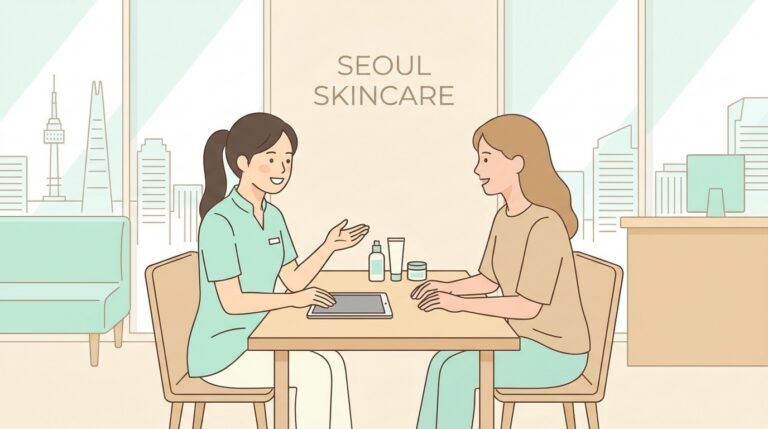
Phase 1: Empathy (Story-Driven Opening)
안녕하세요! 매일한글 에디터입니다. Have you ever strolled past the chic glass-front dermatology clinics in Gangnam or Hongdae, dreaming of that flawless K-drama glass skin, yet paused anxiously at the entrance? Many of our Daily Hangul learners share this exact pain point: “I desperately wanted to clear out my stubborn blackheads and clogged pores with a gentle Aqua Peel, but looking at the Korean consultation screen terrified me! I was scared I’d accidentally agree to an intense laser peel instead!” Visiting a Korean skin clinic (피부과, pibugwa) shouldn’t feel like an exam. Based on real feedback from expats and travelers in Seoul, this guide gives you the exact, natural A2-level phrases you need to state your concerns, request an Aqua Peel, and walk away with glowing confidence!
Phase 2: Key Expressions Breakdown
1. 모공이랑 블랙헤드가 고민이에요. (Mogong-irang beullaekhedeuga gomin-ieyo.)
- Pronunciation: [Mogong-irang beul-laek-he-deu-ga go-min-i-e-yo] (Sounds like moh-gong ee-rahng black-head-ga go-meen-ee-yo)
- Meaning: “I am worried about my pores and blackheads.”
- K-Culture Moment: In lifestyle vlogs and makeover reality shows like Get It Beauty, guests sit across from dermatologists, shyly tapping their noses and uttering this exact phrase to explain seasonal oiliness.
- Editor’s Insight: Koreans use “고민” (gomin – worry/concern) instead of “문제” (munje – problem) when discussing skin. Saying your pores are a “concern” sounds modest, natural, and polite.
- Situation Spectrum: Casual ⚠️ | Semi-formal ✅ | Formal ✅
- 🤔 Think About It: Why do you think Korean uses the word “worry” (고민) rather than “flaw” or “defect” when describing normal skin texture? What does this say about empathy in Korean communication?
2. 아쿠아필 케어 받고 싶어요. (Akuapil keeo batgo sipeoyo.)
- Pronunciation: [A-kwa-pil ke-eo bat-go si-peo-yo] (Sounds like ah-koo-ah-peel care baht-goh she-poh-yoh)
- Meaning: “I want to get an Aqua Peel care treatment.”
- K-Culture Moment: K-pop idols often schedule a quick “Aqua Peel” session between camera rehearsals because it suctions dead skin without visible redness or swelling.
- Editor’s Insight: Adding “케어” (keeo – care) after “아쿠아필” clarifies that you want the relaxing, complete aesthetic step rather than an abrasive medical procedure.
- Situation Spectrum: Casual ⚠️ | Semi-formal ✅ | Formal ✅
- 🤔 Think About It: In English, we often say “I want to buy” or “I want to do a facial,” but Korean uses “받다” (to receive). How does receiving treatment reflect the relational nature of service in Korea?
3. 자극이 심하지 않은 케어로 추천해 주세요. (Jageugi simhaji aneun keeoro chucheonhae juseyo.)
- Pronunciation: [Ja-geuk-i sim-ha-ji an-eun ke-eo-ro chu-cheon-hae ju-se-yo] (Sounds like jah-geuk-ee sheem-hah-jee ahn-eun care-ro choo-chun-hae joo-seh-yoh)
- Meaning: “Please recommend a gentle care treatment that isn’t too irritating.”
- K-Culture Moment: Whenever a character with sensitive skin visits a salon in a K-drama, this phrase serves as their magic shield against harsh peeling agents.
- Editor’s Insight: “자극” (jageuk) means irritation or stimulation. Pairing it with “심하지 않은” (not severe) shows clear self-awareness without sounding demanding.
- Situation Spectrum: Casual 🚫 | Semi-formal ✅ | Formal ✅
- 🤔 Think About It: Rather than rejecting strong treatments outright, Koreans phrase requests as polite preferences. How does this soften interpersonal dynamics?
Phase 3: Textbook Korean vs. Real Korean
Situation 1: Explaining excess oil and rough skin texture
- 📖 교과서 한국어: 제 안면부에 피지 분비물이 과다합니다. (Je anmyeonbue piji bunbimuri gwadahamnida. / Excessive sebum secretion is present on my facial area.)
- 🗣️ 진짜 한국어: 코 쪽에 피지랑 각질이 좀 올라와요. (Ko jjoge pijirang gakjiri jom ollawayo. / Sebum and dead skin are acting up a bit around my nose.)
- 💡 왜 다를까?: Textbook terms like “안면부” (facial area) sound like a clinical autopsy report. Native speakers casually say “올라와요” (comes up/surfaces) to talk about breakout flare-ups.
Situation 2: Asking for a pain-free aesthetic procedure
- 📖 교과서 한국어: 통증이 전혀 발생하지 않는 시술을 원합니다. (Tongjeungi jeonhyeo balsaenghaji anneun sisureul wonhamnida. / I desire a procedure that generates zero pain.)
- 🗣️ 진짜 한국어: 안 아픈 기본 케어로 받고 싶어요. (An apeun gibon keeoro batgo sipeoyo. / I’d like to get a basic care treatment that doesn’t hurt.)
- 💡 왜 다를까?: Natural Korean conversations favor simple descriptive verbs (“안 아픈” – painless) and everyday loanwords (“기본 케어” – basic care) instead of heavy Sino-Korean vocabulary.
Phase 4: K-Culture Deep Dive & Non-Verbal Manners
4-1. 눈치 (Nunchi) & Clinic Etiquette
- The Butterfly Zone Gesture: When describing pores, do not point aggressively at your face. Instead, lightly cradle your cheeks or make a gentle circling motion around your “T-zone” (nose and forehead) with two fingers.
- The Attentive Nod (끄덕끄덕, kkeodeok-kkeodeok): While the skin counselor (상담실장님) examines your face under the bright lamp, look into their mirror display and nod slightly. It shows trust and respect for their diagnosis.
- Indoor Slipper Etiquette: Most Korean aesthetic clinics require you to switch to indoor slippers at the locker area before the consultation room. Always point your street shoes toward the entrance when taking them off!
4-2. Culture Code: The “Gwang” (광) Obsession
In Korean beauty philosophy, true beauty isn’t thick foundation coverage—it is “물광” (mul-gwang, water glow) or “꿀광” (kkul-gwang, honey glow). Procedures like Aqua Peel are popular because they do not require downtime. Seoul office workers routinely slip into Gangnam clinics during a 50-minute lunch break, receive an Aqua Peel, touch up their sunscreen, and return to work without anyone knowing.
Phase 5: Real-Life Roleplay Scenario
- Setting: A bright, minimalist skincare clinic in Gangnam, Seoul.
- Characters:
- 민지 (Minji): Experienced skin counselor holding a digital tablet.
- Alex (Learner): First-time visitor hoping to eliminate stubborn blackheads.
민지: 어서 오세요! 오늘 어떤 관리 보러 오셨어요? (Eoseo oseyo! Oneul eotteon gwanri boreo osyeosseoyo? / Welcome! What kind of treatment are you looking into today?)
🎭 밝은 미소로 상담 태블릿을 건네며
Alex: 안녕하세요! 요즘 코 주변에 모공이랑 블랙헤드가 너무 고민이에요. (Annyeonghaseyo! Yojeum ko jubyeone mogong-irang beullaekhedeuga neomu gomin-ieyo. / Hello! Lately I’m really concerned about pores and blackheads around my nose.)
🎭 손가락으로 코 주변 T존을 조심스럽게 가리키며
민지: 아, T존에 피지가 조금 쌓이셨네요. 혹시 생각해 두신 시술 있으세요? (A, tijone pijiga jogeum ssayisyeonneyo. Hoksi saenggakhae dusin sisul isseuseyo? / Ah, some sebum has built up on your T-zone. Did you have any specific treatment in mind?)
🎭 조명 거울로 피부 상태를 꼼꼼하게 살피며
Alex: 네, 자극 없이 깨끗해지는 아쿠아필 케어 받고 싶어요. (Ne, jageuk eopsi kkaekkeuthaejineun akuapil keeo batgo sipeoyo. / Yes, I want to get an Aqua Peel treatment that cleanses gently without irritation.)
🎭 기대감 어린 표정으로 차분하게 눈을 맞추며
민지: 아쿠아필 딱 좋으세요! 각질이랑 피지 흡입하고 수분까지 꽉 채워드리거든요. (Akuapil ttak joeuseyo! Gakjirirang piji heub-iphago subun-kkaji kkwak chaewodeurigeodeunyo. / Aqua Peel is perfect for you! It suctions out dead skin and sebum, then infuses deep moisture.)
🎭 화면에 표시된 3단계 관리 과정을 손끝으로 보여주며
Alex: 아, 다행이에요. 시술 후에 바로 화장해도 괜찮아요? (A, dahaeng-ieyo. Sisul hue baro hwajanghaedo gwaenchannayo? / Ah, what a relief. Is it okay to put on makeup right after the treatment?)
🎭 안도하며 살짝 고개를 갸웃거리며
민지: 네! 아쿠아필은 다운타임이 없어서 바로 메이크업하셔도 전혀 문제없어요. (Ne! Akuapireun dauntaimi eopseoseo baro meikeueophasyeodo jeonhyeo munjeeopseoyo. / Yes! Aqua Peel has no downtime, so applying makeup right away is completely fine.)
🎭 안심하라는 듯 친절하게 고개를 끄덕이며
Alex: 좋아요, 그럼 오늘 아쿠아필로 진행해 주세요! (Joayo, geureom oneul akuapillo jinhaenghae juseyo! / Wonderful, then please proceed with the Aqua Peel today!)
🎭 결정을 내리고 결제 카드를 미리 준비하며
🔀 Interactive Decision Point
How would you respond if the counselor asks: “압출도 같이 진행해 드릴까요?” (Shall we also do extractions for you?)
* Choice A: “네, 모공 청소되는 아쿠아필이랑 같이 해 주세요.” (Best Choice ✅ – Confident and clear approval.)
* Choice B: “아무거나 제일 센 거로 다 뽑아주세요!” (Risk Choice ⚠️ – Asking for the “strongest” procedure might cause unnecessary redness.)
* Choice C: “싫어요, 그냥 집에 갈래요.” (Bad Choice 🚫 – Abrupt and overly defensive.)
Phase 6: 10-Second Emotion Shadowing Drill
Repeat each sentence matching the emotion tag and rhythmic pauses marked by /:
[🥺 솔직하고 고민스럽게]
요즘 / 모공이랑 블랙헤드가 / 너무 고민이에요.
(Yojeum / mogong-irang beullaekhedeuga / neomu gomin-ieyo.)
“Lately, my pores and blackheads are really worrying me.”-
[✨ 눈을 반짝이며 기대하듯]
자극이 심하지 않은 / 아쿠아필 케어로 / 받고 싶어요!
(Jageugi simhaji aneun / akuapil keeoro / batgo sipeoyo!)
“I want to receive an Aqua Peel care that isn’t too harsh!” -
[😊 안도하며 환하게]
시술 끝나고 / 바로 메이크업 / 해도 괜찮죠?
(Sisul kkeutnago / baro meikeueop / haedo gwaenchantjyo?)
“It’s okay to wear makeup right after the treatment, right?”
Phase 7: K-Culture Mini-Dictionary
- 모공 (Mogong) | Pores
Literally “hair holes.” Widely used across beauty ads, sheet mask labels, and clinic menus (e.g., 모공 축소 – pore tightening). - 피지 (Piji) | Sebum / Facial Oil
Natural skin oil. Koreans often say “피지가 폭발했다” (sebum exploded) during humid summer months. - 각질 (Gakjil) | Dead Skin Cells
Keratin buildup on the skin surface. Frequent exfoliation products are labeled “각질 제거” (dead skin removal). - 다운타임 (Dauntaim) | Downtime / Recovery Period
Borrowed English term used constantly in Seoul clinics to explain whether a treatment leaves bruising or peeling.
Phase 8: Traveler’s Survival Kit
Top 3 Clinic Survival Phrases
- 조금 살살해 주세요. (Jogeum salsalhae juseyo.)
Pro Tip: Use this while lying down if the suction sensation on your nose feels slightly too intense. - 선크림까지 발라주세요. (Seonkeurim-kkaji ballajuseyo.)
Pro Tip: At the end of the modeling mask step, staff will ask if you want sunscreen applied before leaving. - 텍스 리펀 영수증 끊어주세요. (Tekseu ripeon yeongsujeung kkeuneojuseyo.)
Pro Tip: Many certified dermatology clinics in tourist areas provide immediate tax refunds for foreigners!
Editor’s Travel Note
Before stepping into Gangnam or Myeongdong clinics, install 여신티켓 앱 다운로드 to compare transparent price lists and actual user reviews. Don’t worry about finding clinics on foreign map apps; you can easily verify exact station exits using 네이버 지도 앱 다운로드. Most clinics accept overseas credit cards, but remember to bring your physical passport if you plan to claim tax refund benefits on the spot.
Phase 9: Stepping Deeper (Cultural Reflection)
In many Western cultures, visiting a medical clinic is reserved strictly for treating diseases or acute distress. In South Korea, however, skincare maintenance (피부 관리) is viewed as regular self-care hygiene, akin to getting a monthly haircut or visiting the gym. By embracing proactive treatment names like “케어” (care) instead of clinical surgeries, Korean society frames skin health as an empowering routine of self-respect.
💬 Your Turn: How does your home country view professional skincare treatments? Are clinics considered purely medical, or do people visit them casually like in Korea? Share your perspective in the comments!
Phase 10: FAQ & Common Mistakes
Q: Does an Aqua Peel hurt at all?
A: Not at all! An Aqua Peel uses gentle AHA/BHA chemical liquid exfoliation combined with mild vacuum suction. It feels like a cool, damp tip gliding over your skin. Most clients find it soothing enough to fall asleep!
Q: Do I need to book weeks in advance for an Aqua Peel?
A: For basic care like Aqua Peel, most large aesthetic clinics in Seoul accept same-day reservations or simple walk-ins if you arrive before 4 PM on weekdays. However, weekend slots in Gangnam or Hongdae fill up quickly, so checking availability a day prior is recommended.
Q: Can I shave or use retinol products before getting this treatment?
A: Avoid strong active ingredients like retinol or chemical peel pads for at least 48 hours prior to your visit. Shaving right before the appointment can also cause minor stinging when the gentle acid solution touches the skin.
🚨 Common Mistakes Alert!
- Mistake 1: Pronouncing “Aqua Peel” with heavy English vowel cadence (Ah-kwuh-peel).
Correct Action: Pronounce each Korean syllable evenly: 아-쿠-아-필 (Ah-koo-ah-peel). - Mistake 2: Confusing 피지 (Piji – Sebum) with 피 (Pi – Blood).
Correct Action: Clearly pronounce “피지” so the medical staff understands you are talking about oil buildup, not active bleeding! - Mistake 3: Not specifying the nose area.
Correct Action: Say “코 주변” (ko jubyeon) while pointing so the aesthetician spends extra time suctioning the crevices around your nostrils.
Phase 11: Action Missions
- 🥉 Bronze Mission (Solo Practice): Stand before your bathroom mirror, lightly touch your nose, and recite: “모공이랑 블랙헤드가 고민이에요” three times with a natural, polite expression.
- 🥈 Silver Mission (Social Share): Write down your favorite Korean beauty term on your Instagram story or study journal and tag
@DailyHangulwith your pronunciation voice note! - 🥇 Gold Mission (Real-World Test): Walk into a Korean cosmetic store (like Olive Young) or clinic and tell the staff: “모공 케어 제품 추천해 주세요!” (Please recommend a pore care product!).
- 🎮 K-Culture Mission: Watch any Korean celebrity “Get Ready With Me” (GRWM) YouTube video and listen for the words 모공, 피지, or 수분!
Phase 12: Interactive Quiz Challenge
Test your clinic communication skills below!
- [Situation Judgment] You want to explain that your skin gets irritated easily by harsh procedures. Which phrase should you say?
- (A) 제일 아픈 시술로 해 주세요.
- (B) 자극이 심하지 않은 케어로 추천해 주세요.
- (C) 얼굴에 아무것도 바르지 마세요.
- [Fill in the Blank] Complete the sentence meaning “I am worried about my pores and blackheads.”
- 요즘 코 주변에 ( _____ )이랑 블랙헤드가 너무 고민이에요.
- [True or False] Aqua Peel requires at least three full days of downtime during which you cannot wear makeup.
- True / False
👉 Click to reveal answers & explanations!
- Answer: (B)
Explanation: (B) politely requests a gentle treatment without harsh irritation. (A) asks for the most painful procedure, and (C) demands not to apply anything. - Answer: 모공 (Mogong)
Explanation: “모공” means pores. Together with 블랙헤드 (blackheads), it forms the core vocabulary for T-zone concerns. - Answer: False
Explanation: Aqua Peel is famous precisely because it has zero downtime (다운타임 없음). You can apply light makeup and resume your daily routine right after!







