

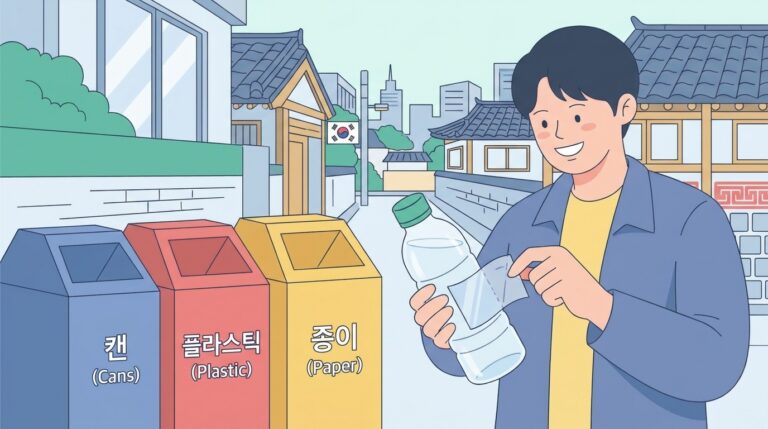
Phase 1: Empathy (Story-Driven Opening)
안녕하세요! 매일한글 에디터입니다.
Picture this: It’s 10:30 PM on a Tuesday in Seoul. You walk down to your apartment or studio building’s designated trash zone, holding a few empty iced Americano cups and water bottles. You are just trying to be a good resident. But as soon as you step into the sorting area, you freeze. Standing by the blue bins is the building manager (Gyeongbi-won ajeossi), watching your every move with sharp eagle eyes. You drop the plastic bottle into the big bin with a soft clatter—only to hear a sigh: “Wait, young person! You have to take the plastic wrap off and rinse it first!”
If you have ever lived or stayed in Korea, you know that recycling—known as 분리수거 (bunrisugeo)—is treated like an Olympic sport. One wrong toss can lead to building fines, complaints in the elevator, or polite scolding. This guide is built directly from real student struggles and local residential guidelines. By mastering just three simple action verbs, you will navigate Korea’s eco-rules smoothly, protect your wallet, and win instant smiles from your Korean neighbors.
Phase 2: Key Expressions Deep Dive
1. 페트병 안을 물로 헹궈요 (Peteu-byeong aneul mullo haeng-gwoyo)
- Pronunciation: [Pe-teu-byeong a-neul mul-lo haeng-gwo-yo] (Sound analogy: “Haeng” sounds like “hang” with a softer ‘a’, and “gwo” rhymes with “grow” if you say it quickly with rounded lips!)
- Meaning: Literal: “Rinse the inside of the PET bottle with water.” / Nuance: Clean out any food residue or coffee syrup so it is completely clean for sorting.
- K-Culture Moment: On MBC’s variety show I Live Alone (나 혼자 산다), celebrities often show their neat daily routines by meticulously swishing tap water inside empty sauce and water containers before tossing them into recycling bins.
- Editor’s Insight: The verb 헹구다 (haeng-guda) means “to rinse lightly without soap.” Even a tiny drop of leftover latte will disqualify a bottle from being recycled as high-grade plastic in Korea.
- Situation Spectrum:
- Casual: ✅ (페트병 물로 헹궈!)
- Semi-formal: ✅ (페트병 안을 물로 헹궈요.)
- Formal: ✅ (페트병 안을 물로 헹구어 주시기 바랍니다.)
- 🤔 Think About It: In many Western countries, sorting facilities wash plastics on industrial conveyor lines. Why do you think Korean communities expect individuals to do the pre-cleaning step at home?
2. 비닐 라벨을 떼요 (Binil rabereul tteyo)
- Pronunciation: [Bi-nil ra-be-reul tte-yo] (Sound analogy: “Tte” starts with a tight, doubled ‘t’ sound, like the sharp “t” in the English word “stop”!)
- Meaning: Literal: “Peel off the vinyl label.” / Nuance: Remove the printed plastic film wrapper before throwing the clear bottle away.
- K-Culture Moment: Korean beverage companies now design bottles with perforated pull-tabs marked 절취선 (jeolchwiseon – tear line) so consumers can rip them off in one satisfying second on Korean vlog channels.
- Editor’s Insight: The verb 떼다 (tte-da) means to detach or peel something that is stuck. Korea enforces a strict national policy: clear PET bottles (투명 페트병) must be 100% label-free to turn into recycled polyester fabrics.
- Situation Spectrum:
- Casual: ✅ (라벨 떼!)
- Semi-formal: ✅ (라벨 떼요.)
- Formal: ✅ (라벨을 떼어 분리배출하십시오.)
- 🤔 Think About It: Notice how Korean drinks use loose wrap-around plastic rather than sticky glue labels. How does product design reflect government sorting policies?
3. 찌그러뜨려서 버려요 (Jjigeureotteuryeoseo beoryeoyo)
- Pronunciation: [Jji-geu-reo-tteu-ryeo-seo beo-ryeo-yo] (Sound analogy: “Jji” has a crisp “jj” like the sound in “mozzarella”, followed by “tteu” like the crisp ‘t’ in “skittles”.)
- Meaning: Literal: “Crush it and throw it away.” / Nuance: Squeeze or stomp the bottle completely flat so it takes up minimal communal bin space.
- K-Culture Moment: In slice-of-life K-Dramas like Hospital Playlist, you often see exhausted junior doctors stepping on empty water bottles in the pantry with a crunchy foot stomp before tossing them into the trash.
- Editor’s Insight: Combining 찌그러뜨리다 (to crumple/crush) with -어서 (and then) shows a connected sequence of actions. Crushing bottles saves bin volume, preventing overflowing garbage piles that cause neighbor conflict.
- Situation Spectrum:
- Casual: ✅ (찌그러뜨려 버려!)
- Semi-formal: ✅ (찌그러뜨려서 버려요.)
- Formal: ✅ (압착하여 배출해 주십시오.)
- 🤔 Think About It: In Korea’s dense urban apartment living, garbage space is strictly shared. How does crushing a bottle show consideration (배려) for the whole building?
Phase 3: Textbook Korean vs Real Korean
Situation 1: Prepping the Bottle
- 📖 교과서 한국어 (Textbook): 투명 페트병의 라벨을 제거하고 내부를 세척하십시오. (Tumyeong peteu-byeong-ui rabereul je-geo-hago nae-bureul se-cheok-ha-sip-si-o. / Please remove the label of the transparent PET bottle and wash the interior.)
- 🗣️ 진짜 한국어 (Real-life): 라벨 떼고 물로 한번 헹궈서 버려주세요. (Rabel ttego mullo han-beon haeng-gwo-seo beoryeo-juseyo. / Please peel off the label, rinse it once with water, and throw it out.)
- 💡 왜 다를까? (Why the difference?): Public instruction boards use Sino-Korean legal terms like 제거 (removal) and 세척 (cleaning), but real humans speak in native Korean action verbs like 떼다 (to peel) and 헹구다 (to rinse).
Situation 2: Flattening the Bottle
- 📖 교과서 한국어 (Textbook): 부피를 최소화하기 위해 페트병을 압착하십시오. (Bupireul choe-so-hwa-hagi wihae peteu-byeong-eul apchak-ha-sip-si-o. / Please compress the PET bottle to minimize volume.)
- 🗣️ 진짜 한국어 (Real-life): 발로 꾹 밟아서 찌그러뜨리면 돼요! (Ballo kkuk balbaseo jjigeureotteurimyeon dwaeyo! / Just step on it firmly with your foot to crush it flat!)
- 💡 왜 다를까? (Why the difference?): Koreans value speed and practicality. Describing the physical action (발로 꾹 밟다 – step down firmly) is far more natural than mechanical technical terms like 압착 (compression).
Phase 4: K-Culture Deep Dive & Non-Verbal Manners
4-1. 눈치 (Nunchi) & Sound Manners
When disposing of recyclables late at night in Korea, 눈치 (nunchi – situational awareness) is essential. Stomping on plastic bottles makes a loud cracking pop! Doing this at 11 PM near open first-floor apartment windows can trigger noise complaints (층간소음/소음 분쟁). Always crush your bottles inside your apartment during daytime, or gently squeeze them with your hands instead of stomping when you are downstairs late at night. Maintain soft eye contact, give a quick 15-degree head bow to anyone sorting nearby, and keep metal clinking sounds down.
4-2. Cultural Code Analysis: The Transparent Plastic Revolution
Since late 2020, South Korea has enforced the 투명 페트병 별도 분리배출제 (Separate Disposal System for Clear PET Bottles). Clear water/drink bottles are collected in separate mesh sacks apart from colored plastic bottles (like soda or detergent jugs). Why? Clear PET can be melted down into high-grade yarn for sportswear and eco-friendly tote bags made by trendy K-Fashion brands. Throwing a bottle with a label attached ruins the entire batch, which is why guards and neighbors take it so seriously!
Phase 5: Real Role-Play Scenario
Setting: Tuesday morning, 8:15 AM. You are standing in the recycling courtyard of a brick villa apartment in Mapo-gu, Seoul. Mr. Park (박 반장님), the neighborhood supervisor with a neon vest, watches you hold a green iced-tea bottle.
- Turn 1 (Mr. Park): 학생, 잠깐만요! 그 페트병 그냥 넣으면 안 돼요. (Haksaeng, jamkkanmanyo! Geu peteu-byeong geunyang neo-eumyeon an dwaeyo.)
- 🎭 Action: Walks over while pointing a gloved finger at the plastic bottle.
- English: “Student, wait a second! You cannot just put that PET bottle in like that.”
- Turn 2 (You): 아, 죄송해요! 어떻게 버려야 해요? (A, joesonghaeyo! Eotteoke beoryeoya haeyo?)
- 🎭 Action: Lower shoulders apologetically and look up with curious eyes.
- English: “Ah, I’m sorry! How should I throw it away?”
- Turn 3 (Mr. Park): 여기 겉에 비닐 라벨 보여요? 이거 먼저 뜯어야지. (Yeogi geote binil rabel boyeoyo? Igeo meonjeo tteudeoyaji.)
- 🎭 Action: Taps the colorful plastic label wrapped around your bottle.
- English: “See this vinyl label on the outside? You have to peel this off first.”
- Turn 4 (You): 네, 라벨은 떼서 비닐류에 넣을게요! (Ne, rabereun tteseo binillyue neo-eulgeyo!)
- 🎭 Action: Promptly find the perforated line and peel the label clean off.
- English: “Yes, I will peel off the label and put it into the vinyl bin!”
- Turn 5 (Mr. Park): 잘하네! 그리고 안에 단물 남아있잖아. 물로 헹궜어? (Jalhane! Geurigo ane danmul nama-itjana. Mullo haeng-gwosseo?)
- 🎭 Action: Tilts the bottle slightly to inspect the bottom.
- English: “Good job! And there’s sweet liquid left inside. Did you rinse it with water?”
- Turn 6 (You): 아직 안 헹궜어요. 지금 수전에서 물로 헹궈 올게요! (Ajik an haeng-gwosseoyo. Jigeum sujeoneseob mullo haeng-gwo olgeyo!)
- 🎭 Action: Points toward the outdoor communal tap with a polite nod.
- English: “I haven’t rinsed it yet. I’ll go rinse it with water at the tap right now!”
- Turn 7 (Mr. Park): 그래요. 헹구고 발로 꾹 밟아서 찌그러뜨려 넣어요. (Geuraeyo. Haeng-gugo ballo kkuk balbaseo jjigeureotteuryeo neo-eoyo.)
- 🎭 Action: Nods with a satisfied smile and pats your shoulder.
- English: “Alright. Rinse it, step on it firmly to crush it, and put it in.”
- Turn 8 (You): 네, 깨끗하게 찌그러뜨려서 버릴게요. 감사합니다! (Ne, kkaekkeuthage jjigeureotteuryeoseo beorilgeyo. Gamsahamnida!)
- 🎭 Action: Delivers a crisp 45-degree bow.
- English: “Yes, I will crush it clean and throw it away. Thank you!”
🔀 Interactive Decision Point
After rinsing and peeling the bottle, Mr. Park turns away to sort cardboards. What do you do with the separated plastic bottle cap (뚜껑)?
* Choice A: Throw the plastic cap into the general trash (일반쓰레기).
* Choice B: Fasten the cap back onto the crushed bottle, or toss it into the dedicated cap collection bucket.
* Choice C: Toss the cap on the ground next to the bin.
- Feedback:
- Choice A (Risk): While some districts tolerate this, plastic caps are recyclable HDPE plastic! Throwing them in general trash wastes usable resources.
- Choice B (Best!): In Korea, after crushing the bottle, you can close the cap lightly so the bottle stays flat and caps don’t scatter, or put it in dedicated cap baskets. Mr. Park will treat you like a recycling prodigy!
- Choice C (Bad): Never leave litter around bins. It attracts pests and violates neighborhood rules.
Phase 6: 10-Second Emotion Shadowing Drill
Repeat these sentences matching the emotional cues and pauses (/):
[😅 살짝 민망하고 공손하게 - Slightly embarrassed but polite]- 아, 죄송해요! / 라벨을 깜빡하고 안 뗐어요. (A, joesonghaeyo! / Rabereul kkamppakhago an ttesseoyo.)
- “Oh, I’m sorry! / I forgot and didn’t peel off the label.”
[😊 씩씩하고 야무지게 - Energetic and confident]- 안을 물로 깨끗이 헹구고 / 꾹 찌그러뜨릴게요! (Aneul mullo kkaekkeusi haeng-gugo / kkuk jjigeureotteurilgeyo!)
- “I will rinse the inside clean with water / and crush it down flat!”
[🤝 밝고 싹싹하게 - Cheerful and neighborly]- 알려주셔서 감사합니다, / 반장님! (Allyeojusyeoseo gamsahamnida, / banjangnim!)
- “Thank you for showing me, / neighborhood supervisor!”
Phase 7: K-Culture Mini Dictionary
- 분리수거 (Bunrisugeo)
- Meaning: Separate collection / Recycling.
- Usage: Used everywhere from apartment elevators to public parks. You will often see notices: “화요일은 분리수거 날입니다” (Tuesday is recycling day).
- 투명 페트병 (Tumyeong peteu-byeong)
- Meaning: Transparent/Clear PET plastic bottle.
- Usage: Refers strictly to colorless drinking bottles (water, sparkling water). Colored plastic bottles go into the general 플라스틱 (plastic) bin.
- 비닐류 (Binillyu)
- Meaning: Plastic film/wrappers category.
- Usage: Snack bags, bubble wrap, and peeled bottle labels belong here. They must be clean and free of food sauces.
- 종량제 봉투 (Jongnyangje bongtu)
- Meaning: Prepaid government standard garbage bag.
- Usage: In Korea, non-recyclable general trash must be placed into specific prepaid district bags purchased at convenience stores.
Phase 8: Traveler’s Survival Kit
Top 3 Survival Expressions
- 이거 어디에 버려요? (Igeo eodie beoryeoyo?)
- Pronunciation: [I-geo eo-di-e beo-ryeo-yo?]
- Pro Tip: If you are at a café or highway rest stop and baffled by multiple recycling slots, show your trash and ask staff this phrase.
- 라벨 떼야 해요? (Rabel tteya haeyo?)
- Pronunciation: [Ra-bel tte-ya hae-yo?]
- Pro Tip: Ask this when you are unsure if a printed film counts as a label or permanent packaging.
- 종량제 봉투 어디 있어요? (Jongnyangje bongtu eodi isseoyo?)
- Pronunciation: [Jong-nyang-je bong-tu eo-di is-seo-yo?]
- Pro Tip: Say this at any convenience store counter to buy official trash bags.
Editor’s Travel Note
Before wandering Seoul’s residential districts, check your local area rules on the 스마트 분리배출 공식 가이드 (Smart Waste Separation Official Guide). Also, download the 네이버 지도 앱 다운로드 (Naver Map App Download) to search for nearby community centers (주민센터) where you can exchange clean crushed clear PET bottles and empty batteries for free rolls of prepaid trash bags (종량제 봉투)!
Phase 9: 한 발 더 깊이 (One Step Deeper)
In Korean culture, communal spaces are treated as extensions of the home. Because South Korea has a high population density with over 60% of residents living in multi-family apartments or studio villas, waste management is not seen as an anonymous public service, but as a mutual pact of respect (배려 – baeryeo). Cleaning your own plastic bottle before discarding it signifies that you refuse to pass an unpleasant task to your elderly neighbor or building cleaner. Recycling in Korea is an everyday practice of citizenship and empathy.
💬 Your Turn: How does recycling work in your home country? Do you rinse your bottles and peel labels before throwing them out, or does a facility do it for you? Share your experience in the comments below!
Phase 10: FAQ & Common Mistakes
Q: Can I put coffee cups with printed logos into the transparent PET bottle bin?
A: No! Takeout plastic coffee cups from cafés are usually made of mixed polystyrene or colored PET, and they have printed inks. They go into the general “Plastic” (플라스틱) bin, not the “Clear PET” (투명 페트병) bin.
Q: Do I need to remove the small ring left on the bottle neck after opening the cap?
A: No, you do not need to cut the tamper-evident ring off! The recycling processing plants use water flotation tanks where shredded bottle flakes sink and cap rings float, so they separate automatically.
Q: What time should I bring out recyclables in a studio villa (원룸)?
A: Most residential areas designate specific recycling nights (e.g., Sunday and Wednesday from 7:00 PM to midnight). Never leave recyclables on the sidewalk in the morning or on unauthorized days, as street cameras (CCTV) monitor illegal dumping.
🚨 Common Mistakes Board
- ❌ Mistake 1: Tossing unrinsed instant noodle containers or coffee cups into plastics.
- 👉 Correct Action: If red chili oil or dark syrup stains won’t wash out, it cannot be recycled! Discard it in the prepaid general trash bag (종량제 봉투).
- ❌ Mistake 2: Leaving plastic labels attached to water bottles.
- 👉 Correct Action: Unzip the label via the tear line and throw the label into the 비닐류 (vinyl) bag.
- ❌ Mistake 3: Stomping bottles late at night in hallway corridors.
- 👉 Correct Action: Flatten them inside your room before 9 PM to avoid indoor noise disputes with neighbors.
Phase 11: Action Mission & Engagement
- 🥉 Bronze Mission (Solo Drill): Go to your kitchen right now. Take one empty plastic bottle, say out loud: “라벨을 떼고 (peel label), 물로 헹구고 (rinse with water), 찌그러뜨려요 (crush it)!” while doing each action.
- 🥈 Silver Mission (Social Sharing): Take a photo of your neatly crushed, label-free bottle and post it on your Instagram Story with the hashtag
#DailyHangulRecyclingand tag a friend who needs this survival tip! - 🥇 Gold Mission (Real-world Challenge): Next time you visit a Korean convenience store or stay at an Airbnb in Korea, sort your bottles into the designated bins without asking for help.
🎮 K-Culture Mission: Watch any episode of the variety program 나 혼자 산다 (I Live Alone) or 삼시세끼 (Three Meals a Day). Listen carefully for when cast members mention the words 분리수거 (recycling) or 페트병 (PET bottle)!
Phase 12: Interactive Quiz Challenge
Test your real-world recycling instincts below!
1. Situation Judgment
You just finished a strawberry smoothie in a clear takeout cup. The cup still has sweet pink syrup along the bottom and a sticky logo label. What should you do?
* A) Toss it directly into the “투명 페트병 (Clear PET)” bin because it looks transparent.
* B) Rinse the syrup out with water, peel what you can, and place it into the regular “플라스틱 (Plastic)” bin.
* C) Leave it on top of a street mailbox.
2. Fill-in-the-Blank
Complete the sentence using the proper verb for removing the label:
페트병 겉에 붙은 비닐 라벨을 [ ] 물로 헹궈요.
* A) 마시고 (masigo)
* B) 떼서 (tteseo)
* C) 사서 (saseo)
3. True or False Cultural Quiz
Statement: In Korea, you are expected to stomp on plastic bottles late at night in the apartment corridor because recycling bins close at midnight.
* (True / False)
👉 Click to reveal Answers & Explanations!
- Answer: B
- Explanation: Takeout drink cups are not classified under “투명 페트병 (Clear PET)” (which is reserved exclusively for clean bottled water and simple beverage bottles). Rinse out the sugar syrup and discard it into the regular plastic bin.
- Answer: B (떼서 – tteseo)
- Explanation: The verb 떼다 (to peel/detach) becomes 떼서 (peel and then). The full sentence means: “Peel off the vinyl label stuck on the outside of the PET bottle, and then rinse with water.”
- Answer: False
- Explanation: Absolutely False! Hallway stomping creates severe inter-floor noise (층간소음). Always crush bottles quietly with your hands or crush them during daylight hours inside your own apartment!
- Explanation: Absolutely False! Hallway stomping creates severe inter-floor noise (층간소음). Always crush bottles quietly with your hands or crush them during daylight hours inside your own apartment!






