

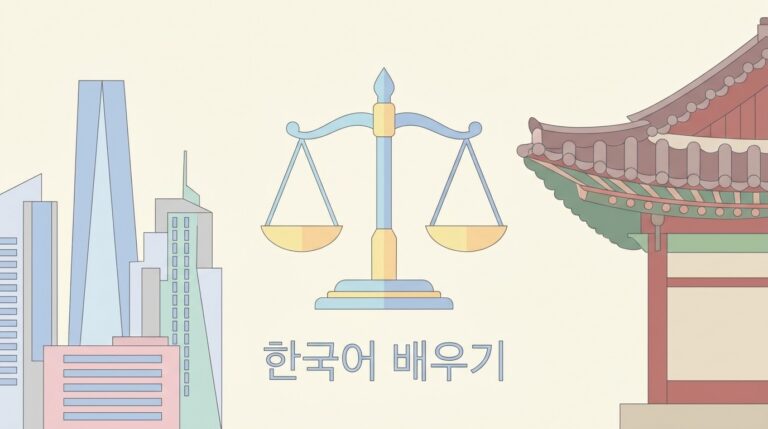
Balancing the Rigid Frame and Living Justice: Good Faith and Rebus Sic Stantibus in Korean Civil Law
Phase 1: Empathy (Storytelling Opening)
안녕하세요! 매일한글 에디터입니다.
Imagine sitting in a high-rise conference room overlooking the bustling streets of Teheran-ro in Gangnam. Your business counterpart pushes a crisp contract across the polished mahogany table. A sudden geopolitical shift or unprecedented market upheaval has just rendered your initial contractual obligations catastrophic. You look at them, and they recite the age-old Latin maxim: Pacta sunt servanda—agreements must be kept. Under Korean civil law, this ironclad principle is known as 법적 안정성 (Legal Stability). But does Korean jurisprudence really expect you to bleed dry just to satisfy the letter of the text?
Many advanced learners hitting the C2 ceiling find themselves paralyzed here. You know formal vocabulary, but navigating the sophisticated philosophical tension between strict legality and equitable fairness feels like tiptoeing across broken glass. The truth is, the Korean Civil Code (Minbeop) possesses a masterfully designed heartbeat. As one seasoned high-court judge famously noted, if legal certainty is the rigid skeleton of society, the valve pumping warm blood into that framework is 신의성실의 원칙 (The Principle of Good Faith and Fair Dealing), often coupled with 사정변경의 원칙 (The Doctrine of Changed Circumstances / Rebus Sic Stantibus).
Today, drawing from over a decade of advising international legal teams and corporate professionals in Seoul, we will unpack how elite Korean speakers wield these overarching civil principles. By the end of this guide, you will master the elevated lexicon required to balance unyielding rules with human-centered justice.
Phase 2: Deep Dive into 3 Core Expressions
1. 신의성실의 원칙 (Sin-ui-seong-sil-ui won-chik)
- Pronunciation: [Sin-ui-seong-sil-ui won-chik] (Sounds like: Sheen-wee-seong-sheel-wee won-cheek)
- Meaning: The Principle of Good Faith and Sincerity. Commonly abbreviated in legal and professional circles as 신의칙 (Sin-ui-chik).
- K-Culture Moment: Seen in boardroom showdowns in K-dramas like Hyena or Vincenzo, where an attorney dramatically halts an aggressive foreclosure by claiming the opposing party violated mutual trust.
- Editor’s Insight: Article 2, Paragraph 1 of the Korean Civil Act dictates that rights must be exercised and duties performed faithfully in good faith. It is not mere politeness; it is a substantive judicial scalpel that cuts down unethical enforcement.
- Situation Spectrum: Casual 🚫 | Semi-formal ⚠️ | Formal/Professional ✅
- 🤔 Think About It: Does your native legal system treat “good faith” as an overarching supreme principle, or merely as a gap-filler in statutory interpretation?
2. 사정변경의 원칙 (Sa-jeong-byeon-gyeong-ui won-chik)
- Pronunciation: [Sa-jeong-byeon-gyeong-ui won-chik] (Sounds like: Sah-jeong-byun-gyung-wee won-cheek)
- Meaning: The Doctrine of Changed Circumstances (Clausula Rebus Sic Stantibus).
- K-Culture Moment: Evoked in corporate melodramas when real estate developers demand renegotiation after an unexpected government rezoning shakes the bedrock of a multi-million-dollar deal.
- Editor’s Insight: The Korean Supreme Court historically took an exceptionally stringent view on this doctrine, but recent jurisprudence increasingly recognizes it when an unforeseeable, fundamental disruption strips a contract of its foundational premise.
- Situation Spectrum: Casual 🚫 | Semi-formal ⚠️ | Formal/Professional ✅
- 🤔 Think About It: Where is the boundary between taking a calculated business risk and encountering a legitimate “change of circumstances”?
3. 구체적 타당성 (Gu-che-jeok ta-dang-seong)
- Pronunciation: [Gu-che-jeok ta-dang-seong] (Sounds like: Goo-che-juck tah-dahng-sung)
- Meaning: Concrete Validity; Substantive Justice in a specific, real-world case.
- K-Culture Moment: Frequently articulated in judicial dramas like Extraordinary Attorney Woo, where judges wrestle between a black-letter statute and reaching an equitable, humanistic outcome.
- Editor’s Insight: In Korean legal philosophy, 법적 안정성 (predictability/order) and 구체적 타당성 (individual equity) exist in dynamic tension. C2 proficiency requires using this phrase to explain why a general rule produces an unconscionable result in a particular case.
- Situation Spectrum: Casual 🚫 | Semi-formal ⚠️ | Formal/Professional ✅
- 🤔 Think About It: When rigid enforcement destroys human dignity, which should prevail: abstract social order or concrete justice?
Phase 3: Textbook Korean vs. Real Professional Korean
Scenario 1: Objecting to ruthless contract enforcement
- 📖 교과서 한국어 (Textbook):
“계약을 그대로 이행하는 것은 우리에게 너무 불공정합니다.”
(Gye-yag-eul geu-dae-ro i-haeng-ha-neun geos-eun u-ri-e-ge neo-mu bul-gong-jeong-ham-ni-da. / Executing the contract as it is is too unfair to us.) - 🗣️ 진짜 한국어 (Elite Professional C2):
“상대방의 귀책 없이 발생한 급격한 시장 변동을 도외시한 채, 원안만을 고수하는 것은 신의칙상 권리남용에 해당합니다.”
(Sang-dae-bang-ui gwi-chaek eop-si bal-saeng-han geup-gyeok-han si-jang byeon-dong-eul do-oe-si-han chae, won-an-man-eul go-su-ha-neun geos-eun sin-ui-chik-sang gwon-ri-nam-yong-e hae-dang-ham-ni-da. / Clinging rigidly to the original terms while disregarding drastic market volatility that arose without our fault constitutes an abuse of rights under good faith.) - 💡 왜 다를까? (Why the difference?): Saying “it’s unfair” sounds like emotional whining. Professional Korean frames unfairness through the objective legal construct of 권리남용 (Abuse of Rights) and 신의칙.
Scenario 2: Requesting formal renegotiation due to macro shifts
- 📖 교과서 한국어 (Textbook):
“상황이 바뀌었으니 조건을 다시 이야기합시다.”
(Sang-hwang-i ba-kkwieoss-eu-ni jo-geon-eul da-si i-ya-gi-hap-si-da. / The situation changed, so let’s talk about conditions again.) - 🗣️ 진짜 한국어 (Elite Professional C2):
“계약 체결 당시 예견할 수 없었던 현저한 사정변경이 발생한 만큼, 조문의 합목적적 해석과 양측의 형평을 고려한 조건 조정이 불가피합니다.”
(Gye-yak che-gyeol dang-si ye-gyeon-hal su eop-seot-deon hyeon-jeo-han sa-jeong-byeon-gyeong-i bal-saeng-han man-keum, jo-mun-ui hap-mok-jeok-jeok hae-seok-gwa yang-cheuk-ui hyeong-pyeong-eul go-ryeo-han jo-geon jo-jeong-i bul-ga-pi-ham-ni-da. / As a significant change of circumstances that could not have been foreseen at signing has occurred, adjusting the terms is inevitable to honor purposive interpretation and mutual equity.) - 💡 왜 다를까? (Why the difference?): Using terms like 합목적적 (purposive/teleological) and 형평 (equity) moves the request from a unilateral concession to a legally justified equilibrium.
Phase 4: K-Culture Deep Dive & Non-Verbal Manners
4-1. 눈치 (Nunchi) & Professional Demeanor
When invoking 신의칙 in a Korean corporate setting, your non-verbal communication must never radiate aggressive confrontation. In Korea, claiming the other party lacks “good faith” can be perceived as an indictment of their moral character (인격적 모욕).
* The Tilt & Pause: Deliver key phrases with a calm, deliberate tone, maintaining eye contact without glaring. Slightly lower your chin when phrasing legal counterarguments: this signals that you are appealing to mutual reason and harmony (상생), not threatening litigation.
* Paper Handling: Keep both hands flat on the desk, touching the contract softly with your fingertips rather than pointing a pen or finger directly at the text.
4-2. Cultural Code Analysis: The Balance of 법 (Law) and 정 (Affection/Humanity)
In Western civil systems, contract enforcement leans heavily on strict individualism. Korean society, while operating under an advanced civil code derived from the German BGB, preserves a deep communal ethos. Korean law strives for what legal scholars term a 살아있는 법 (Living Law). When K-drama protagonists fight titanic conglomerates, the emotional climax rarely revolves around a mere punctuation error in a statute; it hinges on exposing how a party broke trust (신뢰 관계). Koreans expect the law to possess warmth—hence the metaphor that good faith is the blood keeping the skeleton of legal certainty alive.
Phase 5: Real-World Roleplay Scenario
Setting: A negotiation room at a prestigious legal firm in Seoul. International Director Dr. Elena Vance is meeting Senior Partner Park Min-woo regarding a suddenly unviable commercial lease and development agreement caused by regulatory overhaul.
- Elena Vance: 이번 규제 변경은 계약 당사자 쌍방이 전혀 예측할 수 없었던 외부 요인입니다.
(I-beon gyu-je byeon-gyeong-eun gye-yak dang-sa-ja ssang-bang-i jeon-hyeo ye-cheuk-hal su eop-seot-deon oe-bu yo-in-im-ni-da.)
“This regulatory change is an external factor that neither contracting party could have predicted.”
(🎭 Calms her breath, spreading her hands open across the conference table) -
Park Min-woo: 동의합니다만, 법적 안정성의 원칙상 이미 날인된 조항을 번복하기는 쉽지 않습니다.
(Dong-ui-ham-ni-da-man, beop-jeok an-jeong-seong-ui won-chik-sang i-mi nal-in-doen jo-hang-eul beon-bok-ha-gi-neun swip-ji anh-seum-ni-da.)
“I agree, but under the principle of legal certainty, reversing an already sealed clause is no simple matter.”
(🎭 Adjusts his glasses, maintaining a courteous yet neutral posture) -
Elena Vance: 바로 그렇기 때문에 신의성실의 원칙이 필요한 것 아닐까요?
(Ba-ro geu-reoh-gi ttae-mun-e sin-ui-seong-sil-ui won-chik-i pil-yo-han geos a-nil-kka-yo?)
“Isn’t that precisely why the principle of good faith exists?”
(🎭 Speaks in an even, respectful cadence, making direct eye contact) -
Park Min-woo: 신의칙을 통한 계약 수정은 매우 예외적인 경우에만 인정되는 판례 경향이 있습니다.
(Sin-ui-chik-eul tong-han gye-yak su-jeong-eun mae-u ye-oe-jeok-in gyeong-u-e-man in-jeong-doen-eun pan-rye gyeong-hyang-i it-seum-ni-da.)
“Judicial precedent tends to recognize contract modification via good faith only in exceptional cases.”
(🎭 Taps the legal precedent dossier gently on the table) -
Elena Vance: 맞습니다. 하지만 구체적 타당성을 외면한 기계적 이행 강제는 본 계약의 근간을 훼손합니다.
(Mat-seum-ni-da. Ha-ji-man gu-che-jeok ta-dang-seong-eul oe-myeon-han gi-gye-jeok i-haeng gang-je-neun bon gye-yak-ui geun-gan-eul hwe-son-ham-ni-da.)
“Correct. However, mechanical enforcement that ignores concrete equity destroys the very foundation of this contract.”
(🎭 Nods thoughtfully, validating his legal concern before countering) -
Park Min-woo: 그렇다면 사정변경에 따른 해제 대신, 이행 조건의 합리적 조정을 검토하시겠다는 뜻입니까?
(Geu-reoh-da-myeon sa-jeong-byeon-gyeong-e tta-reun hae-je dae-sin, i-haeng jo-geon-ui hap-ri-jeok jo-jeong-eul geom-to-ha-si-get-da-neun tteus-im-ni-kka?)
“Do you mean you wish to explore a reasonable adjustment of performance terms, rather than termination via changed circumstances?”
(🎭 Leans forward with increased interest, sensing an equitable compromise) -
Elena Vance: 네. 그것이야말로 법적 안정성과 구체적 타당성이 조화를 이루는 길이라고 봅니다.
(Ne. Geu-geos-i-ya-mal-ro beop-jeok an-jeong-seong-gwa gu-che-jeok ta-dang-seong-i jo-hwa-reul i-ru-neun gil-i-ra-go bom-ni-da.)
“Yes. I believe that is precisely the path where legal certainty and concrete justice achieve harmony.”
(🎭 Offers a composed, collaborative smile) -
Park Min-woo: 일리 있는 제안입니다. 내부 협의를 통해 수정안을 마련해 보겠습니다.
(Il-ri it-neun je-an-im-ni-da. Nae-bu hyeop-ui-reul tong-hae su-jeong-an-eul ma-ryeon-hae bo-get-seum-ni-da.)
“That is a sound proposition. We will consult internally and prepare a revised draft.”
(🎭 Nods respectfully and closes his file)
🔀 Interactive Decision Point
How should Elena respond to Park Min-woo’s final agreement?
* Choice A: “당연한 결정입니다. 법적으로 가도 저희가 무조건 이겼을 겁니다.” (That’s an obvious choice. Even if we went to court, we would have definitely won.)
* Choice B: “배려해 주셔서 감사합니다. 양측의 신뢰 관계를 지키는 최선의 합의점을 찾길 기대합니다.” (Thank you for your consideration. I look forward to finding the optimal middle ground that preserves our mutual trust.)
* Choice C: “약속하신 거니까 나중에 딴소리하시면 절대 안 됩니다.” (You promised, so you must never change your word later.)
Feedback:
* Choice A (Bad): Disastrous. Boasting legal victory shatters rapport and makes the counterpart feel legally threatened rather than cooperatively aligned.
* Choice B (Best): Flawless. Invoking 신뢰 관계 (relationship of trust) honors the relational ethic while maintaining high professional dignity.
* Choice C (Risk): Too colloquial and confrontational (딴소리 is informal slang), undermining your C2 executive stature.
Phase 6: 10-Second Emotion Shadowing Drill
Practice cadence, pauses (/), and emotional intent:
[⚖️ 차분하고 지적으로 단호하게 - Calm and intellectually resolute]
법적 안정성이라는 / 단단한 뼈대 위에 / 구체적 타당성이라는 따뜻한 피가 흐르게 해야 합니다.
(Beop-jeok an-jeong-seong-i-ra-neun / dan-dan-han ppyeo-dae wi-e / gu-che-jeok ta-dang-seong-i-ra-neun tta-tteut-han pi-ga heu-reu-ge hae-ya ham-ni-da.)-
[🤝 설득력 있고 정중하게 - Persuasive and courteous]
계약의 본질적 목적을 살리기 위해 / 신의칙에 기반한 유연한 해석을 / 정중히 요청합니다.
(Gye-yak-ui bon-jil-jeok mok-jeok-eul sal-li-gi wi-hae / sin-ui-chik-e gi-ban-han yu-yeon-han hae-seok-eul / jeong-jung-hi yo-cheong-ham-ni-da.) -
[🛑 단호하고 격조 높은 경고 - Resolute and dignified warning]
예측 불가능했던 현저한 사정변경을 무시하는 것은 / 권리남용의 소지가 다분합니다.
(Ye-cheuk bul-ga-neung-haet-deon hyeon-jeo-han sa-jeong-byeon-gyeong-eul mu-si-ha-neun geos-eun / gwon-ri-nam-yong-ui so-ji-ga da-bun-ham-ni-da.)
Phase 7: K-Culture Mini Dictionary
- 법적 안정성 (Beop-jeok an-jeong-seong)
- Definition: Legal Certainty / Legal Stability.
- Usage: Essential in commercial debates. Reflects the principle that legal rules must remain predictable and contracts unbreached so society does not slide into chaos.
- 권리남용 (Gwon-ri-nam-yong)
- Definition: Abuse of Rights (Civil Act Article 2, Paragraph 2).
- Usage: Invoked when a party exercises a legitimate legal entitlement purely to inflict hardship or extract unconscionable gains without justifiable benefit.
- 쌍방 (Ssang-bang)
- Definition: Both parties (Bilateral / Mutual).
- Usage: Standard terminology in contractual discourse (쌍방 합의 – mutual consent; 쌍방 과실 – mutual fault).
- 원상복구 (Won-sang-bok-gu)
- Definition: Restitution to original state / Status quo ante.
- Usage: Ubiquitous in Korean leasing and commercial agreements upon termination or voidance.
Phase 8: Traveler & Expat Survival Kit
Navigating real estate contracts (전세/월세) or freelance agreements in South Korea requires knowing your baseline protections:
- Survival Expression 1: 계약 당사자 간의 신의칙에 어긋나는 일방적 통보는 수용할 수 없습니다. (Gye-yak dang-sa-ja gan-ui sin-ui-chik-e eo-geut-na-neun il-bang-jeok tong-bo-neun su-yong-hal su eop-seum-ni-da. / I cannot accept a unilateral notice that violates good faith between contracting parties.)
- Survival Expression 2: 예상치 못한 중대한 상황 변화가 발생했으니 재협의를 요청드립니다. (Ye-sang-chi mot-han jung-dae-han sang-hwang byeon-hwa-ga bal-saeng-haess-eu-ni jae-hyeop-ui-reul yo-cheong-deu-rim-ni-da. / A significant, unforeseen situational change has occurred, so I request renegotiation.)
- Survival Expression 3: 원만한 합의를 위해 구체적 타당성을 고려해 주시기 바랍니다. (Won-man-han hap-ui-reul wi-hae gu-che-jeok ta-dang-seong-eul go-ryeo-hae ju-si-gi ba-ram-ni-da. / Please consider concrete equity for an amicable agreement.)
Editor’s Travel & Expat Note:
If you encounter a lease or commercial crisis in South Korea, do not panic or resort to emotional arguments. Consult institutional resources like the Seoul Global Center Legal Consultation Service or seek mediation through the Korea Legal Aid Corporation. Remember: presenting your facts framed around mutual good faith (신의성실) often de-escalates conflicts faster than aggressive threats.
Phase 9: “한 발 더 깊이” (Deep Cultural Reflection)
In Korean jurisprudence, the phrase “법대로 하자” (Let’s do it by the law) is rarely a sign of respect for order; it is often the final insult when human relations have ruptured completely. Traditionally, Korean culture values 도리 (Dori – moral path/duty) alongside codified statutes. When German civil law doctrines were adopted into modern Korea, civil jurists embraced Treu und Glauben (Good Faith) precisely because it harmonized statutory law with deep-seated cultural ethics. To speak Korean at a C2 level is to understand that a contract is not just a defensive fortress against liability; it is a sacred mutual promise that must breathe with the reality of human existence.
💬 Your Turn: Have you ever encountered a situation where following the strict letter of an agreement resulted in total unfairness? How would you explain that using 구체적 타당성? Share your thoughts below!
Phase 10: FAQ & Common Mistakes (FAQ Schema)
Q: Can I use the principle of changed circumstances (사정변경의 원칙) to cancel any bad investment?
A: Absolutely not. The Korean Supreme Court (대법원) maintains a high bar. The change must be completely unforeseeable at contract signing, outside the risk allocation agreed upon, and continuing performance must yield a result so unconscionable that it violates the principle of good faith.
Q: Is 신의칙 (Sin-ui-chik) used in everyday conversation or only in court?
A: While rooted in civil law, educated Korean speakers often invoke 신의칙 metaphorically in sophisticated discussions, workplace ethics debates, and editorial writing to critique someone acting in bad faith.
Q: What is the difference between 형평 (Hyeong-pyeong) and 구체적 타당성 (Gu-che-jeok ta-dang-seong)?
A: 형평 (Equity/Fairness) is the moral state of balance between opposing interests, whereas 구체적 타당성 is the specific judicial imperative to tailor justice to the distinct facts of an individual case rather than relying solely on abstract general rules.
🚨 Common Mistakes Warning Board
- Mistake 1: Translating “in bad faith” as “나쁜 믿음으로” (Nappeun mid-eum-eu-ro).
- Correct Action: Use 신의칙에 반하여 (Sin-ui-chik-e ban-ha-yeo) or 악의로 (Ak-ui-ro – in knowledge of the fact).
- Mistake 2: Using informal expressions like “법대로 해” (Do it by the law) in business negotiations.
- Correct Action: Frame your point using 법적 안정성과 신의칙의 조화 (Harmonizing legal stability with good faith).
- Mistake 3: Conflating 사정변경 (Changed circumstances) with mere 단순 변심 (Simple change of mind). The former requires objective, fundamental impossibility or extreme unconscionability.
Phase 11: Action Missions
- 🥉 Bronze Mission (Solo Shadowing): Read aloud the Phase 6 shadowing sentences 5 times, focusing on clean pauses between 법적 안정성 and 구체적 타당성.
- 🥈 Silver Mission (Community Sharing): Write a 2-sentence legal opinion in Korean regarding an unexpected delay in a business project using the word 신의칙 and post it in the comments below.
- 🥇 Gold Mission (Real-World Application): Identify a recent news article about Korean commercial disputes or tenant protections. Spot whether the article mentions 권리남용 or 사정변경.
- 🎮 K-Culture Mission: Watch an episode of a Korean courtroom or corporate drama (like Stranger, Hyena, or Vincenzo) and listen for when characters appeal to moral duty over black-letter contracts.
Phase 12: Interactive Quiz Challenge
1. Situation Judgment Quiz
A commercial supplier faces a 400% international raw material price spike due to war. The buyer demands delivery at the original price, threatening to bankrupt the supplier. What legal principle should the supplier invoke to demand renegotiation?
* A) 기한의 이익 (Benefit of time)
* B) 사정변경의 원칙에 기한 계약 조건 조정 (Adjustment of contract terms based on changed circumstances)
* C) 무과실 책임 (Strict liability)
2. Fill-in-the-Blank Quiz
법적 안정성이라는 단단한 뼈대 위에 [ ]이라는 따뜻한 피가 흐르게 해야 진정한 정의가 실현됩니다.
3. True or False Cultural Quiz
In Korean civil law, invoking “권리남용” (Abuse of Rights) means that a party has completely forfeited all legal rights forever. (True / False)
👉 Click to reveal the Answer Key & Explanations
- Answer: B. The sudden, unpredictable external spike creates grounds to argue for adjustment or termination via 사정변경의 원칙 rooted in 신의성실의 원칙.
- Answer: 구체적 타당성 (Concrete validity / Case-specific equity). This pairs philosophically with legal certainty (법적 안정성).
- Answer: False. Abuse of rights (권리남용금지의 원칙) means that the specific exercise of a right in that particular context will not be granted legal protection or judicial enforcement because it violates good faith; it does not permanently strip the person of legal standing.







