

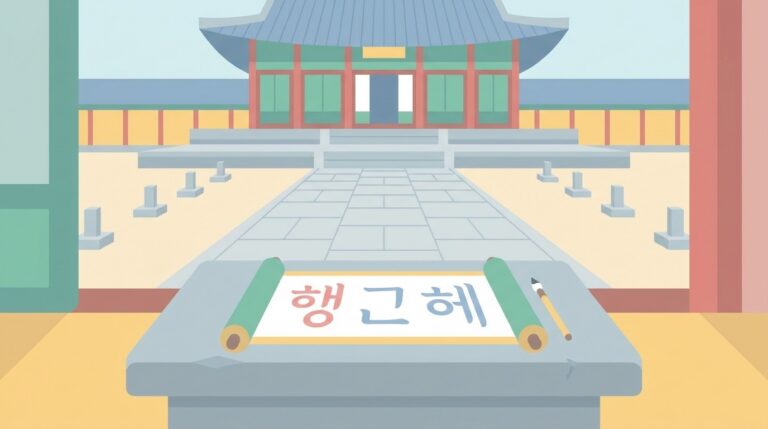
Decoding Joseon Courtroom Rhetoric: From Royal Edicts (Eomyeong) to Life-Risking Remonstrances (Sangso)
Phase 1: Empathy — Stepping into the Royal Courtroom
안녕하세요! 매일한글 에디터입니다.
Have you ever settled in for an episode of an iconic historical K-drama like The Red Sleeve (옷소매 붉은 끝동) or Under the Queen’s Umbrella (슈룹), expecting your hard-earned C1/C2 Korean to carry you through, only to be completely floored by an icy dialogue exchange in the throne room? An impassioned scholar clad in crimson robes falls to his knees, clutched scroll trembling in his hands, crying out words that sound entirely foreign: “전하, 통촉하여 주시옵소서!” Meanwhile, the king scowls from the dragon throne, snapping back with “과인의 전교를 거역하겠다는 뜻인가?”
Suddenly, the comfortable conversational Korean you mastered feels lightyears away. That frustration is completely natural. Joseon dynasty court speech isn’t merely an antiquated dialect; it is a meticulously coded political chess game governed by Neo-Confucian constitutional philosophy, intricate hierarchical honorifics, and visceral power struggles. In this lesson, we will unpack how royal directives—spanning 어명 (Eomyeong), 윤음 (Yuneum), and 전교 (Jeongyo)—collided with 상소 (Sangso) and 간언 (Ganeon), the remonstrances through which ministers literally put their necks on the line to critique royal tyranny. Master this register, and historical literature and Sageuk dialogues will transform from cryptic background noise into a thrilling masterclass of rhetorical combat.
Phase 2: Core Expressions Deep Dive
1. 어명 (御命, Eomyeong) / 전교 (傳敎, Jeongyo) / 윤음 (綸音, Yuneum)
- Pronunciation: [Eo-myeong] (Think “Uh-m-young,” pronounced with crisp, descending finality) / [Jeon-gyo] / [Yun-eum]
- Meaning: Literal: “The Royal Order” | Nuance: An irrevocable decree carrying the absolute weight of royal sovereign authority.
- K-Culture Moment: The iconic royal messenger arrives at an exile’s secluded thatched cottage carrying a wooden box wrapped in crimson silk, declaring: “어명을 받으라!” (Receive the royal decree!). The protagonist immediately falls to their knees in the mud.
- Editor’s Insight: While pop culture uses 어명 (Eomyeong) as a catch-all term, archival Joseon literature makes sharp distinctions. 전교 (Jeongyo) refers to administrative directives issued directly to government ministries. In contrast, 윤음 (Yuneum) is an emotionally charged, pastoral royal proclamation issued directly to the civilian populace or scholar-officials, often expressing royal remorse during droughts, famines, or political rebellions.
- Situation Spectrum: Casual 🚫 | Semi-formal 🚫 | Formal (Archaic / High Royal Historical Register) ✅
- 🤔 Think About It: In Western monarchies, decrees were often justified through divine right (Dei Gratia). In Joseon, why did kings have to frame their Yuneum in moral humility, claiming heaven’s punishment for their own lack of virtue?
2. 상소 (上疏, Sangso) / 간언 (諫言, Ganeon)
- Pronunciation: [Sang-so] (Resonant nasal start, crisp falling ‘so’) / [Gan-eon]
- Meaning: Literal: “Submitting a formal memorial to the throne” / “Moral remonstrance.”
- K-Culture Moment: White-clad Confucian academy scholars (Yusaeng, 유생) kneel outside Gyeongbokgung’s Gwanghwamun gate, laying an unrolled scroll before them, staging an ideological strike that paralyzes the capital.
- Editor’s Insight: 상소 (Sangso) was not a polite suggestion; it was an institutionalized check on autocratic power. Officials of the Daegan (대간, the remonstrance inspection organs) possessed the legal right—and moral duty—to critique the sovereign. If an official submitted an unwanted 간언 (Ganeon) that infuriated a despotic ruler, it often resulted in exile or execution by poison (사약, Sayak).
- Situation Spectrum: Casual 🚫 | Semi-formal ⚠️ (Used humorously in modern corporate contexts) | Formal ✅
- 🤔 Think About It: How does this institutionalized dissent contrast with modern whistleblowing or petitioning in constitutional democracies?
3. 통촉하여 주시옵소서 (Tongchokhayeo jusiopsoseo)
- Pronunciation: [Tong-cho-ka-yeo ju-si-op-so-seo] (Sharp aspirated ‘ch’ sliding into the ultra-reverential ‘op-so-seo’)
- Meaning: Literal: “Please illuminate and discern with piercing wisdom.” | Nuance: “I beg Your Majesty to reconsider your deeply flawed judgment!”
- K-Culture Moment: The entire State Council bows their heads to the royal stone tiles in unison, chanting in a synchronized, resonant rhythm: “전하, 어명을 거두어 주시옵소서! 통촉하여 주시옵소서!”
- Editor’s Insight: 통촉 (洞燭, Tongchok) combines ‘cavern/penetrate’ (洞) and ‘candle/illuminate’ (燭). You are metaphorically asking the king to shine the candle of his moral intellect into the dark, flawed corners of his current decision. It is the polite apex of royal contradiction.
- Situation Spectrum: Casual 🚫 | Semi-formal 🚫 | Historical Formal High Register ✅
- 🤔 Think About It: Consider how the highest form of respect in the Korean language (-옵소서, -opsoseo) is employed here not to flatter, but to confront authority.
Phase 3: Textbook Korean vs Real Korean
Situation 1: Describing an Uncompromising Top-Down Directive
- 📖 교과서 한국어 (Textbook): 사장님이 직원들에게 프로젝트 마감일을 앞당기라고 강력하게 명령했습니다. (Sajangnimi jigwondeurege peurojekteu magamireul apdanggirago gangryeokhage myeongnyeonghaessseumnida. / The CEO strongly ordered the employees to advance the project deadline.)
- 🗣️ 진짜 한국어 (Native Sarcastic Metaphor): 이번 프로젝트 일정, 위에서 내려온 거의 ‘어명’ 수준이라 무조건 따라야 해. (Ibeon peurojekteu iljeong, wieseo naeryeoon geoui ‘eomyeong’ sujuneira mujokeon ddaraya hae. / This new project timeline is straight-out treated like a royal decree from executive leadership; we have zero say in it.)
- 💡 Why the Difference? Modern Koreans regularly invoke monarchical vocabulary (어명, 하사품) in corporate and social banter to highlight rigid, unquestionable top-down hierarchies with self-deprecating irony.
Situation 2: Submitting an Earnest Appeal Against a Management Blunder
- 📖 교과서 한국어 (Textbook): 경영진의 방침에 반대하는 의견서를 정식으로 제출할 예정입니다. (Gyeongyeongjinui bangchime bandaehaneun uigyeonseoreul jeongsigeuro jechulhal yejeongimnida. / I plan to officially submit an opinion dissenting against management’s policy.)
- 🗣️ 진짜 한국어 (Native Idiomatic / Satirical): 팀장님, 부당한 인사 발령에 맞서서 우리 전 부서원 이름으로 대표님께 ‘상소문’이라도 올려야 하는 것 아닙니까? (Timjangnim, budanghan insa ballyeonge matseoseo uri jeon buseowon ireumeuro daepyoonimkke ‘sangsomun’irado ollyeoya haneun geot animnikka? / Team leader, shouldn’t we submit a collective ‘memorial scroll’ to the CEO to protest these unfair personnel transfers?)
- 💡 Why the Difference? Invoking 상소문 (Sangsomun) elevates an internal complaint into a dramatic moral stand, drawing directly upon the cultural trope of unyielding Joseon officials confronting royalty.
Phase 4: K-Culture Deep Dive & Non-Verbal Manners
4-1. Nunchi & Gesture: The Physicality of Court Defiance
In Joseon court protocol, non-verbal posture conveyed whether one was submitting a routine petition or preparing for martyrdom:
* Bokji Budong (복지부동, 伏地不動): Prostrating completely flat on the flagstones (bakseok, 박석) with palms, forearms, and forehead pressed firmly to the floor. When accompanied by the removal of the official wing-tipped hat (tal-gwan, 탈관), it signaled: “I surrender my official status and life if my remonstrance is rejected.”
* The Scepter of Accountability (홀, Hol): When addressing the sovereign directly, an official held a jade or ivory tablet (hol) upright with both hands in front of the chest, blocking their own breath from dishonoring the king, while directing their gaze down at the king’s embroidered dragon chest badge (gyong, 흉배), never meeting his eyes directly. Meeting the monarch’s gaze during an argument was interpreted as treasonous arrogance (bul-gyeong-joe, 불경죄).
4-2. Cultural Code Analysis: The Check and Balance of the Daegan (대간)
Contrary to Western depictions of monolithic oriental despotism, the Joseon dynasty operated under an extraordinarily rigorous constitutional structure. The king was legally restrained by three offices known collectively as the Samsa (3사):
1. Saganwon (사간원): Chief Office of Remonstrance, whose sole mandate was to critique the king’s personal misconduct.
2. Saheonbu (사헌부): The Office of the Inspector-General, tasked with policing corrupt officials.
3. Hongmungwan (홍문관): The Office of Special Advisors, acting as philosophical and constitutional guardians.
A king could not execute an edict (Jeongyo) without the validating signature (Seogyeong, 서경) of these young, ideological officials. When a Joseon king attempted to overrule bureaucratic consensus, officials utilized the 지부상소 (Jibusangso, 持斧上疏)—entering the palace gates carrying a carpenter’s wood-splitting axe, laying it beside their petition, and declaring: “If my words are unjust, sever my neck with this axe. If they are just, revoke your unrighteous decree!”
Phase 5: Real-Life Sageuk Roleplay Scenario
Setting: Changdeokgung Injeongjeon (창덕궁 인정전). Midnight emergency audience. Lanterns flicker against the red lacquer pillars. The young King has arbitrarily decreed a massive luxury construction project during a severe regional famine.
Characters:
* King (임금): Volatile, defensive, proud.
* Chief Censor / Daesaheon (대사헌 – Learner): Unwavering, constitutionally precise, risking death.
Turn 1 (King):
과인의 전교는 이미 반포되었소. 대사헌은 어찌하여 또다시 국고를 논하며 어명을 지체시키는 것이오?
(Gwainui jeongyoneun imi banpodoeeosso. Daesaheoneun eojjihayeo ttodasi gukgoreul nonhamyeo eomyeongeul jichesikineun gosio?)
["My royal directive has already been promulgated. On what grounds does the Chief Censor obstruct my decree by harping once again on the state treasury?"]
🎭 Slaps the armrest of the dragon throne in clear agitation.

Turn 2 (Daesaheon):
전하, 삼가 아뢰옵기 송구하오나, 이번 전교는 삼사의 서경을 거치지 않은 독단이옵니다.
(Jeonha, samga aroewopgi songguhona, ibeon jeongyoneun samsaui seogyeongeul geochiji aneun dokdanimnida.)
["Your Majesty, it pains me to utter these words, but this directive is an arbitrary fiat lacking the formal constitutional consent of the Samsa."]
🎭 Holds the ivory tablet (홀) steady, refusing to yield ground.

Turn 3 (King):
독단이라니! 과인의 영을 능멸하는 처사가 아니더냐! 경은 과인의 왕권을 능가하려 드는 겐가?
(Dokdanirani! Gwainui yeongeul neungmyeolhaneun cheosaga anideonya! Gyeongeun gwainui wangkwoneul neungg PROTOharyeo deuneun genga?)
["Arbitrary fiat! You hold my royal will in open contempt! Do you presume to usurp the royal authority of this sovereign?"]
🎭 Leans forward with a piercing, venomous gaze.

Turn 4 (Daesaheon):
황공하오나 전하, 민초들이 기근으로 쓰러지는 마당에 궁궐을 증축함은 하늘의 뜻을 거스르는 처사이옵니다.
(Hwanggonghaona jeonha, minchodeuri gigeuneuro sseureojineun madange gunggworeul jeungchukhamun haneurui tteuseul geoseureuneun cheosaimnida.)
["I tremble with dread, Your Majesty, yet expanding palace halls while the people collapse from famine is an outrage that defies the mandate of Heaven."]
🎭 Unrolls a crisp white memorial scroll onto the cold stone.

Turn 5 (King):
그 입 다물라! 당장 저자의 관직을 삭탈하고 의금부로 압송하라!
(Geu ip damulla! Dangjang jeojaui gwanjigeul saktalhago Uigeumburo apsonghara!)
["Silence your insolent tongue! Strip him of his official title instantly and march him away to the State Tribunal!"]
🎭 Royal guards advance, drawing their swords half an inch.

Turn 6 (Daesaheon):
소신의 목을 벨지언정, 충언의 길을 막지는 마시옵소서! 전하, 통촉하여 주시옵소서!
(Sosinui mogeul beljieonjeong, chungeonui gireul makjineun masiopsoseo! Jeonha, tongchokhayeo jusiopsoseo!)
["Though you may sever my humble neck, do not choke off the path of righteous counsel! Your Majesty, we implore you to see reason!"]
🎭 Removes the official cap (탈관), dropping to the floor in prostration.

Turn 7 (King):
경이 진정 죽음을 두려워하지 않는단 말인가...
(Gyeongi jinjeong jukeumeul duryeowohaji anneundan maringa...)
["Do you truly harbour no fear of death at my hand..."]
🎭 Falters momentarily, unnerved by the moral gravitas of the protest.

Turn 8 (Daesaheon):
전하께서 성군으로 남으실 수만 있다면, 소신의 목숨 따위는 초개와 같사옵니다.
(Jeonhakkeseo seongguneuro nameusil suman itdamyeon, sosinui moksum ttawineun chogaewa gatsaopnida.)
["If it ensures Your Majesty endures in history as a benevolent and wise ruler, this humble servant's life is of no more consequence than wild grass."]
🎭 Presses forehead firmly against the flagstones, motionless.
🔀 Interactive Branching Choice
The King asks: “If I revoke this decree, how will the court address the collapsed prestige of the crown?”
- Choice A (Constitutional & Filial Route): “전하, 잘못된 전교를 스스로 거두어들이는 용기야말로 성인(聖人)의 도리이자 천하에 덕을 떨치는 길입니다.” (Your Majesty, the moral courage to retract an erring decree is the true way of the sage, broadcasting virtue throughout the realm.)
- Choice B (Aggressive Axe Remonstrance / Jibusangso Route): “도끼로 소신의 목을 베신 뒤 궁궐을 지으소서! 천추만대에 폭군으로 기록되실 것입니다!” (Sever my head with an axe and build your palace! You shall be inscribed for ten thousand generations as a tyrant!)
- Choice C (Pragmatic Financial Route): “추후 풍년이 들면 백성들이 자발적으로 부역에 나설 것이니, 공사를 명년 봄으로 잠정 연기하시옵소서.” (When bountiful harvests return, the people will labor willingly; postpone the construction work until next spring.)
Branch Feedback:
- Choice A (Best / Master Class): Perfect C2 Neo-Confucian mastery. You leverage Mencian philosophy, reframing royal retraction not as political defeat, but as supreme sage-monarch benevolence (Seonggun, 성군). The King saves face while yielding to your remonstrance.
- Choice B (Risk / Volatile High-Stakes): Ultra-dramatic and historically accurate for zealots, but highly risky. You force the King into an emotional corner where executing you becomes the only way to avoid looking powerless in front of the court.
- Choice C (Bad / Pragmatic Capitulation): Weak moral footing for a Chief Censor. By bargaining over administrative timelines rather than defending constitutional principles and famine relief, you lose moral authority (Myeongbun, 명분) among your peer scholars.
Phase 6: 10-Second Emotional Shadowing Drill
Practice these lines focusing on breath control, downward sentence stress, and resonant Confucian pathos.
[🔥 목숨을 건 비장함으로 (Defiantly staking one's life)]
“소신의 목을 / 벨지언정 / 충언의 길을 / 막지는 마시옵소서!”
(Sosinui mogeul / beljieonjeong / chung-eonui gireul / makjineun masiopsoseo!)
Note: Place an emphatic pause after ‘beljieonjeong’ to let the threat of execution reverberate.-
[⚡ 왕의 절대적인 위엄과 냉혹함 (Icy royal finality)]
“과인의 전교는 / 이미 반포되었으니 / 더는 / 논하지 말라!”
(Gwainui jeongyoneun / imi banpodoeeosseuni / deoneun / nonhaji malla!)
Note: Crisp, falling cadence on ‘malla’—never trail off upwards. -
[🥺 비통하고 간곡한 호소 (Grief-stricken earnest supplication)]
“전하, / 부디 백성들의 곡소리를 헤아리시어 / 어명을 / 거두어 주시옵소서!”
(Jeonha, / budi baekseongdeurui goksorireul he-arisieo / eomyeongeul / geodueo jusiopsoseo!)
Phase 7: K-Culture Mini Dictionary
-
지부상소 (持斧上疏, Jibusangso) | Axe-bearing Remonstrance
The most extreme form of Joseon political protest, where a scholar carried a woodcutter’s axe while petitioning, declaring readiness for instant decapitation if the king deemed the memorial erroneous. Famous practitioners include Jo Heon (조헌) and Choe Ik-hyeon (최익현). -
대간 (臺諫, Daegan) | The Remonstrance Watchdogs
The joint body of officials from the Office of the Inspector-General and the Office of Censors who served as systemic institutional whistleblowers against royal overreach. -
윤음 (綸音, Yuneum) | Heartfelt Royal Proclamation
A rare, solemn letter written directly by the King to his subjects, often published in both classical Hanja and vernacular Hangul (Eonmun, 언문) so commoners could read royal reflections directly. -
사관 (史官, Sagwan) | The Incorruptible Royal Chroniclers
Scribes who shadowed the King 24/7, documenting every whisper, slip of the tongue, and temper tantrum in the Sillok (Veritable Records). Even kings were legally forbidden from reading what the Sagwan wrote.
Phase 8: Traveler’s Survival Kit
Visiting Seoul’s Grand Palaces (Gyeongbokgung, Changdeokgung) or the National Palace Museum of Korea? Elevate your experience with historical literacy:
Survival Expressions TOP 3:
- “이곳이 대간들이 왕에게 상소를 올리던 곳인가요?”
(Igosi daegandeuri wangege sangsoreul ollideon gosingayo?)
“Is this stone courtyard where the censors submitted their remonstrance scrolls to the king?”
Pro Tip: Use this when exploring the Jeongjeon (throne hall courtyards) of Changdeokgung. -
“전시된 유물 중에 임금의 친필 윤음이 있나요?”
(Jeonsidoen yumul junge imgeumui chinpil yuneumi innayo?)
“Are there any original hand-written royal proclamations (Yuneum) on display among these artifacts?”
Pro Tip: Perfect question for docents inside the National Palace Museum of Korea exhibition guide. -
“사관들의 기록인 사초(史草)는 어디서 보관했나요?”
(Sagwandeurui girogin sachoneun eodiseo bogwanhaennayo?)
“Where did they safeguard the raw historical drafts recorded by the royal scribes?”
Editor’s Travel Note:
When walking across the stone pavers of Gyeongbokgung, notice the small iron rings embedded in the stone courtyard (Gori, 고리). They weren’t just for securing sun-shade tents for royal banquets—they marked the exact geometric standing spots where ministers knelt during fierce debates. To decode these architectural markers in real-time, grab the Smart Gyeongbokgung Palace Audio Guide App before passing through Heungnyemun Gate.
Phase 9: “한 발 더 깊이” (One Step Deeper)
Western media frequently portrays pre-modern East Asian dynastic systems as monolithic, unquestioned autocracies. Yet the vocabulary of Joseon court politics tells the opposite story: royal legitimacy was precarious, conditional, and bound to Heaven’s Mandate (Cheonmyeong, 천명). The existence of institutionalized dissent through 상소 (Sangso) demonstrates that speech was an active, codified weapon. A king’s decree (어명, Eomyeong) was powerful, but it could not escape the biting critique of a 25-year-old newly minted censor wielding nothing more than an ink brush, historical precedent, and moral defiance.
This intellectual legacy did not vanish with the fall of the empire. The Joseon tradition of collective, righteous confrontation lives on directly in modern South Korean political culture—from mass candlelit citizen protests in Gwanghwamun to passionate digital petitions on blue house/presidential bulletin boards. When modern Koreans demand radical accountability from institutional power, they are unconsciously channeling six centuries of Sangso culture.
💬 Your Turn: Does your native culture possess an equivalent historical tradition of institutionalized moral rebellion against supreme rulers? Share your historical parallels in the comments below!
Phase 10: FAQ & Avoiding Misunderstandings
Q: Can I use “어명” jokingly with my Korean friends or colleagues?
A: Yes, absolutely! Modern Koreans love playful melodrama. If your boss drops an urgent, non-negotiable task late on a Friday afternoon, turning to your coworker and whispering: “대표님 어명이 떨어졌네…” (The CEO’s royal decree has dropped…) adds hilarious, relatable corporate sarcasm. Just ensure you never use it in serious, formal business writing.
Q: What is the exact distinction between ‘교지 (Gyoji)’ and ‘전교 (Jeongyo)’?
A: 전교 (Jeongyo) is an operational executive instruction given by the King to high-ranking ministers. 교지 (Gyoji) is an official royal certificate of appointment or civil-exam degree granted to an individual scholar. When you see someone in a drama receiving a red or white scroll conferring their new magistracy title, that scroll is a Gyoji.
Q: Why did officials refer to themselves as ‘소신 (Sosin)’ or ‘신 (Sin)’ in front of the king?
A: In the court register, personal pronouns like 나 (Na) or 저 (Jeo) were strictly forbidden. Officials used 소신 (小臣, Sosin – ‘humble small servant’) or 신 (臣, Sin – ‘your subject’) to grammatically cement their institutional subordination while paradoxically using that exact humble stance to deliver scathing policy rebukes.
🚨 흔한 실수 (Common Mistakes) Warning Board
- Mistake: Using 어명 (Eomyeong) to describe any order given by an older person or manager in casual settings.
Correct Action: Use it strictly as deliberate satire or irony. In normal professional settings, stick to 지시사항 (directives) or 요청사항 (requests). - Mistake: Assuming 통촉하여 주시옵소서 means “Please forgive my sins.”
Correct Action: It means “Please see through to the truth and reconsider your royal mistake.” It critiques the King’s intellect, not your own errors. - Mistake: Mixing modern informal polite endings (-요) with archaic court vocabulary (e.g., saying 어명이에요).
Correct Action: Court archaisms require authentic ultra-honorific verbal endings (-옵소서, -하시옵소서, -사옵니다) to preserve rhetorical gravitas.
Phase 11: Action Missions
- Bronze Mission (Solo Mastery): Record yourself reading the Chief Censor’s Turn 6 speech from Phase 5 using the emotion marks from Phase 6. Listen back for assertive vocal projection and solemn pacing.
- Silver Mission (Sageuk Spotting): Watch an episode of a high-production historical drama (Under the Queen’s Umbrella, The Red Sleeve, or Mr. Queen). Note down at least two instances where 전교, 상소, or 통촉 are uttered. Observe the physical gestures accompanying the lines.
- Gold Mission (Active Satirical Writing): Write a 3-sentence mock 상소문 (memorial scroll) in our comment section complaining about an everyday annoyance (e.g., soaring iced americano prices, sudden subway delays) using authentic court honorifics (통촉하여 주시옵소서).
🎮 K-Culture Challenge: Search on YouTube for scenes featuring 지부상소 (Axe remonstrance). Notice how the camera angles capture the symbolic placement of the blade right in front of the throne hall stairs!
Phase 12: Interactive Quiz Challenge
Test your mastery of Joseon court vocabulary and constitutional dynamics!
Question 1: Situation Analysis
During a state council meeting, an official believes the King’s new luxury tax policy will ruin farmers. Which rhetorical phrase should he chant to demand the King reconsider without breaking court law?
* A) 성은이 망극하옵니다 (Seongeuni manggeukhaopnida)
* B) 어명을 거두어 주시옵소서, 통촉하여 주시옵소서 (Eomyeongeul geodueo jusiopsoseo, tongchokhayeo jusiopsoseo)
* C) 황송무지하옵니다 (Hwangsongmujihanida)
Question 2: Fill-in-the-Blank
Joseon kings who wished to appeal directly to the suffering populace during catastrophic national droughts issued a heartfelt, published royal letter known specifically as a ________ (윤_).
Question 3: True or False Cultural Check
(True/False) In Joseon court protocol, a royal order (Jeongyo) held instant despotic authority and could never be blocked or challenged by the younger censors of the Samsa.
👉 Click to reveal answers & deep explanations
- Answer 1: B) “어명을 거두어 주시옵소서, 통촉하여 주시옵소서!”
Explanation: Option A expresses boundless gratitude (The King’s grace is immeasurable), and Option C expresses overwhelming shame/awe. Only Option B directly demands that the sovereign withdraw (거두다) the flawed policy while pleading for his intellectual illumination (통촉). - Answer 2: 윤음 (綸音, Yuneum)
Explanation: While Jeongyo was an administrative memo to ministries, Yuneum was a paternalistic, soul-searching public proclamation addressed from king to citizens. - Answer 3: False
Explanation: Joseon was an institutionalized bureaucracy. The Daegan censors held legal veto powers (Seogyeong) over royal decrees and appointments, regularly engaging in strikes and remonstrances (Sangso) to freeze unconstitutional edicts.







