

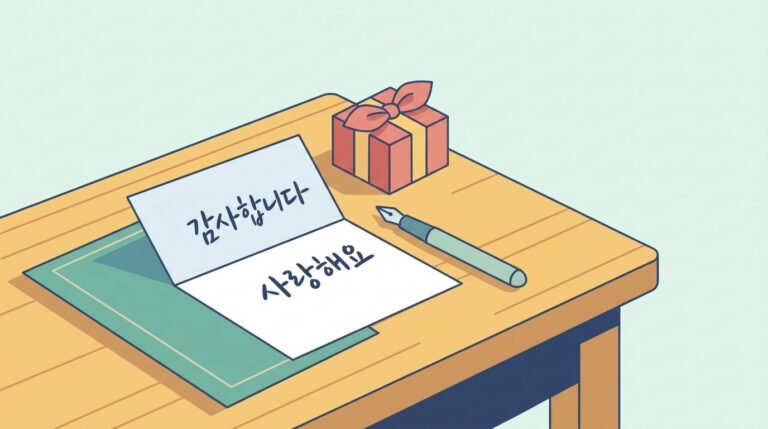
안녕하세요! 매일한글 에디터입니다.
Have you ever stood in front of a respected professor, boss, or tutor in Korea, clutching a small gift bag, only for your mind to go completely blank? You want to say so much more than just a dry “Gamsahamnida” (감사합니다), but your voice trembles and your cheeks flush red. In Korean dramas, we often see this exact moment: a student softly looking down, handing over a neatly folded envelope with two trembling hands while muttering, “Mallo da pyohyeonhagineun bukkeureowoseo…” (말로 다 표현하기엔 부끄러워서…).
Expressing profound gratitude in Korean culture can feel tricky. If you speak too casually, it lacks respect; if you speak too stiffly, your warmth gets lost in robotic honorifics. That is why the handwritten letter (sonpyeonji, 손편지) remains one of Korea’s most cherished cultural gestures. When you write your feelings down, modesty and sincerity harmonize beautifully. Based on real feedback from dozens of our intermediate learners, this guide unpacks the art of writing a moving note to an eunsanim (은사님 – a revered teacher or mentor) so you can deliver your heart without awkwardness.
Phase 2: Top 3 Core Expressions In-Depth Analysis
1. 말로 다 표현하기엔 부끄러워서 (Mallo da pyohyeonhagineun bukkeureowoseo)
- Pronunciation: [Mal-lo da pyo-hyeon-ha-gi-nen buk-keu-reo-wo-seo] (Think: “Mahl-low” like a low wall, followed by “pyo-hyeon”, and “bukkeureo” sounding softly punchy like “book-core-uh”)
- Meaning: “Feeling too shy to say it all out loud…” / “Because words alone make me bashful…”
- K-Culture Moment: Seen frequently in graduation ceremonies or variety shows like Master in the House when mentees present special gifts to their life mentors.
- Editor’s Insight: The suffix -기엔 (-gien) means “in order to do [verb], it is too…”. Pairing it with bukkeureopda (to feel shy/embarrassed) shows traditional Korean modesty (gyeomson, 겸손). You aren’t saying you lack gratitude; you are admitting that vocal words feel too small for how deeply you care.
- Situation Spectrum: Casual ⚠️ | Semi-formal ✅ | Formal ✅
- 🤔 Think About It: In many Western cultures, verbalizing high praise directly is seen as confident and sincere. Why do you think Korean emotional etiquette often values bashful understatement over loud proclamation?
2. 제 진심을 이 편지에 꾹꾹 눌러 담았습니다 (Je jinsimeul i pyeonjie kkuk-kkuk nulleo damatseumnida)
- Pronunciation: [Je jin-sim-eul i pyeon-ji-e kkook-kkook nul-leo da-mat-seum-ni-da] (Simulate the sound of pressing a rubber stamp firmly on thick paper: “Kkuk-kkuk”)
- Meaning: “I pressed my heartfelt sincerity deeply into this letter.”
- K-Culture Moment: Often read aloud during emotional year-end fan meetings by K-Pop idols reading letters written to their fans or longtime trainers.
- Editor’s Insight: Kkuk-kkuk (꾹꾹) is a mimetic word describing the physical act of pressing down hard with a pen so that every single stroke leaves an imprint. It transforms an abstract noun (jinsim, sincerity) into a physical substance you have packed into paper.
- Situation Spectrum: Casual ⚠️ | Semi-formal ✅ | Formal ✅
- 🤔 Think About It: How does personifying or physicalizing an emotion (like “pressing sincerity”) change the emotional weight of a thank-you note in your native language?
3. 약소하지만 작은 정성을 담아 보냅니다 (Yaksohajiman jageun jeongseong-eul dama bonaemnida)
- Pronunciation: [Yak-so-ha-ji-man ja-geun jeong-seong-eul da-ma bo-naem-ni-da] (Analogy: “Yak-so” rhymes with “talk slow”)
- Meaning: “It is modest/small, but I send it filled with my little devotion.”
- K-Culture Moment: The staple phrase used when gifting premium tea, handmade pastries, or hand cream to mentors during Chuseok or Teacher’s Day (Seuseung-ui Nal).
- Editor’s Insight: Yaksohada (약소하다) means modest or humble. Koreans deliberately downplay the monetary value of a gift to highlight the jeongseong (정성 – care, effort, devotion) behind it.
- Situation Spectrum: Casual 🚫 | Semi-formal ✅ | Formal ✅
- 🤔 Think About It: Why does over-praising your own gift (“Look at this expensive present I got you!”) sound rude in Korea, while self-deprecating its size feels polite?
Phase 3: Textbook Korean vs. Real Korean
Situation 1: Presenting a gift to a mentor
- 📖 교과서 한국어 (Textbook):
- 제 선물을 받으십시오. (Je seonmureul badeusipsio.) — “Please receive my present.”
- 🗣️ 진짜 한국어 (Real Native):
- 교수님 생각나서 작은 정성으로 준비해 봤어요. (Gyosunim saenggangnaseo jageun jeongseong-euro junbihae bwasseoyo.) — “I thought of you, Professor, so I prepared a small token of gratitude.”
- 💡 왜 다를까? (Why the difference?): Imperative commands like badeusipsio sound demanding or transactional. Real natives soften the gift delivery by framing it around saenggak (thinking of the person).
Situation 2: Expressing life-changing appreciation
- 📖 교과서 한국어 (Textbook):
- 대단히 감사합니다. (Daedanhi gamsahamnida.) — “Thank you very much.”
- 🗣️ 진짜 한국어 (Real Native):
- 선생님 덕분에 제가 한 뼘 더 자란 것 같아요. (Seonsaengnim deokbune jega han ppyeom deo jaran geot gat-ayo.) — “Thanks to you, Teacher, I feel like I’ve grown a handspan taller.”
- 💡 왜 다를까? (Why the difference?): Standard dictionary adverbs feel flat. Metaphors like han ppyeom (한 뼘 – the span of an open hand) add human warmth and vivid imagery to your growth.
Phase 4: K-Culture Deep Dive & Non-Verbal Manners
4-1. Nunchi & Two-Hand Etiquette
When handing over a card or gift to a mentor in Korea, your posture speaks louder than your words:
* The Two-Hand Rule: Always hold the envelope or gift box using both hands (du son, 두 손). If one hand must be free or supporting, place your non-dominant hand lightly under your other wrist or elbow.
* Eye Line & Head Tilt: Do not maintain continuous, unblinking eye contact while presenting the item—it can project defiance. Instead, bow your head slightly (around 15 to 30 degrees), glance down at the gift, and softly bring your gaze back up.
* Opening Courtesy: Do not expect or pressure your mentor to unwrap the gift in front of you. In Korea, opening a gift immediately can feel materialistic unless the recipient specifically asks: “Jigeum tteodabwado dwaeyo?” (지금 뜯어봐도 돼요? – Can I open it now?).
4-2. Cultural Code: The Meaning of Teacher’s Day & Handwritten Letters
May 15th is Seuseung-ui Nal (스승의 날 – Teachers’ Day) in Korea. In recent years, due to strict anti-corruption regulations known as the Kim Young-ran Act (김영란법), students in formal education institutions are legally barred from giving expensive gifts to teachers and professors.
Consequently, the handwritten letter has regained supreme cultural status. While high-end luxury items can trigger ethical dilemmas, a thoughtful letter written on quality paper carries unmatched sentimental value. It proves you dedicated time and emotional energy rather than just swiping a credit card.
Phase 5: Real-World Roleplay Scenario
Setting: Professor Min’s university office during end-of-semester office hours. Sunlight streams over book-stacked shelves. You are holding a small envelope and a box of traditional pear-ginger tea.
- Professor Min: 어서 와요! 이번 학기 과제하느라 정말 고생 많았죠? (Eoseo wayo! Ibeon hakgi gwajehaneura jeongmal gosaeng manatjyo?)
🎭 Smiling warmly while pulling up a chair for you.
(Welcome! You worked so hard on the assignments this semester, didn’t you?) - Learner: 아닙니다, 교수님. 교수님 수업 덕분에 정말 많이 배웠습니다. (Animnida, gyosunim. Gyosunim sueop deokbune jeongmal mani baewotseumnida.)
🎭 Sitting down respectfully with both hands neatly resting on knees.
(Not at all, Professor. Thanks to your class, I learned so much.) - Professor Min: 그렇게 말해주니 뿌듯하네요. 한국어 글쓰기 실력이 처음보다 눈에 띄게 늘었어요. (Geureoke malhaejuni ppudeuthaneyo. Hangugeo geulsseugi sillyeogi cheoeumboda nune ttwige neoreosseoyo.)
🎭 Nodding with an appreciative, encouraging look.
(Hearing you say that makes me proud. Your Korean writing skills have noticeably improved.) - Learner: 사실 말로 다 표현하기엔 부끄러워서 작은 정성과 함께 제 진심을 이 편지에 꾹꾹 눌러 담았습니다. (Sasil mallo da pyohyeonhagineun bukkeureowoseo jageun jeongseonggwa hamkke je jinsimeul i pyeonjie kkuk-kkuk nulleo damatseumnida.)
🎭 Standing up slightly and offering the envelope and gift bag with both hands.
(Honestly, feeling too shy to say it all out loud, I pressed my sincere gratitude into this letter along with a small token.) - Professor Min: 아이고, 이런 거 안 챙겨와도 되는데… 그래도 학생 마음이 너무 예쁘네요. 고마워요. (Aigo, ireon geo an chaenggyeowado doeneunde… geuraedo haksaeng maeumi neomu yeppeuneyo. Gomawoyo.)
🎭 Receiving the items with both hands, gently stroking the envelope.
(Oh my, you didn’t have to prepare anything like this… but your heart is so lovely. Thank you.) - Learner: 약소하지만 차 한잔 드시면서 피로 푸셨으면 좋겠습니다. (Yaksohajiman cha hanjan deusimyeonseo piro pusyeosseumyeon joketseumnida.)
🎭 Bowing head slightly with an affectionate smile.
(It’s very modest, but I hope you can enjoy a warm cup of tea and relieve your fatigue.) - Professor Min: 오늘 밤에 따뜻하게 마시면서 편지 꼭 읽어볼게요. (Oneul bame ttatteuthage masimyeonseo pyeonji kkok ilgeobolgeyo.)
🎭 Placing the letter carefully on the center of her desk.
(I will definitely read your letter tonight while drinking a warm cup.) - Learner: 항상 건강 챙기세요, 교수님. 정말 감사드립니다! (Hangsang geon-gang chaenggiseyo, gyosunim. Jeongmal gamsadeurimnida!)
🎭 Giving a clean 30-degree bow before stepping back.
(Please take care of your health always, Professor. Thank you so very much!)
🔀 Interactive Decision Point
How would you conclude your closing remark when placing the letter on their desk?
- Option A: “선생님, 편지에 제 인스타 아이디 적었으니 맞팔해요!” (Seonsaengnim, pyeonjie je inseuta aidi jeogeosseuni matpalhaeyo! / Teacher, I wrote my Instagram handle in the letter, let’s follow each other!)
- Option B: “부족한 제자이지만 앞으로도 자랑스러운 학생이 되겠습니다. 편지 읽어주세요.” (Bujokan jejaijiman apeurodo jarangseureoun haksaengi doegetseumnida. Pyeonji ilgeojuseyo. / Though I am a student with shortcomings, I will become a proud pupil in the future. Please read my letter.)
- Option C: “선생님 사랑해요! 다음에 술 한잔 사주세요!” (Seonsaengnim saranghaeyo! Daeume sul hanjan sajuseyo! / Love you teacher! Buy me drinks next time!)
Feedback:
- Option A (Risk): Preserving personal boundary distance is crucial with seniors. Asking for an Instagram follow right after a formal letter breaks situational decorum.
- Option B (Best!): Classic, elegant Korean humbleness (bujokan jeja – imperfect disciple). It touches mentors deeply.
- Option C (Bad): Far too informal and presumptuous unless you have known each other for a decade and are drinking together.
Phase 6: 10-Second Emotional Shadowing Drill
Read these aloud while pausing at each slash (/) and channeling the emotional cue:
[🥺 조심스럽고 쑥스럽게 - Hesitant & Shy]
말로 다 표현하기엔 / 부끄러워서… / (Mallo da pyohyeonhagineun / bukkeureowoseo…)-
[🌿 진심을 담아 또박또박 - Earnest & Steady]
제 진심을 / 이 편지에 / 꾹꾹 눌러 담았습니다. / (Je jinsimeul / i pyeonjie / kkuk-kkuk nulleo damatseumnida.) -
[🙏 겸손하고 공손하게 - Humble & Respectful]
약소하지만 / 제 작은 정성이에요. / (Yaksohajiman / je jageun jeongseong-ieyo.) -
[☀️ 밝고 따뜻한 축복 - Bright & Warm Wish]
늘 건강하시고 / 행복한 날만 가득하세요. / (Neul geon-ganghasigo / haengbokan nalman gadeukhaseyo.)
Phase 7: K-Culture Mini Dictionary
- 은사님 (Eunsanim) — A revered teacher/mentor who shaped your life.
Usage: Unlike standard seonsaengnim (teacher), eunsanim denotes deep moral respect for a teacher who guided your life’s path. - 정성 (Jeongseong) — Heartfelt devotion, true care, dedication.
Usage: Used when giving gifts or preparing meals: “Jeongseongi damgin seonmul” (a gift filled with genuine heart). - 꾹꾹 (Kkuk-kkuk) — Pressing down firmly and repeatedly.
Usage: Often used for handwritten letters (pyeonjireul kkuk-kkuk nulleo sseuda) or packing cooked rice firmly into a bowl. - 쑥스럽다 (Ssuksureopda) — Feeling bashful, shy, or slightly sheepish.
Usage: The exact emotion when you receive a grand compliment or share deep personal feelings in public.
Phase 8: Traveler & Learner Survival Kit
Top 3 Survival Expressions
- 편지지 어디에 있나요? (Pyeonjiji eodie innayo?) — Where can I find stationery paper?
Pro Tip: Use this at bookstore boutiques like Hottracks or Artbox. - 포장 예쁘게 해주실 수 있나요? (Pojang yeppeuge haejusil su innayo?) — Could you wrap this up nicely for me?
Pro Tip: Department stores and select gift shops offer specialized wrapping (bojagis or gift boxes) for nominal fees. - 선생님 덕분에 큰 힘이 되었습니다. (Seonsaengnim deokbune keun himi doeeotseumnida.) — Thanks to you, Teacher, I found great strength.
Pro Tip: The ultimate closing phrase for any mentor card.
Editor’s Travel Note
Looking for the perfect card? Skip basic convenience store envelopes! Check out 교보문고 핫트랙스 매장 찾기 to explore traditional Korean hanji (mulberry paper) stationery and aesthetic calligraphy cards in Gwanghwamun or Gangnam. Pair your note with a box of traditional walnut cakes (hodugwaja) or red ginseng candy for a safe, culturally appreciated gift.
Phase 9: A Step Deeper (한 발 더 깊이)
In Western communication, clarity and direct verbal articulation are often celebrated as marks of maturity and honesty. However, traditional Korean communicative culture (jeong, 정) harbors a quiet affection for what remains unspoken. When an intermediate learner says, “Mallo da pyohyeonhagineun bukkeureowoseo”, they are invoking an age-old social aesthetic: the belief that the deepest human sentiments overflow beyond spoken words, and that modesty honors the mentor far more than theatrical eloquence. By transferring your emotional weight into ink on paper, you align with a rich legacy of Korean literary intimacy.
💬 Your Turn: Have you ever hesitated to speak your feelings in another language? How would you express this quiet modesty in your own mother tongue? Drop your thoughts below!
Phase 10: FAQ & Common Mistakes
Q: What should I write at the very start and end of the letter?
A: Address them at the top with [Name/Title] + 께 (e.g., 존경하는 김 교수님께 – To the respected Professor Kim). At the bottom, write the date followed by [Your Name] + 올림 (formal: offered by) or [Your Name] + 드림 (semi-formal: given by).
Q: Is it okay to use emojis (like ^^ or ㅎㅎ) in a letter to a professor?
A: Keep text-based internet slang (ㅎㅎ, ㅋㅋ, ㅠㅠ) completely out of letters to seniors. However, a polite smiley mark like ^^ can be used sparingly at the end of a warm sentence if your relationship with your mentor is affectionate.
Q: Can I use red ink when writing a thank-you letter?
A: Never use red ink. In Korean superstition, writing a living person’s name or letter in red ink symbolizes death or bad omen. Stick to traditional black or dark blue ink.
🚨 흔한 실수 (Common Mistakes) Warning Board
- Mistake: Addressing the mentor with Dangsin (당신).
Correct Action: Never use dangsin for superiors. Always repeat their title: Seonsaengnim (선생님) or Gyosunim (교수님). - Mistake: Signing off with “[Name]ga” ([Name]가).
Correct Action: -[i]ga is only used when writing down to children or friends. Always use Ollim (올림) or Deurim (드림). - Mistake: Writing “Chukahamnida” (Congratulations) instead of “Gamsahamnida” (Thank you) on Teachers’ Day.
Correct Action: Teachers’ Day is an occasion for gratitude, not a personal birthday. Say “Gamsahamnida”.
Phase 11: Action Missions & K-Culture Hunt
- 🥉 Bronze Mission (Solo Practice): Copy expression #2 (“제 진심을 이 편지에 꾹꾹 눌러 담았습니다”) three times in your notebook with your neatest Korean handwriting.
- 🥈 Silver Mission (Social Audio): Record your voice saying Phase 6’s Shadowing sentences with the indicated emotional tones on your phone memo app.
- 🥇 Gold Mission (Real Action): Write a 3-sentence thank-you note in Korean to your current tutor, favorite creator, or language partner using at least two expressions from this guide.
- 🎮 K-Culture Mission: Watch an episode of a school or university K-drama (like Weightlifting Fairy Kim Bok-joo or Crash Course in Romance). Listen carefully for how students verbally greet and take leave of their mentors!
Phase 12: Interactive Quiz Challenge
Test your knowledge before you seal that envelope!
- Situational Check: Which closing honorific is the most respectful when writing to your university advisor?
- (A) 민지 씀 (Minji sseum)
- (B) 민지 올림 (Minji ollim)
- (C) 민지가 (Minjiga)
- Fill-in-the-Blank: Complete the iconic phrase:
- 말로 다 표현하기엔 ________ 작은 선물을 준비했습니다. (Feeling too shy to express it in words…)
- (A) 시끄러워서 (sikkeureowoseo)
- (B) 부끄러워서 (bukkeureowoseo)
- (C) 게을러서 (geeulleoseo)
- True or False: In Korea, you should hand a present to your teacher using only your right hand while keeping your left hand in your pocket.
- (True / False)
🔍 Click to reveal answers & explanations!
-
Answer: (B) 민지 올림 (Minji ollim)
Explanation: Ollim literally means “lifted up to you,” which is the most polite signature for mentors. Sseum is neutral/casual, and -ga is strictly for equal/lower status. -
Answer: (B) 부끄러워서 (bukkeureowoseo)
Explanation: Bukkeureowoseo means “because I am shy/bashful.” Sikkeureowoseo means noisy, and geeulleoseo means lazy! -
Answer: False
Explanation: You must always present gifts with both hands (du son) as a sign of respect and undivided attention.







