

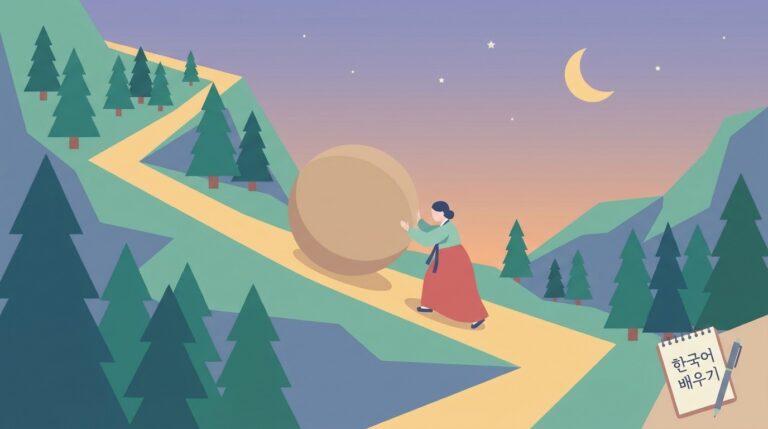
Defying the Absurd with Lucid Dignity: Camus, Sisyphus, and the Advanced Korean Art of Unyielding Perseverance
Phase 1: Empathy (Story-driven Opening)
안녕하세요! 매일한글 에디터입니다.
Imagine standing at Sindorim Station during Monday morning rush hour. The relentless human tide presses forward, Subway Line 2 loops infinitely across Seoul, and you are gripped by a profoundly Camusian realization: Is this our modern boulder? If you have ever felt trapped between existential dread and the grinding demands of modern life, you are not alone. Many of our advanced learners at the C2 level confess that while they can debate politics or literature fluently, expressing the nuanced philosophical defiance of Albert Camus—refusing nihilistic surrender while lucidly embracing life’s inherent absurdity—feels elusive in Korean.
In Korean culture, the myth of Sisyphus is not merely a European thought experiment; it resonates deeply with a society that historically turned grief and oppression into creative endurance. In this guide, grounded in direct feedback from learners who wanted to bridge high-level European existentialism with native Korean discourse, you will master the elite vocabulary and sociolinguistic codes needed to discuss human dignity, perseverance, and rebellion against the absurd universe with total native eloquence.
Phase 2: Core Expressions (In-Depth Analysis)
1. 부조리에 맞서다 (Bujorie matseoda)
- Pronunciation: [Bujorie matseoda] (Think of ‘boo-jo-ree’ gliding smoothly, followed by a crisp, grounded ‘mat-seo-da’ like snapping a branch with intent.)
- Meaning: Literally “to stand face-to-face against absurdity,” conceptually signifying active existential revolt and refusal to submit to cosmic meaninglessness.
- K-Culture Moment: Evoked in high-end intellectual K-dramas like My Liberation Notes (나의 해방일지) when characters reject societal suffocations to claim their authentic sovereignty.
- Editor’s Insight: ‘부조리’ (不條理) carries dense Hanja weight denoting logical impossibility and unjust contradiction. Pairing it with ‘맞서다’ conveys proactive defiance rather than passive complaint.
- Situation Spectrum: Casual 🚫 | Semi-formal ⚠️ | Formal ✅ (Best reserved for intellectual discussions, academic critiques, and deep soul-searching essays).
- 🤔 Think About It: In English, “rebel against absurdity” can sound purely academic, but in Korean, does confronting structural absurdity mirror the historical Korean ethos of righteous civilian protest (의병/민주화)?
2. 묵묵히 제 갈 길을 가다 (Mungmukhi je gal gireul gada)
- Pronunciation: [Mungmukhi je gal gireul gada] (The ‘mung’ resonates deep in the chest, mimicking quiet, stoic weight, while ‘gada’ flows like continuous footsteps.)
- Meaning: Literally “to silently walk one’s own path,” carrying the nuance of enduring Sisyphus-like toil without performative vanity or defeatism.
- K-Culture Moment: Often said by veteran creators, independent cinema directors, or long-standing artisans featured in Korean cultural documentaries when asked why they persist despite commercial failure.
- Editor’s Insight: ‘묵묵히’ is the soul of this phrase. It does not mean cowardly silence; it expresses self-possessed resilience that requires no outside validation.
- Situation Spectrum: Casual ✅ | Semi-formal ✅ | Formal ✅ (Highly versatile and admired across all strata of Korean society).
- 🤔 Think About It: How does the western emphasis on vocal resistance differ from the East Asian virtue of dignified, quiet perseverance through relentless action?
3. 굴복하지 않는 의지 (Gulbokhaji anneun uiji)
- Pronunciation: [Gulbokhaji anneun uiji] (Articulate the sharp ‘gul-bok’ with tension, releasing softly into ‘uiji’.)
- Meaning: “An unyielding, unbowed will”—the conscious refusal to capitulate to nihilism or despair.
- K-Culture Moment: Frequently quoted in profound retrospectives on indie athletic victories or poetic moments in historical period dramas when tragic protagonists assert their moral agency.
- Editor’s Insight: Unlike simple stubbornness (고집), ‘의지’ represents a conscious, ethical resolve anchored in philosophical clarity.
- Situation Spectrum: Casual ⚠️ | Semi-formal ✅ | Formal ✅
- 🤔 Think About It: Can dignity exist without an opposing obstacle? How does your native language distinguish pure obstinacy from existential dignity?
Phase 3: Textbook Korean vs. Real Korean
Situation 1: Expressing the determination to push forward despite meaningless daily repetition
- 📖 교과서 한국어: 저는 삶이 무의미하고 힘들어도 인내심을 갖고 꾸준히 살아가겠습니다. (Jeoneun salmi muuimihago himdeureodo innaesimeul gatgo kkujunhi saragagessseumnida. – I will endure with patience and live diligently even if life is meaningless and hard.)
- 🗣️ 진짜 한국어: 세상이 무의미의 연속이라 해도, 묵묵히 제 몫의 바위를 밀어 올리는 게 진짜 존엄 아닐까요? (Sesangi muuimiui yeonsogira haedo, mungmukhi je moksui bwireul mireo ollineun ge jinjja joneom anilkkayo? – Even if the world is a series of meaningless repetitions, isn’t pushing up one’s own share of the boulder the true definition of dignity?)
- 💡 왜 다를까?: The textbook version sounds like a bland compliance essay. Native intellectuals at the C2 level use metaphorical shorthand (제 몫의 바위 – one’s assigned boulder) to evoke Camusian stoicism gracefully.
Situation 2: Describing someone dealing with structural absurdity and burnout
- 📖 교과서 한국어: 그는 불합리한 시스템을 비판하면서도 직장을 계속 다닙니다. (Geuneun bulhamnihan siseutemeul bipanhamyeonseodo jikjangeul gyesok danimnida. – He criticizes the unreasonable system yet continues to go to work.)
- 🗣️ 진짜 한국어: 냉소에 빠져 체념하기보단, 매일 제자리를 지키며 조용한 실존적 반항을 이어가는 셈이죠. (Naengsoe ppajyeo chenyeomhagi-bodan, maeil jejari-reul jikimyeo joyonghan siljonjeok banhangeul ieoganeun semijyo. – Rather than sinking into cynicism and despair, he is carrying out a quiet existential rebellion by standing his ground each day.)
- 💡 왜 다를까?: Native Korean intellectual discourse rejects binary complaining. Blending ‘조용한 실존적 반항’ (quiet existential rebellion) elevated everyday persistence into a badge of honor.
Phase 4: K-Culture Deep Dive & Non-Verbal Manners
4-1. 눈치 (Nunchi) & Stoic Poise: The Body Language of Lucid Defiance
In Western debate, intellectual rebellion often manifests as passionate oration, wide gestures, and assertive vocal inflection. In Korean high-context communication, philosophical defiance is communicated through dandanh-ham (단단함 – internal density) and collected quietude.
* The Steady Gaze (묵묵한 시선): When acknowledging an insurmountable paradox, Koreans maintain a level, calm gaze rather than rolling the eyes or throwing hands up in exasperation. Exasperation indicates that absurdity surprised you; calm contemplation shows you already anticipated it.
* Posture: An upright spine with hands folded loosely in front or gently holding a warm tea cup. Dignity is non-performative. Avoid dramatic sighs (한숨), which in Korean culture signal defeat and the depletion of one’s vital energy (복이 달아난다).
4-2. Cultural Code: ‘존버 (Jonbeo)’ vs. Sisyphus’s Rock
While pop culture created the slang term 존버 (stubbornly holding out against all odds), at its philosophical core, it is modern Korea’s vernacular translation of Sisyphus. From the overworked salarymen depicted in the iconic webtoon/drama Misaeng (미생) to young people cultivating 갓생 (God-saeng)—living a meticulously disciplined day amidst economic stagnation—Koreans answer systemic absurdity not by giving up (탈조선), but by mastering their immediate sphere with radical diligence.
Phase 5: Real-World Roleplay Scenario
Setting: A dimly lit, jazz-infused LP vinyl bar in Euljiro, Seoul. Rain trickles against the foggy glass. You are conversing with Min-woo, a burned-out indie documentarian debating whether to abandon his unappreciated film project.
- 민우: 결국 제가 찍는 다큐멘터리가 세상을 바꿀 수 있을지 회의감이 들어요. 계란으로 바위 치기 같아요. (Gyeolguk jega jjikneun dakyumenteoriga sesangeul bakkul su isseulji hoeuigami deureoyo. Gyeraneuro bawi chigi gatayo.)
🎭 민우는 위스키 잔을 매만지며 힘없이 한숨을 내쉰다. (Min-woo gently rubs his whiskey glass and sighs listlessly.)
“In the end, I’m skeptical whether this documentary can change the world. It feels like throwing an egg against a boulder.” - 당신: 계란이 깨지더라도 바위에 흔적은 남기 마련이에요. (Gyerani kkaejideorado bawie heunjeogeun namgi maryeonieyo.)
🎭 단호하지만 따뜻한 눈빛으로 민우를 응시하며. (Gazing at Min-woo with a firm yet warm look.)
“Even if the egg breaks, it is bound to leave a mark on the rock.” - 민우: 바위에 흔적이 남는다고 해서, 바위가 꿈쩍이나 할까요? 카뮈의 시시포스처럼 끝없이 굴러떨어질 뿐인데요. (Bawie heunjeogi namneundago haeseo, bawiga kkumjjeogina halkkayo? Kamyu-ui sisiposeucheoreom kkeuteopsi gulleotteoreojil ppuninde-yo.)
🎭 씁쓸한 미소를 지으며 얼음을 달그락거린다. (Smiling bitterly while clinking the ice in his glass.)
“Even if it leaves a mark, will the rock budge an inch? It’s just endlessly tumbling back down like Sisyphus.” - 당신: 카뮈도 시시포스가 불행하다고 단언하지 않았잖아요. 바위를 밀어 올리는 그 과정 자체가 인간의 존엄이니까요. (Kamyudo sisiposeuga bulhaenghadago daneonhaji anatjanh-ayo. Bwireul mireo ollineun geu gwajeong jachega inganui joneominikkayo.)
🎭 목소리를 낮추어 확신에 찬 어조로. (Lowering the voice with a tone of clear conviction.)
“Camus himself never concluded that Sisyphus was unhappy. The very process of pushing that stone upward constitutes human dignity.” - 민우: 부조리를 알면서도 계속 밀어 올린다… 그게 무의미에 굴복하지 않는 유일한 길이라는 뜻인가요? (Bujorireul almyeonseodo gyesok mireo ollinda… Geuge muuimie gulbokhaji anneun yuilhan giriraneun tteusingayo?)
🎭 자세를 바로잡으며 깊은 생각에 잠긴다. (Straightening his posture, falling into deep contemplation.)
“Pushing it upward while knowing the absurdity… Does that mean it is the only way not to submit to meaninglessness?” - 당신: 바로 그거예요. 세상의 헛됨을 직시하되, 패배주의에 빠지지 않고 묵묵히 걷는 반항인 셈이죠. (Baro geugeoyeyo. Sesangui heotdoe-meul jiksihadae, paebaejuuie ppajiji anko mungmukhi geotneun banhang-in semijyo.)
🎭 잔을 살짝 들어 건배를 청한다. (Slightly raising the glass to propose a toast.)
“Precisely. Looking futility right in the eye, yet remaining a defiant rebel who walks forward without falling into defeatism.” - 민우: 하긴, 결과가 허무로 끝난다 해도 이 과정을 포기하면 제 실존 자체가 부정당하는 거니까요. (Hagin, gyeolgwaga heomuro kkeutnanda haedo i gwajeongeul pogihamyeon je siljon jachega bujeongdanghaneun geonikkayo.)
🎭 눈가에 다시 총기가 돌며 옅은 미소를 짓는다. (A spark returns to his eyes as a faint smile appears.)
“Indeed. Even if the result ends in vanity, abandoning this process would mean denying my very existence.” - 당신: 맞아요. 결과가 아닌 이 순간의 치열함이 민우 씨의 승리예요. (Majayo. Gyeolgwaga anin i sunganui chiyeolhami Min-woo ssi-ui seungrieyo.)
🎭 미소로 화답하며 잔을 맞부딪친다. (Smiling back and clinking glasses together.)
“Exactly. It is the fierce intensity of this very moment, not the outcome, that is your victory.”
🔀 Interactive Branching Moment
If Min-woo asks: “그래도 가끔 모든 게 덧없게 느껴질 땐 어떻게 중심을 잡으세요?” (Still, when everything feels fleeting, how do you ground yourself?)
- Option A: “그냥 아무 생각 없이 맛있는 거 먹고 넷플릭스 보면 다 잊혀져요.”
Feedback: [Bad] Reduces profound existential vertigo to basic distraction. Inappropriate for a C2 intellectual discussion. - Option B: “어차피 부조리한 세상인데, 지나친 의미 부여를 내려놓고 오늘 내게 주어진 호흡과 발걸음에만 집중해요.”
Feedback: [Best] Perfect philosophical balance! Acknowledges the absurdity while re-anchoring agency in immediate phenomenology and mindful presence. - Option C: “인간은 원래 혼자 태어나서 고통받다 죽는 존재니까 그냥 참아야죠.”
Feedback: [Risk] Excessive fatalism and cynicism. Risks leaving your conversational partner distressed rather than empowered.
Phase 6: 10-Second Emotional Shadowing Drill
[🔥 비장하고 단호하게 / Resolute & Lucid]
세상이 부조리할지라도 / 타협하거나 도피하지 않고 / 묵묵히 저만의 바위를 밀어 올리겠습니다.
(Sesangi bujorihaljirado / tahyeophageona dopihaji anko / mungmukhi jeomanui bwireul mireo olligessseumnida.)
Even if the world is absurd / without compromising or escaping / I will silently push up my own boulder.-
[🌿 담담하지만 흔들림 없이 / Serene & Unshakable]
체념하는 대신 / 삶의 무게를 온전히 짊어지는 태도야말로 / 진정한 실존적 자유입니다.
(Chenyeomhaneun daesin / salmui muge-reul onjeonhi jil-eojineun taedoyamallo / jinjeonghan siljonjeok jayu-imnida.)
Instead of resigning in despair / the attitude of fully shouldering the weight of life / is true existential freedom.
Phase 7: K-Culture Mini Dictionary
- 부조리 (Bujori)
Translation: Absurdity / Irrationality
Usage: Historically used to describe military/workplace structural abuses, but in philosophy, refers specifically to the cosmic discord between the human hunger for meaning and the cold, silent universe. - 존버 (Jonbeo)
Translation: Tenacious endurance / Holding out through grim reality
Usage: Originally raw internet slang, it has culturally matured into a collective badge of honoring those who stubbornly endure grueling startup shifts, market crashes, or endless exams. - 달관 (Dalgwan)
Translation: Enlightened detachment / Taking the long, transcendent view
Usage: Moving beyond anger or cynicism; viewing world absurdities with peaceful clarity and humorous acceptance. - 실존 (Siljon)
Translation: Existence (in the existentialist sense: Dasein / L’existence)
Usage: Essential in literary essays, art critiques, and high-level conversation to signify human agency preceding essence.
Phase 8: Survival Kit for Travelers
Top 3 Intellectual & Deep-Conversation Expressions
- “의미를 찾기보다 과정 자체를 긍정하고 싶어요.” (Uimireul chatgiboda gwajeong jache-reul geungjeonghago sipeoyo.)
Pro Tip: Perfect for responding when a Korean mentor asks about your demanding life plans or creative projects. - “세상이 뜻대로 안 풀려도 중심을 잃지 않으려 해요.” (Sesangi tteutdaero an pullyeodo jungsimeul ilchi aneuryeo haeyo.)
Pro Tip: Demonstrates inner resilience and emotional maturity without toxic positivity. - “결과보다는 이 치열한 태도에 가치를 둡니다.” (Gyeolgwabodaneun i chiyeolhan taedoe gachireul dumnida.)
Pro Tip: Highly respected by Korean professionals and artists when speaking in interviews or panel talks.
Editor’s Travel Note: Contemplative Spaces in Seoul
If you want to experience the quiet contemplation of Seoul’s modern thinkers, take a solo walk along the rocky ridgelines of Inwangsan Mountain (인왕산) at dusk or visit the independent philosophy and poetry bookshops tucked away in Mangwon-dong and Seochon. Navigating these narrow alleys is best done via the localized Naver Map app download to find hidden cultural salon-bars where deep conversations unfold over makgeolli.
Phase 9: “한 발 더 깊이” (Philosophical Reflection)
Koreans carry a historical cultural concept known as 한 (Han)—a deep-seated collective sorrow born of historical suffering. Yet, the miracle of modern Korea lies in 흥 (Heung) and resilience: turning Han inside out not through cosmic denial, but by actively creating, singing, and building in the face of despair. Camus’ rebel who loves the earth and refuses nihilism finds an instinctive brother in Korean stoicism.
💬 Your Turn: Have you ever felt that pursuing your Korean studies against difficult grammar plateaus felt like Sisyphus pushing his boulder? How do you define your own “rebel dignity” in your life journey? Share your thoughts below in Korean!
Phase 10: FAQ & Common Mistakes
Q: Can I use ‘부조리’ to talk about a corrupt boss or unfair company policy?
A: Yes! In fact, everyday Koreans frequently use ‘직장 내 부조리’ (workplace irrationality/injustice). However, in existential contexts, clarify it by saying ‘실존적 부조리’ (existential absurdity) to ensure your interlocutor knows you are referring to the human condition rather than simply reporting an HR violation.
Q: Is ‘존버’ acceptable to say to an elder or boss?
A: No! While it has become widely accepted in media, its root contains vulgar profanity (비속어). To a senior colleague or in an academic presentation, replace it with 묵묵한 인내 (stoic endurance) or 치열한 버팀 (fierce persistence).
Q: How does Camus’ concept of ‘반항 (revolt)’ differ from political rebellion in Korean?
A: Political rebellion is usually termed ‘반란’ or ‘저항’. Camus’ concept is translated philosophically as ‘반항하는 인간’ (L’Homme révolté). When discussing Camus, use 반항 (ban-hang) combined with 존엄 (dignity) to clearly establish the existential context.
🚨 Common Mistakes Warning Board
- Mistake: Saying “인생은 무의미해서 슬퍼요” (Life is meaningless so I’m sad) during philosophical debates.
Correct Action: Elevate to “무의미성 앞에서도 삶의 존엄을 지켜내고자 합니다” (In the face of meaninglessness, I seek to preserve the dignity of life). - Mistake: Confusing ‘포기’ (quitting out of laziness) with ‘체념’ (existential resignation).
Correct Action: When contrasting active defiance with passive surrender, use 체념에 맞서다 (defy resignation). - Mistake: Pronouncing 묵묵히 as [muk-muk-hi].
Correct Action: Pronounce it as [멍무키 / mung-mu-khi] due to nasal assimilation and aspiration rules.
Phase 11: Action Mission & Engagement
- Bronze Level: Record yourself speaking the Phase 6 Shadowing sentences with solemn, clear vocal weight.
- Silver Level: Post an Instagram story of your daily study corner or coffee mug with the caption: “오늘도 묵묵히 제 몫의 바위를 밀어 올립니다. 🪨✨”
- Gold Level: Watch an episode of a grounded K-drama (Misaeng or My Liberation Notes) and write a short 3-sentence critique in Korean analyzing a character’s actions through the lens of Camus’ existential revolt.
🎮 K-Culture Mission: Identify one Korean indie song lyric (such as works by Lee Juck, Kim Kwang-seok, or indie band Silica Gel) that expresses defiance against cosmic emptiness without giving in to despair.
Phase 12: Interactive Quiz Challenge
Test your mastery of high-level existential Korean expressions below!
- Situational Judgment: You are writing an essay on why humans should not fall into despair despite cosmic meaninglessness. Which phrase best embodies Camus’ “rebel” dignity?
- A) 현실을 회피하며 향락에 빠진다.
- B) 부조리에 굴복하지 않고 묵묵히 제 갈 길을 간다.
- C) 모든 것을 운명이라 여기며 무기력하게 순응한다.
- Fill in the Blank: “시시포스의 신화는 허무주의에 빠지는 대신 삶의 ( )을/를 정면으로 응시하며 반항하는 인간의 아름다움을 노래한다.”
- Word Bank: 부조리, 사치, 위선
- True or False: The slang word ‘존버’ can be respectfully used in a university doctoral defense to describe Heideggerian persistence.
Click to reveal answers & explanations!
- Answer: B
Explanation: Option A is escapism (도피), and Option C is fatalistic surrender (체념). Option B encapsulates authentic Camusian perseverance. - Answer: 부조리
Explanation: The sentence reads: “The Myth of Sisyphus sings of the beauty of a rebelling human who stares directly at the absurdity of life instead of falling into nihilism.” - Answer: False
Explanation: While culturally pervasive, ‘존버’ carries vulgar vulgarity roots. In formal academic settings, use terms like ‘묵묵한 실존적 지속’ (silent existential endurance) or ‘치열한 인내’.







