

Phase 1: Empathy & Story Intro
안녕하세요! 매일한글 에디터입니다. (Hello! I’m your Daily Hangul editor.)
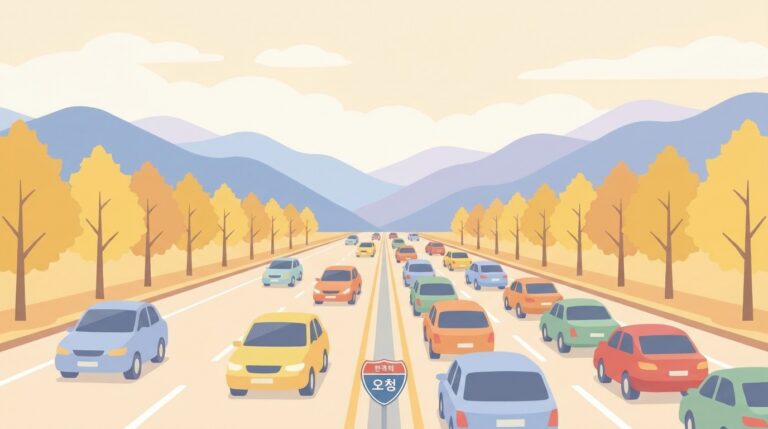
Imagine this scene: It’s the afternoon before Chuseok (Korean Thanksgiving) or Seollal (Lunar New Year) in Seoul. You step into Seoul Station or the Express Bus Terminal, and you are greeted by an ocean of people carrying gift boxes of Korean beef, spam gift sets, and fresh autumn fruits. You glance at the GPS map on your phone, and the main highway stretches between Seoul and Busan are glowing deep, fiery red. Welcome to Gwiseong-gil (귀성길)—the legendary Korean holiday homecoming migration!
If you have watched K-dramas or reality shows, you’ve probably seen families crammed into cars eating peeled mandarins and dried squid while moving at 5 kilometers per hour. For foreigners living in Korea or chatting with Korean friends, this season can feel mysterious and intimidating. How do you ask a coworker about their trip without sounding awkward? What do you say when someone sighs about a 9-hour drive that normally takes three hours?
Don’t worry! Based on real questions from hundreds of A1 beginner learners, this guide will give you the exact friendly phrases to sound polite, caring, and culturally tuned-in during Korea’s biggest holidays.
Phase 2: Core Expressions Deep Dive
Here are the three must-know expressions to navigate holiday travel conversations like a true Seoul insider.
1. 길이 많이 막혀요 (Gil-i mani makyeoyo)
- Pronunciation: [Gil-i mani mak-hyeo-yo] (Sound analogy: Think of a fish’s “gill” + “ee”, then the English word “money”, followed by “mah-k’yeo-yo”!)
- Meaning: Literal: “The road is very blocked.” | Real Nuance: “Traffic is really heavy!” or “The roads are jammed.”
- K-Culture Moment: Seen in almost every holiday drama special when someone calls their mother from the highway to report why they haven’t arrived for dinner yet.
- Editor’s Insight: The verb 막히다 (mak-hida) means to be clogged, blocked, or plugged. Whether a sink is clogged or a highway is congested, Koreans describe it with this exact word!
- Situation Spectrum: Casual: ⚠️ (Use ‘길 많이 막혀’ with close pals) | Semi-formal: ✅ (Perfect for daily life) | Formal: ✅ (‘길이 많이 막힙니다’)
- 🤔 Think About It: In English, we describe traffic as “heavy” or “bad.” Koreans describe the road itself as being “blocked” (막히다). What does this reveal about how Korean speakers visualize movement and flow?
2. 고향에 잘 다녀오세요 (Gohyang-e jal danyeo-oseyo)
- Pronunciation: [Go-hyang-e jal da-nyeo-o-se-yo] (Sound analogy: “Go-hyahng-eh jahl dah-nyuh-oh-seh-yo”—glide smoothly through the syllables!)
- Meaning: Literal: “Go to and return well from your hometown.” | Real Nuance: “Have a safe and wonderful trip back home for the holiday!”
- K-Culture Moment: The warm parting words exchanged across office desks on Friday afternoon before everyone rushes out to catch the KTX train.
- Editor’s Insight: Notice the verb “다녀오다” (danyeooda)—it combines “go” (가다) and “come” (오다). Koreans rarely just say “Goodbye” for trips; we emphasize returning safely.
- Situation Spectrum: Casual: 🚫 (Too formal for your buddy) | Semi-formal: ✅ (Gold standard!) | Formal: ✅
- 🤔 Think About It: Why does Korean etiquette place so much importance on the “return” journey when bidding someone farewell for holidays?
3. 조심히 가세요 (Josimhi gaseyo)
- Pronunciation: [Jo-sim-hi ga-se-yo] (Sound analogy: “Jo-shim-hee gah-seh-yo”—like saying “Joe seems happy” without the “ppy”!)
- Meaning: Literal: “Go carefully.” | Real Nuance: “Drive safely!” / “Safe travels!”
- K-Culture Moment: Parents waving from the countryside gate as their adult children drive away back toward the city.
- Editor’s Insight: In English, “be careful” can sound like a warning of impending danger. In Korean, “조심히” (carefully) is pure, warm affection showing you care about someone’s well-being.
- Situation Spectrum: Casual: ⚠️ (‘조심히 가’ with close friends) | Semi-formal: ✅ | Formal: ✅
- 🤔 Think About It: How do farewell greetings in your native language reflect cultural attitudes toward safety and hospitality?
Phase 3: 교과서 한국어 vs 진짜 한국어 (Textbook vs. Real Korean)
Let’s upgrade your Korean from stiff textbook grammar to genuine street-smart phrasing!
Situation 1: Describing a massive traffic jam
- 📖 교과서 한국어: 교통 체증이 매우 심각합니다. (Gyotong chejeung-i maeu simgakamnida. / Traffic congestion is extremely severe.)
- 🗣️ 진짜 한국어: 길이 꽉 막혔어요! (Gil-i kkwak makyeosseoyo! / The road is totally jammed!)
- 💡 왜 다를까? (Why is it different?): “교통 체증” sounds like a radio traffic reporter. Real Koreans love sensory onomatopoeia: “꽉” (kkwak) means tightly squeezed or jammed full.
Situation 2: Asking if someone is visiting family
- 📖 교과서 한국어: 이번 휴일에 귀향하십니까? (Ibeon hyu-ir-e gwihyang-hasimnikka? / Are you returning to your native town this holiday?)
- 🗣️ 진짜 한국어: 이번 연휴에 시골 내려가세요? (Ibeon yeonhyu-e sigol naeryeogaseyo? / Are you heading down to the hometown this break?)
- 💡 왜 다를까? (Why is it different?): “귀향” is formal Sino-Korean writing. In casual conversation, people say “시골 내려가다” (head down to the countryside) because Seoul sits near the top of the Korean peninsula map!
Phase 4: K-Culture 딥다이브 & 비언어적 매너 (Deep Dive & Manners)
4-1. 눈치 (Nunchi) & Gestures
- The Empathetic Sigh: When a Korean coworker or acquaintance mentions, “I have to drive to Busan tomorrow,” do not respond with a casual “Cool!” Instead, practice Korean nunchi: furrow your eyebrows with gentle sympathy, nod slowly, and let out a soft “아이고… (Aigo…)”. This instantly proves you understand the burden of the road.
- Two-Handed Farewell: If someone gives you a holiday gift set or shakes your hand before leaving, hold your right hand with your left hand under the wrist or forearm. It shows immense respect.
4-2. Culture Code: The Rest Stop (휴게소) Odyssey
Why do millions of Koreans willingly sit through 8 to 12 hours of highway traffic every holiday? Aside from paying respects to ancestors through traditional rituals (Charye), the journey has its own beloved comfort: the 휴게소 (Hyugeso – Highway Rest Stop). When traffic stalls, pulling into a rest area for hot walnut cakes (hodu-gwaja), sausage rice-cake skewers (so-tteok so-tteok), and steaming sweet potatoes turns an exhausting crawl into a nationwide street-food festival!
Phase 5: 실전 롤플레이 시나리오 (Real-Life Roleplay)
Setting: It is Friday afternoon before Chuseok at a cozy office cafe in Seoul. You see your Korean team member, Minji, packing her bag with a large fruit gift box.
- Minji: 오늘 드디어 연휴 시작이네요! (Oneul deudieo yeonhyu sijag-ineyo!)
🎭 Stretching her arms with a relieved smile.
(The holiday break is finally starting today!) -
You: 맞아요! 민지 씨, 오늘 고향 가요? (Majayo! Minji ssi, oneul gohyang gayo?)
🎭 Tilting head forward politely.
(That’s right! Minji, are you going to your hometown today?) -
Minji: 네, 대전 가요. 그런데 지금 길이 많이 막혀요. (Ne, Daejeon gayo. Geureonde jigeum gil-i mani makyeoyo.)
🎭 Showing her smartphone navigation screen glowing solid red.
(Yes, heading to Daejeon. But the roads are super jammed right now.) -
You: 아이고, 몇 시간 걸려요? (Aigo, myeot sigan geollyeoyo?)
🎭 Gently frowning in sympathy.
(Oh no, how many hours does it take?) -
Minji: 보통 두 시간인데, 오늘은 다섯 시간 걸릴 것 같아요. (Botong du sigan-inde, oneur-eun daseot sigan geollil geot gat-ayo.)
🎭 Sighing dramatically.
(Normally it’s two hours, but today it might take five hours.) -
You: 다섯 시간이요? 정말 힘들겠어요! (Daseot sigan-iyo? Jeongmal himdeulgesseoyo!)
🎭 Gasping softly with empathetic hands.
(Five hours? That sounds really tough!) -
Minji: 휴게소에서 맛있는 거 많이 사 먹어야죠! (Hyugeso-eseo masinneun geo mani sa meogeoyajyo!)
🎭 Laughing cheerily.
(I guess I will have to buy lots of tasty snacks at the rest stop!) -
You: 고향에 잘 다녀오세요! 조심히 가세요. (Gohyang-e jal danyeo-oseyo! Josimhi gaseyo.)
🎭 Bowing slightly at a 15-degree angle.
(Have a great trip back home! Safe travels.)
🔀 인터랙티브 분기점 (Interactive Choice)
Minji turns to you and asks: “이번 연휴에 뭐 해요? (What are you doing this holiday?)” How do you respond?
- Option A: “그냥 집에만 있어요. 너무 심심해요. (I’m just staying at home. So bored.)”
- ⚠️ Feedback [Risk]: A bit too gloomy. Your Korean friend might worry and feel guilty for leaving you alone in Seoul!
- Option B: “서울에서 푹 쉬려고요! 맛있는 것도 많이 먹을 거예요. (I plan to get lots of rest in Seoul! And eat plenty of delicious food.)”
- ✅ Feedback [Best]: Bright, cheerful, and positive! Shows you appreciate the quiet holiday break. Minji will smile and reply: “푹 쉬세요! (Rest well!)”
- Option C: “나랑 같이 대전 가요! (Come with me to Daejeon!)”
- 🚫 Feedback [Bad]: Too direct and surprising. Family holiday trips are reserved for close relatives and traditional ancestral duties.
Phase 6: 10초 감정 섀도잉 드릴 (10-Second Emotion Drill)
Read these out loud, pausing briefly at the slashes (/) and channeling the target emotion!
[😩 피곤하고 공감하며 - Sympathetic & exhausted]
길이 / 많이 / 막혀요.
(Gil-i / mani / makyeoyo. / The road / is really / jammed.)-
[😊 따뜻하고 다정하게 - Warm & affectionate]
고향에 / 잘 / 다녀오세요!
(Gohyang-e / jal / danyeo-oseyo! / To your hometown / safely / go and return!) -
[🚗 진심 어린 걱정 - Sincere care]
조심히 / 가세요!
(Josimhi / gaseyo! / Drive / safely!)
Phase 7: K-Culture 미니 사전 (Mini Dictionary)
- 귀성길 (Gwiseong-gil) | Homecoming journey | The massive nationwide travel movement from metropolitan areas back to family provinces during Seollal and Chuseok.
- 휴게소 (Hyugeso) | Highway rest stop | Essential cultural landmarks along Korean expressways featuring gas stations, clean restrooms, and iconic street snacks.
- 연휴 (Yeonhyu) | Consecutive holiday / long weekend | The magical word workers and students await all semester long.
- 명절 (Myeongjeol) | Traditional holiday | Refers specifically to Korea’s major seasonal holidays (primarily Lunar New Year and Chuseok).
Phase 8: 여행자를 위한 생존 키트 (Traveler’s Survival Kit)
Survival Expressions TOP 3
- 지금 출발해요? (Jigeum chulbalhaeyo?)
Meaning: Are you leaving right now?
Pro Tip: Use this to gauge whether to say your holiday farewell today or tomorrow. - 휴게소 들러요? (Hyugeso deulleoyo?)
Meaning: Are we stopping at a rest area?
Pro Tip: Perfect if you are carpooling or taking an intercity bus and urgently need a snack or restroom break! - 차가 안 움직여요. (Cha-ga an umjig-yeoyo.)
Meaning: The cars aren’t moving at all.
Pro Tip: A super easy A1 phrase to describe complete gridlock.
Editor’s Travel Note
- Navigation Tip: Avoid using Google Maps for road travel in South Korea! Make sure to install the Naver Map navigation application or KakaoMap to check real-time color-coded highway traffic feeds and highway CCTV cameras.
- Train Bookings: If you plan to travel between major cities during holidays, book months in advance through the official Korail Talk train ticket service, as tickets sell out within minutes of opening.
Phase 9: “한 발 더 깊이” (Deeper Step: Cultural Reflection)
Why do millions of modern Koreans endure 10 grueling hours on highway asphalt each holiday season? In our hyper-connected, high-speed digital era, enduring holiday traffic is not just considered an inconvenience—it is viewed as a physical demonstration of family loyalty (Jeong and Hyo). Surviving the jammed expressway together is an unspoken cultural ritual of care.
💬 Your Turn: Does your country have a national holiday where everyone hits the highways at the same time? What snacks do you eat during long road trips? Share your story in the comments below!
Phase 10: FAQ & 오해 방지 (FAQ Schema)
Q: Can I just say “안녕히 가세요” instead of “고향에 잘 다녀오세요”?
A: Yes, “안녕히 가세요” is grammatically correct for “goodbye.” However, saying “고향에 잘 다녀오세요” shows that you recognize they are visiting their hometown for the holiday, making you sound infinitely warmer and more culturally fluent!
Q: Is Seoul completely empty during Seollal and Chuseok?
A: In the past, Seoul felt like a ghost town. Today, major tourist districts like Myeongdong, Hongdae, and large shopping malls remain open, although local neighborhood groceries and traditional mom-and-pop restaurants still close for 2 to 3 days.
Q: What is the difference between “막혀요” and “밀려요”?
A: Both refer to slow traffic! “막혀요” (makyeoyo) literally means “blocked”, while “차가 밀려요” (cha-ga millyeoyo) means “cars are backed up.” Beginners can comfortably stick to “막혀요” for simplicity.
🚨 흔한 실수 (Common Mistakes) 경고판
- Mistake: Wishing someone “새해 복 많이 받으세요” (Happy New Year) during Chuseok!
Correct Action: Save that for Seollal (Lunar New Year). For Chuseok, use “풍성한 한가위 되세요” or simply “연휴 잘 보내세요” (Have a great holiday). - Mistake: Dropping the honorific ending “-세요” with elders or colleagues (e.g., saying “조심히 가”).
Correct Action: Always keep “-세요” on the end: “조심히 가세요!” - Mistake: Calling traffic “트래픽” (teuraepik) in Korean.
Correct Action: Koreans rarely use the loanword “traffic” in conversation; always say “길이 막혀요”.
Phase 11: 액션 미션 & 참여 유도 (Action Missions)
- 🥉 Bronze Mission (Solo Practice): Stand in front of your mirror, furrow your eyebrows with empathetic drama, and practice saying “길이 많이 막혀요” 3 times!
- 🥈 Silver Mission (Social Share): Snap a photo of your evening commute or local traffic and post it on your social media story with the Korean text sticker:
길이 많이 막혀요! 🚗 - 🥇 Gold Mission (Real Life): Before the next weekend or holiday, greet a Korean coworker, teacher, or friend with: “고향에 잘 다녀오세요!”
- 🎮 K-Culture Mission: Watch an episode of a Korean variety show like 2 Days & 1 Night (1박 2일) and listen for the cast complaining about “길 막혀” whenever they drive on the highway!
Phase 12: 인터랙티브 퀴즈 챌린지 (Quiz Challenge)
Test your knowledge before hitting the holiday road!
1. Situation Quiz: Your Korean language exchange partner tells you they are taking the bus to visit their parents for Chuseok. What is the most natural greeting?
* a) 새해 복 많이 받으세요!
* b) 고향에 잘 다녀오세요, 조심히 가세요!
* c) 길이 안 막혀요.
👉 Click to Reveal Answer & Explanation
Correct Answer: b) 고향에 잘 다녀오세요, 조심히 가세요!
Explanation: Option (b) politely wishes them a safe trip to their hometown. Option (a) is only for New Year’s, and (c) means traffic is not blocked!
2. Fill-in-the-Blank: Complete the sentence meaning “Traffic is very heavy”:
“차가 너무 많아서 길이 많이 [ ______ ]요.”
* a) 가 (ga)
* b) 막혀 (makyeo)
* c) 먹어 (meogeo)
👉 Click to Reveal Answer & Explanation
Correct Answer: b) 막혀 (makyeo)
Explanation: The verb stem 막히- combines with -어요 to become 막혀요 (blocked/congested).
3. True or False: During Seollal and Chuseok, highways in Korea are completely empty because everybody is forbidden from driving.
👉 Click to Reveal Answer & Explanation
Correct Answer: False!
Explanation: The highways experience the heaviest traffic jams of the entire year as millions travel simultaneously during the great holiday migration (귀성길)!







