

Phase 1: Empathy (Story-Immersive Opening)
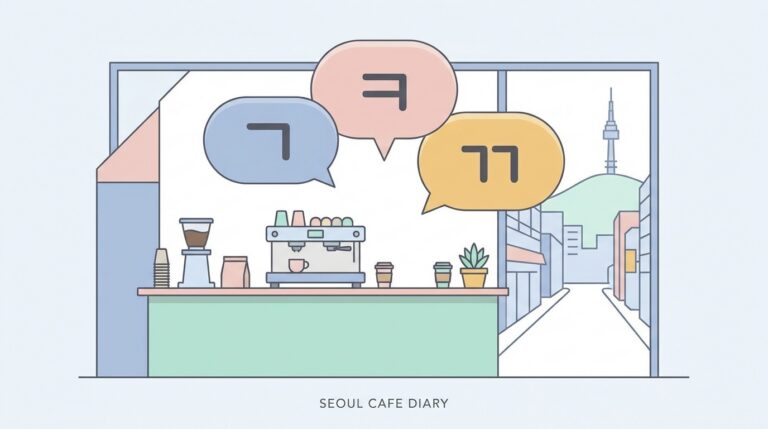
안녕하세요! 매일한글 에디터입니다. Have you ever experienced that sudden freeze at a bustling Seoul subway cafe when trying to order? You muster your courage, lean over the counter, and order what you think is “Kape rate” (카페 라테 – Cafe latte), but out comes something that sounds like “Gape rate”—and the barista tilts their head with an apologetic “네?” (Ne? / Pardon?).
Don’t worry, you are not alone! Distinguishing the plain sound 가 (Ga), the aspirated burst 카 (Ka), and the tensed double consonant 까 (Kka) is universally known among Korean learners as the “Great Wall of Hangul.” Foreign ears often hear them as the exact same sound, while Koreans treat them as completely distinct universes. Today, based on real feedback from hundreds of beginner students, we will unlock the secret mouth mechanics and cultural cheat codes behind these three sounds. By the end of this guide, you will order food, ask for bargains, and sing your favorite K-pop tracks without ever second-guessing your tongue!
Phase 2: Core Expressions Deep Dive
1. 가방 있어요? (Gabang isseoyo?)
- Pronunciation: [Ga-bang i-sseo-yo?] (Think of the relaxed ‘g’ in ‘garden’, relaxed throat with minimal breath.)
- Meaning: Literal: “Do you have a bag?” / Nuance: “Can I get a shopping bag for these items?”
- K-Culture Moment: Heard constantly at Korean convenience stores (CU, GS25) when buying snacks late at night after a long K-drama marathon.
- Editor’s Insight: The initial consonant ㄱ (g/k) is soft and lax. You do not push air out forcefully. Keep your vocal cords relaxed, like exhaling a gentle sigh while saying “ga.”
- Situation Spectrum: Casual ⚠️ | Semi-formal ✅ | Formal ✅
- 🤔 Think About It: In English, “k” and “g” are separated by voicing (vibrating vocal cords). In Korean, ㄱ is about muscle relaxation. Can you relax your jaw completely before speaking?
2. 카드 돼요? (Kadeu dwaeyo?)
- Pronunciation: [Ka-deu dwae-yo?] (Think of the sharp, crisp ‘c’ in ‘car’ or ‘cup’ with a clean burst of air.)
- Meaning: Literal: “Is card possible?” / Nuance: “Do you accept credit/debit cards?”
- K-Culture Moment: Every trendy cafe in Seongsu-dong or Hongdae is practically cashless, making this phrase the ultimate survival magic spell.
- Editor’s Insight: ㅋ (k) is aspirated. Imagine blowing out a birthday candle placed three inches from your lips. If you hold a sheet of paper in front of your mouth, saying 카 (Ka) must make the paper fly forward vigorously!
- Situation Spectrum: Casual ⚠️ | Semi-formal ✅ | Formal 🚫 (Use “카드 결제 되나요?” for formal)
- 🤔 Think About It: Koreans love fast, breezy transactions. Notice how asking “Is card okay?” is much shorter than English’s formal “May I pay by credit card?”
3. 조금만 깎아 주세요 (Jogeumman kkakka juseyo)
- Pronunciation: [Jo-geum-man kka-kka ju-se-yo] (Think of the tight, explosive ‘k’ in ‘sky’ or ‘basketball’—zero air release!)
- Meaning: Literal: “Please trim a little bit” / Nuance: “Could you give me a small discount?”
- K-Culture Moment: Traditional shopping havens like Dongdaemun or Namdaemun Market where friendly haggling with vendor aunties (이모) is an art form.
- Editor’s Insight: The double consonant ㄲ (kk) requires tension. Constrict your throat muscles tight, hold your breath for a split second, and pop the sound without letting ANY breath escape. The tissue paper test: the paper should NOT flinch at all!
- Situation Spectrum: Casual ⚠️ | Semi-formal ✅ | Formal 🚫
- 🤔 Think About It: Double consonants carry emotional intensity in Korean. Does tightening your vocal cords reflect the cheeky determination of asking for a discount?
Phase 3: Textbook Korean vs. Real Korean
Situation 1: Leaving a cafe with friends
- 📖 교과서 한국어 (Textbook Korean): 우리 이제 갑시다. (Uri ije gapsida. / Let us depart now.)
- 🗣️ 진짜 한국어 (Real Korean): 우리 이제 슬슬 가요! (Uri ije seulseul gayo! / Let’s slowly get going!)
- 💡 왜 다를까? (Why the difference?): The textbook command “갑시다” sounds overly rigid, like a military marching order. Real Koreans soften departures using the cute adverb “슬슬” (seulseul – gently/slowly) to sound considerate and warm.
Situation 2: Asking if a stall accepts cards
- 📖 교과서 한국어 (Textbook Korean): 신용카드로 계산해 주시겠습니까? (Sinyongkadeuro gyesanhae jusigesseumnikka? / Would you please calculate this with a credit card?)
- 🗣️ 진짜 한국어 (Real Korean): 사장님, 카드 돼요? (Sajangnim, kadeu dwaeyo? / Boss, is card okay?)
- 💡 왜 다를까? (Why the difference?): Daily street Korean strips away bureaucratic noun clusters (“신용카드”, “계산”) in favor of conversational speed, adding friendly warmth by calling the owner “사장님” (Sajangnim – store boss).
Phase 4: K-Culture Deep Dive & Non-Verbal Manners
4-1. 눈치 (Nunchi) & Gestures
When producing 가 / 카 / 까, Koreans don’t just use vocal cords—their physical posture reflects the tension!
* When saying soft sounds like 가, your head stays upright and relaxed.
* When practicing 카 and 까, place your palm flat two inches in front of your lips. For 카 (Ka), feel the warm wind hit your hand. For 까 (Kka), feel the air lock inside your throat with no breeze on your palm.
* Cultural Tip: When handing over a card after saying “카드 돼요?” (Kadeu dwaeyo?), always present the card with both hands or support your right elbow with your left hand. This tiny gesture wins instant smiles and top-tier customer service anywhere in Korea.
4-2. Cultural Code Analysis: The Aegyo vs. Swagger Factor
Notice how in K-Pop songs and K-Dramas, double consonants like ㄲ (kk) and ㅃ (pp) are heavily used for cute emphasis (Aegyo) or dramatic punch. Words like “진짜?” (Jinjja? – Really?) or “깜짝이야!” (Kkamjjagiya! – What a fright!) depend entirely on that glottal compression. If an actor in a romance drama says “가지 마” (Gaji ma – Don’t go) softly, it feels mournful. But if they say “꼭 가야 돼?” (Kkok gaya dwae? – Do you REALLY have to go?), that tense ㄲ amplifies the desperation tenfold.
Phase 5: Real-Life Roleplay Scenario
- Location: A vintage clothing boutique in the neon-lit back alleys of Hongdae (홍대).
- NPC: Auntie Min (민 이모) – Trendy, sharp-eyed, wearing colorful reading glasses around her neck.
Dialogue
- Auntie Min: 어서 와요! 편하게 봐요~ (Eoseo wayo! Pyeonhage bwayo~ / Welcome! Take your time looking around~)
- 🎭 Polishing vintage leather jackets while tapping her foot to K-pop music.
- You: 저기요, 이 코트 예뻐요. (Jeogiyo, i koteu yeppeoyo. / Excuse me, this coat is pretty.)
- 🎭 Pointing gently at a wool coat with both hands.
- Auntie Min: 아이구, 안목 있네! 그거 오늘 들어온 거야. (Aigu, anmok inne! Geugeo oneul deureoon geoya. / Oh my, you’ve got great taste! That just came in today.)
- 🎭 Holding the coat up against your shoulders with a proud grin.
- You: 가방에 넣어 갈 수 있어요? (Gabange neoeo gal su isseoyo? / Can I take it in a shopping bag?)
- 🎭 Pronouncing soft lax ‘Ga’ in 가방 smoothly without puffing air.
- Auntie Min: 당연하지! 큰 쇼핑백에 쏙 넣어줄게. (Dangyeonhaji! Keun syopingbaege ssok neoeojulge. / Of course! I’ll put it right into a big shopping bag.)
- 🎭 Nodding enthusiastically and grabbing a sturdy bag.
- You: 이모님, 조금만 깎아 주세요! (Imonim, jogeumman kkakka juseyo! / Auntie, please give me a tiny discount!)
- 🎭 Tightening throat for crisp ‘Kka’, tilting head slightly with a playful smile.
- Auntie Min: 아이고, 귀여우니까 오천 원 빼준다! (Aigo, gwiyeounikka ocheon won bbaejunda! / Gosh, since you’re cute, I’ll take off 5,000 won!)
- 🎭 Laughing out loud and waving her hand in concession.
- You: 와, 감사합니다! 카드 돼요? (Wa, gamsahamnida! Kadeu dwaeyo? / Wow, thank you! Is card okay?)
- 🎭 Emitting a sharp puff of air on ‘Ka’ in 카드 while holding card with both hands.
🔀 Interactive Choice Point
Auntie Min prepares the card machine and says, “현금이면 더 깎아줄 텐데!” (I would discount more if it were cash!). How do you respond?
* Choice A: “어? 가드 안 돼요?” (Eo? Gadeu an dwaeyo?)
* ⚠️ Feedback (Risk): Pronouncing ‘카드’ as lax ‘가드’ makes it sound like “guard.” Auntie might blink twice before realizing what you meant. Keep that ㅋ airy!
* Choice B: “현금 없어요. 카드로 할게요, 이모님!” (Hyeongeum eopseoyo. Kadeuro halgeyo, imonim!)
* ✅ Feedback (Best!): Polite, crisp pronunciation with a respectful tone. You keep the discount and leave a sparkling impression!
* Choice C: “야! 그냥 까까 줘!” (Ya! Geunyang kkakka jwo!)
* 🚫 Feedback (Bad): Disastrous! “야” (Hey!) is disrespectful to elders, and “까까” with flat banmal sounds like a demanding toddler asking for baby crackers! Auntie’s smile will instantly freeze.
Phase 6: 10-Second Emotion Shadowing Drill
Drill these three contrasts out loud! Pay attention to breath markers (/) and facial tension.
[🌿 Relaxed, Gentle & Soft - No Air Burst]- 우리 / 슬슬 / 가요. (Uri / seulseul / gayo.)
- Meaning: Let’s slowly get going.
[💨 Sharp, Airy & Punchy - Big Air Burst]- 시원한 / 카페 / 가요! (Siwonhan / kape / gayo!)
- Meaning: Let’s head to a cool cafe!
[🔥 Tensed, Tight Throat & High Pitch Pop - Zero Air]- 가격 좀 / 깎아 / 주세요! (Gagyeok jom / kkakka / juseyo!)
- Meaning: Please trim the price down a bit!
Phase 7: K-Culture Mini Dictionary
- 가성비 (Gaseongbi) | Cost-effectiveness / Value for money | Used constantly in travel blogs, convenience store food reviews, and youth culture to celebrate high-quality budget finds.
- 카페 투어 (Kape tueo) | Cafe hopping | An essential lifestyle ritual in modern Korea where exploring aesthetically distinct, themed cafes across neighborhoods is a primary weekend hobby.
- 깎아주세요 (Kkakka juseyo) | Please discount this | The quintessential phrase of affection and street bargaining at traditional open markets, turning a sterile transaction into human connection.
- 깜짝이야! (Kkamjjagiya!) | What a surprise! / You startled me! | The ultimate reflexive exclamation heard in variety shows and street pranks whenever someone is startled by an unexpected sound or appearance.
Phase 8: Traveler’s Survival Kit
Top 3 Survival Phrases
- 가까워요? (Gakkawoyo?) | Is it close? | Pro Tip: Notice both ㄱ (soft) and ㄲ (tensed) occur here! “Ga-kkao-wo-yo”. Essential when deciding whether to hail a taxi or walk.
- 카드 결제 돼요? (Kadeu gyeolje dwaeyo?) | Is card payment accepted? | Pro Tip: Emphasize the airy ‘Ka’ sound so cashiers can instantly prepare the card terminal before you even reach the counter.
- 영수증 버려주세요 (Yeongsujeung beoryeojuseyo) | Please throw away the receipt | Pro Tip: In eco-conscious Korea, say this with a smile if you don’t need a paper slip for your iced coffee.
Editor’s Travel Note
When navigating modern Korean cities, international mapping services often lag or lack public transport details. Be sure to download the official Naver Map application to find hidden cafes and check subway exits effortlessly. Also, remember that most vending machines and express city buses in Seoul are now completely cashless, so having an active T-Money transport card or foreign-accepted credit card ready is vital!
Phase 9: A Step Deeper (Reflective Prompt)
In Western languages like English, the boundary between consonants relies heavily on vocal cord vibration—voicing versus unvoicing (like /b/ versus /p/, or /d/ versus /t/). Korean phonology, however, does something fascinating: it splits sounds into three dimensions of tension and air (Relaxed ㄱ, Aspirated ㅋ, Tensed ㄲ). This tripartite distinction mirrors the nuance of Korean interpersonal etiquette. Some situations require relaxed composure (가), others require overt, bright projection (카), while moments of intimacy, determination, or excitement pull vocal cords into dense, focused energy (까).
💬 Your Turn: In your native tongue, do you vary your vocal tension to show affection, sarcasm, or respect? Which sound feels hardest to articulate without air—the soft “Ga” or the tensed “Kka”? Drop your thoughts in the comments below!
Phase 10: FAQ & Avoiding Misunderstandings
Q: Why do Koreans say my “Ga” (가) sounds like “Ka” (카)?
A: Because English initial “G” (as in go) is heavily voiced, but initial “K” (as in kite) has a strong puff of air. Korean initial ㄱ is unvoiced but has very little breath! To an English speaker’s ear, initial ㄱ sounds like “k”, but to a Korean, an English “k” sounds like ㅋ because of all that escaping breath. To fix this, pronounce 가 like the ‘k’ in “skate” where no air puff comes out.
Q: Can I use “깎아 주세요” (Kkakka juseyo) in luxury department stores?
A: Absolutely not! Department stores (like Shinsegae or Hyundai), franchise brand shops, and convenience stores have fixed digital pricing. Trying to haggle there will make everyone feel awkward. Reserve this phrase exclusively for traditional markets, street apparel stalls, and flea markets.
Q: What is the single best physical trick to master double consonants like 까?
A: The “Swallow & Lock” trick! Swallow your saliva once and notice where your throat closes up tight right before the swallow finishes. Hold that throat lock, press your tongue against the roof of your mouth, and suddenly pop the vowel “ah” without releasing any air through your nose or lips. That sharp, dry pop is 까!
🚨 흔한 실수 (Common Mistakes) Warning Board
- Mistake: Pronouncing 까 (Kka) with a heavy puff of breath, making it sound identical to 카 (Ka).
- Correct Action: Hold a tissue paper right in front of your mouth. Practice until the paper stays completely motionless when saying “까!”
- Mistake: Over-vocalizing 가 (Ga) like a deep, vibrating English “Guh”.
- Correct Action: Keep the sound light and breathy, like a soft whisper at the start of a sentence.
- Mistake: Confusing 과자 (Gwaja – snack) or 까까 (Kkakka – baby snack) with 깎아 (Kkakka – to discount).
- Correct Action: Context helps, but remember that the verb “to discount” always pairs with “주세요” (juseyo – please give): 깎아 주세요!







