

Mastering Korean Town Hall Meetings: How to Ask Leadership Tough Questions with Perfect Nunchi
Phase 1: Empathy (Story-Driven Opening)
안녕하세요! 매일한글 에디터입니다. (Annyeonghaseyo! It’s your Daily Hangul editor.)
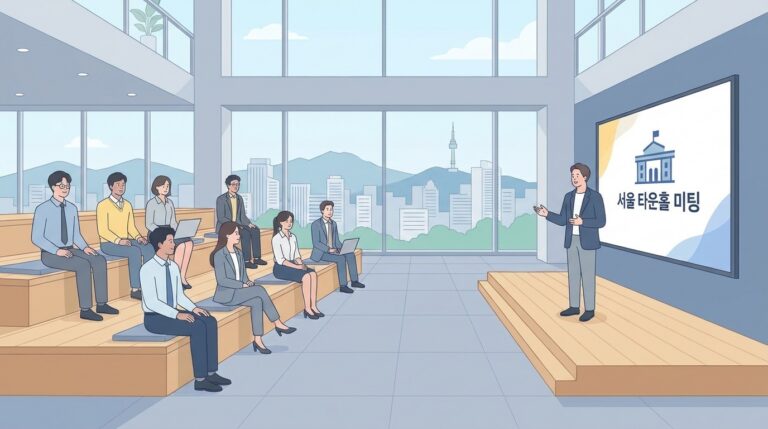
Picture this: It’s the final Friday of the month at 4 PM in a bustling Gangnam tech office. The aroma of catered drip coffee drifts through the open lounge as screens flicker to life for the hybrid all-hands meeting. Leadership takes the stage, sharing quarterly milestones and wrapping up with the familiar slide: “Q&A / 건의사항 (Suggestions).” You notice your colleagues subtly glancing at their laptops, refreshing the anonymous Slido board. You have a genuinely constructive idea about improving cross-team workflows and expanding flexible hours, but your fingers hover anxiously over the keyboard.
If I ask this anonymously, will it sound passive-aggressive? If I use formal Korean, will it sound like an ultimatum instead of a helpful suggestion?
If you have ever felt your heart race during a Korean corporate Q&A session, you are definitely not alone. Many of our intermediate learners working in Korea tell us that speaking up in front of executive leadership feels like walking a tightrope between modern agility and traditional hierarchy. But here is the secret: Korean executives actually welcome proactive feedback—provided it wraps ambition in respect and collective benefit. This guide is crafted from real corporate coaching feedback to help you voice sharp, impactful ideas at your company’s next town hall with 100% cultural confidence.
Phase 2: 3 Core Expressions in Depth
1. 익명으로 조심스럽게 건의드려도 될까요? (Ingmyeong-euro josimseureopge geon-uideuryeodo doelkkayo?)
- Pronunciation: eeng-myeong-eu-ro jo-shim-seu-reop-ge gon-wee-deu-ryeo-doh dwel-kka-yo? (Think of ‘ing’ like ‘sing’ + ‘myeong’ rhyming with ‘young’, with a soft, respectful cadence)
- Meaning: “May I carefully offer a suggestion anonymously?” (Literal: “Is it okay if I offer a suggestion carefully by anonymity?”)
- K-Culture Moment: In modern Korean office dramas like Agency (대행사) or Start-Up, junior team members use this phrasing when submitting sensitive questions to an open town hall board so executives know the intention is constructive, not disruptive.
- Editor’s Insight: The adverb 조심스럽게 (josimseureopge – carefully/cautiously) acts as an essential cultural buffer. It signals humility and respect for leadership’s authority before delivering candid critique.
- Situation Spectrum: Casual: 🚫 | Semi-formal: ⚠️ | Formal: ✅
- 🤔 Think About It: Why does Korean culture value verbal softeners like “carefully” even when using anonymous question platforms?
2. 업무 효율성을 높이기 위해 유연근무제 확대를 검토해 주실 수 있나요? (Eopmu hyoyulseong-eul nop-igi wihae yuyeongeunmuje hwakdaereul geomtohae jusil su innayo?)
- Pronunciation: up-moo hyo-yool-song-eul no-pee-gee wee-hae yoo-yeon-geun-moo-je hwak-dae-reul geom-toh-hae joo-shil soo een-nah-yo?
- Meaning: “Could leadership consider expanding flexible working hours to enhance work efficiency?”
- K-Culture Moment: A forward-thinking manager in a K-drama pitch meeting framing employee benefits around company productivity rather than personal comfort.
- Editor’s Insight: Notice that the justification comes first: 업무 효율성을 높이기 위해 (to increase work efficiency). In Korean business culture, framing personal requests as collective company wins makes leadership far more receptive.
- Situation Spectrum: Casual: 🚫 | Semi-formal: ⚠️ | Formal: ✅
- 🤔 Think About It: In your home country, do town hall questions focus on individual employee satisfaction or collective output first?
3. 조직문화 개선을 위한 작은 제안이 있습니다. (Jojikmunhwa gaeseoneul wihan jageun je-ani itsseumnida.)
- Pronunciation: joh-jeek-moon-hwa gae-son-eul wee-han jah-geun je-ah-nee eet-seum-nee-da.
- Meaning: “I have a modest suggestion for improving our organizational culture.”
- K-Culture Moment: The protagonist standing up during an open-mic session in a drama like Misaeng (미생), choosing modesty before dropping a game-changing perspective.
- Editor’s Insight: Calling your own proposal a 작은 제안 (modest/small proposal) is classic Korean self-lowering modesty (gyeonyang). It lowers defenses across the room.
- Situation Spectrum: Casual: 🚫 | Semi-formal: ✅ | Formal: ✅
- 🤔 Think About It: Does downplaying your suggestion make it sound less confident in Western corporate culture, and why does it produce the opposite effect in Korea?
Phase 3: Textbook Korean vs. Real Korean
Situation 1: Proposing a New Policy
- 📖 교과서 한국어: 우리는 복지 혜택을 늘려야 합니다. (Urineun bokji hetaeg-eul neullyeoya hamnida. – “We must expand welfare benefits.”)
- 🗣️ 진짜 한국어: 임직원 사기 진작을 위해 복지 확대를 긍정적으로 검토해 주시면 좋겠습니다. (Imjig-won sagi jinja-geul wihae bokji hwakdaereul geungjeongjeog-euro geomtohae jusimyeon jokesseumnida. – “It would be wonderful if leadership could favorably review expanding benefits to boost staff morale.”)
- 💡 왜 다를까? Direct modal verbs like “~해야 합니다” (must do) can sound demanding or accusatory to Korean leadership. Framing suggestions conditionally with “~검토해 주시면 좋겠습니다” (it would be great if you could review) shows strategic deference.
Situation 2: Referencing an Anonymous Poll Item
- 📖 교과서 한국어: 익명 질문에 대해 언제 대답합니까? (Ingmyeong jilmune daehae eonje daedaphamnikka? – “When will you answer the anonymous question?”)
- 🗣️ 진짜 한국어: 실시간 익명 보드에 가장 많은 추천을 받은 안건인데요, 경영진의 견해가 궁금합니다. (Silsigan ingmyeong bodeu-e gajang maneun chucheoneul badeun an-geon-indeyo, gyeong-yeongjin-ui gyeonhaega gung-geumhamnida. – “This item received the most upvotes on our live anonymous board; we would love to hear leadership’s perspective on it.”)
- 💡 왜 다를까? Real workplace Korean relies on social proof (“most upvoted”) and gentle inquiry (“curious about your perspective”) rather than demanding an immediate deadline.
Phase 4: K-Culture Deep Dive & Non-Verbal Manners
4-1. Nunchi & Physical Poise at Town Halls
When speaking into the microphone during an all-hands meeting, hold the mic with both hands or rest your left hand gently under your right wrist. Maintain an open posture, nodding slightly when executives acknowledge your point. If you are submitting an anonymous digital inquiry via interactive tools like Slido or Mentimeter, watch the live room atmosphere first. If leadership just shared disappointing quarterly earnings, hold off on asking about paid company retreats or luxury office perks until the mood stabilizes. This is corporate 눈치 (Nunchi)—sensing the shared temperature before speaking.
4-2. Culture Code: The Evolution of Town Halls in Korean Media
In classic Korean workplace dramas such as Misaeng (미생), communication flows strictly downward from the executive suite, with junior employees quietly bowing behind their monitors. Contrast that with modern tech series like Start-Up (스타트업) or contemporary web dramas, where horizontal culture (수평적 문화) and open Town Halls take center stage. Today’s Korean companies actively strive to foster Silicon Valley-style open dialogue, but the underlying respect for seniority remains strong. Blending sharp transparency with respectful honorifics is the quintessential skill of a successful modern professional in Korea.
Phase 5: Real Role-play Scenario
Setting: Friday Town Hall at a fast-growing Seoul enterprise. CEO Park (대표님) is answering audience queries on stage, while Team Lead Min (팀장님) sits beside Alex.
- Alex: 🎭 (Glancing at the live Slido screen, leaning toward Team Lead Min) 팀장님, 유연근무제 관련 질문이 아직 안 다뤄졌는데 익명으로 올려도 괜찮을까요? (Timjangnim, yuyeongeunmuje gwanryeon jilmuni ajik an darwojyeonneunde ingmyeong-euro ollyeodo gwaenchaneulkkayo? / “Team lead, the question regarding flexible hours hasn’t been addressed yet. Would it be okay if I submit it anonymously?”)
- Team Lead Min: 🎭 (Nodding reassuringly with a warm smile) 그럼요! 대신 질문 의도가 오해되지 않게 표현만 정중히 다듬어 올려보세요. (Geureomyo! Daesin jilmun uidoga ohaedoeji anke pyohyeonman jeongjunghi dadeumeo ollyeoboseyo. / “Of course! Just polish the phrasing respectfully so the intention isn’t misunderstood.”)
- Alex: 🎭 (Typing carefully into the app) 네, 이렇게 적었습니다. “생산성 향상을 위한 유연근무제 확대 가능성이 궁금합니다.” (Ne, ireoke jeogeotseumnida. “Saengsansang hyangsang-eul wihan yuyeongeunmuje hwakdae ganeungseong-i gung-geumhamnida.” / “Understood. I wrote: ‘We are curious about the feasibility of expanding flexible hours to enhance productivity.'”)
- CEO Park: 🎭 (Looking up at the projector screen, reading the top upvoted question) 아, 실시간 보드에 유연근무제 안건이 올라왔군요. 아주 유익한 건의입니다. (A, silsigan bodeue yuyeongeunmuje an-geoni ollawatgunyo. Aju yu-ikhan geon-ui-imnida. / “Ah, an item regarding flexible working hours has come up on the live board. This is a very constructive suggestion.”)
- Alex: 🎭 (Holding the microphone from the audience seat) 대표님, 부연 설명을 드려도 되겠습니까? (Daepyonim, bu-yeon seolmyeong-eul deuryeodo doegesseumnikka? / “CEO Park, may I provide a brief follow-up explanation?”)
- CEO Park: 🎭 (Smiling warmly, gesturing forward) 네, 편하게 말씀해 주세요. (Ne, pyeonhage malsseumhae juseyo. / “Yes, please feel free to speak.”)
- Alex: 🎭 (Standing up with both hands gently holding the mic) 글로벌 협업 부서의 시차를 고려하여 제도를 보완하면 업무 효율이 더욱 극대화될 것이라 생각합니다. (Geullobeol hyeobeop buseo-ui sichareul goryeohayeo jedoreul bowanhamyeon eopmu hyoyuri deouk geukdaehwadoel geosira saenggakhamnida. / “Considering the time differences in our global collaboration teams, refining this system will maximize our work efficiency even further.”)
- CEO Park: 🎭 (Nodding thoughtfully with arms crossed) 일리 있는 말씀입니다. 인사팀과 협의하여 다음 분기 시범 운영을 검토하겠습니다. (Illi inneun malsseumimnida. Insatimgwa hyeob-uihayeo daeum bungi sibeom un-yeong-eul geomtohagessumnida. / “That is a fair point. We will consult with HR to consider a pilot program next quarter.”)
🔀 Interactive Choice Point
CEO Park asks: “혹시 이 제안에 덧붙여 다른 개선 의견이 있는 팀원이 있나요?” (Does anyone have additional improvement suggestions to add to this proposal?)
- Choice A: “야근이 너무 많아서 힘드니까 무조건 빨리 도입해 주세요!” (We have too much overtime, so please introduce it immediately no matter what!)
- Choice B: “관련 부서의 의견을 모아 구체적인 실행안을 사내 게시판에 공유드리겠습니다.” (I will gather feedback from related teams and share a concrete proposal on the internal intranet board.)
- Choice C: “다른 회사들은 다 이미 하고 있는데 우리 회사만 늦은 것 같습니다.” (All other companies are already doing this, so it seems our company is lagging behind.)
Feedback:
* Choice A (Risk): Complaining emotionally about individual exhaustion makes leadership feel confronted rather than partnered.
* Choice B (Best): Proactive, team-oriented, and solutions-focused! You turn an open question into an actionable leadership initiative.
* Choice C (Bad): Directly comparing your company unfavorably to competitors damages executive face (che-myeon) during an open forum.
Phase 6: 10-Second Emotion Shadowing Drill
Follow the rhythm marks (/) and embody the indicated emotion for each phrase:
[🤝 Respectful & Suggestive]
“생산성 / 향상을 위해 / 유연근무제 확대를 / 긍정적으로 / 검토해 주실 수 있나요?”
(Saengsansang / hyangsang-eul wihae / yuyeongeunmuje hwakdaereul / geungjeongjeog-euro / geomtohae jusil su innayo?)-
[😊 Polished & Confident]
“조직문화 개선을 위한 / 작은 제안이 있어 / 조심스럽게 / 말씀드립니다.”
(Jojikmunhwa gaeseoneul wihan / jageun je-ani isseo / josimseureopge / malsseumdeurimnida.) -
[👏 Collaborative & Grateful]
“대표님의 진솔한 답변과 / 지속적인 관심에 / 깊이 감사드립니다.”
(Daepyonim-ui jinsolhan dapbyeon-gwa / jisokjeog-in gwansime / gipi gamsadeurimnida.)
Phase 7: K-Culture Mini Dictionary
- 타운홀 미팅 (Taunhol Miting) | Town Hall Meeting | The regular company-wide gathering where leadership updates employees and holds interactive Q&A. Widely used in Korean startups and modern multinationals.
- 건의사항 (Geon-uisahang) | Constructive Suggestions | Distinct from mere complaints (불만), this term refers to thoughtful proposals aimed at organizational enhancement.
- 블라인드 (Beullaindeu) | Blind App Culture | The ubiquitous anonymous verified employee app in Korea. Town halls are often deliberately held to address topics bubbling up on Blind before they escalate.
- 수평적 문화 (Supyeongjeok Munhwa) | Flat/Horizontal Work Culture | The corporate movement across Korea prioritizing English nicknames, casual dress, and egalitarian feedback over strict hierarchical titles.
Phase 8: Expat Professional Survival Kit
-
Top 3 Workplace Survival Phrases:
- 슬라이도 링크를 사내 메신저로 공유해 주시겠어요? (Seullaido ringkeureul sanae mesinjeoro gong-yuhae jusigesseoyo?) – “Could you share the Slido link via company messenger?” (Pro Tip: Save this to your clipboard before the town hall starts).
- 익명 게시판에 추천을 눌렀습니다. (Ingmyeong gesipane chucheoneul nulleotseumnida.) – “I upvoted it on the anonymous board.” (Pro Tip: Great for building quiet consensus among teammates).
- 다음 회의 때 추가 논의가 가능할까요? (Daeum hoe-ui ttae chuga non-uiga ganeunghalkkayo?) – “Could we follow up on this during the next meeting?” (Pro Tip: Use when time runs out on an executive’s answer).
- Editor’s Travel & Expat Note:
For smooth post-town hall team dinners (hoesik), make sure you check venue locations in advance by using the Naver Map application. When splitting expenses or paying company coffee tabs, install Korean payment solutions like Toss or KakaoPay to navigate shared team funds seamlessly.
Phase 9: A Step Deeper (Reflective Essay)
In many Western corporate contexts, radical candor is celebrated as an individual virtue: you spot an operational flaw, you call it out directly. Korean workplace culture, rooted in relational harmony (jeong and gongdongche community values), views the company as an interconnected collective. Making a suggestion is not simply a critique of current policy; it is an act of care that must preserve everyone’s dignity. When you temper your honesty with deference and collective motivation, you aren’t being evasive—you are honoring the relationships that make meaningful reform possible.
💬 Your Turn: Have you ever hesitated to ask an anonymous question during an all-hands meeting? What is the biggest difference between corporate feedback in your country and in Korea? Share your story in the comments below!
Phase 10: FAQ & Avoiding Misunderstandings
Q: Can I use conversational endings like “~요” (-yo) when asking questions in a town hall?
A: While casual polite style (-yo) is widely accepted in conversational office settings, using formal polite style (-ㅂ니다 / -습니까) during an all-hands meeting with C-suite executives sounds far more polished and authoritative.
Q: Does asking anonymous questions look cowardly to Korean executives?
A: Not at all! Modern Korean leadership utilizes Slido and Mentimeter specifically to encourage honest bottom-up feedback. The key is to ensure the anonymous text remains constructive and polite rather than sarcastic.
Q: What is the best way to address the CEO when speaking publicly?
A: Always append their job title with the honorific suffix 님 (nim). Address them as 대표님 (Daepyonim – CEO), never by their name alone or an informal title.
🚨 Common Mistakes Warning Board
- Mistake 1: Starting a question with “제가 생각하기에는…” (In my personal opinion…) without addressing the company’s benefit.
- Correct Action: Pivot to “임직원 업무 효율성 측면에서…” (From the perspective of employee efficiency…).
- Mistake 2: Using the demanding phrase “개선해 주세요” (Please fix this).
- Correct Action: Soften into “개선 방안을 함께 검토해 주실 수 있을지 여쭙고 싶습니다” (I would like to respectfully ask if we could review improvement plans together).
- Mistake 3: Failing to acknowledge the CEO’s answer before sitting down.
- Correct Action: Always close with “답변 감사드립니다” (Thank you for your answer) with a slight nod.
Phase 11: Action Missions
- 🥉 Bronze Mission: Practice the 3 Core Expressions aloud 5 times while recording your voice to match the soft intonation markers.
- 🥈 Silver Mission: Write your own town hall suggestion sentence in Korean combining “업무 효율성” (efficiency) and “검토해 주시면 감사하겠습니다” (appreciate your review) and leave it in our comment section!
- 🥇 Gold Mission: At your next company meeting or Korean language study group, use one non-verbal respect gesture (two-handed microphone posture or wrist support) while speaking.
- 🎮 K-Culture Mission: Watch an episode of a modern Korean office drama (like Search: WWW or Misaeng) and spot how junior employees physically position themselves when addressing executives.
Phase 12: Interactive Quiz Challenge
1. Situational Judgment: You want to ask the executive committee if the company can sponsor monthly gym memberships. Which phrasing is most effective?
* A) 헬스비 지원 언제 해줄 겁니까? (When will you support gym fees?)
* B) 직원들의 건강 관리와 활기찬 조직문화를 위해 체력단련비 지원을 긍정적으로 검토해 주실 수 있나요? (Could leadership consider supporting fitness costs for employee health management and a vibrant organizational culture?)
* C) 다른 회사는 다 헬스비 주는데 우리도 주세요. (All other companies give gym fees, so give us some too.)
2. Fill-in-the-Blank: Complete the respectful opening phrase:
* “조직문화 개선을 위한 작은 (________)이 있습니다.”
3. True or False: In a Korean town hall meeting, using anonymous Q&A tools is considered rude by modern executive leadership.
* [True / False]
Click to reveal answers & explanations!
- Answer: B. Option B establishes collective corporate value (“employee health management and a vibrant culture”) and uses refined honorific verbs (“검토해 주실 수 있나요”).
- Answer: 제안 (Je-an – Suggestion/Proposal). Combining “작은” (modest) with “제안” creates the ideal humble phrasing for Korean corporate etiquette.
- Answer: False. Modern Korean enterprises actively implement anonymous boards precisely to empower open discussion and discover grassroots sentiment!







