

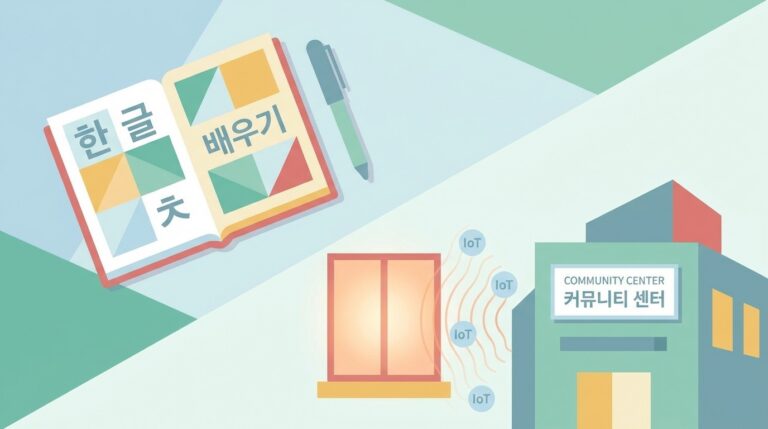
Phase 1: Empathy (Immersive Story Opening)
안녕하세요! This is your Daily Hangul editor, back with another cultural deep dive!
Have you ever watched the poignant K-drama Move to Heaven (무브 투 헤븐) or scenes in My Mister (나의 아저씨) and felt a sudden chill seeing a tiny studio apartment untouched for weeks behind a locked digital door? In ultra-modern Seoul, neon signs flash all night, yet behind soundproof apartment doors, more than one in three households is now a 1-person household (1인 가구). When illness or job loss strikes someone without family ties or close friends, isolation can quickly turn critical. In Korean society, this quiet tragedy is known as 고독사 (Godoksa – lonely death).
To prevent people from slipping through the cracks, Korean local governments (jijache) aren’t just relying on traditional door-knocking anymore. They are deploying cutting-edge big data algorithms, AI call bots, and IoT smart plugs that monitor electric currents and water meters to notice when someone hasn’t turned on a light or boiled water for 24 hours.
Discussing social welfare, municipal technology, and isolation can feel intimidating in Korean—textbooks rarely prepare you for upper-intermediate civic discussions! But whether you live in Korea as an expat, volunteer with neighborhood groups, or simply want to debate contemporary Korean issues over coffee with Korean friends, mastering these concepts will transform you from a basic speaker into a deeply empathetic communicator. Based on real feedback from intermediate learners tackling Korean current affairs, here is your essential guide to navigating Korea’s digital community safety nets.
Phase 2: Core Expressions (In-Depth Analysis)
1. 고독사 예방 (Godeoksa yebang)
- Pronunciation: [Godeoksa yebang] (Goh-dohk-sah yeh-bahng — “goh-dohk” sounds like “go dock”, while “ye-bang” rhymes with “say song”)
- Meaning: Literal: Lonely death prevention | Real Nuance: Systematic community and municipal efforts to ensure socially isolated individuals do not die alone and unassisted.
- K-Culture Moment: Seen on neighborhood banners hung across district offices (Gu-cheong) and featured in civic investigative programs like Unanswered Questions (그것이 알고 싶다).
- Editor’s Insight: While English often says “preventing solitary deaths,” in Korean, 고독사 (孤独死) carries deep existential sorrow (고독 = bitter solitude). Using 예방 (prevention) frames it not just as an individual fate, but as a collective civic duty.
- Situation Spectrum: Casual ⚠️ | Semi-formal ✅ | Formal ✅
- 🤔 Think About It: Does your native language have a single designated noun for dying completely alone, or do you use descriptive phrases? Why do you think Korea formalized this concept into official law?
2. 안부를 묻다 / 안부 확인 (Anbureul mutda / Anbu hwagin)
- Pronunciation: [Anbureul mutda / Anbu hwagin] (Ahn-boo-reul moot-dah — “ahn-boo” rhymes with “on cue”)
- Meaning: Literal: Asking after someone’s safety and comfort | Real Nuance: Proactively checking in to make sure someone is healthy, alive, and doing well.
- K-Culture Moment: In neighborhood welfare programs, case managers say: “스마트 플러그로 어르신 안부를 확인하고 있어요.” (We are checking on elderly residents’ safety via smart plugs.)
- Editor’s Insight: 안부 (安否) is not a casual “Sup?”. It specifically asks whether someone is secure (안 – safe) or experiencing distress (부 – not safe). In safety net contexts, 안부 확인 is an active lifeline.
- Situation Spectrum: Casual ✅ | Semi-formal ✅ | Formal ✅
- 🤔 Think About It: How does the cultural custom of 안부 transform from a traditional holiday phone call into an automated IoT sensor notification in modern Korea?
3. 사회적 안전망을 구축하다 (Sahoejeok anjeonmangeul guchukada)
- Pronunciation: [Sahoejeok anjeonmangeul guchukada] (Sah-hweh-jeok ahn-jeon-mahng-eul goo-choo-kah-dah)
- Meaning: Literal: Constructing a social safety net | Real Nuance: Implementing multi-layered welfare, community, and tech systems so vulnerable citizens don’t fall into complete despair.
- K-Culture Moment: Frequently used by municipal leaders and news anchors on KBS/JTBC when unveiling smart energy monitoring partnerships with telecom companies like KT or SKT.
- Editor’s Insight: 구축하다 (to construct/build) conveys building solid infrastructure. Pair it with 사회적 안전망 to sound like an articulate B2 speaker who understands public policy.
- Situation Spectrum: Casual 🚫 | Semi-formal ✅ | Formal ✅
- 🤔 Think About It: What constitutes an “effective safety net” in your culture: financial aid, close family obligations, or digital state intervention?
Phase 3: Textbook Korean vs. Real Korean
Situation 1: Talking about an isolated neighbor
- 📖 교과서 한국어 (Textbook):
“이웃 주민이 사회적 고립 상태에 놓여 있습니다.”
(Iut jumini sahoejeok gorip sangtae-e noyeo itseumnida. / The neighbor is placed in a state of social isolation.) - 🗣️ 진짜 한국어 (Real-World):
“옆집 분이 바깥출입도 거의 안 하시고 세상이랑 완전 단절되신 것 같아요.”
(Yeopjip buni bakkat-churipdo geoi an hasigo sesang-irang wanjeon danjeoldoesin geot gatayo. / The person next door barely steps outside; it feels like they’re totally cut off from the world.) - 💡 왜 다를까? (Why the difference?):
Native speakers rarely use bureaucratic phrases like ~상태에 놓이다 in spoken dialogue. Instead, they refer to everyday actions like 바깥출입 (stepping outside) and emotive verbs like 단절되다 (severed/disconnected).
Situation 2: Inquiring about a welfare check
- 📖 교과서 한국어 (Textbook):
“담당자가 해당 1인 가구를 방문하여 생사를 확인했습니까?”
(Damdangjaga haedang il-in gagureul bangmunhayeo saengsareul hwaginhaesseumnikka? / Did the officer visit the corresponding single-person household to verify life or death?) - 🗣️ 진짜 한국어 (Real-World):
“그 집 전기 사용량이 이상해서 가봤는데, 안에 인기척이 좀 있던가요?”
(Geu jip jeongi sayongnyangi isanghaeseo gabwanneunde, ane ingicheogi jom itdeongayo? / The electricity usage looked weird so we stopped by—was there any sign of life inside?) - 💡 왜 다를까? (Why the difference?):
Asking bluntly about 생사 (life or death) sounds jarring and cold. Locals listen for 인기척 (faint presence or sound of people) when knocking on doors.
Phase 4: K-Culture Deep Dive & Non-Verbal Manners
4-1. 눈치 (Nunchi) & Non-Verbal Manners in Welfare Inquiries
When discussing isolated households or participating in neighborhood safety drives in Korea, privacy and pride (체면, Chaemyeon) are huge factors. Many vulnerable people feel ashamed of their poverty or loneliness.
* Lower the Gaze & Hands: If you ever accompany a community volunteer or visit a neighbor, never point at sensors or look around inquisitively. Keep your hands clasped loosely in front of your waist (공손한 자세).
* Don’t Hammer the Door: When performing an 안부 확인 (wellness check), avoid loud banging. Knock gently three times, wait, and call out: “어르신, 주민센터에서 안부차 들렀어요~” (Elder, I just dropped by from the community center to check in~). Using an upbeat, soft melodic tone prevents the person inside from feeling like they are being raided or investigated.
4-2. Cultural Code: From “Bansanghoe” to IoT Smart Plugs
Historically, Korean neighborhoods had 반상회 (Bansanghoe)—mandatory monthly neighborhood meetings where residents gathered in one living room, ate melon slices, and knew who was sick or broke. But rapid urbanization into high-rise officetels and high-security apartments (도어락, digital door locks) dismantled these micro-communities.
To replace lost human eyes, Korea turned to its greatest superpower: Smart Tech. The 스마트 플러그 (Smart Plug) plugged into a solitary elder’s TV or microwave tracks wattage in real-time. If zero electricity is consumed for 24 hours, an automated alert pings the local welfare worker’s smartphone. Furthermore, local governments partner with the Korea Electric Power Corporation (KEPCO) and mobile telecom companies to analyze combined AI data—sudden drops in smartphone screen movement + water meter inactivity = immediate dispatch. High-tech Korea is reinventing Jeong (정) as a digital safety algorithm.
Phase 5: Real-Life Roleplay Scenario
Setting: You are volunteering alongside Min-su, a 30-something public welfare coordinator at the Mapo Community Center (주민센터). The IoT monitoring dashboard on the computer screen just flagged an alert.
- 민수 (Min-su): “어? 마포동 302호 김 어르신 댁 스마트 플러그 전력량이 어제부터 아예 멈춰 있네요.”
(Eo? Mapo-dong sambeg-i-ho Gim eoreusin daek seumateu peulleogeu jeonnyeongnyangi eojebuteo aye meomchwo inneeyo. / Huh? Elder Kim’s smart plug power in Unit 302 has completely flatlined since yesterday.)
🎭 [눈살을 찌푸리며 모니터를 확대한다 – Frowns and zooms into the screen] -
You: “네? 평소엔 TV를 항상 켜두시는 분이잖아요. 통화는 해보셨어요?”
(Ne? Pyeongso-en tibireul hangsang kyeodusineun bun-ijanh-ayo. Tonghwaneun haebosyeosseoyo? / What? He usually keeps the TV on all day. Have you tried calling him?)
🎭 [걱정스러운 표정으로 화면을 들여다본다 – Looks at the monitor with a worried face] -
민수 (Min-su): “AI 안부 전화도 세 번이나 안 받으셨어요. 가족도 없는 무연고 분이라 너무 걱정되는데요.”
(Ei-ai anbu jeonhwado se beon-ina an badeusyeosseoyo. Gajokdo eomneun muyeon-go bun-ira neomu geokjeongdoeneundeyo. / He missed the AI check-in call three times too. He has no family on record, so I’m really concerned.)
🎭 [수화기를 내려놓으며 외투를 집어 든다 – Hangs up the phone and grabs his coat] -
You: “현장 확인이 급하겠네요. 제가 같이 동행할까요?”
(Hyeonjang hwagini geuphagenneyo. Jega gachi donghaenghalkkayo? / We need an on-site check urgently. Should I come along with you?)
🎭 [신발끈을 묶으며 나갈 채비를 한다 – Ties shoelaces, getting ready to leave] -
민수 (Min-su): “고마워요! 문이 잠겨 있으면 119에 공동 대응 요청해야 할 수도 있어요.”
(Gomawoyo! Muni jamgyeo isseumyeon il-il-gue gongdong daeeung yocheonghaeya hal sudo isseoyo. / Thank you! If the door is locked, we might have to request joint dispatch with emergency 119.)
🎭 [빠른 걸음으로 센터 문을 나선다 – Steps out of the center at a brisk pace] -
You: “혹시 댁 앞에 신문이나 우편물도 쌓여 있는지 먼저 확인해 봐요.”
(Hoksi daek ape sinmun-ina upyeonmuldo ssayeo inneunji meonjeo hwaginhae bwayo. / Let’s also check if newspapers or mail are piling up outside his door first.)
🎭 [계단을 내려가며 민수의 보폭을 맞춘다 – Matches Min-su’s stride going down the stairs] -
민수 (Min-su): “좋은 생각이에요. 이런 조기 발굴 시스템이 없었으면 큰일 날 뻔했어요.”
(Joeun saenggag-ieyo. Ireon jogi balgul siseutemi eopseosseumyeon keun-il nal ppeonhaesseoyo. / Good thinking. If we didn’t have this early detection system, it could have been catastrophic.)
🎭 [비상 연락망 태블릿을 손에 꽉 쥔다 – Grips the emergency contact tablet tightly] -
You: “아무 일 없이 그냥 나들이 가신 거였으면 좋겠네요. 서둘러요!”
(Amu il eopsi geunyang nadeuri gasin geoyeosseumyeon jokenneyo. Seodulleoyo! / I really hope he just went out for a stroll and nothing happened. Let’s hurry!)
🎭 [안도하길 바라는 마음으로 발걸음을 재촉한다 – Quickens pace, hoping for the best]
🔀 Interactive Choice Point
You arrive at the front door. The smart sensor shows zero power usage, and there is no answer after three light knocks. What do you say to Min-su?
- Choice A: “인기척이 전혀 없어요. 문 강제로 뜯고 바로 들어가죠!” (There’s zero presence. Let’s break the door right open and enter!)
- Choice B: “계량기 돌아가는 소리도 안 나네요. 규정대로 119에 개방 협조 요청하고 관리실에 연락할게요.” (I don’t hear the utility meter running either. Following protocol, I’ll call 119 for forced entry clearance and notify the management office.)
- Choice C: “그냥 낮잠 주무시는 걸 수도 있으니 내일 아침에 다시 올까요?” (He might just be taking a nap, should we come back tomorrow morning?)
Feedback:
* Choice A (Risk): Breaking a private door without police or fire authority (소방·경찰 입회) causes severe legal liability in Korea. Always coordinate with officials.
* Choice B (Best! 🌟): Perfect civic judgment! Mentioning 계량기 (meter) and following joint dispatch protocol (개방 협조 요청) reflects top-tier B2 Korean social etiquette.
* Choice C (Bad): Dangerous neglect. When IoT smart plugs trigger a 24-hour warning for a solitary resident, every single hour is critical.
Phase 6: 10-Second Shadowing Drill
Practice these natural rhythm pauses (/) and channel each emotional milestone!
- “스마트 플러그 덕분에 / 위급한 상황을 / 초기에 발견할 수 있었어요.”
- [😊 안도하며 보람차게 – With heartfelt relief and accomplishment]
- Seumateu peulleogeu deokbune / wigeupan sanghwang-eul / chogie balgyeonhal su isseosseoyo.
- (Thanks to the smart plug / we were able to detect the emergency / at an early stage.)
- “가족이나 이웃과 단절된 분들은 / 작은 이상 신호도 / 놓치면 안 돼요.”
- [🧐 진지하고 결단력 있게 – Serious and determined]
- Gajog-ina i-utgwa danjeoldoen bundeureun / jageun isang sinhodo / notchimyeon an dwaeyo.
- (For those disconnected from family or neighbors / even small abnormal signals / must not be missed.)
- “혹시 며칠 동안 안 보이시면 / 꼭 주민센터에 / 안부 확인을 부탁해 보세요.”
- [🥺 걱정스럽고 다정하게 – Caring, warm, and earnest]
- Hoksi myeochil dongan an boisimyeon / kkok jumin-senteo-e / anbu hwagin-eul butakhae boseyo.
- (If you don’t see them for a few days / please make sure to / request a wellness check at the community center.)
Phase 7: K-Culture Mini Dictionary
- 무연고 가구 (Muyeon-go gagu)
- Translation: Disconnected / Unrelated household (Households with zero traceable family or contacts).
- Context: Used in administrative social work. When someone passes away without kin to claim their remains, the state conducts a 무연고 장례 (public funeral).
- 사회적 고립 (Sahoejeok gorip)
- Translation: Social isolation.
- Context: Distinct from mere physical solitude (1인 가구). It denotes someone having zero individuals to call when sick, broke, or depressed.
- 스마트 안심 살피미 (Seumateu ansim salpimi)
- Translation: Smart Peace-of-Mind Care Service.
- Context: Mobile apps deployed by Korean district offices that send an alert to welfare officers if a phone remains motionless for 24-48 hours.
- 인기척 (Ingicheok)
- Translation: Faint signs of human presence or movement.
- Context: When checking on quiet homes, native speakers will whisper: “인기척이 없는데…” (There is no sign of anyone moving inside…).
Phase 8: Expat & Traveler Survival Kit
Top 3 Survival Phrases
- “어르신 댁에 며칠째 인기척이 없어서 확인 부탁드려요.”
- Romanization: Eoreusin daeg-e myeochiljjae ingicheogi eopseoseo hwagin butakdeuryeoyo.
- Pro Tip: Use this at the front desk of an apartment or villa management office if you suspect an isolated neighbor is unwell.
- “혼자 사시는 분들을 위한 안심 서비스가 있나요?”
- Romanization: Honja sasineun bundeureul wihan ansim seobiseuga innayo?
- Pro Tip: Inquire at your local Jumin Center about free municipal safety alerts for solitary dwellers.
- “이웃 간에 안부를 챙기는 모임이 있으면 참여하고 싶어요.”
- Romanization: I-ut gane anbureul chaenggineun moim-i isseumyeon chamyeohago sipeoyo.
- Pro Tip: Great phrase for connecting with community volunteer kitchens (반찬 나눔 봉사).
Editor’s Travel Note: Staying Connected in Korea
If you live alone in Korea as a foreign resident or exchange student, loneliness can creep in unexpectedly. Make sure to download the Bokjiro Welfare Information Portal app or consult the Seoul Foreign Resident Center. Korean community centers welcome foreign residents who want to participate in neighborhood volunteer initiatives, and it is one of the quickest ways to build deep, lifelong Jeong.
Phase 9: “One Step Deeper” (Reflective Cultural Essay)
Korea’s traditional philosophy was anchored in Jeong (정)—a sticky, unspoken bond that blurred the boundaries between neighbors, where everyone knew the sound of your rice cooker. Today’s hyper-dense mega-cities prioritize intense personal privacy, yet the human yearning for safety remains intact. By turning to electricity algorithms and IoT plugs to watch over lonely citizens, Korean society is neither purely cold nor purely technological; it is attempting a fascinating experiment to automate communal love. It begs the question: Can technology replace a neighbor’s genuine voice, or is it merely the digital skeleton awaiting a human heartbeat?
💬 Your Turn: Does your neighborhood or hometown have automated or community-driven ways to check on isolated citizens? How would people react if the city tracked electricity to see if they were safe? Share your thoughts below in Korean or English!
Phase 10: FAQ & Common Pitfalls
Q: Does “고독사” only refer to the elderly dying alone?
A: No. While it historically affected older generations, recent Korean civic data shows a steep rise in 청년 고독사 (young adult lonely deaths) and middle-aged men (50대 고립 가구) facing economic crisis. The safety nets now monitor all age groups living in isolation.
Q: How do local governments legally install IoT sensors inside homes?
A: They are 100% voluntary. Social caseworkers visit vulnerable single-person households identified via utility debt records and obtain signed consent to install smart plugs or smartphone activity apps.
Q: Can foreign residents living alone in Korea sign up for these safety check services?
A: Yes! Many district offices (Gu-cheong) extend 안심 살피미 app services to registered foreign residents living alone, especially international students or multicultural families experiencing social isolation.
🚨 Common Mistakes Alert!
- Mistake: Confusing 고독 (Godok – Solitude) with 독도 (Dokdo) or 고독하다 with casual 심심하다 (bored).
- Correction: Never say “오늘 주말이라 너무 고독해요” when you just feel bored. 고독 implies deep, heavy philosophical or existential loneliness.
- Mistake: Using 확인하세요! (Check it!) aggressively when asking a social worker.
- Correction: Use polite service grammar: “확인 좀 부탁드릴게요” (Could I please request a check?).
- Mistake: Saying “1인 가족” instead of “1인 가구”.
- Correction: In sociological and official terms, a single-person household is always 1인 가구 (gagu = household), not 1인 가족.
Phase 11: Action Missions
- 🥉 Bronze Mission (Solo Shadowing): Read Phase 6’s three shadowing lines aloud, focusing on using the emotional milestones without looking at the romanization.
- 🥈 Silver Mission (Social Share): Look up one news article about 고독사 예방 스마트 플러그 on Naver or Daum, screenshot one sentence, and share it on your study Instagram/X tagging
#DailyHangul. - 🥇 Gold Mission (Real-Life Application): Next time you greet an elderly neighbor or building security guard (경비원 아저씨), ask warmly: “날씨가 쌀쌀한데 건강은 괜찮으세요? 안부차 여쭤봐요!”
🎮 K-Culture Mission: Watch Episode 1 of the drama Move to Heaven on Netflix. Note down how many times neighborhood relationships and isolated living arrangements are visualized on screen!
Phase 12: Interactive Quiz Challenge
1. Situational Judgment
Your Korean friend mentions that an elderly person living alone downstairs hasn’t turned on their apartment balcony light for two days and their mailbox is overflowing. Which response is best?
* A) “그냥 여행 가셨나 봐요. 신경 끄세요.”
* B) “우편물이 쌓이고 인기척이 없으면 걱정되네요. 주민센터에 안부 확인 요청해 볼까요?”
* C) “제가 발로 문을 차서 열어볼게요!”
2. Fill-in-the-Blank
지자체에서는 1인 가구의 단절을 막기 위해 빅데이터를 활용한 사회적 __________을 구축하고 있다.
(Local governments are building a societal __________ utilizing big data to prevent isolation of single-person households.)
* Hint: It means “safety net” (3 Korean syllables: 안 _ _).
3. True or False
- Q: In Korea, “Smart Plug” technology can detect an emergency by sensing when zero appliance electricity is consumed over an extended period. (T / F)
👉 Click here to reveal the Quiz Answers & Explanations!
- Answer: B
Explanation: Suggesting an 안부 확인 through official community channels is both respectful and proactive. Option A is negligent, and Option C is illegal property damage! - Answer: 안전망 (An-jeon-mang)
Full sentence: 사회적 안전망을 구축하고 있다 (Building a social safety net). - Answer: True (T)
Explanation: Smart plugs measure the electricity draw of essential appliances (like televisions or electric kettles) and alert welfare officers when activity ceases.







