

Navigating Cashless Korea: How to Talk About Kiosks and Digital Inclusion in Korean
Phase 1: Empathy (Story-Driven Opening)
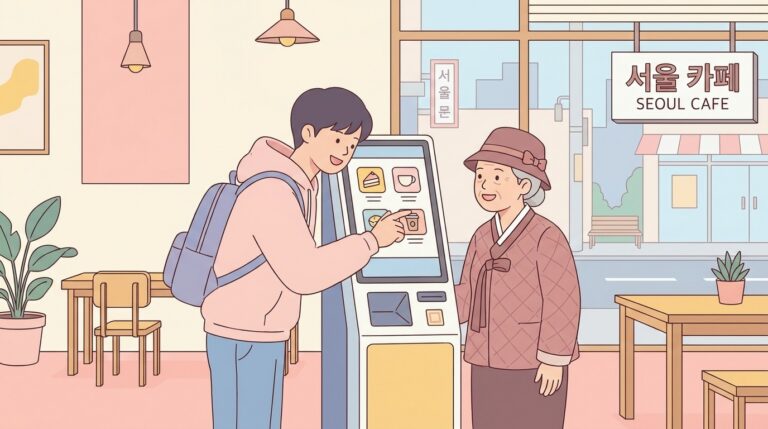
안녕하세요! (Annyeonghaseyo!) It is your Daily Hangul editor here. Picture this: you step into a bustling franchise cafe in Euljiro, Seoul, craving an iced Americano. The counter is quiet—almost eerie—because human cashiers are gone. In their place stand three sleek touchscreen kiosks (키오스크). Behind you, an elderly Korean grandmother (어르신 – eoreusin) holds a crisp 10,000 won bill, squinting at confusing menus like ‘shot add’ or ‘membership points.’ Her hands hesitate. The line swells. You want to offer help, and you also want to discuss this striking reality of modern South Korea with your Korean friends: how did the world’s most convenient cashless society leave its elders behind? Based on feedback from our B1 learners, stepping past basic ordering into thoughtful conversations about digital exclusion (디지털 소외) is the exact turning point where your Korean transforms from simple survival tourist speak into deep, meaningful connection.
Phase 2: 3 Key Expressions Deep-Dive
1. 키오스크 주문이 익숙하지 않으신가 봐요 (Kiosk jumuni iksuk-haji aneusinga bwayo)
- Pronunciation: [Kee-oh-seu-keu joo-moon-ee eek-sook-hah-jee ahn-eu-shin-gah bwah-yoh] (Think of ‘kiosk’ ending with a soft European ‘eu’ sound, not a hard ‘k’)
- Meaning: Literal: “It seems kiosk ordering is not familiar to you.” / Real Nuance: “You seem to be having a bit of trouble with the screen; may I gently acknowledge it without embarrassing you?”
- K-Culture Moment: Seen frequently in slice-of-life K-dramas where a thoughtful young lead notices an elder frozen in front of a fast-food touch terminal.
- Editor’s Insight: The ending
-나 봐요(-na bwayo) creates a polite speculative buffer. Rather than saying bluntly “You don’t know how to use this,” it softens your observation with warmth.- Situation Spectrum: Casual: ⚠️ (Use
-나 봐with friends only) | Semi-formal: ✅ | Formal: ✅- 🤔 Think About It: In your home country, do people talk aloud about technology barriers in public spaces, or is it considered private business?
2. 현금 없는 매장이 점점 늘어나고 있어요 (Hyeongeum eomneun maejang-i jeomjeom neureonago isseoyo)
- Pronunciation: [Hyun-geum ohm-neun mae-jahng-ee jum-jum neu-ruh-nah-goh eess-uh-yoh]
- Meaning: Literal: “Stores without cash are gradually increasing.” / Real Nuance: “Cashless stores are becoming the standard everywhere nowadays.”
- K-Culture Moment: Typical social commentary heard on YouTube street interviews and podcast debates about Korea’s hyper-digital payment revolution.
- Editor’s Insight:
점점(jeomjeom) means ‘step by step’ or ‘gradually.’ Pair it with-아/어 가다to describe noticeable societal transitions smoothly.- Situation Spectrum: Casual: ✅ | Semi-formal: ✅ | Formal: ✅
- 🤔 Think About It: How does your native language describe the tension between technological speed and human accommodation?
3. 어르신들이 많이 불편해하세요 (Eoreusindeuri mani bulpyeonheo-haseyo)
- Pronunciation: [Uh-reu-shin-deul-ee mahn-ee bool-pyeon-heh-hah-seh-yoh]
- Meaning: Literal: “The elders feel very uncomfortable.” / Real Nuance: “Seniors are having a really hard time coping with these changes.”
- K-Culture Moment: Mentioned in current-affairs talk shows when discussing the digital divide and public transport ticketing machines.
- Editor’s Insight: Notice the difference between
불편해요(I feel uncomfortable) and불편해하세요(He/she/they show feelings of discomfort). In Korean, when describing a senior’s internal feelings, the respectful-어/아 하시다form is mandatory at B1 level.- Situation Spectrum: Casual: 🚫 (Always honor elders with 어르신) | Semi-formal: ✅ | Formal: ✅
- 🤔 Think About It: Notice how Korean replaces clinical demographic labels like ‘the aged’ with honorific family-adjacent titles.
Phase 3: Textbook Korean vs Real Korean
Situation 1: Offering assistance to someone struggling at a self-checkout
- 📖 Textbook Korean: 제가 당신의 주문을 도와드릴까요? (Jega dangsin-ui jumuneul dowadeurilkkayo? – Shall I help your order, you?)
- 🗣️ Real Korean: 혹시 주문 어려우시면 제가 눌러드릴게요! (Hoksi jumun eoryeousimyeon jega nulleodeurilgeyo! – By any chance, if ordering is tricky, let me tap the screen for you!)
- 💡 Why is it different? Koreans almost never use ‘당신’ (dangsin) in direct speech to strangers. Instead, starting with ‘혹시’ (by any chance) reduces pressure, and ‘눌러드릴게요’ (I will press it for you) offers concrete, proactive help.
Situation 2: Discussing digital isolation with a coworker
- 📖 Textbook Korean: 노인들은 현대 기술에 적응하지 못합니다. (Noindeureun hyeondae gisure jeogeunghaji mothamnida. – The aged cannot adapt to modern technology.)
- 🗣️ Real Korean: 기계가 너무 빠르니까 어르신들은 소외감을 느끼실 수밖에 없어요. (Gigyega neomu ppareunikka eoreusindeureun so-oegam-eul neukkisil subakke eopseoyo. – Because technology evolves so fast, seniors inevitably end up feeling left out.)
- 💡 Why is it different? ‘노인’ sounds clinical; ‘어르신’ exudes warmth and filial respect. The grammar structure
-ㄹ 수밖에 없다(cannot help but) expresses natural empathy toward systemic issues.
Phase 4: K-Culture Deep Dive & Non-verbal Manners
4-1. 눈치 (Nunchi) & Spatial Manners at Kiosks
When someone elderly is stalled at a kiosk in Korea, hovering immediately behind their shoulder looking at your watch creates intense panic (식은땀). Practice good Nunchi (tactful situational awareness): stand at least two big steps back, facing slightly diagonally rather than staring directly at their screen. If you step in to help, never grab the payment card directly out of their hand. Instead, point gently with an open palm toward the screen option or card slot, and always use two hands (두 손) if receiving or guiding their transit card or credit card.
4-2. Cultural Code: The ‘Ppalli-Ppalli’ Speed Paradox
Korea’s legendary Ppalli-Ppalli (빨리빨리 – hurry, hurry) mindset birthed unmatched high-speed infrastructure: zero-wait table ordering, facial-recognition subway gates, and app-based taxis. Yet Korea is also an aging society built firmly on Confucian elder-respect. This friction creates a unique social conversation known as Digital Exclusion (디지털 소외). When visiting traditional neighborhood markets in Insadong or modern cafes in Gangnam, notice how smaller neighborhood spots still keep a bell or human window specifically marked for seniors.
Phase 5: Real-World Roleplay Scenario
- Setting: A high-turnover takeout coffee shop in downtown Seoul during the morning office rush.
- Character: 박 어르신 (Grandma Park, 74), who wants hot grain tea (미숫가루) but is paralyzed by a kiosk popup screen asking for app barcodes and extra syrup options.
-
Turn 1 (Grandma Park): 아이고… 화면이 왜 또 넘어갔담. 글씨가 하나도 안 뵈네.
(Aigo… hwamyeoni wae tto neomeogatdam. Geulssiga hanado an boene.)
“Oh dear… why did the screen jump again? I can’t read this small text at all.”🎭 Furrows brow, tapping randomly with trembling finger -
Turn 2 (You): 어르신, 혹시 도움이 필요하세요? 제가 도와드릴까요?
(Eoreusin, hoksi doumi piryohaseyo? Jega dowadeurilkkayo?)
“Grandmother, by any chance do you need some help? Shall I help you?”🎭 Steps forward gently with an open, friendly posture -
Turn 3 (Grandma Park): 학생, 고마워요. 따뜻한 미숫가루 한 잔 마시고 싶은데 뭘 눌러야 할지 모르겠어.
(Haksaeng, gomawoyo. Ttatteut-han misutgaru han jan masigo sipeunde mwol nulleoya halji moreugesseo.)
“Thank you, young person. I just want one warm grain latte, but I don’t know what to press.”🎭 Sighs with relief, pointing at the category tabs -
Turn 4 (You): 따뜻한 미숫가루요? 제가 눌러드릴게요. 매장에서 드실 건가요, 아니면 가져가실 건가요?
(Ttatteut-han misutgaruyo? Jega nulleodeurilgeyo. Maejang-eseo deusil geon-gayo, animyeon gajyeogasil geon-gayo?)
“Hot grain tea? I’ll press it for you. Will you drink it here, or take it to go?”🎭 Smiles, tapping the beverage smoothly and pausing at checkout -
Turn 5 (Grandma Park): 들고 갈 거야. 근데 내가 현금밖에 없는데… 여긴 카드만 받나 봐?
(Deulgo gal geoya. Geunde naega hyeongeumbakke eomneunde… yeogin kadeuman banna bwa?)
“To go, please. But I only have cash… does this place only take cards?”🎭 Pulls out a paper banknote hesitatingly -
Turn 6 (You): 아, 여기가 현금 없는 매장이네요. 괜찮으시면 제 카드로 결제하고 현금 주시겠어요?
(A, yeogiga hyeongeum eomneun maejang-ineyyo. Gwaenchaneusimyeon je kadeuro gyeoljehago hyeongeum jusigesseoyo?)
“Ah, this is a cashless store. If it is okay with you, shall I pay with my card and take your cash?”🎭 Takes out credit card calmly -
Turn 7 (Grandma Park): 어머나, 그래도 돼? 정말 너무 고마워요. 젊은이가 참 친절하네.
(Eomeona, geuraedo dwae? Jeongmal neomu gomawoyo. Jeolmeun-iga cham chinjeolhane.)
“Oh my, is that allowed? Thank you ever so much. You are so kind.”🎭 Hands over the cash with both hands, smiling brightly -
Turn 8 (You): 별말씀을요! 영수증 여기 있습니다. 주문번호 204번 나오면 받아 가세요!
(Byeolmalsseumeullyo! Yeongsujeung yeogi itsseumnida. Jumunbeonho ibaeksabon naomyeon bada gaseyo!)
“Don’t mention it at all! Here is your receipt. When order number 204 is called, you can pick it up!”🎭 Hands over receipt with two hands and bows politely
🔀 Interactive Decision Point
Suppose you are behind someone taking a long time at a busy station kiosk. What do you do?
* Choice A: Say softly, “어르신, 바쁘시면 제가 대신 주문해 드릴까요?” (Polite offer to assist).
* Feedback: [BEST] Highly courteous, respectful, and softens social anxiety for everyone in line.
* Choice B: Walk straight to the front, sigh loudly, and press buttons without asking.
* Feedback: [BAD] Extremely disrespectful in Korean culture; breaches spatial boundary and harms elder dignity.
* Choice C: Yell at the barista counter, “여기 사장님! 현금 손님 직접 와서 받으세요!”
* Feedback: [RISK] Well-intentioned, but puts both the minimum-wage worker and the elder in acute embarrassment.
Phase 6: 10-Second Emotion Shadowing Drill
[😊 다정하고 조심스럽게 / Warmly and gently]
혹시 / 키오스크 사용이 / 어려우신가요? / 제가 눌러드릴게요.
(Hoksi / kiosk sayong-i / eoryeousin-gayo? / Jega nulleodeurilgeyo.)
“By any chance / is using the kiosk / difficult? / I will tap it for you.”-
[🤔 안타깝고 진지하게 / Thoughtful and concerned]
디지털 기기가 편하긴 한데… / 어르신들은 / 소외되기 쉬운 것 같아요.
(Dijiteol gigiga pyeonhagin hande… / eoreusindeureun / so-oedoegi swiun geot gat-ayo.)
“Digital devices are indeed convenient, but… / elderly people / seem prone to being left out.” -
[🤝 명쾌하고 싹싹하게 / Bright and reassuring]
현금 없으시면 / 제 카드로 긁고 / 현금 주셔도 돼요!
(Hyeongeum eopseusimyeon / je kadeuro geulko / hyeongeum jusyeodo dwaeyo!)
“If you don’t have a card / I can swipe my card / and you can just hand me cash!”
Phase 7: K-Culture Mini Dictionary
- 키오스크 (Kiosk / Kioskeu): Unmanned touch-screen ordering terminal. Widely adopted across Korean bakeries, cafes, and snack bars (분식집).
- 디지털 소외 (Digital Soe / Digital Exclusion): The systemic gap where elderly citizens cannot access basic goods, tickets, or services due to rapid automation.
- 어르신 (Eoreusin / Respected Senior): The most polite and warm title for senior citizens in daily life, preferred far above ‘노인’ (No-in).
- 현금 없는 매장 (Hyeongeum Eomneun Maejang / Cashless Store): Establishments refusing paper money and coins, commonly seen in subway stops and large franchises.
Phase 8: Traveler’s Survival Kit
Top 3 Survival Phrases
- 1. 현금 결제도 되나요? (Hyeongeum gyeoljedo doenayo?)
- Pro Tip: Ask this before waiting in line if you only carry paper won at traditional markets or tourist stores.
- 2. 화면 글씨를 조금 키울 수 있나요? (Hwamyeon geulssireul jogeum kiul su innayo?)
- Pro Tip: Modern Korean government kiosks now include an ‘어르신 모드’ (Senior Mode with large fonts and simplified buttons).
- 3. 제가 대신 결제해 드릴게요. (Jega daesin gyeoljehae deurilgeyo.)
- Pro Tip: The golden phrase when you want to swipe your travel debit card on behalf of a confused senior holding cash.
Editor’s Travel Note
Before roaming around Seoul’s trendy cafes, download the [Naver Map app (네이버 지도 앱 다운로드)] to view user photos beforehand; many reviews mention whether ordering requires a kiosk or Korean mobile identity verification. Also, consider carrying a rechargeable transit card (T-money) or WOWPASS card, as almost all unmanned terminals accept these even when foreign credit cards occasionally glitch!
Phase 9: A Step Deeper (Reflection)
Korea’s rapid leap into a cashless reality reflects its boundless ambition for convenience, hygiene, and technological supremacy. Yet this velocity sometimes collides head-on with a core value of Korean civilization: Hyo (효 – filial responsibility and care for the community’s elders). Language is the mirror of this struggle—transforming cold technical obstacles into collective moments of warmth whenever someone pauses to say “제가 도와드릴게요.” Technology should build bridges across generations, not walls.
💬 Your Turn: Have you noticed cashless automation isolating seniors in your home city? How would you explain this challenge to a Korean friend? Drop your thoughts in Korean or English in the comments below!
Phase 10: FAQ & Avoiding Misunderstandings
Q: Is it rude to offer help to an elderly stranger at a Korean kiosk?
A: Not at all, provided your tone is humble! As long as you start with ‘혹시’ (by any chance) and ask ‘도와드릴까요?’ (May I help?), it is viewed as exemplary manners and warmth (jeong – 정).
Q: Why do so many Korean cafes refuse cash altogether?
A: High labor costs, store hygiene standards, and rapid inventory accounting led corporate franchises and compact takeout spots to switch to 100% cashless payment networks.
Q: Can foreign travelers use their home credit cards on Korean kiosks?
A: Most kiosks accept Visa and Mastercard, but older kiosks occasionally reject foreign cards if they require local IC-chip authorization. Carrying a prepaid tourist card like WOWPASS is a great backup.
🚨 Common Mistakes Alert
- Mistake 1: Calling an elder ‘할머니’ (Grandma) or ‘할아버지’ (Grandpa) when you are an adult stranger.
- Correct Action: Use 어르신 (Eoreusin) for a respectful, dignified address.
- Mistake 2: Using the verb ‘도와줄게요’ (I will help you) directly to an elder.
- Correct Action: Always use the humble honorific helper verb: 도와드릴게요 (Dowadeurilgeyo).
- Mistake 3: Shoving a card into the machine for someone without explaining.
- Correct Action: Keep them informed step by step: “카드 여기에 꽂으시면 돼요” (You can insert the card right here).
Phase 11: Action Missions
- 🥉 Bronze Mission: Practice pronouncing “어르신, 제가 주문 도와드릴까요?” three times in front of your mirror with a gentle smile.
- 🥈 Silver Mission: Write a 2-sentence Instagram or notebook reflection using the keyword 디지털 소외 (Digital exclusion) and tag
@DailyHangul. - 🥇 Gold Mission: On your next trip to Korea, look out for anyone hesitating near a kiosk or metro card recharge machine, and offer polite help in Korean!
- 🎮 K-Culture Mission: Watch an episode of a modern family K-drama (like Once Again or My Mister) and listen closely for how family members explain new mobile smartphone apps or kiosks to their grandparents.
Phase 12: Interactive Quiz Challenge
Test your knowledge from today’s guide! Click the toggle below to check your answers.
- Situational Judgment: You see an elderly gentleman staring blankly at a cafe kiosk that won’t accept his cash. What is the most natural B1 phrase to offer help?
- a) 야, 비켜봐. 내가 해줄게.
- b) 어르신, 제가 카드로 결제해 드릴까요?
- c) 노인은 기계를 쓰면 안 돼요.
- Fill in the Blank: Modern kiosks cause elderly digital exclusion: “기계가 너무 복잡해서 어르신들이 ________.” (Feel uncomfortable/struggle – honorific)
- Hint: Combine ‘불편하다’ with the honorific indirect feeling form.
- True or False: Calling a senior stranger ‘어르신’ is considered too formal and cold for everyday coffee shops.
👉 Click here for answers and explanations!
- Answer: b) 어르신, 제가 카드로 결제해 드릴까요?
- Explanation: It honors the elder with ‘어르신’ and uses the humble verb ‘결제해 드리다’. Choice (a) is rude slang; Choice (c) is offensive.
- Answer: 불편해하세요 (bulpyeonheo-haseyo)
- Explanation: When expressing that an elder experiences discomfort, use the honorific psychological pattern
-어/아 하시다.
- Explanation: When expressing that an elder experiences discomfort, use the honorific psychological pattern
- Answer: False!
- Explanation: ‘어르신’ is the most beloved, polite, and warmly accepted term for senior citizens across Korea.
- Explanation: ‘어르신’ is the most beloved, polite, and warmly accepted term for senior citizens across Korea.







