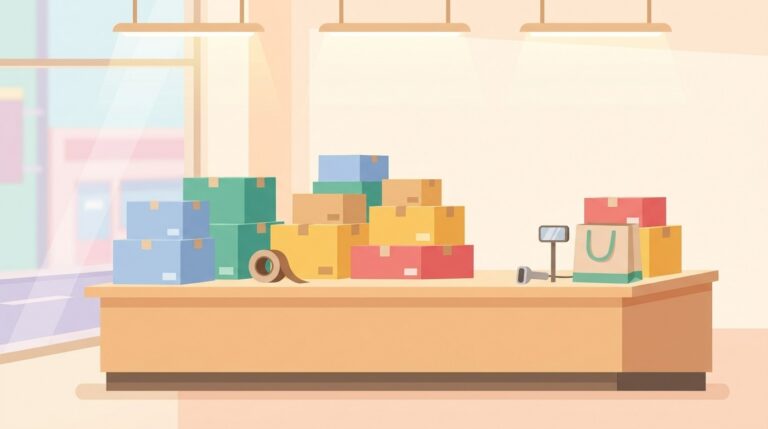
Master the Korean Supermarket Self-Packing Counter: Pack Like a Local Without the Sweat
Phase 1: 공감 (Story Immersion Opening)
안녕하세요! 매일한글 에디터입니다. (Hello! This is your Daily Hangul editor.)
Imagine this: You have just conquered a massive grocery run at E-Mart. You scored the coveted 1+1 dumplings, grabbed discounted Korean strawberries with tonight’s expiration sticker, and successfully swiped your card at the checkout. But just when you thought the mission was complete, you hit the ultimate final boss of Korean grocery culture: 자율포장대 (Jayul-pojangdae / The Self-Packing Counter).
You shuffle over with an overflowing shopping cart. Before you lies a towering mountain of flattened cardboard boxes, a few pairs of scissors, and a determined line of local shoppers who seem to fold, tuck, and assemble durable shipping-grade crates in 4.2 seconds flat. Meanwhile, you are holding a box upside down, your fragile instant ramyeon is about to get crushed by a 2-liter bottle of Jeju Samdasoo water, and a kind-hearted local ajumma is watching your packaging technique with anxious concern.
Does this sound familiar? You are definitely not alone. Every expat and traveler in Korea experiences that split-second panic at the self-packing counter. But mastering this space is a rite of passage! Today, drawing from real feedback from dozens of Daily Hangul learners, we will walk you through the essential A2-level Korean phrases, packing etiquette, and survival hacks you need to breeze through the counter with total confidence.
Phase 2: 핵심 표현 3선 심층 분석 (Top 3 Core Expressions)
1. 무거운 것부터 넣으세요. (Mugeoun geot-buteo neoeuseyo.)
- Pronunciation: [Moo-guh-oon got-boo-tuh nuh-uh-seh-yo] (Sounds like “Moo-go-un” + “gut-boo-tuh” + “no-uh-say-yo”)
- Meaning: “Please put the heavy items in first.”
- K-Culture Moment: In variety shows like Three Meals a Day or family K-Dramas, whenever someone prepares care packages (택배) of kimchi and side dishes to send to relatives in Seoul, family elders always repeat this exact golden rule.
- Editor’s Insight: “-부터 (-buteo)” means “starting from.” Combining it with “무거운 것 (heavy thing)” creates the classic logic of packing. If a mart worker or friendly shopper sees your crushed bread underneath canned tuna, they will warmly chime in with this phrase!
- Situation Spectrum:
- Casual (무거운 거 먼저 넣어): ⚠️ (Use only with close friends/younger people)
- Semi-formal (무거운 것부터 넣으세요): ✅ (Perfect for talking to strangers, clerks, or peers)
- Formal (무거운 물품부터 적재해 주시기 바랍니다): 🚫 (Too bureaucratic for daily life)
- 🤔 Think About It: Why does Korean frequently turn adjectives into nouns using “-것/거” (thing) rather than naming the specific object? Notice how efficient and flexible Korean becomes when grouping items by physical traits!
2. 박스 테이프는 없어요. (Bakseu teipeu-neun eopseoyo.)
- Pronunciation: [Bahk-soo tay-ee-poo-noon up-suh-yo] (Think of “box” said sharply, “tape” with two beats, and “up-suh-yo” like walking up stairs)
- Meaning: “There is no box tape (packing tape).”
- K-Culture Moment: Watch any recent vlog of foreigners visiting a Korean hypermarket post-2020. You will almost certainly see them wandering around the counter looking for clear tape, only to be politely informed by mart staff that tape has been removed due to eco-regulations!
- Editor’s Insight: Since 2020, major Korean supermarkets (Lotte Mart, Homeplus, E-Mart) banned plastic tape and plastic strapping bands to encourage recyclable paper box assembly. Knowing this saves you 10 minutes of looking around aimlessly.
- Situation Spectrum:
- Casual (테이프 없어): ⚠️ (Only with peers)
- Semi-formal (박스 테이프는 없어요): ✅ (Standard polite daily speech)
- Formal (테이프는 제공되지 않습니다): 🚫 (Announcements/official signage)
- 🤔 Think About It: How does the removal of tape shift the culture of the space from individual convenience to collective eco-responsibility?
3. 찌그러지지 않게 조심하세요. (Jjigeureojiji anke josimhaseyo.)
- Pronunciation: [Jjee-goo-ruh-jee-jee ahn-kay jo-sheem-ha-seh-yo] (The “Jji” sound pops like sizzling oil: “Jjee”!)
- Meaning: “Be careful so it doesn’t get crushed/dented.”
- K-Culture Moment: Seen in popular grocery-shopping scenes in dramas like Crash Landing on You or webtoons, where delicate snacks, fresh eggs, or tofu are protected like newborn babies amidst hectic market trips.
- Editor’s Insight: “찌그러지다 (jjigeureojida)” specifically describes hollow or soft things losing their shape under pressure (like a dented soda can, squished bakery bread, or crumpled fruit box).
- Situation Spectrum:
- Casual (찌그러지지 않게 조심해): ⚠️
- Semi-formal (찌그러지지 않게 조심하세요): ✅
- Formal (파손에 유의하시기 바랍니다): 🚫 (Used on warning signs)
- 🤔 Think About It: Korean has dozens of mimetic words describing damage or physical transformation. What does this reveal about Korean visual and tactile awareness?
Phase 3: 교과서 한국어 vs 진짜 한국어 (Textbook vs. Real-Life Korean)
Situation 1: Telling someone to put heavy items on the bottom
- 📖 교과서 한국어: 무거운 물품을 하단에 먼저 적재하십시오. (Mugeoun mulpumeul hadane meonjeo jeokjaehasipsio. / Please load heavy goods at the lower base first.)
- 🗣️ 진짜 한국어: 무거운 거 밑에 깔고, 가벼운 건 위에 올리세요. (Mugeoun geo mite kkalgo, gabyeoun geon wie olliseyo. / Put the heavy stuff on the bottom, and put the light stuff on top.)
- 💡 왜 다를까?: Real Koreans use the expressive everyday verb “깔다 (kkal-da)” (to lay down/spread at the bottom) rather than formal Sino-Korean terms like “적재하다 (to load cargo).”
Situation 2: Asking if a flattened box is available
- 📖 교과서 한국어: 이 상자를 제가 사용해도 괜찮습니까? (I sangjareul jega sayonghaedo gwaenchansseumnikka? / Is it permissible for me to utilize this box?)
- 🗣️ 진짜 한국어: 이거 쓰시는 거예요? (Igeo sseusineun geoyeyo? / Are you using this?)
- 💡 왜 다를까?: In real Korean conversation, less is more. Pointing slightly with your eyes or hand and asking “Is this being used?” is polite, clear, and universally understood without textbook stiffness.
Phase 4: K-Culture 딥다이브 & 비언어적 매너 (Deep Dive & Non-Verbal Manners)
4-1. 눈치 (Nunchi) & Body Language at the Packaging Station
- The Space Claim Rule: Self-packing counters get crowded during peak evening discount hours (8:00 PM – 10:00 PM). Never claim a whole table with your body. Place your box in your dedicated slot, fold the flaps, and keep your cart tucked behind you so others can pass.
- The Shared Scissors Courtesy: Scissors are often tied to the table with elastic string. If someone near you is waiting, make quick eye contact, cut your box flaps, and gently place the scissors in the center of the table with the handle facing toward them. A subtle head nod (목례) works wonders.
- Tucking Flaps Like an Origami Master: Since there is no plastic tape, you must interlock the bottom four flaps (fold flap 1, flap 2, flap 3, then tuck flap 4 under flap 1). If you look confused, an elderly shopper will likely step in to help. Accept their help with a bright smile!
4-2. Cultural Code: The Zero-Waste Revolution in Korea
Korea is among the world’s most disciplined nations regarding recycling (분리수거). When the Ministry of Environment phased out plastic tape and strings at mart self-counters, it sparked a national trend toward sturdy, self-locking origami folds or bringing massive reusable woven grocery bags (재사용 타포린백). Packaging your box without single-use plastic is not just a mart rule—it is an active civic performance of environmental responsibility.
Phase 5: 실전 롤플레이 시나리오 (Real-World Roleplay)
Setting: E-Mart Yeoksam Branch, 8:30 PM. The self-packing counter is bustling. You are holding a box that won’t stay closed, with fragile eggs and heavy milk cartons sitting on the table. A friendly neighborhood mart regular, Mrs. Park (박 여사님), notices your struggle.
- Turn 1 (Mrs. Park):
- 박 여사: 아이고, 총각/아가씨, 박스 밑이 다 터지겠어요! (Aigo, chonggak/agassi, bakseu mit-i da teojigesseoyo!)
- 🎭 Action: Points with worry at your unlocked box bottom.
- English: Oh dear, the bottom of your box is going to burst open!
- Turn 2 (You):
- You: 어, 진짜요? 테이프가 없어서 어려워요. (Eo, jinjjayo? Teipeuga eopseoseo eoryeowoyo.)
- 🎭 Action: Scratching your head sheepishly.
- English: Oh, really? It’s hard because there’s no tape.
- Turn 3 (Mrs. Park):
- 박 여사: 테이프 없어도 돼요. 날개 네 개를 엇갈려서 끼우면 튼튼해요. (Teipeu eopseodo dwaeyo. Nalgae ne gaereul eotgallyeoseo kki-umyeon teunteunhaeyo.)
- 🎭 Action: Swiftly demonstrates interlocking the cardboard flaps.
- English: You don’t need tape! If you interlock the four flaps, it’s very strong.
- Turn 4 (You):
- You: 와, 신기하네요! 가르쳐 주셔서 감사합니다. (Wa, singihaneyo! Gareuchyeo jusyeoseo gamsahamnida.)
- 🎭 Action: Bowing slightly with genuine admiration.
- English: Wow, that’s amazing! Thank you for showing me.
- Turn 5 (Mrs. Park):
- 박 여사: 그리고 무거운 것부터 넣으세요. 우유 밑에 넣고, 계란은 맨 위에! (Geurigo mugeoun geot-buteo neoeuseyo. Uyu mite neoko, gyeraneun maen wie!)
- 🎭 Action: Picking up the egg carton and handing it to you gently.
- English: And put the heavy items in first. Put the milk on the bottom, and eggs right on top!
- Turn 6 (You):
- You: 네, 계란 찌그러지지 않게 조심할게요. (Ne, gyeran jjigeureojiji anke josimhalgeyo.)
- 🎭 Action: Carefully placing the heavy milk cartons at the base of the box.
- English: Yes, I’ll be careful so the eggs don’t get crushed.
- Turn 7 (Mrs. Park):
- 박 여사: 옳지, 잘하네! 이제 끈 없이도 잘 들 수 있겠죠? (Olchi, jalhane! Ije kkeun eopsido jal deul su itgetjyo?)
- 🎭 Action: Giving you a proud grandmotherly pat on the shoulder.
- English: That’s it, good job! Now you can carry it easily even without string, right?
- Turn 8 (You):
- You: 네! 덕분에 다 포장했어요. 좋은 저녁 보내세요! (Ne! Deokbune da pojanghaesseoyo. Joeun jeonyeok bonaeseyo!)
- 🎭 Action: Lifting the firmly packed box with both hands and smiling.
- English: Yes! Thanks to you, I packed it all. Have a wonderful evening!
🔀 Interactive Branching Moment
While packing, you realize you need a pair of scissors sitting right next to another shopper. What do you do?
- Option A: Silently reach across their box and grab the scissors quickly.
- 🚫 Bad: Reaching directly across someone’s personal packing bubble without eye contact is considered rude and can cause them to drop fragile groceries.
- Option B: Point towards the scissors, smile, and say: “가위 잠깐만 써도 될까요?” (Gawi jamkkanman sseodo doelkkayo? / May I use the scissors for just a moment?)
- ✅ Best (Native Level): Polite, respectful, clear, and perfectly matches Korean public space etiquette!
- Option C: Loudly shout across the counter: “저기요! 가위 주세요!” (Jeogiyo! Gawi juseyo! / Hey over there! Give me scissors!)
- ⚠️ Risk: Too demanding. Other shoppers might think you are bossing them around as if they work at the mart.
Phase 6: 10초 감정 섀도잉 드릴 (10-Second Emotion Shadowing Drill)
Read these out loud with natural intonation, rhythm, and pauses indicated by /.
[😅 당황스럽고 조심스럽게 / Confused and gentle]
저기 혹시… / 이거 쓰시는 박스예요?
(Jeogi hoksi… / igeo sseusineun bakseuyeyo?)
“Excuse me… / by any chance, is this box being used?”-
[💡 깨달음을 얻고 밝게 / Bright realization]
아! / 무거운 것부터 / 먼저 넣어야겠네요.
(Ah! / mugeoun geot-buteo / meonjeo neoeoyagetneyo.)
“Ah! / I should definitely put / the heavy items in first.” -
[😊 고맙고 안도하며 / Relieved and warmly grateful]
도와주셔서 감사합니다! / 조심히 들고 갈게요.
(Dowajusyeoseo gamsahamnida! / josimhi deulgo galgeyo.)
“Thank you for helping me! / I will carry it carefully.”
Phase 7: K-Culture 미니 사전 (Mini Dictionary)
- 자율포장대 (Jayul-pojangdae): Self-packing station. Found near the exit doors of big marts. A designated public DIY zone filled with empty distribution boxes for customers.
- 종이박스 (Jongi-bakseu): Paper cardboard box. These are actual product boxes unpacked by mart clerks that morning—reused freely by customers instead of plastic bags!
- 장바구니 (Jangbaguni): Reusable shopping bag. If you don’t want to fold a box, marts rent out heavy-duty 500-won reusable bags that you can return anytime for a full cash refund.
- 마감세일 (Magam-seil): Closing time discount. Usually starts between 7:30 PM and 9:00 PM, offering 20% to 50% off fresh sushi, meat, and seasonal fruits.
Phase 8: 여행자를 위한 생존 키트 (Traveler’s Survival Kit)
Top 3 Survival Phrases
- 박스 하나 더 가져가도 돼요? (Bakseu hana deo gajyeogado dwaeyo?)
- Pro Tip: Ask this to nearby staff if your haul is too big for one box and you need an extra from the cart stack.
- 이거 깨지기 쉬워요. (Igeo kkaejigi swiwoyo.)
- Pro Tip: Use this to warn someone when placing eggs, glass jam jars, or soju bottles on the counter table.
- 종량제 봉투 한 장 주세요. (Jongnyangje bongtu han jang juseyo.)
- Pro Tip: If boxes are empty or your hands are full, say this at checkout to buy a standard city trash bag you can legally use as a shopping bag and then use for household trash later!
Editor’s Travel Note
- If you need to navigate to the nearest big mart branch, check opening and closing days via the Naver Map app official download link. Remember: in Korea, major hypermarkets are legally required to close on the 2nd and 4th Sunday of every month!
- Always keep an international mobile payment method or domestic WOWPASS / debit card ready, as many checkout lines are entirely cashless self-checkout (무인 계산대).
Phase 9: “한 발 더 깊이” (Cultural Reflection Essay)
In many countries, grocery shopping is an individualistic transaction: you pay, you receive your pre-bagged goods, and you walk away. The Korean 자율포장대 (self-packing station), however, is a miniature ecosystem of shared Korean communal consciousness (공동체 의식). Here, leftover industrial boxes become shared public property, scissors are communal tools, and strangers naturally watch out for each other’s fragile groceries. It reflects the Korean spirit of Palli-Palli (speed and efficiency) balanced with everyday Jeong (warm empathy).
💬 Your Turn: In your home country, how are groceries packed at supermarkets? Would a tape-free, DIY recycled box station work where you live? Tell us in the comments below!
Phase 10: FAQ & 흔한 실수 방지 (FAQ & Mistakes Prevention)
Q: Why did the staff take away packing tape and plastic string from Korean marts?
A: The Korean Ministry of Environment reached a voluntary agreement with mega-marts in 2020 to reduce unrecyclable plastic waste. Boxes bound with excessive tape cannot be recycled as clean pulp, so marts promote interlocking box bottoms or reusable bags.
Q: Can I take as many empty cardboard boxes as I want from the self-packing counter?
A: While boxes are free, courtesy dictates taking only what you need for your immediate purchases. Taking multiple empty boxes for moving home or personal parcel shipping without shopping at the mart is considered bad manners.
Q: What should I do if there are no folded boxes left at the counter?
A: Look underneath the counter table or near the mart pillar. Mart employees frequently roll out giant metal cage carts stacked with newly flattened produce boxes. You can politely take one from the cart!
🚨 흔한 실수 (Common Mistakes) 경고판
- ❌ Mistake 1: Putting fresh refrigerated meat or watery fish packages directly against raw cardboard with no inner bag, causing the box to get soggy and break.
- 👉 Correct Action: Use the thin biodegradable roll bags (롤백) from the produce section to wrap wet items before placing them into your box.
- ❌ Mistake 2: Forgetting to interlock the bottom flaps of the box, causing the contents to collapse right as you walk outside.
- 👉 Correct Action: Always fold the four flaps in alternating succession, and press firmly down inside the center to test its strength.
- ❌ Mistake 3: Leaving leftover scraps of cardboard, receipt trash, and plastic packaging on the counter table.
- 👉 Correct Action: Toss loose cardboard strips into the blue recycling bin (재활용 쓰레기통) located right beside the station.
Phase 11: 액션 미션 & 참여 유도 (Action Missions)
- 🥉 Bronze Mission: Stand in your kitchen, lift a heavy item, and say aloud three times: “무거운 것부터 넣으세요!”
- 🥈 Silver Mission: Find a cardboard box at home and practice the interlocking 4-flap fold without using any scotch tape. Take a quick photo and share it with your language buddies!
- 🥇 Gold Mission: Visit a Korean mart or Asian grocery store this weekend, assemble a box at the counter, and exchange a polite “감사합니다!” with fellow shoppers.
- 🎮 K-Culture Mission: Watch an episode of a Korean variety show featuring grocery shopping (like I Live Alone or Omniscient Interfering View). Listen closely for when the cast members say 박스 (box) or 장바구니 (shopping bag)!
Phase 12: 인터랙티브 퀴즈 챌린지 (Interactive Quiz Challenge)
Test your grocery packing savvy below!
1. Situational Judgment: You are packing a watermelon, a box of eggs, a bag of chips, and two 2-liter bottles of water. What goes into the bottom of the box first?
(A) Eggs and chips
(B) Watermelon and water bottles
(C) Chips and water bottles
2. Fill-in-the-Blank: Complete the phrase meaning “Be careful so it doesn’t get crushed”:
“(________) 않게 조심하세요.”
(A) 찌그러지지
(B) 넘어지지
(C) 젖지
3. True or False: Major Korean supermarkets provide clear plastic tape and plastic strapping bands at the self-packing counter for free. (True / False)
👉 Click here to check the answers and explanations!
- Answer: (B) – Always place heavy, solid items like watermelon and water bottles at the very bottom (“무거운 것부터 넣으세요”) to maintain balance and prevent crushing delicate goods.
- Answer: (A) 찌그러지지 – “찌그러지지 않게 조심하세요” means “Be careful so it doesn’t get crushed or dented.” (넘어지지 = don’t fall over; 젖지 = don’t get wet).
- Answer: False – Due to environmental sustainability laws in Korea, plastic packing tape and strapping bands were removed from self-packing stations in 2020. You fold and interlock the cardboard boxes naturally!