

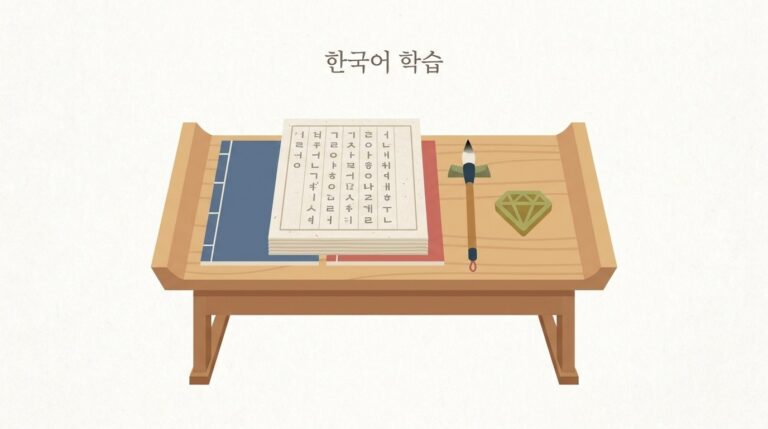
Phase 1: Empathy (Story-Immersive Opening)
안녕하세요! 매일한글 에디터입니다.
Imagine this scene: You are sitting in an austere, sun-drenched conference room inside a Paju Book City publishing house. You have just spent months drafting a critical essay or an ambitious creative manuscript in Korean. You pride yourself on reaching CEFR C2—you know how to construct elaborate relative clauses, you have mastered florid adjectival forms, and your vocabulary is packed with five-syllable Sino-Korean adverbs. You hand your draft to a veteran Korean literary editor. She smiles warmly, sips her barley tea, takes out a crisp red pen, and systematically slashes through half of your carefully chosen adjectives, cross-cutting your adverbs and striking through your winding modifier clauses.
Your stomach drops. Did you make grammatical errors? No. Grammatically, your text was immaculate. But as the editor slides the red-inked manuscript back across the table, she offers a piece of advice that changes your relationship with the language forever: “문장이 너무 기름져요. 군살을 덜어내야 뼈대가 살아납니다.” (The sentence is too greasy. You must strip away the flab for the spine to come alive.)
Many advanced Korean learners hit a deceptive plateau at the C2 level. In Western rhetorical traditions, precision often equates to exhaustive syntactic elaboration—qualifying every claim with specific adverbs and layered descriptors. In high-register, master-level Korean, however, true rhetorical mastery lies in the art of Jeolje (절제, restraint) and Toego (퇴고, rigorous revision). When you ruthlessly prune redundant descriptive markers, you liberate the lean, muscular nouns and verbs beneath. The result? A prose texture that doesn’t just inform, but hits the reader with the dense, cold weight of a polished diamond. This masterclass is built directly from years of coaching advanced translators and screenwriters, designed to help you cross the final threshold: saying exponentially more by saying dramatically less.
Phase 2: Deep Dive into 3 Core Rhetorical Expressions
1. 군더더기를 덜어내다 (Gundeodeogireul deoreonaeda)
- Pronunciation: [Goon-duh-duh-gi-reul duh-ruh-nae-da] (Think of a crisp, rhythmic cadence: “Goon” like a low gong, “duh-duh-gi” spoken lightly like tapping a desk, followed by a sweeping “duh-ruh-nae-da” as if brushing crumbs off a table.)
- Meaning: Literally “to subtract redundant baggage/dead weight”; rhetorically, to ruthlessly prune decorative words to reveal the conceptual core.
- K-Culture Moment: In the writer’s room of a prestige studio drama like My Mister (나의 아저씨) or The Glory (더 글로리), directors frequently demand: “감정 지문에 군더더기 다 덜어내세요.” (Strip all the flab from the emotional stage directions.) Instead of describing how a character “cries bitterly with a heart-wrenching sob,” the script simply reads: “민우, 문을 닫는다. 운다.” (Min-woo shuts the door. Weeps.)
- Editor’s Insight: 군더더기 (gundeodeogi) refers to useless flesh, skin tags, or clutter. Applying this verb to prose signals that your adjectives are not ornaments—they are obstacles blocking the emotional force of the predicate.
- Situation Spectrum: Casual (⚠️) / Semi-formal (✅) / Formal (✅)
- 🤔 Think About It: Does your native tongue equate descriptive density with intelligence? What happens to the pacing of a narrative when you refuse to guide the reader’s emotion with adverbs?
2. 행간에 묻어두다 (Haenggane mudeoduda)
- Pronunciation: [Haeng-gahn-eh moo-duh-doo-dah] (Intone “haeng-gan” cleanly like an open corridor, then land gently on “mudeoduda,” as if burying an heirloom softly under snow.)
- Meaning: Literally “to bury something between the lines”; the deliberate practice of omitting overt conclusions so that subtext vibrates in the reader’s mind.
- K-Culture Moment: When director Bong Joon-ho discusses screenwriting in interviews, he often highlights the unspoken friction between social classes. Characters never lecture each other on sociology; their economic despair is 행간에 묻어둔 채 (buried within the lines of ordinary, transactional banter).
- Editor’s Insight: Beginner and intermediate writers fear silence because they worry the reader won’t understand. Master-level Korean relies on an unspoken pact of mutual intuition (Nunchi) between writer and reader. If you spell out the moral of the story, you insult the audience’s perception.
- Situation Spectrum: Casual (⚠️) / Semi-formal (✅) / Formal (✅)
- 🤔 Think About It: How does trusting your audience to read between the lines elevate the collaborative intimacy between writer and reader?
3. 뼈대만 남기다 (Ppyodaeman namgida)
- Pronunciation: [Ppyo-dae-mahn nahm-gi-dah] (Explode the initial tense “Pp” sharply like a snapped twig, transitioning smoothly into the steady grounding of “namgida”.)
- Meaning: Literally “to leave only the structural skeleton”; reducing a syntactic construction strictly to the essential subject and root verb.
- K-Culture Moment: Renowned Korean novelists, such as Han Kang or Kim Hoon, are famous for boiling sentences down to their bare skeletal marrow. Kim Hoon famously spent days deliberating over whether to write “꽃이 피었다” (Flowers bloomed) versus “꽃은 피었다” (As for the flowers, they bloomed), discarding all intervening descriptors to let the raw fact of nature strike the page.
- Editor’s Insight: This expression reflects an architectural philosophy: adjectives are merely interior decor, but verbs and nominal cores are the load-bearing pillars. A sentence choked with decorative foliage collapses under its own weight.
- Situation Spectrum: Casual (✅) / Semi-formal (✅) / Formal (✅)
- 🤔 Think About It: In architecture and design, minimalism creates profound presence. How does applying that exact principle to Korean verbs alter your psychological posture when speaking or writing?
Phase 3: Textbook Korean vs. Real Native Master-Level Korean
Situation 1: Expressing Devastating Grief in Narrative Writing
- 📖 교과서 한국어 (Textbook/Over-decorated Korean):
그는 너무나도 참담하고 말로 다 표현할 수 없을 정도로 깊은 슬픔을 느끼며 조용히 하염없이 흐느껴 울었다.
(Geuneun neomunado chamdamhago mallo da pyohyeonhal su eopseul jeongdoro gipeun seulpeumeul neukkimyeo joyonghi hayeomeopsi heuneukkyeo ureotda.)
Translation: “He quietly and endlessly sobbed, feeling an extraordinarily tragic and deeply sorrowful grief that could not even be expressed in words.” - 🗣️ 진짜 한국어 (Diamond-Hard Native Korean):
그는 울음을 삼켰다. 끝내 무너졌다.
(Geuneun ureumeul samkyeotda. Kkeunnae muneojeotda.)
Translation: “He swallowed his weeping. In the end, he broke.” - 💡 왜 다를까? (Why the Difference?):
Textbook Korean learners often pile up adverbial intensifiers (너무나도, 말로 다 표현할 수 없을 정도로) to signal emotional magnitude. High-level literary Korean does the reverse: it uses stark, unadorned verbs (삼켰다, 무너졌다) to create a vacuum. The silence of the omitted adjectives hits the reader far harder than any hyperbolic description.
Situation 2: Drafting a High-Stakes Strategic Executive Summary
- 📖 교과서 한국어 (Textbook/Cluttered Korean):
본 프로젝트는 매우 다양한 잠재적 위험 요인들이 존재하고 있기 때문에, 저희는 무엇보다도 신중한 태도로 접근해야만 할 필요성이 상당히 높다고 판단됩니다.
(Bon peurojekteuneun maeu dayanghan jamjaejeok wiheom yoin-deuri jonjaehago itgi ttaemune, jeohuineun mueotbodado sinjunghan taedoro jeopgeunhaeyaman hal piryoseongi sangdanghi nopdago pandandoemnida.)
Translation: “Because very diverse potential risk factors are existing in this project, it is judged that the necessity to approach with a careful attitude more than anything else is considerably high.” - 🗣️ 진짜 한국어 (Diamond-Hard Native Korean):
위험 요인이 산적합니다. 신중한 접근이 불가피합니다.
(Wiheom yoini sanjeokhamnida. Sinjunghan jeopgeuni bulgapihamnida.)
Translation: “Risks abound. Prudence is imperative.” - 💡 왜 다를까? (Why the Difference?):
Weak corporate writing relies on hedging adjectives (매우 다양한, 상당히 높은) and bureaucratic noun wrappers (존재하고 있기 때문에, 필요성이 판단됩니다). Veteran Korean executives communicate using concise four-character Sino-Korean roots (산적, 불가피) and lean verbal assertions that command respect and convey authority.
Phase 4: K-Culture Deep Dive & Non-Verbal Manners
4-1. Nunchi & The Art of Physical Stillness
In elite Korean literary and academic settings, your physical demeanor must mirror your prose: controlled, composed, and devoid of performative excess. When presenting your arguments or debating editorial cuts with a Korean peer or professor:
* The Pregnant Pause (여운의 침묵): Do not rush to fill conversational gaps with filler sounds like “어… 그러니까 제 생각에는…” (Uh… I mean, in my opinion…). In Korean high discourse, taking three seconds of absolute, silent stillness before answering demonstrates profound cognitive gravity (무게감).
* Eye Line & Nodding: Instead of large, frantic Western head-nods, use a deliberate, fractional downward tilt of the chin. Keep your posture upright, hands lightly clasped over your notebook, and let your voice drop into a calm, steady lower register. Your physical containment reinforces your linguistic economy.
4-2. Cultural Code: The Poetics of ‘Yeobaek’ (여백의 미)
In traditional Korean ink-wash painting (수묵화, Sumukhwa), the most critical part of the canvas is not the dark strokes of pine trees or craggy cliffs—it is the Yeobaek (여백), the intentional white space left blank. This empty space is not an absence of meaning; it is the sea, the sky, the mist, and the breathing room of the cosmos.
This aesthetic logic directly governs master-level Korean sentence craft. An adjectival phrase tells the reader how to see; a modifier clause tells the reader how to interpret. By ruthlessly pruning these qualifiers, you create linguistic Yeobaek. Contemporary masterpieces—from the razor-sharp screenplays of Park Chan-wook (Decision to Leave) to the haunting, crystalline sentences of Han Kang—achieve visceral power precisely because the creator steps back, leaving an intentional void where the reader’s imagination rushes in.
Phase 5: Real-World Roleplay Scenario
Setting: An intimate editorial workshop inside a tranquil publishing cafe in Seochon, Seoul. Rainfall taps against the tall glass.
Characters:
* Editor Cha (차 편집장): A sharp-witted, renowned literary editor with 20 years of experience, holding a fountain pen.
* Julian (줄리안): A dedicated foreign scholar and writer refining his Korean critical essay for a major quarterly journal.
- Editor Cha: 🎭 Flipping slowly through the manuscript, tapping the red cap of her pen against the wooden table.
줄리안 씨, 글 전반에 담긴 사유는 참 깊어요. 그런데 문장이 숨을 못 쉬고 있네요.
(Julian-ssi, geul jeonbane damgin sayuneun cham gipeoyo. Geurende munjangi sumeul mot swigo inneeyo.)
“Julian, the contemplation across this entire piece is truly profound. But your sentences can’t breathe.” -
Julian: 🎭 Hesitating slightly, leaning forward with genuine curiosity.
숨을 못 쉰다니요? 논리적 연결을 위해 접속사와 수식어를 꼼꼼히 챙겼는데요.
(Sumeul mot swindaniyo? Nollijeok yeongyeoreul wihae jeopsoksa-wa susigeoreul kkomkkomhi chaenggyeonneundeyo.)
“They can’t breathe? I meticulously included connectives and modifiers to ensure logical coherence.” -
Editor Cha: 🎭 Underlining a dense sentence and looking up with a gentle, discerning gaze.
바로 그 수식어가 문제예요. 한 문장에 관형절이 세 개씩 엉켜 있으니 동사의 힘이 다 죽어버렸잖아요.
(Baro geu susigeoga munjeyeyo. Han munjange gwanhyeongjeori se gaessik eongkyeo isseuni dongsaui himi da jugeobeoryeotjanayo.)
“Those very modifiers are the problem. When three relative clauses entangle a single sentence, the verb’s vitality dies completely.” -
Julian: 🎭 Looking at the marked line, furrowing his brow as he reads it aloud.
‘끝없이 반복되는 고통에 시달리던 그는 결국…’ 아, 여기서 ‘끝없이 반복되는’을 도려내도 문맥이 통하네요.
(“Kkeuteopsi banbokdoeneun gotonge sidallideon geuneun gyeolguk…” Ah, yeogiseo ‘kkeuteopsi banbokdoeneun’eul doryonaedo munmaegi tonghaneyo.)
“‘Afflicted by endlessly repeating agony, he eventually…’ Ah, even if I excise ‘endlessly repeating,’ the context holds.” -
Editor Cha: 🎭 Smiling faintly, drawing a single clean stroke through the adjectives.
통하는 수준이 아니라, 비로소 울림이 생기죠. ‘그는 고통 속에 무너졌다.’ 이렇게 뼈대만 남기면 어떤가요?
(Tonghaneun sujuni anira, biroso ullimi saenggijo. ‘Geuneun gotong soge muneojeotda.’ Ireoke ppyodaeman namgimyeon eotteongayo.)
“It doesn’t just hold; it finally resonates. ‘He broke within the pain.’ What do you think when we leave only the skeleton like this?” -
Julian: 🎭 Taking a slow breath, his eyes widening as the structural clarity dawns on him.
훨씬 서늘하고 단단하네요. 제가 제 문장을 불신해서 군더더기를 덧칠하고 있었나 봐요.
(Hwolssin seoneulhago dandanhaneyo. Jega je munjangeul bulsinhaeseo gundeodeogireul deotchilhago isseonna bwayo.)
“It feels much colder, much harder. I think I was plastering on clutter because I lacked faith in my own sentences.” -
Editor Cha: 🎭 Handing the red pen across the table with an encouraging nod.
퇴고는 장식이 아니라 덜어내는 칼질이에요. 이제 줄리안 씨가 직접 불필요한 부사들을 쳐내 보세요.
(Toegoneun jangsigianira deoreonaeneun kaljirieyo. Ije Julian-ssiga jikjeop bulpiryohan busadeureul cheonae boseyo.)
“Revision isn’t decoration; it is the craft of cutting away. Now, try striking down the redundant adverbs yourself.” -
Julian: 🎭 Firmly gripping the pen, hovering over the next paragraph with decisive resolve.
네, 문장의 군살을 남김없이 덜어내겠습니다. 다이아몬드처럼 남을 때까지요.
(Ne, munjangui gunsareul namgimeopsi deoreonaegesseumnida. Daiamondeucheoreom nameul ttaekkajiyo.)
“Yes. I will prune away the flab without hesitation. Until it remains hard as a diamond.”
🔀 Interactive Decision Point
Editor Cha points to the final paragraph: “정말로 대단히 가슴 아프고 슬픈 비극적 운명이 눈앞에 다가왔다.”
How should Julian revise this sentence to achieve peak rhetorical impact?
- Option A: “비극이 닥쳤다.” (Bigeugi dakchyeotda. / Tragedy struck.)
- Option B: “참으로 비극적인 가련한 운명이 다가오고야 말았다.” (Chameuro bigeukjeogin garyeonhan unmyeongi dagaogoya maratda. / Truly, a tragic and pitiful destiny came upon them at last.)
- Option C: “그들은 너무나 불행하게도 비극을 정면으로 맞닥뜨렸다.” (Geudeureun neomuna bulhaenghagedo bigeugeul jeongmyeoneuro matdaktteuryeotda. / Unhappily, they faced tragedy head-on.)
Detailed Feedback:
* Option A (Best): 🏆 Masterstroke. You eliminated four redundant emotional wrappers (정말로, 대단히, 가슴 아프고, 슬픈) and transformed the bloated nominal construction into a single, thunderous subject-verb strike: 비극이 닥쳤다. The compression multiplies the gravity tenfold.
* Option B (Bad): ❌ Linguistic Gluttony. You merely replaced one set of archaic adjectives with another (참으로, 비극적인, 가련한). This keeps the sentence soggy, exhausting the reader before they even reach the predicate.
* Option C (Risk): ⚠️ Superficial Edit. While grammatically sound, adverbs like 너무나 and filler phrases like 불행하게도 dilute the tragedy. True grief in Korean thrives on restraint, not self-pitying adverbs.
Phase 6: 10-Second Emotion Shadowing Drill
Practice these lines out loud. Obey the slash marks (/) for breath pauses, and inhabit the emotional stage tags strictly.
[🧊 담담하지만 서늘하게 (Calm, yet chillingly detached)]
말을 보태지 마라. / 침묵이 / 더 많은 것을 말한다.
(Mareul botaeji mara. / Chimmugi / deo maneun geoseul malhanda.)
“Do not add words. / Silence / speaks vastly more.”-
[✍️ 결연하고 단호하게 (Resolute and fiercely decisive)]
군살을 / 다 도려내고 나니, / 비로소 / 문장의 뼈대가 드러났다.
(Gunsareul / da doryonaego nani, / biroso / munjangui ppyodaega deureonatda.)
“Once the flab / was excised entirely, / at long last / the sentence’s true spine appeared.” -
[🌌 깊은 여운을 머금고 (Holding deep, meditative resonance)]
모든 것을 다 쓰지 마라. / 진짜 이야기는 / 행간에서 피어난다.
(Modeun geoseul da sseuji mara. / Jinjja iyagineun / haenggan-eseo pieonanda.)
“Do not spell out everything. / The real story / blooms between the lines.”
Phase 7: K-Culture Mini Dictionary
-
퇴고 (Toego / [Toe-go]):
Literal Translation: Pushing and Knocking.
Cultural Usage: Derived from ancient poet Jia Dao debating whether to use “push the door” (퇴) or “knock on the door” (고). In contemporary Korean media and writing, it refers to the uncompromising, obsessive process of editing down one’s work until every syllable is indispensable. -
여백 (Yeobaek / [Yeo-baek]):
Literal Translation: Remaining/blank white space.
Cultural Usage: The cornerstone of traditional East Asian aesthetic philosophy. In screenwriting and literature, it describes the intentional emotional void where narrative meaning is suggested rather than explicitly broadcasted. -
군살 (Gunsal / [Goon-sal]):
Literal Translation: Flab; excess body fat.
Cultural Usage: Ubiquitously applied to writing, speaking, and organizational processes. A “sentence with flab” (군살이 낀 문장) is viewed as self-indulgent, undisciplined, and amateurish. -
압축미 (Apchukmi / [Ahp-chook-mi]):
Literal Translation: The beauty of high compression.
Cultural Usage: Used to praise masterworks of Korean poetry, minimalist cinema, and crisp corporate memos where vast philosophical or narrative weight is squeezed into a razor-thin structural container.
Phase 8: Traveler’s Survival Kit for Literary & High-Register Encounters
When exploring Seoul’s indie bookstores, cultural forums, or intellectual cafes in Daehangno or Seochon, use these ultra-concise survival phrases:
- Top 1: 핵심만 짚어주세요. (Haeksimman jipeojuseyo.)
Translation: “Please point out only the core essence.”
Pro Tip: Use this when a guide or colleague is giving overly lengthy explanations; it sounds exceptionally polished and professional. - Top 2: 줄여서 말하자면 이렇습니다. (Juryeoseo malhajamyeon ireoseumnida.)
Translation: “To put it in trimmed terms, it is as follows.”
Pro Tip: The premier phrase to transition your spoken thoughts into a punchy, high-impact summary. - Top 3: 군더더기 없이 깔끔하네요. (Gundeodeogi eopsi kkalkkeumhaneyo.)
Translation: “It is clean, without an ounce of clutter.”
Pro Tip: The highest compliment you can pay to an architect’s design, an essay, or a barista’s minimalist interior aesthetic.
Editor’s Travel Note:
When navigating Korea’s intellectual landscape, skip bloated search engine results and head directly to physical creative hubs like the Paju Book City complex or the independent publishing enclaves in Seochon. For seamless real-time transit and bookshop routing without linguistic clutter, make sure to execute your Naver Map app download well before you embark, as non-Korean mapping platforms frequently miss subtle neighborhood alleyways and independent bookshops.
Phase 9: “One Step Deeper” (Reflective Essay)
In Western classical rhetoric, eloquence is often equated with accumulation: the grand crescendo of adjectives, the parallel structure of stacked clauses, the majestic display of syntactic abundance. Korean intellectual history, shaped deeply by Daoist, Buddhist, and Seon (Zen) sensibilities, operates on the inverse premise: perfection is reached not when there is nothing left to add, but when there is nothing left to strip away. To load a sentence with adverbs is to demonstrate anxiety—a fear that the reality of the noun and the dynamism of the verb are insufficient on their own. Embracing the craft of Toego is therefore more than an editorial discipline; it is an ontological shift toward humility. When you master the confidence to let a solitary verb echo in the white space of the page, your Korean ceases to sound like a translated exercise—it begins to breathe with the authentic spirit of the culture.
💬 Your Turn: Look back at the last Korean paragraph you wrote. Which adjective or adverb can you delete right now that actually makes the core meaning hit three times harder? Share your “before and after” sentence below!
Phase 10: FAQ & Common Pitfalls
Q: If I cut all my adjectives and adverbs, won’t my Korean sound dry, robotic, or like an A1 beginner?
A: That is the ultimate paradox of C2 mastery. Beginners write simple sentences because they have no other vocabulary. Masters write stripped-down sentences because they have mastered every nuance and chose restraint. The difference lies in word choice: a beginner uses “나빴다” (was bad), whereas an advanced editor pares down a three-line rant into “파국이었다” (It was a catastrophe). Precise nouns and lethal verbs create poetic austerity, not robotic simplicity.
Q: Can I use this sparse style in everyday casual texting (카톡)?
A: Absolutely, but with care. In casual messaging, stripping adjectives entirely without emotional particles might make you sound blunt or cold (단답형). However, in professional Slack channels, literary drafting, editorial feedback, and high-level presentations, pruning verbal flab immediately marks you as an articulate, high-competence communicator.
Q: How do I identify what counts as “gunsal” (flab) in my writing?
A: Use the “Thumb Test.” Place your thumb over an adverb (like 대단히, 무척, 정말로) or a descriptive clause. Read the sentence aloud without it. Did the fundamental factual truth or emotional impact change? If not, that word was dead weight. Strike it out.
🚨 Common Mistakes Board
| Foreign Learner Mistake | Why It Weakens Your Korean | Correct Native Action |
|---|---|---|
| Overusing “너무”, “매우”, “진짜” in formal essays | Degrades the authority of your claims into casual hyperbole | Select a singular, high-register Sino-Korean verb or noun (극에 달하다, 치명적) |
| Stacking relative clauses (-하는, -했던, -한 것 같은) | Suffocates the subject and exhausts reader working memory | Split the monster clause into two lean, distinct sentences |
| Explaining the character’s internal feelings explicitly in stories | Treats the reader like a child, stripping all dramatic tension | State the cold physical action and bury the emotion in the subtext (행간) |
Phase 11: Action Mission & Engagement
- 🥉 Bronze Level: Open your Korean journal or a recent writing sample. Find three instances of the adverb “정말”, “너무”, or “굉장히”. Delete them completely and adjust the verb to carry the weight alone.
- 🥈 Silver Level: Craft an authentic, one-sentence literary description of Seoul on a rainy night using no adjectives whatsoever (nouns and verbs only). Share it on Instagram or Threads tagging
#DailyHangulC2. - 🥇 Gold Level: Read an editorial column from a premier Korean newspaper (like Kyunghyang Shinmun or Hankyoreh). Identify a complex sentence with more than 30 characters and rewrite it using 뼈대만 남기기 (leaving only the skeleton) under 15 characters without losing the core premise.
- 🎮 K-Culture Mission: Watch an episode of a critically acclaimed drama (e.g., My Mister or Stranger). Pause during a climactic emotional scene. Notice how few words the characters actually exchange during moments of profound heartbreak or crisis. Write down that silence.
Phase 12: Interactive Quiz Challenge
Test your mastery of advanced pruning and linguistic density!
1. Situational Judgment
You are polishing an analytical book review. Your current draft reads:
“이 책은 작가가 가지고 있는 매우 독특하고 누구도 쉽게 흉내 낼 수 없는 개성 넘치는 문체가 아주 잘 드러나 있는 훌륭한 걸작이다.”
Which of the following revisions exhibits true diamond-level compression?
- (A) 이 책은 작가의 독보적인 문체가 번뜩이는 역작이다.
- (B) 이 책은 대단히 훌륭한 작가만의 유니크한 개성이 철철 넘치는 작품이다.
- (C) 이 책에는 작가가 가진 독특한 문체가 매우 깊이 있게 잘 묘사되어 있는 걸작이다.
👉 Click to reveal Answer & Explanation
Correct Answer: (A)
* Why: Option (A) synthesizes fifteen words of flab (매우 독특하고 누구도 쉽게 흉내 낼 수 없는) into one razor-sharp adjective (독보적인, peerless) and replaces weak descriptors with a dynamic predicate (번뜩이는 역작이다). Options (B) and (C) remain saturated with amateur intensifiers (대단히, 유니크한, 매우 깊이 있게).
2. Fill-in-the-Blank
Complete the classical Korean rhetorical proverb regarding text revision:
“글의 밀도를 높이려면 화려한 수식어를 덜어내고, 문장의 ( )만 남겨야 한다.”
👉 Click to reveal Answer & Explanation
Correct Answer: 뼈대 (Ppyodae – structural skeleton / spine)
* Explanation: In Korean stylistic theory, 뼈대 represents the core subject-verb scaffolding that sustains narrative truth after all decorative foliage has been removed.
3. True / False Cultural Insight
Question: In high-level Korean corporate and artistic communication, explicitly writing out every step of your emotional reasoning is considered polite and persuasive because it eliminates ambiguity.
👉 Click to reveal Answer & Explanation
Correct Answer: False (F)
* Explanation: Over-explanation is frequently interpreted as rhetorical clumsiness or a lack of trust in the listener’s Nunchi and intellect. Leaving space between the lines (행간) and speaking through compressed, diamond-hard syntax conveys far higher intellectual authority and mutual respect.







