

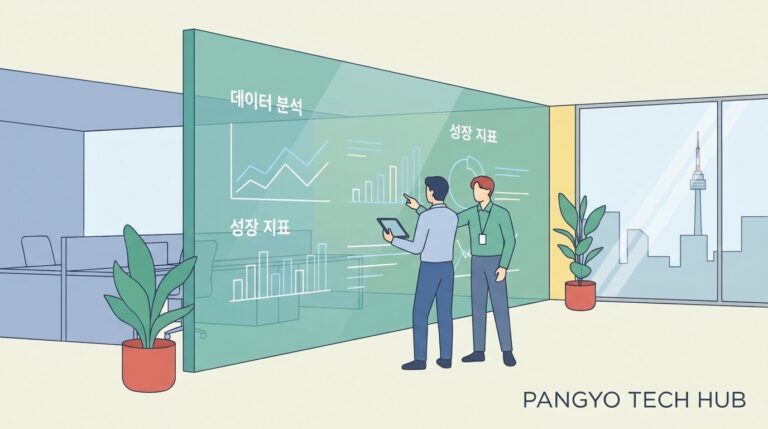
Phase 1: Empathy (Opening Story)
안녕하세요! 매일한글 (Daily Hangul) editor here! Imagine this: You’re standing in front of a sleek glass whiteboard in a sunlit meeting room in Pangyo Techno Valley—Korea’s Silicon Valley. You’ve spent two weeks crunching product metrics for an upcoming feature launch. In the room sits your 팀장님 (team lead), along with senior developers who look like they walked straight out of the K-Drama Start-Up (스타트업).
Confidently, you point at the uptick on the monitor and declare: “트래픽이 늘었으니 이 기능 때문입니다! (Because traffic increased, it must be due to this feature!)”
A heavy silence drops over the room. Your team lead adjusts their glasses, takes a slow sip of an iced Americano (아이스 아메리카노), and tilts their head slightly: “그건 단순 상관관계일 수도 있지 않을까요? (Couldn’t that just be a simple correlation?)”
Ouch. In that single moment, your pitch shifted from a sharp analytical proposal to what Koreans jokingly call “뇌피셜” (brain-official: an unverified personal hypothesis). In high-level Korean professional discourse (C1 level), knowing how to statistically defend your claims, isolate confounders, and clearly articulate the difference between 상관관계 (correlation) and 인과관계 (causation) isn’t just about statistics—it’s about demonstrating intellectual humility, credibility, and mastery of corporate nuance. Our corporate learners consistently tell us that mastering these nuanced hedging phrases transformed how their Korean colleagues perceived their seniority. Let’s elevate your analytical Korean so you never fall into this logical trap again!
Phase 2: Deep Dive into 3 Core Analytical Expressions
1. 단순히 상관관계일 뿐 인과관계로 단정 짓기는 이릅니다
- Korean: 단순히 상관관계일 뿐 인과관계로 단정 짓기는 이릅니다.
- Pronunciation: [Dansunhi sang-gwan-gwan-gye-il ppun in-gwa-gwan-gye-ro danjeong jit-gi-neun ireumnida] (Sounds like: dahn-soon-hee sahng-gwan-gwan-gyeh-eel ppoon een-gwah-gwan-gyeh-roh dahn-jeong jeet-gee-neun ee-reum-nee-dah)
- Meaning: “It is merely a correlation, so it is premature to conclude it as causation.”
- K-Culture Moment: Picture Han Ji-pyeong in Start-Up ruthlessly evaluating an overly optimistic founder pitching hockey-stick growth based on unrelated seasonality data.
- Editor’s Insight: The phrase “단정 짓기는 이릅니다” (it is premature to conclude) is the quintessential Korean business hedge. Instead of bluntly declaring “You are wrong,” this phrase signals sophisticated skepticism while leaving room for the other party to present better empirical proof.
- Situation Spectrum: Casual 🚫 | Semi-formal ⚠️ | Formal/Business ✅
- 🤔 Think About It: Why does Korean professional communication favor temporal distancing (“it is early/premature”) rather than direct disagreement (“that is incorrect”)?
2. 제3의 교란변수 가능성을 배제할 수 없습니다
- Korean: 제3의 교란변수 가능성을 배제할 수 없습니다.
- Pronunciation: [Je-sam-ui gyoranbyeonsu ganeungseong-eul baejehal su eopseumnida] (Sounds like: jeh-sahm-wee gyo-rahn-byon-soo gah-neung-song-eul beh-jeh-hahl soo op-seum-nee-dah)
- Meaning: “We cannot rule out the possibility of a third confounding variable.”
- K-Culture Moment: A forensic analyst or strategic consultant on a K-Drama like Stranger (비밀의 숲) explaining why an apparent financial motive is actually a distraction caused by an underlying policy change.
- Editor’s Insight: 교란변수 (confounding variable) is a must-know C1 statistical term. Pair it with “배제할 수 없습니다” (cannot exclude/rule out) to sound impeccably rigorous. It demonstrates that you see the hidden systemic dynamics rather than just surface-level numbers.
- Situation Spectrum: Casual 🚫 | Semi-formal ⚠️ | Formal/Business ✅
- 🤔 Think About It: How does highlighting external hidden factors reflect the Korean cultural worldview of interconnected context over isolated actors?
3. A가 B를 견인했다고 보기에는 논리적 비약이 있습니다
- Korean: A가 B를 견인했다고 보기에는 논리적 비약이 있습니다.
- Pronunciation: [A-ga B-reul gyeon-inhaetdago bogi-eneun nollijeok biyag-i itseumnida] (Sounds like: A-gah B-reul gyon-een-het-dah-goh boh-gee-eh-neun nohl-lee-jok bee-yahg-ee eet-seum-nee-dah)
- Meaning: “Claiming that A drove B involves a logical leap.”
- K-Culture Moment: An intense boardroom debate in a Seoul conglomerate where an executive shoots down a marketing agency’s exaggerated performance metrics.
- Editor’s Insight: “견인하다” literally means to tow a vehicle, but in economic and analytical contexts, it means to heavily drive or spearhead an outcome. Calling out a “논리적 비약” (logical leap) is polite yet sharp: it targets the reasoning structure rather than attacking the speaker personally.
- Situation Spectrum: Casual 🚫 | Semi-formal ✅ | Formal/Business ✅
- 🤔 Think About It: In your native language, do you criticize the person’s argument directly, or do you characterize the relationship between the facts as a “leap”?
Phase 3: Textbook Korean vs. Real Korean
Scenario 1: Pointing out that two trends just happened at the same time
- 📖 교과서 한국어 (Textbook): 두 데이터는 우연히 같이 변했을 뿐이며 원인과 결과가 아닙니다. (Du de-i-teo-neun uyeon-hi gachi byeonhaesseul ppun-imyeo won-in-gwa gyeolgwa-ga animnida / These two data points merely changed together by chance and are not cause and effect.)
- 🗣️ 진짜 한국어 (Real Professional C1): 동시 발생적 추세일 뿐, 선후 관계가 명확히 입증되지 않았습니다. (Dongsi balsaengjeok chuse-il ppun, seonhu gwan-gye-ga myeonghwak-hi ipjeungdoegi anatseumnida / It is simply a co-occurring trend; the chronological and causal sequence has not been clearly established.)
- 💡 왜 다를까? Textbook Korean sounds like an elementary school science textbook. High-level Korean professionals use conceptual terms like “동시 발생적” (co-occurring) and “선후 관계” (temporal precedence) to present an objective, methodological critique.
Scenario 2: Challenging a hasty conclusion during a sprint meeting
- 📖 교과서 한국어 (Textbook): 당신의 생각은 틀렸습니다. 상관관계와 인과관계는 다릅니다. (Dangsin-ui saenggak-eun teullyeotseumnida. Sang-gwan-gwan-gye-wa in-gwa-gwan-gye-neun dareumnida / Your thought is wrong. Correlation and causation are different.)
- 🗣️ 진짜 한국어 (Real Professional C1): 유의미한 상관성은 보이지만, 기저 효과를 고려한 추가 A/B 테스트 검증이 필요해 보입니다. (Yu-uimihan sang-gwanseong-eun bo-ijiman, gijeo hyogwa-reul goryeohan chuga A/B teseuteu geomjeung-i piryohae bo-imnida / While it exhibits meaningful correlation, further A/B test validation accounting for baseline effects appears necessary.)
- 💡 왜 다를까? Never say “당신은 틀렸습니다” (You are wrong) in a Korean organization. Instead, validate the data point first (“유의미한 상관성은 보이지만”), pinpoint a statistical artifact (“기저 효과”), and end with a constructivist proposal (“추가 검증이 필요해 보입니다”).
Phase 4: K-Culture Deep Dive & Non-Verbal Manners
4-1. 눈치 (Nunchi) & Meeting Room Gestures
When delivering a critical counterargument in a Korean corporate setting, your body language must balance confidence with deference:
* The Head Tilt and Pause: Before delivering a statement questioning causal links, tilt your head slightly (about 10 degrees) and pause for a second. This signals that you are deliberating deeply, not aggressively attacking.
* Two-Handed Laser Pointer / Screen Gesture: When pointing to a dashboard or slide to highlight a confounder, hold your pointer or open palm with your right hand, supported gently at the wrist or elbow by your left hand. This subtle corporate etiquette shows that even your technical challenges are anchored in professional respect.
* Tone Modulation: Lower your vocal pitch slightly at the end of the sentence. Avoid rising terminal intonation, which can sound combative or defensive in formal Korean debates.
4-2. Cultural Code Analysis: The Pangyo Tech Ethos vs. Chaebol Hierarchy
In modern Korean tech hubs like Pangyo, Teheran-ro, and Seongsu-dong, flat hierarchies (수평적 문화) are celebrated, and English nicknames are frequently used (e.g., “Dave 님”). However, beneath this casual surface lies an intense demand for 데이터 기반 의사결정 (Data-Driven Decision Making). Misattributing causality without empirical validation is considered one of the quickest ways to lose credibility. While younger startups tolerate vigorous intellectual pushback, traditional conglomerates (재벌) prefer challenges framed as “additional exploratory angles” (보완적 검토 사항) rather than outright refutations of leadership hypotheses.
Phase 5: Real-World Roleplay Scenario
- Setting: A sleek conference room at a fast-growing Seoul SaaS startup. Post-mortem meeting on quarterly customer churn.
- NPC Character: 팀장 민수 (Team Lead Minsu) — Sharp, detail-oriented, supportive but mathematically relentless.
민수: 이번 분기에 신규 UI 업데이트 이후 이탈률이 15% 감소했어요. 이번 디자인 개편이 사용자 유지율을 직접 견인했다고 볼 수 있겠죠? (Ibeon bun-gi-e sin-gyu UI eopde-iteu ihu itallryul-i sib-o-peosenteu gamsohaesseoyo. Ibeon dijain gaepyeon-i sayongja yujiyul-eul jikjeop gyeon-inhaetdago bol su itgetjyo? / Churn decreased by 15% following this quarter’s UI update. Can we conclude the design revamp directly drove user retention?)
You: 🎭 (Gently leaning forward, resting open palms on the conference table) 팀장님, UI 개편 시점과 맞물린 것은 고무적이지만, 단순히 상관관계일 뿐 인과관계로 단정 짓기는 이릅니다. (Timjangnim, UI gaepyeon sijeom-gwa manmullin geos-eun gomu-jeog-ijiman, dansunhi sang-gwan-gwan-gye-il ppun in-gwa-gwan-gye-ro danjeong jit-gi-neun ireumnida. / Team lead, while aligning with the UI revamp is encouraging, it is merely a correlation, so concluding it as causation is premature.)
민수: 🎭 (Narrowing eyes with curiosity) 음, 단정하기 이르다? 구체적으로 어떤 점에서 그렇게 보시나요? (Eum, danjeonghagi ireuda? Guchejeog-euro eotteon jeom-eseo geureoke bosinayo? / Hmm, premature to conclude? In what specific aspect do you see it that way?)
You: 동기간에 진행된 신규 구독 할인 프로모션이라는 제3의 교란변수 가능성을 배제할 수 없습니다. (Dong-gigane jinhaengdoen sin-gyu gudok hallin peuromosyeon-iraneun je-sam-ui gyoranbyeonsu ganeungseong-eul baejehal su eopseumnida. / We cannot rule out the possibility of a third confounding variable: the new subscription discount promotion run during the same period.)
민수: 🎭 (Tapping his pen on his notepad) 아, 프로모션 효과… 하지만 지표의 시계열 추세가 UI 배포 직후에 급격히 꺾였는데요? (Ah, peuromosyeon hyogwa… hajiman jipyo-ui sigyeyeol chuse-ga UI baepo jikhu-e geup-gyeok-hi kkeok-yeonneundeyo? / Ah, the promotion effect… but the time-series trend of the metric dropped sharply right after the UI deployment?)
You: 배포 직후의 단기적 반응만으로 결론을 내리기에는 표본 기간에 따른 통계적 비약이 있습니다. (Baepo jikhu-ui dan-gijeok ban-eung-man-euro gyeollon-eul naerigi-eneun pyobon gigane ttareun tong-gyejeok biyag-i itseumnida. / Drawing a conclusion solely from short-term reactions immediately following release involves a statistical leap due to the sample window.)
민수: 🎭 (Nodding approvingly with a slight smile) 일리 있는 지적이네요. 그럼 프로모션 비대상 코호트와 대조군 분석을 먼저 분리해 보죠. (Illi inneun jijeog-ineyo. Geureom peuromosyeon bidaesang kohoteu-wa daejogun bunseog-eul meonje bullihae bojyo. / That is a valid point. Let’s separate the non-promotional cohort and run a control group analysis first.)
You: 네, 두 변수의 독립성을 검증한 후 명확한 인과추론 리포트를 공유해 드리겠습니다. (Ne, du byeonsu-ui dongnipseong-eul geomjeunghan hu myeonghwak-han in-gwachuron ripoteu-reul gong-yuhae deurigetseumnida. / Yes, after validating the independence of the two variables, I will share a definitive causal inference report.)
🔀 Interactive Decision Fork
Imagine Team Lead Minsu pushes back: “그래도 경영진 보고는 다음 주인데, UI 성과로 올리는 게 낫지 않겠어요?” (Still, the executive report is next week; wouldn’t it look better to frame this as UI success?) How do you respond?
- Option A: “안 됩니다. 상관관계를 인과관계로 보고하면 나중에 데이터 신뢰도가 완전히 무너집니다.” (No. If we report correlation as causation, our data credibility will collapse later.)
- Outcome (Bad): Too confrontational. Blunts rapport and sounds patronizing to a manager under stakeholder pressure.
- Option B: “경영진께는 UI 개선과 프로모션의 복합적 요인으로 보고하되, 정밀 인과추론 분석을 부록으로 첨부하는 건 어떨까요?” (How about reporting it to executives as a composite outcome of UI enhancements and promotions, while appending our precise causal inference analysis as an addendum?)
- Outcome (Best): Brilliant political intelligence (처세술) and analytical integrity combined. Offers an actionable compromise while protecting methodological truth.
- Option C: “네, 팀장님 뜻이 정 그러시다면 그냥 UI 성과로 보고서 작성하겠습니다.” (Yes, if that is truly your intention team lead, I will just draft the report as UI performance.)
- Outcome (Risk): Sacrifices intellectual integrity. If leadership audits the data and discovers the discount skew, the responsibility falls squarely on the analyst.
Phase 6: 10-Second Emotion Shadowing Drill
Practice reading these lines aloud with the specified pause marks (/) and emotional tone:
[🧐 신중하고 지적이게 / Deliberately and intellectually]
“단순히 상관관계일 뿐 / 인과관계로 단정 짓기는 / 이릅니다.”
(Dansunhi sang-gwan-gwan-gye-il ppun / in-gwa-gwan-gye-ro danjeong jit-gi-neun / ireumnida.)-
[📊 객관적이고 차분하게 / Objectively and calmly]
“제3의 교란변수 가능성을 / 완전히 배제할 수는 / 없습니다.”
(Je-sam-ui gyoranbyeonsu ganeungseong-eul / wanjeon-hi baejehal su-neun / eopseumnida.) -
[🤝 설득력 있고 단호하게 / Persuasively and firmly]
“선후 관계가 명확하지 않은 상태에서 / 결론을 내리는 것은 / 논리적 비약입니다.”
(Seonhu gwan-gye-ga myeonghwak-haji aneun sangtae-eseo / gyeollon-eul naerineun geos-eun / nollijeok biyag-imnida.)
Phase 7: K-Culture Mini Dictionary
- 인과추론 (In-gwachuron) | Causal Inference
- The statistical process of concluding that one event or variable is the actual mechanical reason behind another, rather than just an associative pairing. Vital for advanced research, machine learning evaluation, and C-level Korean data proposals.
- 교란변수 (Gyoranbyeonsu) | Confounder / Confounding Variable
- Literally “disruption variable.” An extraneous variable that correlates with both the dependent and independent variables, muddling the true relationship. Often invoked when challenging oversimplified business dashboards.
- 비약 (Biyak) | Logical Leap / Jump
- An unwarranted jump in reasoning where the premises do not organically yield the conclusion. Used frequently in Korean debates, editorials, and executive performance reviews (“논리의 비약”).
- 뇌피셜 (Noepisyal) | Unsubstantiated Personal Theory
- Slang portmanteau of 뇌 (brain) + 오피셜 (official). Used jokingly among peers when someone states an opinion as an undeniable fact without empirical data.
Phase 8: Professional & Traveler Survival Kit
Top 3 Analytical Quick-Saves
- “추가 변인 통제가 필요합니다.” (Chuga byeon-in tongje-ga piryoham-nida.)
- Pronunciation: Choo-gah byon-een tong-jeh-gah pee-ryoh-hahm-nee-dah.
- Pro Tip: Use this to buy time when asked to make immediate assumptions on unexpected metric spikes.
- “상관성이 유의미하게 나타났습니다.” (Sang-gwanseong-i yu-uimihage natanatseumnida.)
- Pronunciation: Sahng-gwan-song-ee yoo-wee-mee-hah-geh nah-tah-naht-seum-nee-dah.
- Pro Tip: Safe, neutral praise when presenting initial positive data without overpromising causality.
- “대조군(Control Group) 설정이 선행되어야 합니다.” (Daejogun seoljeong-i seonhaengdoeeoya hamnida.)
- Pronunciation: Deh-joh-goon sol-jeong-ee son-heng-dweh-oh-yah hahm-nee-dah.
- Pro Tip: The ultimate C1 power-phrase when evaluating feature launches or operational experiments.
Editor’s Travel & Life Note
If you are visiting Seoul for business conferences, tech meetups, or coworking at places like Maru 180 or Dreamplus in Gangnam:
* Navigation: Google Maps has limited functionality in South Korea due to national security map data laws. Make sure to complete the 네이버 지도 앱 다운로드 to easily locate tech campuses, subway exits, and coworking cafes.
* Public Transit: Commuting between Pangyo and Gangnam via the Shinbundang Line (신분당선) takes only 15 minutes. Pick up a Climate Card (기후동행카드) or standard T-money card at any convenience store for seamless transfers.
Phase 9: “A Step Deeper” (Thinking Prompt)
In Korean intellectual culture, linguistic hedging (완곡어법) is not a sign of uncertainty; it is a manifestation of intellectual sophistication. When dealing with complex systems, declaring that A caused B without caveats signals intellectual arrogance or carelessness. By employing expressions like “~로 단정 짓기는 이릅니다” (it is early to conclude) or “~ 가능성을 배제하기 어렵습니다” (it is difficult to exclude the possibility), you paradoxically build higher trust. You acknowledge the limits of current observations and leave space for collective investigation.
💬 Your Turn: In your corporate or academic culture, is direct assertiveness rewarded more than nuanced hedging, or do your teams also value caution when interpreting statistical data? Share your thoughts below in the comments!
Phase 10: FAQ & Misconceptions
Q: Can I use the casual phrase “그건 뇌피셜이잖아요” in a meeting if my colleagues are friendly?
A: Absolutely not in formal or mixed-seniority business meetings. While “뇌피셜” is very common among coworkers during casual coffee chats or peer-to-peer coding sessions, saying it to a manager or during a presentation comes off as irreverent and dismissive. Stick to formal equivalents like “실증적 근거가 다소 부족합니다” (Empirical evidence is somewhat lacking).
Q: What is the exact difference between “상관성” and “상관관계”?
A: Both refer to correlation. “상관관계” (Correlation relationship) focuses more on the formal relational state between two entities, whereas “상관성” (Correlation property/tendency) is used like an attribute (e.g., “높은 상관성을 보이다” – to show high correlation).
Q: How do I express confidence in a conclusion without sounding careless about causality?
A: Use progressive probabilistic phrasing: “통계적 인과추론 모델을 통해 외생변수를 통제한 결과, 유의미한 영향력이 확인되었습니다.” (As a result of controlling for exogenous variables via statistical causal inference models, a meaningful influence was confirmed.)
🚨 흔한 실수 (Common Mistakes) Checklist
- ❌ Mistake 1: Saying “A 때문에 B가 일어났습니다” without causal proof.
- Correct Action: Use “A와 B 사이에 강한 양의 상관관계가 관찰되었습니다.” (A strong positive correlation was observed between A and B).
- ❌ Mistake 2: Using textbook words like “원인성” instead of “인과관계” or “인과성”.
- Correct Action: Use the standardized academic terms “인과관계” (causal relationship) or “인과추론” (causal inference).
- ❌ Mistake 3: Saying “제 말이 100% 맞습니다” (My word is 100% correct).
- Correct Action: Frame it methodologically: “현재 데이터 세트 기준으로는 해당 가설이 가장 높은 설명력을 지닙니다.” (Based on the current dataset, this hypothesis possesses the highest explanatory power).
Phase 11: Action Missions
- 🥉 Bronze Mission (Solo Practice): Read the Phase 6 Shadowing Drill aloud 3 times, focusing on clear separation at the pause marks (
/). Record yourself on your phone voice memo app and check your pitch. - 🥈 Silver Mission (Social Sharing): Pick one spurious correlation you saw in the news this week (e.g., ice cream sales vs. swimming accidents) and write a one-sentence Korean critique using “단순히 상관관계일 뿐 인과관계로 단정 짓기는 이릅니다.” Post it on Threads or X and tag
@DailyHangul! - 🥇 Gold Mission (Real-World Application): In your next standup, data review, or study group, replace a blunt statement like “A가 B의 원인입니다” with “A와 B 간의 상관성은 뚜렷하나, 교란변수 통제를 거친 후 인과관계를 검증해야 합니다.” Observe how your colleagues respond to your refined phrasing.
- 🎮 K-Culture Mission: Watch an episode of a Korean business or legal drama (like Start-Up or Stranger). Listen for the moment a character uses the word “비약” or “배제하다” in an argument and jot down the context in your study journal.
Phase 12: Interactive Quiz Challenge
1. Situation Judgment
Your junior analyst presents a report stating that users who bought winter coats also bought 30% more hot coffee, concluding that marketing winter coats directly compels users to purchase coffee. How would you give constructive feedback in polished C1 business Korean?
* A) “완전 엉터리 분석이네요. 커피와 코트는 아무 관계가 없습니다.”
* B) “두 변수 간의 상관성은 확인되지만, ‘기온 저하’라는 교란변수를 고려할 때 인과관계로 단정하기는 이릅니다.”
* C) “커피를 많이 사 마신 사람이 코트를 산 것은 아닐까요? 선후 관계가 바뀌었습니다.”
🔍 정답 및 해설 보기 (Click to Reveal)
정답: B
해설: Option B accurately highlights the existence of a common cause/confounder (‘기온 저하’ – drop in temperature) that drives both behaviors, while maintaining polite, constructive professional discourse. Option A is unnecessarily rude, and Option C assumes reverse causality without data.
2. Fill in the Blank
Fill in the missing technical term:
“회귀분석 결과 두 지표 사이의 높은 (________)가 관찰되었으나, A/B 테스트를 통한 (________) 증명 없이는 기능의 효과성을 확정할 수 없습니다.”
🔍 정답 및 해설 보기 (Click to Reveal)
정답: 상관관계 (또는 상관성) / 인과관계 (또는 인과성)
해설: The first blank describes an observational correlation between indicators (상관관계), while the second blank requires proof of causation (인과관계) obtained through experimental intervention (A/B testing).
3. True or False Cultural Quiz
Statement: In Korean corporate settings, pointing out that a metric is merely a correlation rather than causation should always be done directly and bluntly to demonstrate that you are a fearless data-driven thinker.
🔍 정답 및 해설 보기 (Click to Reveal)
정답: False
해설: Even in high-tech startups, methodological critiques must be paired with appropriate 눈치 (tact), temporal hedging (“단정 짓기는 이릅니다”), and collaborative suggestions for further testing rather than blunt dismissals.







