

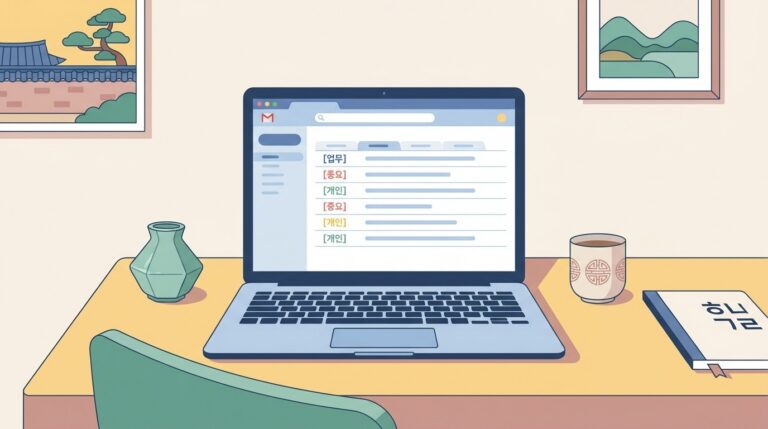
Master Korean Business Email Subject Lines: The Secret Tagging Formula
Phase 1: Empathy & Immersion (The Opening)
안녕하세요! 매일한글 (Daily Hangul) editor here! Imagine this scenario: You have spent three hours carefully crafting a comprehensive project proposal for your Korean partner company. You checked every honorific verb, attached the right PDF files, and eagerly hit ‘Send’. But three days pass, then a week… total silence. Did they find your proposal rude? Did they reject your initiative?
Chances are, your email was not rejected—it simply drowned. Think of classic workplace K-dramas like Misaeng (Incomplete Life) or Agency. Korean corporate professionals receive upwards of 150 emails every single morning before their first iced Americano even begins to melt. If your subject line was simply 안녕하세요, 제안서 전달드립니다 (Hello, sending proposal), it disappeared into the bottomless inbox ocean.
In Korean corporate culture, your email’s subject line is your digital business card and your first handshake. A crisp, structured title complete with a specific bracket tag (말머리 – mal-meo-ri) communicates authority, respect, and utmost professionalism. Drawing from real coaching sessions with global professionals navigating Seoul’s bustling business districts in Yeouido and Teheran-ro, this guide will transform the way you initiate communication. Let’s make sure your emails never get ignored again!
Phase 2: Deep Dive into 3 Key Subject Expressions
1. [협조 요청] (Hyeop-jo yo-cheong)
- Pronunciation: [Revised Romanization: Hyeop-jo yo-cheong | Phonetic clue: sounds like hyup-jaw yo-chung]
- Meaning: Literal: “Cooperation Request” vs. Real Nuance: “Action Required / Assistance Needed from Your Team”
- K-Culture Moment: Seen frequently in Misaeng when Sales Team 3 sends an urgent request to the Risk Management or Compliance team to unblock a project shipment.
- Editor’s Insight: This is the gold standard for cross-departmental requests. While “cooperation” sounds stiff in English, in Korean it strikes the exact balance between organizational courtesy and an imperative call to action.
- Situation Spectrum: Casual 🚫 | Semi-formal ⚠️ | Formal ✅
- 🤔 Think About It: In many Western corporate setups, asking an equal for “cooperation” might sound slightly demanding. Why does collective team obligation in Korean workplaces make
[협조 요청]the friendliest way to ask for work?
2. [공지] (Gong-ji)
- Pronunciation: [Revised Romanization: Gong-ji | Phonetic clue: sounds like a brass bell: Gong-jee]
- Meaning: Literal: “Public Notice” vs. Real Nuance: “FYI / Company-wide Announcement (No Reply Required)”
- K-Culture Moment: The staple subject header for HR department broadcasts announcing holiday gift selections or town hall notices.
- Editor’s Insight: Use this tag when you want to relieve the recipient of the burden of replying. When busy Korean managers see
[공지], their stress drops because they know they only need to read and archive. - Situation Spectrum: Casual ⚠️ | Semi-formal ✅ | Formal ✅
- 🤔 Think About It: Why does upfront categorization show deeper consideration for the other person’s mental energy than burying the intent inside the letter?
3. [긴급] (Gin-geup)
- Pronunciation: [Revised Romanization: Gin-geup | Phonetic clue: sounds like Geen-gup]
- Meaning: Literal: “Emergency / Urgent” vs. Real Nuance: “Immediate Priority / Time-Sensitive Matter”
- K-Culture Moment: In high-stakes advertising dramas like Agency, this tag flashes on monitors when an ad campaign experiences a critical PR breach or immediate client escalation.
- Editor’s Insight: Treat this tag like an emergency flare. If you overuse it for mundane inquiries, colleagues will quickly develop “urgency fatigue” toward your emails. Reserve it for same-day deadlines.
- Situation Spectrum: Casual 🚫 | Semi-formal ⚠️ | Formal ✅
- 🤔 Think About It: How does your native workplace culture flag true urgency without triggering panic or defensiveness?
Phase 3: Textbook Korean vs. Real Korean
Situation 1: Submitting a project draft for feedback
- 📖 Textbook Korean: 보고서를 보냅니다. 읽어보세요. (Bogoseoreul bonaemnida. Ilgeoboseyo. – I am sending the report. Please read it.)
- 🗣️ Real Korean:
[검토 요청] 3분기 마케팅 전략 기획안 1차 초안의 건([Geomto yocheong] Sambungi maketing jeollyak gihoegan ilcha choan-ui geon – [Review Request] In regard to the 1st draft of the Q3 marketing strategy plan) - 💡 Why the difference? Textbook phrasing uses full sentence verbs that sound naive or abrupt in subject lines. Real corporate Korean favors bracketed tags and nominalized noun phrases ending in
~의 건(“in the matter of”).
Situation 2: Asking for a meeting schedule confirmation
- 📖 Textbook Korean: 언제 시간이 되나요? 메일 주세요. (Eonje sigani doenayo? Meil juseyo. – When do you have time? Please email me.)
- 🗣️ Real Korean:
[일정 조율] 신규 파트너십 논의 미팅 요청의 건 (~5/12 마감)([Iljeong joyul] Sin-gyu pateuneosip nonui miting yocheong-ui geon (~5/12 magam) – [Schedule Coordination] Request for meeting to discuss new partnership (~Deadline: 5/12)) - 💡 Why the difference? Real professionals put both the exact purpose and the target deadline right inside the title so the reader can calendar the action without clicking into the email.
Phase 4: K-Culture Deep Dive & Non-Verbal Manners
4-1. Digital Nunchi (눈치) & CC/BCC Etiquette
Email etiquette in Korea is an exercise in high-context reading, known as Nunchi (눈치). When sending an email, your CC (참조 – cham-jo) and BCC (숨은참조 – sum-eun-cham-jo) choices speak louder than words:
* The CC Trap: Adding someone’s team leader or director to CC without warning can be interpreted as an aggressive move to escalate pressure (흔히 말하는 ‘일러바치기’ – tattling). Unless it is customary protocol, notify your peer beforehand.
* BCC Courtesy: When communicating with multiple external vendors or clients at once, failing to use BCC is a serious privacy compliance violation that immediately damages trust.
4-2. Cultural Code: The ‘Head-First’ (두괄식) Imperative
Korean grammar traditionally puts the core verb at the very end (E-mal-eun kkeut-kkaji deureobwaya anda – You must listen until the end of a Korean sentence). However, modern office culture fiercely rebels against this syntax through the 두괄식 (BLUF – Bottom Line Up Front) philosophy. Because workplace professionals are pressed for time, they invert traditional grammar in subject lines, front-loading the bracketed intent ([요청], [안내], [공지]) before anything else.
Phase 5: Real-World Roleplay Scenario
Setting: A dynamic corporate open-plan office in Gangnam. Min-woo (Senior Account Manager) checks in on Sarah (a foreign marketing specialist who just drafted an email to a vendor partner).
Turn 1 (Min-woo): 사라 씨, 이번 협력업체 정산 요청 메일 발송했나요? (Sarah-ssi, ibeon hyeomnyeog-eopche jeongsan yocheong meil balsong-haennayo? – Sarah, did you send out the settlement request email to our vendor partner?)
Turn 2 (Sarah): 네, 팀장님! 제목을 ‘안녕하세요 사라입니다’로 해서 방금 보냈습니다. (Ne, timjangnim! Jemogeul ‘Annyeonghaseyo Sarah-imnida’ro haeseo banggeum bonaesseumnida. – Yes, Manager! I sent it just now with the subject line ‘Hello, this is Sarah’.)
Turn 3 (Min-woo): 🎭 [눈을 크게 뜨며 가볍게 이마를 짚는다] 앗, 사라 씨! 그렇게 보내면 상대방이 스팸 메일인 줄 알고 그냥 넘길 수도 있어요. (At, Sarah-ssi! Geureoke bonaemyeon sangdaebangi seupaem meirin jul algo geunyang neomgil sudo isseoyo. – [Eyes wide, gently touching his forehead] Ah, Sarah! If you send it like that, they might think it’s spam and skip right over it.)
Turn 4 (Sarah): 🎭 [당황한 표정으로] 정말요? 먼저 정중하게 인사부터 건네는 게 예의인 줄 알았어요. (Jeongmallyo? Meonjeo jeongjunghage insabuteo geonneneun ge ye-uin jul arasseoyo. – [Looking flustered] Really? I thought greeting politely first was proper etiquette.)
Turn 5 (Min-woo): 비즈니스 메일에서는 첫 화면에서 용건을 파악할 수 있게 ‘말머리’를 달아주는 게 진짜 배려예요. (Bijeuniseu meireseo-neun cheot hwamyeon-eseo yong-geoneul pa-akhal su itge ‘malmeori’reul darajuneun ge jinjja baeryeoyeyo. – In business emails, real consideration means attaching a ‘tag’ so they understand the business matter at first glance.)
Turn 6 (Sarah): 그렇군요! 그럼 제목을 어떻게 수정하는 게 좋을까요? (Geureokunyo! Geureom jemogeul eotteoke sujeonghaneun ge joeulkkayo? – I see! Then how should I revise the subject line?)
Turn 7 (Min-woo): ‘[정산 요청] 5월 마케팅 용역 대금 지급 건 (~5/20)’처럼 대괄호 태그와 마감일을 함께 적어보세요. (‘[Jeongsan yocheong] O-wol maketing yong-yeok daegeum jigeup geon (~5/20)’cheoreom daegwalho taegeuwa magam-ireul hamkke jeogeoboseyo. – Try putting the bracket tag and deadline together like ‘[Payment Request] In regard to May marketing service fee (~5/20)’.)
Turn 8 (Sarah): 🎭 [수첩에 필기하며 미소 짓는다] 아하! 훨씬 명확하고 프로페셔널해 보이네요. 바로 회수하고 다시 보낼게요! (Aha! Hwoolssin myeonghwakhago peuropesyeoneolhae boineyyo. Baro hoesuhago dasi bonaelgeyo! – [Jotting in notebook with a smile] Aha! That looks infinitely clearer and more professional. I’ll recall it and resend immediately!)
🔀 Interactive Decision Point
Suppose Sarah needs to email the legal team for an urgent review of a contract closing today. Which subject line should she use?
* Choice A: [긴급/검토 요청] 신규 프로젝트 외주 계약서 최종 검토 건 (금일 17시 마감)
* Choice B: 계약서 파일 첨부했으니 오늘 안으로 꼭 봐주세요.
* Choice C: [공지] 계약서 검토 부탁드립니다.
- Feedback:
- Choice A (Best): Spot on! It specifies the urgent tag, describes the exact contract, and defines the hard deadline (17:00 today).
- Choice B (Bad): Far too conversational and demanding; lacks a bracket tag and ends casually without professional poise.
- Choice C (Risk):
[공지]means an announcement where no response is needed. The legal team won’t take action!
Phase 6: 10-Second Emotion Shadowing Drill
Practice reading these realistic email headers out loud with native intonation pauses (indicated by /).
[💼 Confident & Professional]
“[협조 요청] / 하반기 신제품 론칭 관련 / 부서 간 회의 건입니다.”
([Hyeop-jo yo-cheong] / Habangi sinjepum ronching gwanryeon / Buseo gan hoeui geon-imnida. – [Cooperation Request] / Regarding 2nd half new product launch / Inter-department meeting matter.)-
[🚨 Urgent Yet Respectful]
“[긴급 확인 요청] / 서버 정기 점검에 따른 / 사전 데이터 백업 안내의 건입니다.”
([Gingeup hwagin yocheong] / Seobeo jeong-gi jeomgeom-e ttareun / Sajeon de-iteo baegeop annae-ui geon-imnida. – [Urgent Check Request] / Following regular server maintenance / Matter of advance data backup notice.) -
[🤝 Helpful & Supportive]
“[자료 공유] / 글로벌 파트너십 미팅 / 회의록 및 발표 자료 전달 건입니다.”
([Jaryo gong-yu] / Geullobeol pateuneosip miting / Hoe-uirok mit balpyo jaryo jeondal geon-imnida. – [Material Sharing] / Global partnership meeting / Matter of delivering meeting minutes and presentation slides.)
Phase 7: K-Culture Mini Dictionary
- 말머리 (Mal-meo-ri) | Noun | Prefix tag inside brackets (
[]). Literally translating to “horse’s head”, it denotes the leading keyword placed in front of an article or email title. - 참조 (Cham-jo) | Noun | Carbon Copy (CC). In Korean corporate contexts, adding someone as 참조 implies: “You don’t have to act, but you must stay informed.”
- 숨은참조 (Sum-eun-cham-jo) | Noun | Blind Carbon Copy (BCC). Literally “hidden reference”; universally used when protecting external recipients’ identities.
- 두괄식 (Du-gwal-sik) | Noun | Bottom-Line-Up-Front (BLUF) communication structure, prioritizing the main conclusion before supporting explanations.
Phase 8: Traveler & Professional Survival Kit
Even if you are visiting Korea on business or communicating with traditional service providers, these 3 quick-use subject lines will fast-track your requests:
- Top 1:
[예약 문의] 10월 14일 세미나실 대관 가능 여부 문의드립니다.
([Yeyak muni] Siwol sipsail seminasil daegwan ganeung yeobu mun-uideurimnida.)
Pro Tip: Use this when emailing boutique hanok hotels, studio spaces, or event venues. - Top 2:
[방문 확인] 내일 미팅 방문자 명단 전달 건
([Bangmun hwagin] Naeil miting bangmunja myeongdan jeondal geon)
Pro Tip: High-security office towers in Gangnam or Yeouido require pre-registered guest lists before issuing elevator QR passes. - Top 3:
[문의] 결제 오류에 따른 재승인 요청 건
([Muni] Gyeolje oryu-e ttareun jaeseung-in yocheong geon)
Pro Tip: Ensures Korean customer support agents route your billing issue to finance immediately. -
Editor’s Travel & Tech Note: When collaborating with Korean teams, coordinate messaging channels through enterprise tools like Naver Works or Dooray. Use the Naver Papago translation app to cross-verify formal honorific noun endings before pressing send.
Phase 9: “One Step Deeper” (Reflective Essay)
In Western communication, politeness is often communicated through extensive pleasantries and conversational warmth: “I hope this email finds you well on this sunny Tuesday.” But in Korea’s hyper-efficient corporate landscape, consideration (배려 – baeryeo) wears an entirely different coat.
True courtesy here means respecting your counterpart’s cognitive load and precious time. By distilling your core objective into brackets like [협조 요청] and structuring your topic as a concise noun phrase, you free your recipient from guessing your motive. It is an act of communal harmony: saving others three seconds of confusion keeps the entire collective engine running smoothly.
💬 Your Turn: How do you indicate priority and urgency in your native language without sounding rude or pushy? Have you ever had an email buried because of an unclear title? Share your experience in the comments!
Phase 10: FAQ & Common Mistakes
Q: Can I combine multiple tags together, like [긴급/요청]?
A: Yes! Combining two succinct tags like [긴급/검토] or [공지/필독] (pil-dok – must-read) is standard practice when a matter requires both categorization and heightened alertness.
Q: Is it considered demanding to include a deadline in the subject line?
A: Not at all! In fact, stating (~5/18 15시 마감) at the end of the subject line is widely appreciated because it allows recipients to schedule their task queue without having to scan the body text.
Q: Can I use [협조 요청] when emailing clients or senior external executives?
A: Be careful. 협조 implies teamwork among peers or internal departments. When emailing VIP clients or prospective buyers, use softer tags like [제안] (Proposal) or [문의] (Inquiry) rather than asking for their “cooperation.”
🚨 Common Mistakes Warning Board
- Mistake: Writing casual conversational greetings as subject titles (e.g., 안녕하세요 과장님!).
- Correct Action: Keep greetings inside the email body; use
[용건] 핵심 내용의 건for the title.
- Correct Action: Keep greetings inside the email body; use
- Mistake: Using casual polite endings (
~요) in titles (e.g., 기획서 확인해주세요).- Correct Action: End titles in formal noun phrases like
~확인 요청의 건or~공유의 건.
- Correct Action: End titles in formal noun phrases like
- Mistake: Overusing the tag
[필독](Must Read) when you are not senior management or HR.- Correct Action: Stick to
[안내]or[공지]to avoid appearing overbearing.
- Correct Action: Stick to
Phase 11: Action Missions
- 🥉 Bronze Mission (Solo Drill): Open your email client draft folder and create a mock subject line requesting annual leave approval from your manager using the tag
[휴가 신청]. - 🥈 Silver Mission (Social Share): Share your best-crafted Korean business subject line on Threads or Instagram and tag @DailyHangul for editor feedback.
- 🥇 Gold Mission (Real-World Execution): The next time you write an inquiry to a Korean company, university admissions office, or tutor, apply a bracket tag and a clear deadline tag!
- 🎮 K-Culture Mission: Watch one episode of Misaeng or Search: WWW and look at how employees format titles on company intranet monitors.
Phase 12: Interactive Quiz Challenge
1. Situation Judgment: You are sending an email to the design team asking them to adjust a banner size before tomorrow afternoon. Which subject line is the most professional?
* (A) 디자인팀 배너 크기 좀 바꿔주세요 빨리요
* (B) [협조 요청] 신규 프로모션 배너 사이즈 수정 건 (내일 14시 마감)
* (C) [공지] 프로모션 배너 크기 수정
2. Fill-in-the-Blank: Complete the subject line tag used when you are sharing meeting minutes where no follow-up action is needed:
* [_____ 공유] 5월 12일 글로벌 마케팅 정기 회의록 전달의 건
3. True or False: In Korean business emails, it is impolite to put specific brackets or deadlines in the subject line because it looks too impatient.
* (True / False)
👉 Click to reveal answers & explanations!
- Answer: (B) – Perfect tag (
[협조 요청]), formal nominal ending (~의 건), and precise deadline. - Answer: 자료 (or 회의록) –
[자료 공유](Material Sharing) or[회의록 공유]clearly signals an informational handoff. - Answer: False! – Putting brackets and explicit deadlines is considered considerate business etiquette that respects the recipient’s schedule.







