

No More Awkward Goodbyes: The Friendly Secret to Saying See You Again in Korean
Phase 1: Empathy & Storytelling Opening
안녕하세요! 매일한글 에디터입니다. (Hello! I’m your Daily Hangul editor.)
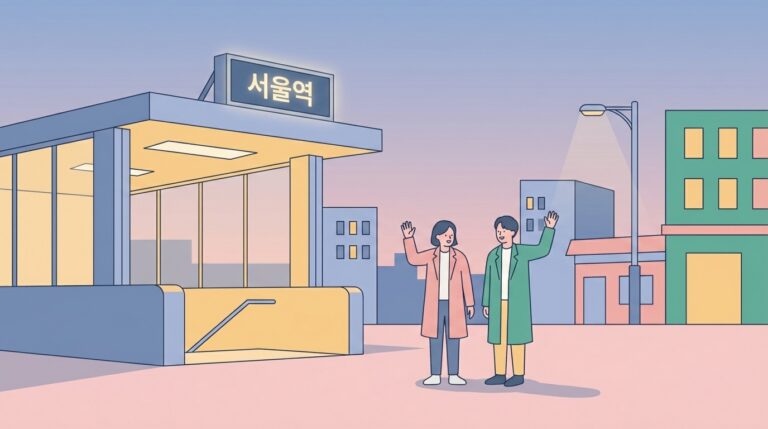
Picture this: You just spent an unforgettable evening in Seoul. You and your new Korean friend shared hot teokbokki at a bustling pojangmacha tent, laughed over spicy noodles, and walked down the illuminated streets of Hongdae. Now, you find yourselves standing outside the subway turnstiles at Hongik University Station. Your friend smiles warmly, bows slightly, and prepares to head down the stairs. Your heart is full, but suddenly… your mind goes completely blank. You want to say, “See you next time!” with warmth and enthusiasm, but all your brain serves up is that robotic phrase from chapter one of an old textbook: 안녕히 가십시오 (Annyeonghi gasipsio). You freeze, hesitate, and end up giving an awkward, stiff two-handed wave while blurting out “Bye-bye!”
Sound familiar? You are definitely not alone. Over the past ten years coaching beginner Korean learners at Daily Hangul, this exact moment is where almost every student hits an emotional wall. Saying goodbye in Korean isn’t just about closing a conversation; it is a warm, cultural bridge that keeps the relationship alive until your next encounter. Today, we are upgrading your goodbye toolkit from stiff and robotic to effortlessly natural, warm, and native-friendly. Let’s dive in!
Phase 2: Core Expressions Deep Dive
Here are the top three farewell expressions you will hear and use constantly across Korea.
1. 다음에 또 만나요 (Daeume tto mannayo)
- Pronunciation: [Dae-um-e tto man-na-yo] (Pronunciation tip: ‘Dae-um-e’ sounds like ‘day-oom-eh’; make the ‘tto’ sharp and punchy like ‘t-toe’; finish with a smooth ‘man-nah-yo’.)
- Meaning: Literal: “Next time again meet.” vs. Real Nuance: “Let’s definitely catch up again next time! (Polite, warm, and inviting)”
- K-Culture Moment: You will hear this at the end of almost every Korean YouTube vlog or after a heartwarming dinner with colleagues in a K-drama.
- Editor’s Insight: The magic ingredient here is 또 (tto), which means “again.” It signals that you genuinely enjoyed your time together and anticipate meeting again.
- Situation Spectrum: Casual ⚠️ | Semi-formal ✅ | Formal ✅
- 🤔 Think About It: In English, we casually toss out “See ya!” without necessarily planning to meet. How does explicitly adding “again” (또) shift the warmth of a friendship?
2. 또 봐요 (Tto bwayo)
- Pronunciation: [Tto bwa-yo] (Pronunciation tip: Pop the ‘tto’ crisply, followed by ‘bwah-yo’ like ‘bwah’ in voila.)
- Meaning: Literal: “See again.” vs. Real Nuance: “See you soon! / Catch you later!”
- K-Culture Moment: Picture your favorite K-pop idols waving at fans at the end of a live stream or leaving a casual dance rehearsal.
- Editor’s Insight: This is the breezy, lighthearted cousin of 다음에 또 만나요 (Daeume tto mannayo). It is shorter, punchier, and feels naturally friendly without losing politeness.
- Situation Spectrum: Casual ✅ | Semi-formal ✅ | Formal 🚫
- 🤔 Think About It: Why do you think shorter phrases in Korean often imply closer emotional distance?
3. 조심히 들어가세요 (Josimhi deureogaseyo)
- Pronunciation: [Jo-sim-hi deu-reo-ga-se-yo] (Pronunciation tip: ‘Jo-sim-hi’ sounds like ‘cho-sheem-hee’, followed by ‘deu-ruh-gah-say-yo’.)
- Meaning: Literal: “Carefully enter [your home].” vs. Real Nuance: “Get home safely! Take care on your way back.”
- K-Culture Moment: The iconic parting scene where a drama lead watches their friend walk toward their apartment door at night.
- Editor’s Insight: Koreans rarely just say goodbye when parting at night; they care about your journey back. Wishing someone a safe arrival home is the ultimate sign of consideration.
- Situation Spectrum: Casual ⚠️ (use 조심히 들어가 [Josimhi deureoga] for close peers) | Semi-formal ✅ | Formal ✅
- 🤔 Think About It: English speakers say “Have a safe trip,” but Koreans specifically mention “entering your house.” What does this tell you about Korean caring culture?
Phase 3: Textbook Korean vs. Real Korean
Situation 1: Parting with a new classmate or friend after coffee
- 📖 교과서 한국어 (Textbook Korean): 안녕히 가십시오. (Annyeonghi gasipsio.) — “Good-bye (Formal).”
- 🗣️ 진짜 한국어 (Real Korean): 다음에 또 봐요! (Daeume tto bwayo!) — “See you again next time!”
- 💡 왜 다를까? (Why the difference?): 안녕히 가십시오 (Annyeonghi gasipsio) sounds like an automated pre-recorded announcement inside a subway train or airport terminal. Real friends use friendly, rhythmic expressions that build warmth.
Situation 2: Saying goodbye to an older acquaintance or coworker at the train station
- 📖 교과서 한국어 (Textbook Korean): 잘 가세요. (Jal gaseyo.) — “Go well.”
- 🗣️ 진짜 한국어 (Real Korean): 조심히 들어가세요, 다음에 또 봬요! (Josimhi deureogaseyo, daeume tto bwaeyo!) — “Get home safely, see you again next time!”
- 💡 왜 다를까? (Why the difference?): While 잘 가세요 (Jal gaseyo) is grammatically fine, by itself it can feel a bit abrupt. Pairing safety wishes with the humble verb 봬요 (bwaeyo – humble form of see) sounds polished and deeply respectful.
Phase 4: K-Culture Deep Dive & Non-Verbal Manners
4-1. 눈치 (Nunchi) & Gestures
- The Two-Handed Gentle Wave: Never wave your hand wildly across your face like you are flagging down a taxi. Instead, keep your elbow close to your waist, raise one or both hands to chest height, and give a subtle, gentle flutter of your fingers while tilting your head in a soft 15-degree nod.
- The “Baeung” (배웅 – Seeing Someone Off) Glance: When parting in Korea, never pivot on your heels and march straight ahead without looking back. Take three steps, pause, turn back around, and offer one final warm nod and smile. This shows you value their presence until the very last second.
4-2. Cultural Code: The Promise of “밥 한번 먹어요”
Have you ever heard someone in a K-drama say 밥 한번 먹어요 (Bap hanbeon meogeoyo – Let’s have a meal sometime) right before leaving? In Western cultures, this might sound like an invitation to open your calendar app. In Korea, this phrase is often a warm social handshake! It symbolizes emotional hospitality and means: “I enjoy your company, and our connection remains open.”
Phase 5: Real-Life Roleplay Scenario
Setting: Outside a cozy vintage record cafe in Yeonnam-dong on an autumn evening. The city breeze is crisp, street lamps cast a gold glow, and you are parting ways with Min-woo (민우), a friendly Korean university student you met through a language exchange.
- Turn 1 (Min-woo): 오늘 진짜 재미있었어요! (Oneul jinjja jaemiisseosseoyo!)
🎭 Smiling brightly while adjusting his wool scarf.
“I had so much fun today!” - Turn 2 (You): 저도요! 시간 가는 줄 몰랐어요. (Jeodoyo! Sigan ganeun jul mollasseoyo.)
🎭 Nodding warmly with both hands in your pockets.
“Me too! I completely lost track of time.” - Turn 3 (Min-woo): 벌써 막차 시간 다 됐네요. (Beolsseo makcha sigan da dwaenneyo.)
🎭 Checking his watch and looking towards the subway entrance.
“It’s already almost time for the last train.” - Turn 4 (You): 아, 맞네요. 얼른 가셔야겠어요. (A, manneoyo. Eolleun gasyeoyagesseoyo.)
🎭 Taking a step toward the station stairs with a gentle smile.
“Ah, you’re right. You should hurry on.” - Turn 5 (Min-woo): 네! 오늘 와줘서 고마워요. (Ne! Oneul wajwoseo gomawoyo.)
🎭 Bowing slightly at a 15-degree angle.
“Yes! Thank you for coming out today.” - Turn 6 (You): 다음에 또 만나요! (Daeume tto mannayo!)
🎭 Giving a small, two-handed chest-level wave.
“Let’s definitely meet again next time!” - Turn 7 (Min-woo): 네, 조심히 들어가고 연락해요! (Ne, josimhi deureogago yeollakhaeyo!)
🎭 Waving back warmly with a wide grin.
“Yes, get home safely and text me!” - Turn 8 (You): 네, 조심히 들어가세요! (Ne, josimhi deureogaseyo!)
🎭 Offering a final nod as he turns toward the ticket gate.
“Yes, get home safely!”
🔀 Interactive Choice Branch
What would you say if Min-woo suddenly said, “집까지 멀어요? (Is it far to your home?)”?
* Option A: 다음에 또 만나요! (Daeume tto mannayo!)
Feedback: [Risk ⚠️] While polite, it completely ignores his caring question! Answer his question first before dropping your farewell.
* Option B: 아니요, 가까워요. 민우 씨도 조심히 들어가세요! (Aniyo, gakkawoyo. Min-woo ssido josimhi deureogaseyo!)
Feedback: [Best ⭐] Flawless! You answered his question reassuringly and immediately bounced back the caring safety wish to him.
* Option C: 안녕히 가십시오. (Annyeonghi gasipsio.)
Feedback: [Bad ❌] Way too stiff! It creates sudden emotional distance between friends who just shared laughter.
Phase 6: 10-Second Emotion Shadowing Drill
Practice reading these out loud! Focus on the rhythm slashes (/) and embody the emotion tags.
[😊 Cheerful & Enthusiastic]
오늘 너무 즐거웠어요! / 다음에 또 만나요!
(Oneul neomu jeulgeowosseoyo! / Daeume tto mannayo!)-
[🥺 Lingering Warmth & Softness]
날씨 추운데, / 조심히 들어가세요.
(Nalssi chuunde, / josimhi deureogaseyo.) -
[👋 Lighthearted & Breezy]
오늘 고마웠어! / 내일 또 봐!
(Oneul gomawosseo! / Naeil tto bwa!)
Phase 7: K-Culture Mini Dictionary
- 배웅 (Baeung): Seeing someone off. Walking a friend to their bus stop or subway gate instead of leaving them at the restaurant door.
- 막차 (Makcha): The last train or bus of the night. A legendary Korean cultural catalyst that prompts quick, warm farewells before midnight.
- 약속 (Yaksok): An appointment, plan, or promise with someone. Essential when scheduling your next reunion.
- 연락 (Yeollak): Staying in touch or texting. Often paired with goodbyes as in “연락할게요 (Yeollakhalgeyo – I’ll text you!).”
Phase 8: Traveler’s Survival Kit
Survival Expressions Top 3
- 다음에 또 봐요! (Daeume tto bwayo!) — Pro Tip: Use this with friendly guesthouse hosts or cafe staff you connected with.
- 조심히 가세요! (Josimhi gaseyo!) — Pro Tip: “Have a safe journey on your way!” Perfect when you are staying and the other person is walking away.
- 도착하면 연락해요! (Dochakhamyeon yeollakhaeyo!) — Pro Tip: “Text me when you get home!” Shows top-tier care for your travel buddies.
Editor’s Travel Note
When navigating Korean transit at night, timing your goodbyes around the last train is vital. To make sure you never miss your midnight transit connection, check real-time schedules on the Naver Map navigation app guide. Keep your transit card topped up so an empty balance doesn’t hold you back when saying your final farewell!
Phase 9: One Step Deeper
In Korean society, human relationships (인연 – inyeon) are viewed not as isolated single encounters, but as continuous flowing streams. Goodbyes are deliberately structured not to conclude a story, but to bookmark it until the next chapter. When you say 다음에 또 만나요 (Daeume tto mannayo), you are affirming that the connection remains unbroken even after you part ways physically.
💬 Your Turn: How do people in your hometown express the wish to see someone again? Do you also check if friends get home safely? Tell us in the comments below!
Phase 10: FAQ & Common Mistakes
Q: Can I use “또 봐요 (Tto bwayo)” with elderly people or my boss?
A: It is better not to. 또 봐요 (Tto bwayo) uses standard polite form (-요), but with elders or company bosses, it feels slightly too casual. Use 다음에 또 봬요 (Daeume tto bwaeyo) instead, which uses the respectful humble verb.
Q: What is the exact difference between “조심히 가세요” and “조심히 들어가세요”?
A: 조심히 가세요 (Josimhi gaseyo) means “Go carefully/safely wherever your journey leads.” 조심히 들어가세요 (Josimhi deureogaseyo) specifically means “Enter your home safely.” Koreans prefer the latter when parting at the end of the day.
Q: Can I just wave and say “바이바이 (Bye-bye)”?
A: Among close same-age friends, yes! However, using Korean parting expressions immediately unlocks warmth and proves you care about Korean conversational culture.
🚨 Common Mistakes Warning Board
- Mistake 1: Using 안녕히 계세요 (Annyeonghi gyeseyo) when you are the one staying behind.
Correct Action: Remember: “계세요” (Stay well) is for the person staying; “가세요” (Go well) is for the person leaving! - Mistake 2: Bowing at 90 degrees to casual acquaintances your own age.
Correct Action: Keep it natural! A light 15-degree head nod paired with a smile is perfect. - Mistake 3: Walking away instantly after waving once.
Correct Action: Practice 배웅 (baeung)—take a few paces, turn around for one final polite nod before heading down the stairs.
Phase 11: Action Missions
- 🥉 Bronze Mission (Solo Shadowing): Stand in front of your mirror and practice saying “다음에 또 만나요! (Daeume tto mannayo!)” 5 times with a gentle chest-level hand wave.
- 🥈 Silver Mission (Social Habit): Next time you finish an online Korean class or chat with an exchange partner, text them: “오늘 감사해요! 다음에 또 봐요! (Oneul gamsahaeyo! Daeume tto bwayo!)”.
- 🥇 Gold Mission (In-Person Mastery): Say “조심히 들어가세요! (Josimhi deureogaseyo!)” to a Korean server or friend when stepping out into the evening.
- 🎮 K-Culture Mission: Watch an episode of any reality travel show or K-drama. Spot how many times characters say “들어가세요 (deureogaseyo)” when parting at night!
Phase 12: Interactive Quiz Challenge
1. Situational Judgment: You had dinner with your Korean language exchange partner (same age). As you part at the bus stop, which farewell sounds the most natural and friendly?
– A) 안녕히 가십시오.
– B) 다음에 또 봐!
– C) 다시 만나지 마요.
2. Fill in the Blank: Complete this common nighttime goodbye meaning “Get home safely”:
“조심히 ____________! (Josimhi ____________!)”
3. True or False: Saying “밥 한번 먹어요 (Bap hanbeon meogeoyo)” before parting always means they will text you the next morning with an exact reservation time.
👉 Click here to reveal answers & explanations!
- Answer: B (다음에 또 봐!)
Explanation: A is way too rigid and formal for peers, while C means “Let’s not meet again!” (yikes!). B is casual, warm, and natural. - Answer: 들어가세요 (deureogaseyo)
Explanation: 조심히 들어가세요 (Josimhi deureogaseyo) is the gold standard for wishing someone a safe arrival back inside their home. - Answer: False
Explanation: It is often a warm cultural idiom demonstrating relational friendliness and affection rather than an immediate calendar booking!







