

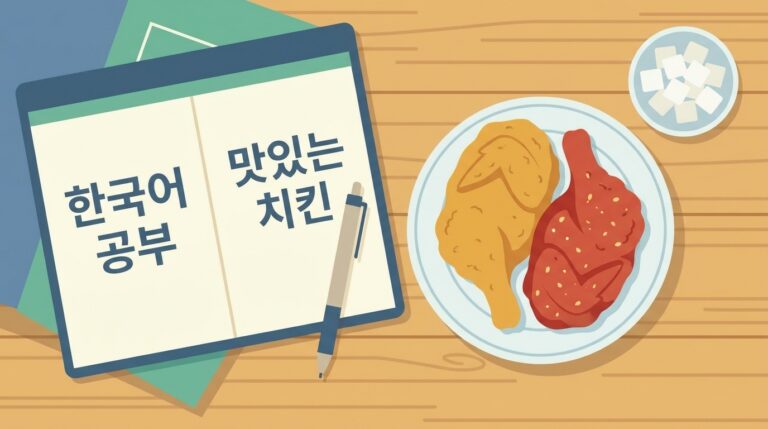
Never Panic at a Korean Chicken Shop: Order Half and Half Like a Local!
Phase 1: Empathy (Story-Driven Opening)
안녕하세요! (Annyeonghaseyo!) I am your friendly editor from Daily Hangul, your trusted Korean culture and language navigator!
Picture this: You are sitting in a cozy, buzzing chicken pub in Hongdae or gazing out at the shimmering Han River on a breezy evening. You have watched countless K-dramas where characters celebrate with crispy, golden chicken and ice-cold beer. Your stomach is growling, and the mouthwatering scent of caramelized garlic and sizzling batter fills the air. But as the server approaches with a pen and notepad, panic hits: Do I want crispy plain fried chicken, or that sweet, sticky, spicy red seasoned chicken? How do I choose just one? And how on earth do I say it without tripping over my tongue?
Take a deep breath! You never have to choose between two great loves in Korea. Over the past decade, we have coached hundreds of nervous beginners who froze up at the counter. With one single, legendary phrase, you can get the best of both worlds with effortless confidence. Today, you will master the art of ordering Ban-ban (half-and-half) like a true Seoulite!
Phase 2: Top 3 Core Expressions in Depth
1. 후라이드 반, 양념 반 주세요 (Huraideu ban, yangnyeom ban juseyo)
- Pronunciation: [Hoo-rah-ee-deu bahn, yahng-nyuhm bahn joo-seh-yo] (Sounds like: “Who ride?” + “Bahn” as in German train, “Yum” with an ng ending, and “Ju-say-yo” like juice with a soft ‘yo’ at the end).
- Meaning: Literal: “Fried half, seasoned half, please give me.” | Nuance: “I’d like half classic crispy fried and half sweet-spicy seasoned chicken, please!”
- K-Culture Moment: Seen in almost every casual drama scene where friends or couples order late-night snacks to avoid arguing over flavors.
- Editor’s Insight: 반 (Ban) means “half.” By repeating 반 (Ban) after each flavor, you sound completely natural. It is the ultimate peacemaker sentence in Korean society.
- Situation Spectrum: Casual: ✅ | Semi-formal: ✅ | Formal: ✅ (Using 주세요 – Juseyo makes it politely universal anywhere).
- 🤔 Think About It: In many Western restaurants, ordering “half-and-half” of two main entrees sounds complicated. Why did Korean food culture make compromise so standard and effortless?
2. 순살로 변경해 주세요 (Sunsallo byeongyeong-hae juseyo)
- Pronunciation: [Soon-sahl-lo byuhn-gyuhng-hae joo-seh-yo] (Think “Soon” + “Salad” without ‘-ad’ + “Lo” like low, “Byung-young-hae”).
- Meaning: Literal: “Pure meat-into change please give me.” | Nuance: “Could you make that boneless, please?”
- K-Culture Moment: Essential when having a picnic at Hangang Park or sitting on the couch while gaming—no messy bones to clean up!
- Editor’s Insight: 순살 (Sunsal) literally means “pure flesh” (boneless meat). If you do not specify, Korean chicken automatically arrives with bones (뼈 – Ppyeo).
- Situation Spectrum: Casual: ✅ | Semi-formal: ✅ | Formal: ✅
- 🤔 Think About It: Notice the word 순 (Sun) meaning pure or unadulterated. Korean food descriptions often highlight the purity or direct quality of the ingredient!
3. 치킨무 많이 주세요 (Chikin-mu mani juseyo)
- Pronunciation: [Chee-keen-moo mah-nee joo-seh-yo] (“Chicken” + “Moo” like a cow + “Manny” without the stress).
- Meaning: Literal: “Chicken radish a lot please give.” | Nuance: “Please give me extra pickled radish cubes!”
- K-Culture Moment: That crisp, white, sweet-and-sour pickled radish cube every Korean character munches on to cleanse their palate between bites of greasy chicken.
- Editor’s Insight: 많이 (Mani) means “plenty” or “a lot.” It is the golden travel word for any side dish (반찬 – Banchan) in Korea.
- Situation Spectrum: Casual: ✅ | Semi-formal: ✅ | Formal: ✅
- 🤔 Think About It: Why does Korea pair hot fried meat with cold pickled radish instead of French fries or coleslaw? It reflects the traditional balance of hot (greasy) and cooling (digestive) elements in Korean food philosophy.
Phase 3: Textbook Korean vs. Real Korean
Situation 1: Ordering Half and Half
- 📖 교과서 한국어 (Textbook): “프라이드치킨 반마리와 양념치킨 반마리를 주십시오.” (Pura-ideu chikin ban-mari-wa yangnyeom chikin ban-mari-reul jusipsio.)
- 🗣️ 진짜 한국어 (Real Life): “반반 주세요!” (Ban-ban juseyo!) or “후라이드 반, 양념 반이요!” (Huraideu ban, yangnyeom ban-iyo!)
- 💡 Why the difference? Nobody speaks in full paragraphs when chicken is sizzling! Koreans shorten the entire concept into the rhythmic compound word 반반 (Ban-ban).
Situation 2: Asking for Boneless
- 📖 교과서 한국어 (Textbook): “뼈가 없는 닭고기로 음식을 조리해 주시겠습니까?” (Ppyeoga eomneun dakgogi-ro eumsik-eul jorihae jusigesseumnikka?)
- 🗣️ 진짜 한국어 (Real Life): “순살로 해 주세요.” (Sunsal-lo hae juseyo.)
- 💡 Why the difference? 순살 (Sunsal) is a dedicated food term universally recognized by all fry cooks. Short, punchy words rule Korean dining spaces.
Phase 4: K-Culture Deep Dive & Non-Verbal Manners
4-1. 눈치 (Nunchi) & Gestures
- The Table Call Button: In Korean chicken spots, do not wave your hands frantically or shout across the room. Look at the corner of your wooden table. See that tiny silver or plastic button? That is the 호출벨 (Hochul-bel). Press it once, listen for the cheerful “Ding-dong!”, and the server will come right over.
- The Two-Pronged Fork Attack: When your bone-in chicken arrives, you will receive two small metal mini-tongs or two small forks. Use both hands—one to anchor the drumstick, the other to strip the meat cleanly. It is neat, efficient, and avoids sticky fingers!
- Two-Handed Respect: When receiving the basket of chicken or handing over your credit card, hold it lightly with both hands (or support your right wrist with your left hand). This small gesture shows huge respect.
4-2. Cultural Code: The Art of 치맥 (Chimaek)
Fried chicken in Korea is not just fast food; it is an emotional ritual called 치맥 (Chimaek)—a blending of 치킨 (Chikin) and 맥주 (Maekju – beer). Whether celebrating a project victory, watching a late-night soccer match, or recovering from a breakup, Koreans gather around a box of half-and-half. The contrasting balance between savory crispy skin and spicy sweet glaze captures the communal spirit: nobody has to sacrifice their craving when everyone can share.
Phase 5: Real-Life Roleplay Scenario
Setting: Hwanggeum Chicken (황금치킨), a vibrant neighborhood chicken shop near Hongik University station. Warm yellow lighting, K-pop hits playing quietly, and the irresistible sizzle of frying batter.
Character: Mrs. Kim (김 사장님), an energetic, friendly restaurant owner wearing an apron with a cartoon chicken.
- Turn 1 (Mrs. Kim): 어서 오세요! 몇 분이세요? (Eoseo oseyo! Myeot bun-iseyo?)
🎭 Welcoming you warmly with a smile and pointing toward an empty booth.
“Welcome! How many people?” - Turn 2 (You): 두 명이요! (Du myeong-iyo!)
🎭 Holding up two fingers with a polite bow.
“Two people!” - Turn 3 (Mrs. Kim): 편한 자리 앉으세요. 주문하시겠어요? (Pyeonhan jari anjeuseyo. Jumun-hasigesseoyo?)
🎭 Handing you a laminated menu and a bowl of crispy puffed corn snacks.
“Sit anywhere comfortable. Ready to order?” - Turn 4 (You): 네! 후라이드 반, 양념 반 주세요. (Ne! Huraideu ban, yangnyeom ban juseyo.)
🎭 Pointing pleasantly at the pictures on the menu.
“Yes! Half fried and half seasoned chicken, please.” - Turn 5 (Mrs. Kim): 뼈로 드릴까요, 순살로 드릴까요? (Ppyeo-ro deurilkkayo, sunsal-lo deurilkkayo?)
🎭 Holding her pen ready over her notepad.
“Would you like bone-in, or boneless?” - Turn 6 (You): 순살로 해 주세요. (Sunsal-lo hae juseyo.)
🎭 Nodding politely.
“Please make it boneless.” - Turn 7 (Mrs. Kim): 음료나 맥주는 필요 없으세요? (Eumryo-na maekju-neun piryo eopseuseyo?)
🎭 Tilting her head playfully toward the drink cooler.
“No drinks or beer needed?” - Turn 8 (You): 콜라 하나랑 치킨무 많이 주세요! (Kolla hana-rang chikin-mu mani juseyo!)
🎭 Handing back the menu with both hands.
“One cola and plenty of pickled radish, please!”
🔀 Interactive Decision Point
Mrs. Kim looks at you and asks: “생맥주 500 두 잔 먼저 드릴까요?” (Saengmaekju obaek du jan meonjeo deurilkkayo? – Shall I bring two 500cc draft beers first?)
- Option A: “네, 맥주 먼저 주세요!” (Ne, maekju meonjeo juseyo!)
Feedback: Best! Perfect timing. Fresh draft beer arrives while the chicken fries to golden perfection. - Option B: “아니요, 치킨 안 먹어요.” (Aniyo, chikin an meogeoyo.)
Feedback: Bad! This means “No, I don’t eat chicken.” Mrs. Kim will look very confused since you just ordered chicken! - Option C: “술 못 마셔요. 사이다 주세요.” (Sul mot masyeoyo. Sa-ida juseyo.)
Feedback: Risk / Alternative! If you don’t drink alcohol, this is a clean, natural reply: “I can’t drink alcohol. Sprite/Chilsung Cider, please.”
Phase 6: 10-Second Emotional Shadowing Drill
Practice speaking with real feeling. Pay attention to pauses marked with /!
[😊 Confident & Hungry]
후라이드 반, / 양념 반 / 주세요!
(Huraideu ban, / yangnyeom ban / juseyo!)-
[😋 Excited & Craving]
뼈 말고, / 순살로 / 변경해 주세요!
(Ppyeo malgo, / sunsal-lo / byeongyeong-hae juseyo!) -
[🥺 Polite & Yearning]
사장님, / 치킨무 / 많이 주세요!
(Sajangnim, / chikin-mu / mani juseyo!)
Phase 7: K-Culture Mini Dictionary
- 반반 (Ban-ban): Literally “half-half.” Widely used for food combinations like chicken, pizza toppings, or even half black-bean noodles and half spicy seafood soup (짬짜면 – Jjamjjamyeon).
- 치맥 (Chimaek): The portmanteau of 치킨 (Chikin) and 맥주 (Maekju). A cornerstone of modern Korean social life and relaxation after work.
- 순살 (Sunsal): Boneless meat. Specifying this avoids having to discard chicken bones when dining outside or at a picnic.
- 치킨무 (Chikin-mu): Cube-cut white radish pickled in sweet vinegar. The undisputed soulmate of Korean fried chicken.
Phase 8: Survival Kit for Travelers
Survival Expressions TOP 3
- 포장해 주세요 (Pojang-hae juseyo): “Please pack this for takeout / to-go.”
Pro Tip: Perfect if you want to take your hot chicken back to your hotel or enjoy it along the Han River. - 남은 거 싸 주세요 (Nameun geo ssa juseyo): “Please wrap up our leftovers.”
Pro Tip: Portions in Korean chicken restaurants are generous (usually one whole chicken). Don’t let delicious food go to waste! - 계산해 주세요 (Gyesan-hae juseyo): “Check, please / I’d like to pay.”
Pro Tip: Head to the counter near the door; Koreans almost always pay at the exit counter rather than at the table.
Editor’s Travel Note
- App Tip: Ready to order delivery straight to your hotel lobby? Check out the Naver Map app on the iOS App Store or Google Play to locate nearby 5-star chicken branches. For tourist-friendly delivery, look for apps that support overseas payment cards without requiring a domestic Korean alien registration card.
- Payment Tip: Nearly all chicken eateries accept international credit cards. Tipping is non-existent in Korea—just pay the exact bill total!
Phase 9: “One Step Deeper” (Reflective Question)
In many Western cultures, dining is often individualized—one burger, one sandwich, or one bowl per person. In Korea, however, fried chicken arrives as a unified centerpiece for the whole table. The creation of 반반 (Ban-ban) is a genius cultural invention: an unspoken agreement that allows different palates to share a single meal happily without dividing the table into solitary plates. It is a modern expression of 정 (Jeong)—the warm bond of sharing food together.
💬 Your Turn: Do you prefer crunchy classic fried chicken, or spicy sticky sweet sauce? Or are you, like most of Korea, an uncompromising lover of 반반? Let us know in the comments below!
Phase 10: FAQ & Avoiding Misunderstandings
Q: Can I order “half-and-half” for any flavor combination on the menu?
A: Usually, yes! While classic fried (후라이드) and sweet-spicy (양념) is the gold standard, most shops let you pair Soy Garlic (간장 – Ganjang) with Fried, or Supreme sauce with Spicy. Just say: “[Flavor A] 반, [Flavor B] 반 주세요!”
Q: Does boneless chicken (순살) cost extra in Korea?
A: Yes, at most chicken franchises, choosing 순살 (Sunsal) adds a small fee of roughly 1,000 to 2,000 KRW (about $1–$1.50 USD) because they use tender breast or thigh meat fillets.
Q: Can I get free refills on pickled radish (치킨무) at the pub?
A: Absolutely! In dine-in restaurants, side dishes including 치킨무 (Chikin-mu), cabbage slaw, and puffed corn snacks are almost always refillable for free. Just ask the staff nicely.
🚨 Common Mistakes Alert
- Mistake: Trying to wave down staff across the busy room by shouting “Excuse me!”
- Correct Action: Look for the table call bell (호출벨) and press it once. If there is none, say a gentle “저기요!” (Jeogiyo!).
- Mistake: Assuming chicken orders automatically come as individual pieces.
- Correct Action: Korean chicken is ordered by the “box / bird” (한 마리 – Han mari), not by single drumsticks. One order easily feeds two adults.
- Mistake: Leaving chicken bones directly on the table napkin.
- Correct Action: Every table has a small stainless steel mini-bucket (뼈통 – Ppyeotong). Always toss bones directly into this bin to keep your table tidy.
Phase 11: Action Missions & Community
- 🥉 Bronze Mission (Solo Shadowing): Stand in front of your mirror, smile, and say: “후라이드 반, 양념 반 주세요!” smoothly 5 times in under 10 seconds.
- 🥈 Silver Mission (Social Share): Next time you eat fried chicken at home or dine out, snap a photo, upload it to Instagram or Twitter, and caption it in Korean: “치맥 타임! 반반 주세요! #DailyHangul”.
- 🥇 Gold Mission (Real Life / Delivery): Walk into a local Korean restaurant or order via an English-friendly delivery app using the phrase “순살로 해 주세요!”.
🎮 K-Culture Mission: Watch any modern K-drama episode (like Crash Landing on You or Weightlifting Fairy Kim Bok-joo). Count how many times the characters order or mention 치맥 (Chimaek) or 반반 (Ban-ban)!
Phase 12: Interactive Quiz Challenge
Quiz 1: Situation Judgment
You are sitting with a friend who cannot eat spicy food at all, but you love spicy seasoned chicken. What is the most culturally savvy and practical phrase to say?
* A) 후라이드만 한 마리 주세요. (Only plain fried chicken, please.)
* B) 후라이드 반, 양념 반 주세요. (Half fried, half seasoned, please.)
* C) 치킨 안 먹어요. (I don’t eat chicken.)
Quiz 2: Fill in the Blank
Complete the sentence to request boneless chicken:
“뼈 말고 __________로 변경해 주세요.”
(Hint: Starts with ‘순’)
Quiz 3: True or False
In Korea, ordering half-and-half chicken is considered rude and creates extra hassle for the kitchen. (True / False)
👉 Click here to reveal the answers and explanations!
Answers:
1. B) 후라이드 반, 양념 반 주세요. — This ensures your friend enjoys the non-spicy crispy chicken while you devour the sweet-and-spicy glazed pieces. Everybody wins!
2. 순살 (Sunsal) — The sentence becomes: “뼈 말고 순살로 변경해 주세요.” (Instead of bone-in, please change to boneless.)
3. False! — 반반 (Ban-ban) is an iconic, fully standardized staple in Korean food culture. Kitchens are designed specifically to prepare it quickly!







