

Phase 1: Empathy & Storytelling Opening
안녕하세요! (Annyeonghaseyo!) I am your Daily Hangul editor, your personal cultural navigator for all things Korea.
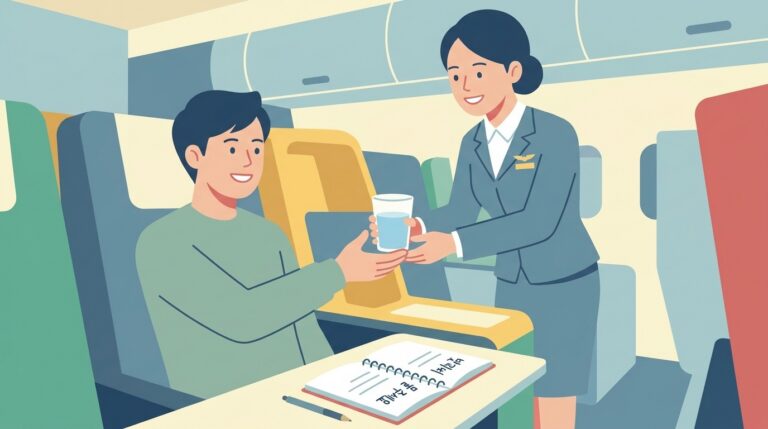
Picture this: You are thirty thousand feet in the air, peering out the window as the flight attendants announce the descent into Incheon International Airport. Cue the sudden shift in cabin pressure. All at once, your ears feel intensely muffled and blocked—what Koreans vividly call having your ears feel meongmeok (먹먹하다). You swallow hard, yawn, wiggle your jaw, but nothing works. You spot a flight attendant gliding down the aisle with that graceful K-drama poise, and you desperately want to ask for a warm cup of water and a sour candy to pop your ears.
Suddenly, your mind goes blank. How do you say “my ears feel plugged” without sounding like an archaic medical textbook? How do you ask for water and candy without sounding demanding? Don’t worry! Every international traveler and Korean learner faces this exact freeze-up moment. Today’s guide is crafted from real student struggles and in-cabin experiences to give you simple, natural A2-level Korean phrases. By the end of this post, you will be able to charm the cabin crew with flawless, polite Korean that gets you exactly what you need with zero stress.
Phase 2: 3 Key Expressions Deep-Dive
1. 귀가 먹먹해요 (Gwi-ga meongmeok-haeyo)
- Pronunciation: [Gwi-ga meong-meok-hae-yo] (Sound analogy: Say “gwee” like gooey without the “oo”, followed by “mung-muck-heh-yo”)
- Meaning: Literal: “Ears are muffled/stuffy.” / Actual nuance: “My ears are plugged from air pressure.”
- K-Culture Moment: You often hear this in Korean travel variety shows (like Earth Arcade or Youth Over Flowers) when cast members look at each other funny during landing, rubbing their ears.
- Editor’s Insight: The word “먹먹하다” (meongmeokhada) is poetic. While it describes plugged ears on airplanes or high mountains, Koreans also use it when their chest feels emotionally choked up with sadness. Here, it is purely physical!
- Situation Spectrum: Casual (⚠️ with close friends: 귀 먹먹해) | Semi-formal (✅ 귀가 먹먹해요) | Formal (✅ 귀가 많이 먹먹합니다)
- 🤔 Think About It: Does your native language have a specific single adjective for the ear-plugged feeling, or do you have to use a descriptive phrase like “popping ears”?
2. 물 한 잔이랑 사탕 좀 주실 수 있어요? (Mul han jan-irang satang jom jusil su isseoyo?)
- Pronunciation: [Mool han jan-ee-rang sah-tang jom joo-sheel soo ee-sseo-yo?]
- Meaning: Literal: “Could you give me a glass of water and some candy please?” / Actual nuance: A super gentle, polite request for hydration and candy.
- K-Culture Moment: In K-dramas, the magic word 좀 (jom) is sprinkled everywhere. It literally means “a little,” but culturally acts as a politeness cushion to soften requests.
- Editor’s Insight: Combining “-이랑” (irang = and/with) lets you combine items in one breath: 물 한 잔 (mul han jan = a glass of water) + 사탕 (satang = hard candy).
- Situation Spectrum: Casual (🚫 rude to staff) | Semi-formal (✅ 물 한 잔이랑 사탕 좀 주실 수 있어요?) | Formal (✅ 물 한 잔과 사탕 좀 부탁드립니다)
- 🤔 Think About It: Notice how asking for “a little bit” of something softens the burden on the listener in Korean hospitality culture.
3. 혹시 사탕 있나요? (Hoksi satang innayo?)
- Pronunciation: [Hok-shee sah-tang een-nah-yo?]
- Meaning: Literal: “By any chance, is there candy?” / Actual nuance: “Do you happen to have any hard candies?”
- K-Culture Moment: Whenever a K-Drama lead hesitates before asking an awkward or humble question, they start with 혹시 (hoksi).
- Editor’s Insight: Starting a sentence with “혹시” (by any chance) prevents you from sounding entitled. It acknowledges that the airline might not have candy, making your question considerate.
- Situation Spectrum: Casual (⚠️ 혹시 사탕 있어?) | Semi-formal (✅ 혹시 사탕 있나요?) | Formal (✅ 혹시 사탕이 준비되어 있습니까?)
- 🤔 Think About It: How does saying “by chance” protect both your dignity and the service worker’s feelings if the answer is no?
Phase 3: Textbook Korean vs. Real Korean
Situation 1: Asking for water on the flight
- 📖 교과서 한국어 (Textbook): 물을 주십시오. (Mul-eul jusipsio.)
- 🗣️ 진짜 한국어 (Real Korean): 물 한 잔만 부탁드려요. (Mul han jan-man butakdeuryeoyo.)
- 💡 왜 다를까? (Why the difference?): “-주십시오” is grammatically correct formal imperative, but in modern everyday service settings, it sounds overly rigid and demanding like a military drill. Using “-부탁드려요” (I kindly request) adds warmth and mutual respect.
Situation 2: Expressing ear discomfort
- 📖 교과서 한국어 (Textbook): 제 귀에 기압 변화가 느껴집니다. (Je gwi-e giap byeonhwa-ga neukkyeojimnida. – “I perceive atmospheric pressure changes in my ears.”)
- 🗣️ 진짜 한국어 (Real Korean): 귀가 너무 먹먹해요. (Gwi-ga neomu meongmeok-haeyo. – “My ears feel totally blocked.”)
- 💡 왜 다를까? (Why the difference?): Nobody uses technical jargon in the cabin unless speaking to a doctor. Real native speakers rely on emotive, onomatopoeic sensory verbs like “먹먹하다”.
Phase 4: K-Culture Deep-Dive & Non-verbal Manners
4-1. Nunchi (눈치) & In-Flight Gestures
Korean cabin crew are world-renowned for their anticipatory service, but flying etiquette in Korea values consideration for busy crew members:
* The Eye Contact Call: Instead of loudly waving your arms or clicking your fingers, look for an passing flight attendant, make soft eye contact, and slightly raise your hand to shoulder height.
* Two-Hand Rule (두 손 사용): When receiving that paper cup of water or a small candy packet, always accept it with both hands (or touch your left hand gently to your right forearm). This tiny physical gesture immediately signals deep respect and won’t go unnoticed!
* Ear Touch Gesture: If words fail you mid-sentence, gently touching your earlobe with a polite grimace will help the crew instantly understand that your ears are blocked.
4-2. The Korean Airline Candy Culture
If you have flown Korean Air or Asiana Airlines, you might have noticed flight attendants distributing small hard candies (often lemon or plum flavored) just before landing. Swallowing saliva while sucking on hard candy opens the Eustachian tube, naturally relieving ear discomfort. In Korean service philosophy, anticipating this physiological comfort is considered baseline jeong (warm care)!
Phase 5: Real-Life Roleplay Scenario
Setting: Korean Air Flight KE082 descending into Seoul Incheon. The descent chime has just rung. Flight Attendant ‘Mina’ is checking seat belts.
- Turn 1 (알렉스 – Alex): 🎭 Catching Mina’s eye with a polite small bow
저기요, 승무원님! (Jeogiyo, seungmuwon-nim!)
(Excuse me, flight attendant!) - Turn 2 (미나 – Mina): 🎭 Bending down gently to eye level
네, 손님! 무엇을 도와드릴까요? (Ne, sonnim! Mueos-eul dowadeurilkkayo?)
(Yes, passenger! How may I help you?) - Turn 3 (알렉스 – Alex): 🎭 Lightly touching his ear with an apologetic expression
비행기가 내려가니까 귀가 너무 먹먹해요. (Bihaenggi-ga naeryeoganikka gwi-ga neomu meongmeok-haeyo.)
(As the plane descends, my ears feel so plugged.) - Turn 4 (미나 – Mina): 🎭 Nodding with warm empathy
아, 기압 때문에 그러실 수 있어요. 많이 불편하시죠? (A, giap ttaemune geureosil su isseoyo. Mani bulpyeonhasijo?)
(Ah, that can happen due to cabin pressure. It’s quite uncomfortable, right?) - Turn 5 (알렉스 – Alex): 🎭 Speaking clearly and softly
혹시 물 한 잔이랑 사탕 좀 주실 수 있어요? (Hoksi mul han jan-irang satang jom jusil su isseoyo?)
(By any chance, could I get a glass of water and some candy?) - Turn 6 (미나 – Mina): 🎭 Smiling reassuringly
네, 그럼요! 따뜻한 물로 준비해 드릴까요? (Ne, geureomyo! Ttatteutan mul-lo junbihae deurilkkayo?)
(Yes, of course! Shall I prepare warm water for you?) - Turn 7 (알렉스 – Alex): 🎭 Nodding gratefully
네, 따뜻한 물로 부탁드려요. 감사합니다! (Ne, ttatteutan mul-lo butakdeuryeoyo. Gamsahamnida!)
(Yes, warm water please. Thank you!) - Turn 8 (미나 – Mina): 🎭 Promptly heading to the galley
잠시만 기다려 주십시오. 바로 가져다드리겠습니다. (Jamsiman gidaryeo jusipsio. Baro gajyeodadeurigessseumnida.)
(Please wait just a moment. I will bring it right to you.)
🔀 Interactive Branching Choice
When the attendant brings your water, what do you say?
* Option A: 물 줘. (Mul jwo.)
* Option B: 감사합니다! 잘 마실게요. (Gamsahamnida! Jal masilgeyo.)
* Option C: 사탕 더 많이 가져와요. (Satang deo mani gajyeowayo.)
Feedback:
* Option A is [Bad]: This is impolite intimate language (반말, banmal). Never use this with flight attendants.
* Option B is [Best]: Polite, natural, and expressive! “잘 마실게요” (I will drink it well) sounds wonderfully native.
* Option C is [Risk]: Grammatically correct, but sounds bossy and demanding rather than asking courteously.
Phase 6: 10-Second Emotional Shadowing Drill
Practice these with natural speech rhythm, pauses (/), and emotional coloring!
[🥺 조심스럽고 조금 아픈 목소리로 - Apologetic and uncomfortable]
저기요, / 비행기가 내려가니까 / 귀가 너무 먹먹해요.
(Jeogiyo, / bihaenggiga naeryeoganikka / gwiga neomu meongmeok-haeyo.)-
[🙏 공손하고 부드럽게 - Polite and soft]
혹시 / 따뜻한 물 한 잔이랑 / 사탕 좀 주실 수 있어요?
(Hoksi / ttatteutan mul han jan-irang / satang jom jusil su isseoyo?) -
[😊 두 손으로 받으며 환하게 - Smiling brightly while receiving with both hands]
네, / 정말 감사합니다! / 잘 마실게요.
(Ne, / jeongmal gamsahamnida! / Jal masilgeyo.)
Phase 7: K-Culture Mini Dictionary
- 승무원 (Seungmuwon) | Flight Attendant / Cabin Crew
Usage: While you can say “저기요” (Excuse me), addressing the attendant politely as “승무원님” (Seungmuwon-nim) is respectful and immediately grabs attention. - 먹먹하다 (Meongmeokhada) | Plugged / Stuffy / Muffled
Usage: Ideal for altitude ear changes, underwater swimming ear sensations, or when an emotional drama scene gives you a heavy heart. - 입국신고서 (Ipguk-singoseo) | Arrival / Immigration Card
Usage: Combine with our phrase pattern: “입국신고서 한 장만 더 주실 수 있어요?” (Could I get one more arrival card?). - 담요 (Damyo) | In-flight Blanket
Usage: Airplane cabins get cold! Say: “담요 하나만 더 부탁드려요” (One more blanket, please).
Phase 8: Survival Kit for Travelers
Survival Expressions TOP 3
- 담요 하나만 더 주실 수 있어요? (Damyo hanaman deo jusil su isseoyo?)
Pro Tip: Request an extra blanket early during boarding before cruising altitude, as supplies run out fast on night flights. - 입국신고서 영어로 된 것 있어요? (Ipguk-singoseo yeong-eoro doen geot isseoyo?)
Pro Tip: If you receive a Korean-language immigration form, use this to ask for the English version. - 펜 하나만 빌려주실 수 있나요? (Pen hanaman billyeojusil su innayo?)
Pro Tip: Always ask for a pen before descent so you can fill out customs declarations without scrambling at the arrival terminal.
Editor’s Travel Note
- Skip the Immigration Lines: Before your trip, search for the official 인천공항 스마트패스 앱 다운로드 (Incheon Airport SmartPass App Download) on Google Play or iOS App Store. Registering your facial biometric data allows you to breeze through dedicated terminal lanes in minutes!
- Train Connections: From Incheon Terminal 1 or 2, take the AREX Express Train straight into Seoul Station in under 45 minutes.
Phase 9: “A Step Deeper” (Reflective Question)
In Korean communication, asking for a service is never just a transaction; it is an exercise in relational positioning. The word “좀” (jom) literally translates to “a little bit,” but functionally it is an invisible shock absorber. When you say “물 좀 주세요” instead of “물 주세요,” you are psychologically telling the other person, “I know you are busy, and I only want to trouble you for a tiny sliver of your time.” Politeness in Korean is grounded in showing that you do not take someone else’s service for granted.
💬 Your Turn: How does your culture soften requests made to service workers? Do you use words like “just” or “a little”? Share your native language equivalent in the comments below!
Phase 10: FAQ & Avoiding Misunderstandings
Q: Can I just call the flight attendant “아가씨” (Agassi) or “언니” (Eonni)?
A: Absolutely not! While you might hear older generations or historical K-dramas use “아가씨” (miss), in modern Korea it carries outdated, sometimes condescending tones. Never call female crew “언니” either. Always use “승무원님” (Seungmuwon-nim) or a polite “저기요” (Jeogiyo).
Q: What if I don’t know the Korean word for something specific on the plane?
A: Use the ultimate substitute noun: 이거 (igeo = this). Point politely and say: “혹시 이거 하나 더 주실 수 있어요?” (Could I get one more of this, by chance?).
Q: How do I ask whether the water is warm or cold?
A: Say “따뜻한 물” (ttatteutan mul) for warm/hot water, and “시원한 물” (siwonhan mul) or “차가운 물” (chagaun mul) for cold water. Cabin staff are happy to provide warm water to soothe ear pressure.
🚨 Common Mistakes Alert
- Mistake: Snapping fingers or shouting “여기요!” (Yeogiyo!) across rows.
Correct Action: Press the overhead attendant call bell once, or wait for them to walk by and make eye contact with a raised hand. - Mistake: Using 반말 (informal talk) like “물 줘” (Give water).
Correct Action: Always attach “-주실 수 있어요?” or “-부탁드려요”. - Mistake: Receiving items with only one hand outstretched.
Correct Action: Support your elbow or hold the cup with both hands to display courteous Korean manners.
Phase 11: Action Missions & Engagement
- 🥉 Bronze Mission (Solo Practice): Stand in front of your mirror. Hold your ear, look slightly uncomfortable, and say aloud 3 times: “귀가 먹먹한데 물 한 잔이랑 사탕 좀 주실 수 있어요?”
- 🥈 Silver Mission (Community Sharing): Leave a comment below translating this request into Korean: “Excuse me, could I get one blanket and a pen?” (Hint: 담요, 펜).
- 🥇 Gold Mission (Real-world Challenge): On your next flight to Incheon or your next domestic flight, do not speak English to the Korean cabin crew. Deliver today’s phrase with both hands ready!
🎮 K-Culture Mission: Watch any in-flight scene in a Korean drama (like Crash Landing on You or King the Land). Observe how the flight attendants speak using honorific endings like “-드리겠습니다” and “-십니까”.
Phase 12: Interactive Quiz Challenge
1. Situation Decision: Your ears hurt as the plane approaches Seoul. You want to ask for candy politely without assuming they definitely have it. Which sentence should you pick?
* A) 사탕 내놔요. (Satang naenwayo.)
* B) 혹시 사탕 있나요? (Hoksi satang innayo?)
* C) 사탕을 먹어라. (Satang-eul meog-eora.)
2. Fill-in-the-Blank: Complete the polite sentence to request a glass of water:
* 물 한 잔______ 사탕 ______ 주실 수 있어요?
3. True or False: In Korea, addressing a female flight attendant as “아가씨” (Agassi) is considered modern, polite etiquette.
* [ ] True
* [ ] False
👉 Click to Reveal the Answers & Explanations!
-
Answer: B (혹시 사탕 있나요?)
Explanation: “혹시” softens the inquiry, acknowledging that candy might not be in stock. Option A is an aggressive demand, and Option C is an imperative command! -
Answer: 이랑 / 좀 (물 한 잔이랑 사탕 좀 주실 수 있어요?)
Explanation: “-이랑” connects two nouns (“water and candy”), while “좀” is the politeness cushion meaning “a little/please.” -
Answer: False
Explanation: Calling flight attendants “아가씨” is considered anachronistic and rude. Always use “승무원님” (Seungmuwon-nim) or simply “저기요” (Excuse me).







