

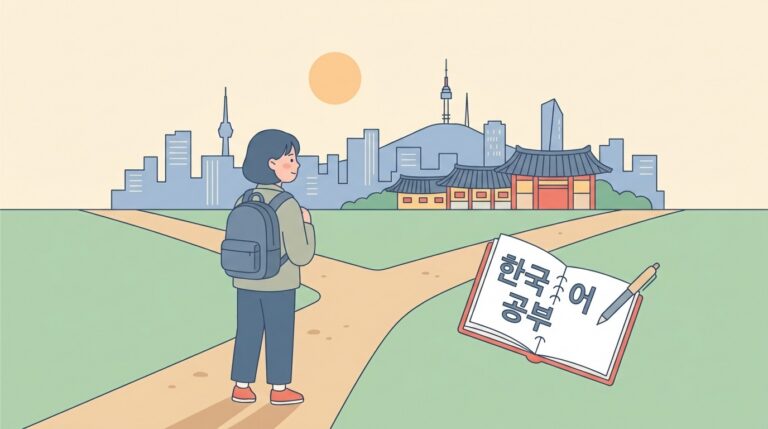
When Family Expectations Clash with Your Dreams: How to Own Your Path in Korean
안녕하세요! 매일한글 에디터입니다. (Hello! It’s your Daily Hangul editor here.)
Have you ever watched an episode of Start-Up or Record of Youth and felt an ache in your chest when the main character sits across from their parents, staring down at a steaming bowl of rice while being told, “Why can’t you just take the stable path? Take the civil service exam!”
If you come from a family or culture where parental sacrifice is deeply respected, balancing filial duty with your personal career aspirations feels like walking a tightrope over the Han River. In Korea, this emotional tug-of-war is almost a universal rite of passage. Many of our intermediate students tell us: “I know what I want to say in English, but in Korean, I either sound like a rebellious teenager throwing a tantrum or a formal robot reading a contract! How do I sound mature, respectful, yet utterly firm?”
Today, we’re mastering the ultimate statement of self-determination: “그렇지만 내 인생을 대신 살아줄 수 있는 사람은 아무도 없으니 결국 후회 없는 선택은 내 몫이라고 생각해요.” (Still, no one else can live my life for me, so making a choice I won’t regret is ultimately my responsibility.) This isn’t just vocabulary; it’s your linguistic armor for standing tall while staying polite.
Phase 2: Deep Dive into 3 Core Expressions
1. 인생을 대신 살아주다 (Insaeng-eul daesin sarajuda)
- Pronunciation: [In-saeng-eul dae-shin sa-ra-ju-da] (Sounds like “in-sang” + “day-sheen” + “sah-rah-joo-dah”)
- Meaning: Literal: “To live life instead of someone” | Nuance: Taking over someone’s destiny or assuming the consequences of another person’s journey.
- K-Culture Moment: You’ll hear this in tear-jerking indie movies or family dramas where an overbearing parent tries to plan out medical school for their child, and the child pleads gently over the kitchen table.
- Editor’s Insight: Using
대신(instead/in place of) paired with-아/어 주다(to do a favor for someone) creates a profound emotional contrast. You are acknowledging that even with all the love in the world, someone else physically cannot carry your existence for you. - Situation Spectrum: Casual: ⚠️ (needs soft endings) | Semi-formal: ✅ | Formal: ✅
- 🤔 Think About It: In your culture, do people talk about “living someone else’s life,” or is autonomy phrased around personal freedom and rights rather than who carries the weight?
2. 후회 없는 선택 (Huhoe eomneun seontaek)
- Pronunciation: [Hoo-hwe eom-neun seon-taek] (Rhymes roughly with “who-way” + “um-noon” + “sun-tech”)
- Meaning: Literal: “A choice without regret” | Nuance: A proactive, resolute decision made with full ownership of whatever happens.
- K-Culture Moment: Frequently used by K-Pop idols during documentary interviews when explaining why they left school or chose an uncertain trainee life over an easy path.
- Editor’s Insight: Notice the modifier
-없는(without). Combining후회(regret) with선택(choice) emphasizes that you aren’t promising guaranteed success—you are promising mental resilience. - Situation Spectrum: Casual: ✅ | Semi-formal: ✅ | Formal: ✅
- 🤔 Think About It: Notice how Korean emphasizes the absence of regret rather than guaranteed victory. Why do you think peace of mind is valued so highly in high-stress societies?
3. ~는 내 몫이다 (~neun nae moksida)
- Pronunciation: [Neun nae mok-shi-da] (The final double consonant ‘ㄳ’ flows into the vowel as an ‘sh’ sound: “mok-shi-da”)
- Meaning: Literal: “It is my share/portion” | Nuance: “The responsibility rests squarely on my shoulders.”
- K-Culture Moment: Protagonists in dramas like Itaewon Class say this when facing towering corporate obstacles—reminding themselves that the burden of rebuilding is theirs alone.
- Editor’s Insight:
몫originally referred to one’s allocated share of food, money, or inheritance. In emotional and philosophical contexts, it means moral duty and accountability. Saying내 몫이에요sounds mature, grounded, and eliminates any blame toward your parents. - Situation Spectrum: Casual: ✅ | Semi-formal: ✅ | Formal: ✅
- 🤔 Think About It: Does your native language compare personal responsibility to a “share of food or inheritance”? What metaphors do you use instead?
Phase 3: Textbook Korean vs. Real Korean
Situation 1: Telling someone you disagree with their career advice
- 📖 Textbook Korean: 저는 부모님의 의견에 동의하지 않습니다. (Jeoneun bumonim-ui uigyeone dong-uihaji anseumnida. – I do not agree with my parents’ opinion.)
- 🗣️ Real Korean: 부모님 걱정하시는 마음은 알지만, 제 뜻대로 밀고 나가고 싶어요. (Bumonim geokjeonghasineun ma-eumeun aljiman, je tteutdaero milgo nagago sipeoyo. – I know you’re worried about me, but I really want to push forward with what I believe in.)
- 💡 Why it’s different: Flat-out saying “I do not agree” sounds like a sterile business debate or confrontational rebellion. Korean culture prioritizes acknowledging the other person’s good intentions (
걱정하시는 마음은 알지만) before stating your own desire.
Situation 2: Accepting the outcome of a risky career leap
- 📖 Textbook Korean: 이 결과는 저의 책임입니다. (I gyeolgwaneun jeoui chaegim-imnida. – This result is my responsibility.)
- 🗣️ Real Korean: 잘되든 안 되든 제가 감당해야 할 몫이니까요. (Jaldeodeun an doedeun jega gamdanghaeya hal moksineikkayo. – Whether it turns out well or not, it’s a share I must handle myself.)
- 💡 Why it’s different:
책임입니다sounds like an official corporate press release after a scandal.감당하다(to shoulder/handle) and몫(one’s share) evoke visceral, emotional maturity.
Phase 4: K-Culture Deep Dive & Non-Verbal Manners
4-1. Nunchi (눈치) & Body Language: The Art of Firm Politeness
In Western discussions about autonomy, strong eye contact and upright posture convey confidence. In Korea, maintaining unblinking eye contact while disagreeing with older relatives or mentors can be perceived as glaring (노려보다) or talking back (대들다).
- The Visual Line: When delivering heavy sentences about your career, drop your gaze slightly to the tabletop or your hands for a second, speak with calm cadence, and then re-engage eye contact.
- The Softening Breath: Take a soft, gentle breath before saying
그렇지만(geureochiman). It signals that you are not reacting impulsively, but reflecting deeply. - Two-Handed Posture: Keep both hands loosely clasped on your lap or on the table near your cup. Open, flailing hand gestures look dismissive in Korean high-stakes talks.
4-2. Cultural Code: The Shadow of “엄친아” and the Family Unit
In Korea, career decisions have historically not been an individual venture, but a family milestone. The dreaded 엄친아 (Eom-chin-a)—short for 엄마 친구 아들 (my mom’s friend’s son, who seemingly passed every civil service exam, works at Samsung, and calls his mother daily)—isn’t just a meme; it represents social validation in a tightly knit community.
When Korean parents push for stability, it rarely comes from malice; it stems from the collective trauma of economic crises (like the 1997 IMF crisis) where non-traditional careers vanished overnight. Understanding this helps you frame your ambition not as an attack on their advice, but as personal ownership.
Phase 5: Real-World Roleplay Scenario
Setting: A quiet pojangmacha (street tent bar) in Mapo on a breezy Thursday night. The aroma of sizzling scallion pancakes and steaming fish-cake broth fills the air. You are having a drink with Minho, a close Korean friend who is struggling between his father’s dream of him becoming a tax accountant and his own passion for indie video game production.
- 민호 (Minho): 우리 아버지는 내가 안정적인 세무사가 되길 바라셔. 인디 게임 개발은 너무 불안정하다고 절대 안 된대. (Uri abeojineun naega anjeongjeogin semusaga doegil barasyeo. Indi geim gaebareun neomu buranjeonghadago jeoldae an doendae.)
🎭 Stares down into his soju glass, sighing.
(My dad wants me to become a stable tax accountant. He says indie game development is far too unstable and completely out of the question.) -
당신 (You): 부모님 세대에서는 안정을 가장 중요하게 생각하시니까 걱정되실 만해. (Bumonim sedae-eseoneun anjeong-eul gajang jung-yohage saenggakhasinikka geokjeongdoesil manhae.)
🎭 Nodding with an empathetic expression, pouring warm broth into a cup.
(It makes sense that they worry, since parents’ generation values stability above all else.) -
민호 (Minho): 맞아. 하지만 내 진짜 열정은 게임 기획에 있거든. 아버지 뜻을 따르자니 내 삶이 답답할 것 같아. (Maja. Hajiman nae jinjja yeoljeong-eun geim gihoege itgeodeun. Abeoji tteuseul ttareujani nae salmi dabdaphal geot gata.)
🎭 Gripping the cup tightly with furrowed brows.
(Right. But my real passion is in game design. If I follow my father’s wishes, I feel like my life will be suffocating.) -
당신 (You): 그렇지만 내 인생을 대신 살아줄 수 있는 사람은 아무도 없으니 결국 후회 없는 선택은 내 몫이라고 생각해요. (Geureochiman nae insaengeul daesin sarajul su inneun sarameun amudo eopseuni gyeolguk huhoe eomneun seontaekeun nae moksirago saenggakaeyo.)
🎭 Leaning forward slightly, speaking with steady and gentle reassurance.
(Still, no one else can live your life for you, so making a choice you won’t regret is ultimately your responsibility.) -
민호 (Minho): 그 말이 맞아… 남의 기대에 맞춰 살다가 나중에 실패하면 아버지를 원망하게 될까 봐 더 두려워. (Geu mari maja… Nameui gidaee matchwo saldaga najung-e silpaehamyeon abeojireul wonmanghage doelkka bwa deo duryeowo.)
🎭 Looking up, his shoulders relaxing slightly.
(You’re right… I’m more terrified that if I live up to someone else’s expectations and fail, I’ll end up resenting my dad.) -
당신 (You): 바로 그거야. 결과가 어떻든 네가 선택한 길이어야 온전히 받아들일 수 있잖아. (Baro geugeoya. Gyeolgwaga eotteotteun nega seontaekhan girieoya onjeonhi badadeuril su itjana.)
🎭 Clinking your glass against Minho’s with a warm smile.
(Exactly. Whatever the outcome, it has to be a path you chose so you can embrace it fully.) -
민호 (Minho): 고마워. 이번 주말에 아버지랑 다시 진지하게 대화해 볼게. 내 포트폴리오도 직접 보여드리면서. (Gomawo. Ibeon jumare abeojirang dasi jinjihage daehwahae bolge. Nae poteupolriodo jikjeop boyeodeurimyeonseo.)
🎭 Smiling faintly with renewed determination.
(Thanks. I’ll have a serious conversation with my dad again this weekend, showing him my portfolio directly.) -
당신 (You): 응, 응원할게! 진심은 반드시 전해질 거야. (Eung, eung-wonhalge! Jinsimeun bandeusi jeonhaejil geoya.)
🎭 Giving a supportive pat on his arm.
(Yeah, I’m rooting for you! Sincerity will always get through.)
🔀 Interactive Choice Moment
Imagine Minho suddenly asks: “If my dad cuts off my allowance because of this, should I back down?” What do you say?
- Choice A: “당연히 포기해야지! 돈 없이는 아무것도 못 해.” (Dang-yeonhi pogihaeyaji! Don eopsineun amugeotdo mot hae. – You should obviously give up! You can’t do anything without money.)
- Choice B: “당장 힘들어도 네 선택의 무게를 감당하는 게 진정한 독립 아닐까?” (Dangjang himdeureodo ne seontaek-ui mugereul gamdanghaneun ge jinjeonghan dongnip anilkka? – Even if it’s tough right now, isn’t shouldering the weight of your choice what true independence is about?)
- Choice C: “그냥 부모님 몰래 회사 취업 준비해 봐.” (Geunyang bumonim mollae hoesa chwieop junbihae bwa. – Just secretly prepare for company jobs behind their back.)
Feedback:
* Choice A [Bad]: Crushes your friend’s spirits instantly and contradicts the core philosophy of owning your life.
* Choice B [Best]: Empathetic, philosophical, and reinforces the concept of감당(shouldering responsibility) without being reckless.
* Choice C [Risk]: High risk of breaking family trust and creates sustained stress rather than solving the conflict.
Phase 6: 10-Second Emotion Shadowing Drill
Practice reading these lines out loud. Pay close attention to the pause slashes (/) and the emotional mindset tags!
[🥺 무겁고 솔직하게 - Heavy & Honest]
부모님 마음도 알지만… / 내 인생을 대신 살아줄 순 없잖아요.
(Bumonim ma-eumdo aljiman… / nae insaeng-eul daesin sarajul sun eopjanayo.)-
[💪 담담하지만 단호하게 - Calm yet Resolute]
결과가 어떻든 / 후회 없는 선택은 / 결국 내 몫이에요.
(Gyeolgwaga eotteotteun / huhoe eomneun seontaek-eun / gyeolguk nae moksi-eyo.) -
[✨ 후련하고 자신감 있게 - Relieved & Confident]
남의 말에 흔들리지 않고 / 내가 원하는 길을 묵묵히 걸어갈래요.
(Nam-ui mare heundeulliji anko / naega wonhaneun gireul mungmukhi georeogallaeyo.)
Phase 7: K-Culture Mini Dictionary
- 공시생 (Gongsisaeng)
Translation: Civil service exam examinee.
Usage: Refers to hundreds of thousands of Korean youths studying in Noryangjin for stable government positions. Often cited as the ultimate parental ideal of security. - 엄친아 / 엄친딸 (Eom-chin-a / Eom-chin-ttal)
Translation: Mom’s friend’s son / Mom’s friend’s daughter.
Usage: The mythical peer who has superior specs, a great job, and perfect manners—frequently used by parents as an unintentional comparison benchmark. - 몫 (Mok)
Translation: Share, role, or allocated portion of responsibility.
Usage: Essential in personal reflections: “제 몫을 다하다” (to do one’s share/part). - 효도 (Hyodo)
Translation: Filial piety.
Usage: Treating parents with deep respect and care. In modern Korea, youths often grapple with how to show hyodo while leading an unconventional lifestyle.
Phase 8: Traveler’s Survival Kit (Inner Journey Edition)
Top 3 Survival Expressions for Deep Conversations
- 혼자 생각할 시간이 좀 필요해요.
(Honja saenggak-hal sigani jom piryohaeyo.)
Pro Tip: Perfect when friends or older acquaintances bombard you with uninvited life advice. It politely hits the pause button. - 제 결정을 믿고 지켜봐 주세요.
(Je gyeoljeong-eul mitgo jikyeobwa juseyo.)
Pro Tip: Far more persuasive than saying “Don’t interfere!” It asks for active trust and emotional partnership. - 누구 탓도 하고 싶지 않아요.
(Nugu tatdo hago sipji anayo.)
Pro Tip: Shuts down arguments about blame. It proves you understand that this choice belongs solely to you.
Editor’s Travel Note: Escaping Career Overwhelm in Seoul
When life decisions weigh heavily on you during your stay in Korea, skip the loud shopping districts and head toward introspective spaces. Take a slow evening walk along the peaceful stone walls of Deoksugung Doldam-gil or find a bench facing the water at Mangwon Hangang Park.
Before heading out, make sure to complete your Naver Map app download to navigate quiet alley cafes effortlessly, and check your transit balance using a reliable T-money card balance check guide so you can travel without interruption.
Phase 9: “One Step Deeper” — Reflections on “우리” vs. “나”
Korean culture is famous for its linguistic preference for “우리” (We / Our) over “내” (My). People casually say “우리 엄마” (our mom) and “우리 학교” (our school), even when speaking as an only child. In a society where identity has historically been communal, declaring “내 인생” (my life) and “내 몫” (my responsibility) requires immense emotional bravery.
Taking ownership of your career isn’t an act of rebellion against collectivism; it is the natural evolution of healthy adulthood within modern Korean society. When you take responsibility for your choices, you transform respect from mere obedience into authentic mutual appreciation.
💬 Your Turn: Have you ever had to choose between your family’s safe expectations and your genuine passion? What words gave you courage? Share your story in the comments below!
Phase 10: FAQ & Common Mistakes
Q: Can I use “내 몫이에요” in a professional business setting?
A: Yes! In corporate Korean, saying “이 프로젝트의 성패는 제 몫입니다” (The success or failure of this project is my responsibility) shows incredible accountability and confidence.
Q: Does saying “내 인생을 대신 살아줄 수 없다” sound rude to elders?
A: It can sound aggressive if your tone is sharp! However, if you cushion it with “부모님 마음도 충분히 이해하지만…” (I fully understand your feelings, but…) and speak in a soft, lower pitch, it conveys mature resolve rather than disrespect.
Q: What is the difference between 책임 (chaegim) and 몫 (mok)?
A: 책임 refers to legal, formal, or moral liability (duty). 몫 is more philosophical, internal, and emotional—it refers to your personal piece of destiny or life’s load.
🚨 Foreigner Pitfall Warning: Common Mistakes
- Mistake: Saying “신경 쓰지 마세요” (Don’t care / mind your own business) to parents or seniors.
Why it hurts: It sounds shockingly cold, as if you are discarding their existence.
Correct Action: Use “걱정 끼쳐 드려서 죄송하지만, 믿고 지켜봐 주세요.” (I’m sorry to cause worry, but please believe in me and watch over me.) - Mistake: Overusing “내 마음대로 할 거예요” (I will do whatever I feel like doing).
Why it hurts: Sounds like a defiant child.
Correct Action: Use “제 소신대로 밀고 나가보고 싶어요.” (I would like to push forward according to my personal conviction.) - Mistake: Forgetting the particle in “내 몫” when connecting with verbs.
Correct Action: Remember that몫takes subject/object markers like몫이다(is my share) or몫을 다하다(fulfill my share).
Phase 11: Action Missions
- 🥉 Bronze Mission (Solo Mastery): Record a 15-second voice memo on your phone saying our core sentence with the proper pausing: “그렇지만 내 인생을 대신 살아줄 수 있는 사람은 아무도 없으니 / 결국 후회 없는 선택은 내 몫이라고 생각해요.”
- 🥈 Silver Mission (Social Challenge): Share your favorite career affirmation quote in Korean on Instagram Stories or Threads using the hashtag
#DailyHangulChallenge. - 🥇 Gold Mission (Real-world Application): The next time a Korean language exchange partner asks about your future plans, weave
후회 없는 선택or내 몫naturally into your answer. - 🎮 K-Culture Mission: Watch an episode of a coming-of-age drama like Twenty-Five Twenty-One or Doctor Cha. Listen carefully for when characters debate between career duties and personal freedom!
Phase 12: Interactive Quiz Challenge
1. Situational Judgment:
Your Korean mentor worries that your career transition is too risky. What is the most balanced response that demonstrates autonomy without offending them?
(A) 상관하지 마세요. 제 인생이에요.
(B) 걱정해 주셔서 감사해요. 그래도 후회 없는 선택을 위해 제 몫으로 안고 가볼게요.
(C) 조언대로 그냥 원래 하던 일이나 계속할게요.
2. Fill-in-the-Blank:
“잘되든 실패하든, 결과에 대한 무게는 온전히 제가 감당해야 할 ( )이라고 생각합니다.”
Hint: A one-syllable noun meaning ‘share’ or ‘allocated responsibility’.
3. True or False:
In Korean culture, outright saying “저는 부모님 의견에 반대합니다” over family dinner is considered the warmest, most traditional way to resolve career tension. (True / False)
👉 Click to reveal answers & explanations!
- Answer: (B) — Option (A) is extremely rude and dismissive, while Option (C) lacks personal conviction. (B) gracefully thanks the mentor while taking firm responsibility.
- Answer: 몫 (Mok) — The sentence means: “Whether it succeeds or fails, I believe the weight of the result is entirely my share to handle.”
- Answer: False — Direct, dry confrontation often escalates emotional distress in family circles. Softening statements that acknowledge care (
걱정해 주셔서 감사합니다) are customary before expressing differences.







