

Phase 1: Empathy (Narrative Opening)
안녕하세요! 매일한글 에디터입니다. (Hello! I’m your Daily Hangul editor.)
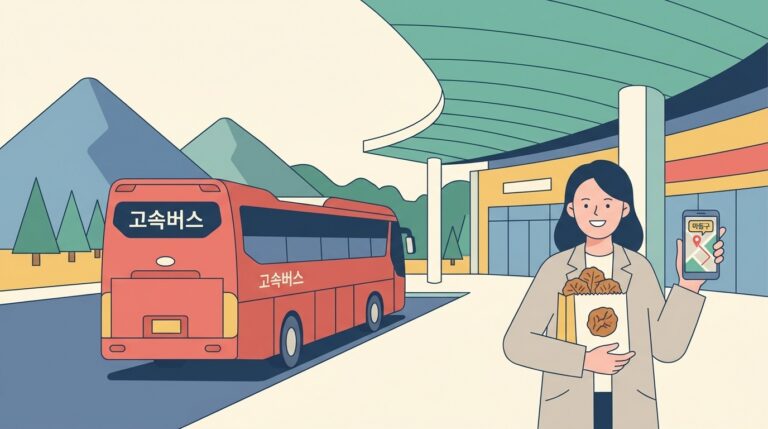
Picture this: You are on an express bus cruising along the scenic Korean highway, headed from Seoul to the coastal gem of Busan. Halfway through the journey, the bus slows down and pulls into a massive, bustling paradise glowing with neon signs: a Korean Hyugeso (휴게소 – highway rest area). The irresistible aroma of fresh walnut cakes (호두과자) and crispy potato tornado skewers wafts into the bus.
The driver turns around and announces something through the speaker. Everyone stands up and walks out. You step down into the crisp air, head into the food court, grab a mouthwatering snack, and walk back out into the parking lot. Suddenly, cold sweat hits you. Parked in neat rows are twenty bright red and white express buses. Every single one looks practically identical. Which one is yours? What if it leaves with your backpack, jacket, and passport inside?
If this scenario gives you chills, you are not alone! Almost every traveler in Korea experiences this mini-heart attack at least once. Korean highway rest stops are world-famous culinary wonderlands, but knowing how to keep track of your bus and communicate with the driver is your golden ticket to stress-free travel. Based on real experiences from our international learners at Daily Hangul, this practical A2-level guide will give you the exact words and cultural instincts you need to never lose your ride.
Phase 2: Top 3 Core Expressions Deep Dive
1. 몇 시까지 돌아와야 해요? (Myeot sikkaji dorawaya haeyo?)
- Pronunciation: [Myeot-si-kka-ji do-ra-wa-ya hae-yo?] (Think: “myut-she-kkah-jee doh-rah-wah-yah hae-yo”)
- Meaning: Literal: “Until what time must I return?” / Nuance: “What time should we be back on the bus?”
- K-Culture Moment: You’ll see this in popular variety shows like 2 Days & 1 Night (1박 2일), where members race against the clock during a 15-minute rest stop mission.
- Editor’s Insight: Express bus breaks in Korea are typically strictly 15 minutes. Asking this phrase before your feet touch the pavement guarantees you know the exact departure minute.
- Situation Spectrum: Casual ⚠️ | Semi-formal ✅ | Formal ✅
- 🤔 Think About It: In Korea, public transit schedules operate on precise collective harmony. If one person is late, 40 people wait. How does time sensitivity on public transportation in Korea compare to your home country?
2. 버스 번호판이 어떻게 돼요? (Beoseu beonhopani eotteoke dwaeyo?)
- Pronunciation: [Beo-seu beon-ho-pan-i eo-tteo-ke dwae-yo?] (Think: “buh-soo bun-hoh-pahn-ee uh-ttuh-keh dway-yo”)
- Meaning: Literal: “How does the bus license plate become?” / Nuance: “What is the license plate number of our bus?”
- K-Culture Moment: Savvy Korean travelers always check the 4-digit license plate number (e.g., 1234) or snap a quick photo on their smartphone before dashing to the restroom.
- Editor’s Insight: Notice the polite pattern 어떻게 돼요? (eotteoke dwaeyo?). Instead of bluntly asking “What is it?” (뭐예요?), Koreans use this phrasing for numbers, names, and ages to sound gentle and respectful.
- Situation Spectrum: Casual ⚠️ | Semi-formal ✅ | Formal ✅
- 🤔 Think About It: Why do you think Korean uses “how” (어떻게) rather than “what” (무엇) when asking for personal or official details politely?
3. 이 버스 부산 가는 버스 맞아요? (I beoseu Busan ganeun beoseu majayo?)
- Pronunciation: [I beo-seu Bu-san ga-neun beo-seu ma-ja-yo?] (Think: “ee buh-soo Boo-sahn gah-neun buh-soo mah-jah-yo”)
- Meaning: Literal: “Is this bus going to Busan correct?” / Nuance: “Is this the bus heading to Busan?”
- K-Culture Moment: Standing outside the bus door, clutching a bag of warm snacks, double-checking with the driver before stepping back onboard.
- Editor’s Insight: 맞아요? (majayo?) is one of the most useful verification expressions in Korean. You can attach it to almost any statement when you need quick reassurance.
- Situation Spectrum: Casual ⚠️ | Semi-formal ✅ | Formal ✅
- 🤔 Think About It: Asking for confirmation (“Is this right?”) is deeply ingrained in Korean communication to avoid collective inconvenience.
Phase 3: Textbook Korean vs. Real-Life Korean
Situation 1: Asking how long the break is
- 📖 Textbook Korean: 휴식 시간은 몇 분 동안 주어집니까? (Hyusik siganeun myeot bun dongan jueojimnikka? – How many minutes of rest time are granted?)
- 🗣️ Real Korean: 몇 분 쉬어요? (Myeot bun swieoyo? – How many minutes do we rest?)
- 💡 Why the difference?: The textbook version sounds like a formal military briefing! Real native speakers use the active everyday verb 쉬다 (swida – to rest) for quick, conversational clarity.
Situation 2: Asking where the bus is parked
- 📖 Textbook Korean: 저희 버스는 주차 구역 어디에 위치해 있습니까? (Jeohui beoseuneun jucha guyeok eodie wichihae itseumnikka? – In which parking sector is our bus situated?)
- 🗣️ Real Korean: 우리 버스 어디에 서 있어요? (Uri beoseu eodie seo isseoyo? – Where is our bus standing/parked?)
- 💡 Why the difference?: Koreans naturally refer to parked vehicles as “standing” (서 있다 – seo itda) rather than using stiff words like “situated” (위치하다).
Phase 4: K-Culture Deep Dive & Non-Verbal Manners
4-1. Nunchi (눈치) & Body Language at Rest Stops
- The 15-Degree Polite Bow: When approaching your bus driver outside the bus, give a gentle nod with your hands resting comfortably at your sides. Bus drivers appreciate travelers who are mindful of the departure time.
- The Visual Snapshot Technique: Never rely solely on memory. Before walking away from the bus, step back, turn around, and take a photo that captures both the bus’s front license plate and a noticeable landmark behind it (such as the main entrance, coffee stall, or restroom sign).
- Boarding 3 Minutes Early: In Korea, arriving exactly at departure time is considered cutting it too close. Aim to be back in your seat at least 2 to 3 minutes before the announced time. When everyone sits down early, the driver can leave smoothly without anxiety.
4-2. The Highway Rest Stop (휴게소) Food Craze
In South Korea, highway rest stops are not just pit stops; they are premier culinary destinations! Thanks to variety programs like Omniscient Interfering View (전지적 참견 시점), where food-loving celebrities mapped out the best delicacies across the country, millions of Koreans look forward to the highway break more than the final destination.
Popular must-eats include 소떡소떡 (Sotteok Sotteok)—skewers of alternating sausage and crispy grilled rice cakes slathered in spicy-sweet sauce—and steaming fresh 호두과자 (Hodu-gwaja), walnut-shaped pastries filled with sweet red bean paste and crunchy walnut chunks. Grab your snack quickly, and remember to check your watch!
Phase 5: Real-Life Roleplay Scenario
Setting: Geumgang Rest Area (금강휴게소) on the Gyeongbu Expressway.
Characters:
* Alex (알렉스): An excited traveler heading to Busan.
* Driver Kim (김 기사님): A warm, experienced bus driver wearing spotless white cotton gloves.
- Driver Kim: 15분 쉬었다 갑니다! 15분! 화장실 다녀오세요.
(Sibo-bun swieotta gamnida! Sibo-bun! Hwajangsil danyeo-oseyo.)
“We’re taking a 15-minute break! 15 minutes! Please use the restroom.”
🎭 마이크를 잡고 승객들을 돌아보며 외친다 (Speaking clearly into the bus PA microphone) -
Alex: 기사님, 몇 시까지 돌아와야 해요?
(Gisanim, myeot sikkaji dorawaya haeyo?)
“Driver, until what time should I be back?”
🎭 문 앞에서 가볍게 고개 숙여 인사하며 (Bowing slightly as he prepares to step off) -
Driver Kim: 지금 2시 10분이니까, 2시 25분까지 타세요!
(Jigeum dusi sipbun-inikka, dusi isibo-bun-kkaji taseyo!)
“It’s 2:10 now, so please board by 2:25!”
🎭 자신의 손목시계를 톡톡 가리키며 (Tapping his wristwatch with a smile) -
Alex: 네! 알겠습니다. 혹시 버스 번호판이 어떻게 돼요?
(Ne! Algetseumnida. Hoksi beoseu beonhopani eotteoke dwaeyo?)
“Yes! Understood. By any chance, what is our bus license plate number?”
🎭 주머니에서 스마트폰을 꺼내며 (Pulling his smartphone out of his pocket) -
Driver Kim: 경기 70아 1234번이에요. 저기 편의점 바로 앞에 서 있어요.
(Gyeonggi chil-sip-a il-i-sam-sa-beonieyo. Jeogi pyeon-uijeom baro ape seo isseoyo.)
“It’s Gyeonggi 70-Ah 1234. It’s parked right in front of that convenience store over there.”
🎭 손가락으로 주차된 위치를 가리키며 (Pointing his finger toward the storefront) -
Alex: (12분 후, 호두과자 봉투를 들고 돌아와서) 기사님, 이 버스 부산 가는 버스 맞아요?
(Gisanim, i beoseu Busan ganeun beoseu majayo?)
“Driver, is this the bus heading to Busan?”
🎭 가쁜 숨을 몰아쉬며 확인하듯 물어본다 (Catching his breath and showing his ticket) -
Driver Kim: 네, 맞아요! 1234번 맞네. 시간 딱 맞춰 왔네요, 어서 타요!
(Ne, majayo! Il-i-sam-sa-beon manne. Sigan ttak matchwo wanne-yo, eoseo tayo!)
“Yes, that’s right! Number 1234. You came back right on time, hop on in!”
🎭 껄껄 웃으며 버스 계단을 향해 손짓한다 (Chuckling and gesturing toward the steps) -
Alex: 감사합니다! 호두과자 사느라 늦을 뻔했어요.
(Gamsahamnida! Hodu-gwaja saneura neujeul ppeonhaesseoyo.)
“Thank you! I almost ran late buying walnut cakes.”
🎭 안도의 미소를 지으며 좌석으로 향한다 (Smiling with relief as he heads to his seat)
🔀 Interactive Choice Point
You step out of the snack pavilion at 2:23 PM. You see five identical white-and-red express buses parked in a line. What do you do?
- Option A: Panic, run to the very first bus, and hop on without checking.
- Option B: Check the photo on your phone, locate the plate number ending in ‘1234’, and confirm with the driver: 이 버스 맞아요? (I beoseu majayo?)
- Option C: Sit at an outdoor bench eating your snack, expecting the driver to walk around calling your name.
Feedback:
* If you chose A (High Risk): You might end up taking an unexpected journey to Gyeongju or Gwangju instead of Busan! Always double check the plate.
* If you chose B (Best Choice!): Pure local mastery! You saved time, preserved your peace of mind, and used Korean like a pro.
* If you chose C (Bad Choice): Korean highway buses operate on strict timetable systems. While drivers do a headcount, they cannot search the entire rest stop and will depart on schedule!
Phase 6: 10-Second Emotion Shadowing Drill
Read these out loud, pausing at each slash (/), and mimicking the indicated emotional tone:
[⏰ Hurried & Focused]
몇 시까지 / 돌아와야 해요?
(Myeot sikkaji / dorawaya haeyo?)
“Until what time / do I need to be back?”-
[📸 Calm & Practical]
버스 번호판 / 사진 찍어 둘게요.
(Beoseu beonhopan / sajin jjigeo dulgeyo.)
“I will / take a picture of the bus license plate.” -
[😊 Relieved & Cheerful]
휴, / 이 버스 부산 가는 버스 맞네요!
(Hyu, / i beoseu Busan ganeun beoseu manne-yo!)
“Phew, / this really is the bus heading to Busan!”
Phase 7: K-Culture Mini Dictionary
- 휴게소 (Hyugeso) | Highway Rest Area
A modern roadside transit hub featuring delicious food courts, spotless restrooms, fueling stations, and convenience stores. - 번호판 (Beonhopan) | License Plate
The identification plate on vehicles. For express buses, the last 4 digits are what you must remember! - 출발 시간 (Chulbal Sigan) | Departure Time
The precise time a vehicle rolls out. In Korean intercity transit, this means wheels moving, not doors opening. - 소떡소떡 (Sotteok Sotteok) | Sausage & Rice Cake Skewer
The undisputed king of Korean rest stop street snacks: chewy cylindrical rice cakes and savory cocktail sausages threaded alternately on a stick.
Phase 8: Traveler’s Survival Kit
TOP 3 Survival Phrases
- 사진 찍어도 돼요? (Sajin jjigeodo dwaeyo?)
Can I take a picture?
Pro Tip: Say this with a friendly smile if the driver is standing in front of the bus when you photograph the license plate. - 화장실이 어디예요? (Hwajangsil-i eodiyeyo?)
Where is the restroom?
Pro Tip: Highway rest area restrooms in Korea are ultra-modern and clean; look for the digital screens showing stall availability near the entrance. - 몇 분 남았어요? (Myeot bun namasseoyo?)
How many minutes are left?
Pro Tip: Use this when ordering snacks at the counter to make sure food preparation won’t make you miss your departure.
Editor’s Travel Note
- App Recommendation: Download the [Naver Map app download for transit routing] before your journey. It provides real-time bus tracking and stop-by-stop notifications.
- Bus Identification Card: When boarding, take a clear photo of your physical or mobile ticket showing the bus company name (e.g., 금호고속 Kumho Express, 중앙고속 Jungang Express) and your seat number.
- Payment Tip: Most snack stalls use self-service automated kiosks (키오스크). International cards (Visa, Mastercard) and transit cards like T-money are widely accepted.
Phase 9: “One Step Deeper” (Humanities Essay & Reflection)
In South Korea, the 15-minute rest stop break reflects a deeper social phenomenon: collective consideration (배려, baeryeo) and the famous Ppalli-ppalli (빨리빨리 – quick, efficient) spirit. When 40 passengers disembark simultaneously, there is an unspoken mutual contract: everyone enjoys their break efficiently, mindful that delaying the bus even by three minutes inconveniences dozens of fellow travelers. Participating in this communal rhythm isn’t just about catching your ride—it’s a shared cultural experience where punctuality becomes an act of courtesy.
💬 Your Turn: Have you ever experienced a nerve-wracking moment while traveling by bus or train abroad? How do you think Korean collective etiquette would feel on your road trip? Let’s chat in the comments below!
Phase 10: FAQ & Common Mistakes
Q: What should I do if my bus accidentally leaves without me at a rest area?
A: Don’t panic! Immediately walk to the rest area’s central building and locate the 종합안내소 (Jonghap Annaeso – General Information Desk). Show them your ticket on your phone. The staff can contact the highway bus control center, track down your specific bus to secure your luggage, and arrange for you to board the next bus traveling along the same route.
Q: Do Korean long-distance express buses have bathrooms onboard?
A: The vast majority (over 95%) of Korean express and intercity buses do not have onboard restrooms. This is why highway rest area stops every 1.5 to 2 hours are mandatory and strictly scheduled.
Q: Can I bring rest stop food back onto the bus?
A: Bottled water, coffee with sealed lids, and dry finger foods like walnut cakes (호두과자) are generally acceptable. However, hot foods with strong smells or loose sauces (like tteokbokki, hot noodles, or messy skewers) should be finished outside before boarding out of respect for fellow passengers.
🚨 Common Mistakes Alert
- Remembering the bus color instead of the plate number: Many bus companies operate dozens of identical red, yellow, or white buses on the same highway. Always record the 4-digit license plate number!
- Leaving your phone or wallet inside the bus: Never leave your essentials on your seat during the break. If you misjudge the time or need assistance, having your phone and payment card is critical.
- Assuming the driver will take roll call by name: While drivers count occupied seats, they do not have passenger names on a list. Always arrive back 2 to 3 minutes early.
Phase 11: Action Missions & Community Challenge
- 🥉 Bronze Mission (Solo Practice): Stand in front of your mirror and practice asking: “몇 시까지 돌아와야 해요?” (Myeot sikkaji dorawaya haeyo?) three times with a bright, polite tone.
- 🥈 Silver Mission (Social Share): Snap a photo of your favorite travel snack, post it on social media, and caption it: “휴게소 가고 싶어요! (I want to visit a Korean rest stop!)” Tag @DailyHangul so we can cheer you on!
- 🥇 Gold Mission (Real Application): On your next trip in Korea (or during language exchange), practice asking for departure times using our Phase 2 sentence patterns.
- 🎮 K-Culture Mission: Watch a clip of comedian Lee Young-ja on Omniscient Interfering View visiting a rest stop, and listen for the words 휴게소 (rest stop) and 호두과자 (walnut cakes)!
Phase 12: Interactive Quiz Challenge
Test your skills before hitting the Korean highway!
1. Situational Comprehension:
Your bus stops at an express rest area at 1:10 PM. The driver announces: “15분 쉴게요! (We will rest for 15 minutes!)” What time should you be back in your seat?
* A) 1:15 PM
* B) 1:23 PM ~ 1:25 PM
* C) 1:40 PM
2. Fill-in-the-Blank:
Complete the sentence to politely verify your destination with the driver:
이 버스 서울 가는 버스 ________? (Is this the bus going to Seoul?)
* Hint: Think of the verification word meaning ‘is it correct?’
3. True or False Cultural Quiz:
True or False: In Korea, asking someone “어떻게 돼요?” is a polite conversational way to ask for numbers or names instead of using blunt phrases.
👉 Click here to reveal the answers and explanations!
-
Answer: B (1:23 PM ~ 1:25 PM)
Explanation: 15 minutes from 1:10 PM is 1:25 PM! Arriving 2 minutes early (1:23 PM) allows everyone to board smoothly without holding up the departure. -
Answer: 맞아요 (majayo)
Explanation: The complete phrase is “이 버스 서울 가는 버스 맞아요?” (I beoseu Seoul ganeun beoseu majayo?), perfect for instant confirmation. -
Answer: True!
Explanation: Using 어떻게 돼요? (eotteoke dwaeyo?) softens your question and is the standard polite phrasing across daily Korean life.







