

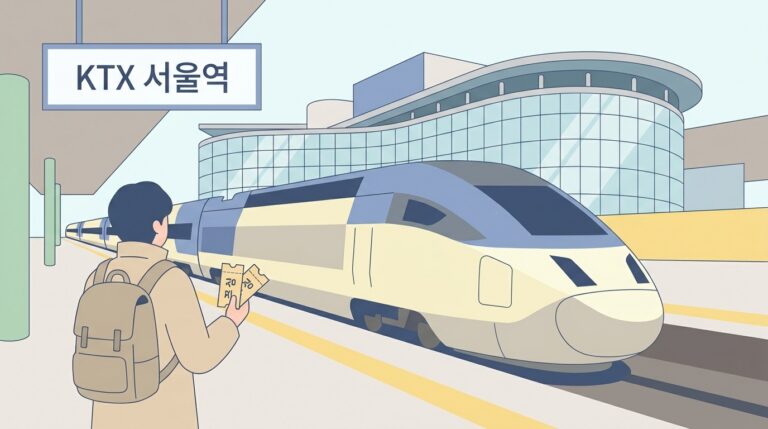
Never Panic at Seoul Station Again: How to Book a Round-Trip Ticket Like a Local
Phase 1: 공감 (Story Opening)
안녕하세요! 매일한글 에디터입니다. (Hello! I’m your Daily Hangul editor.)
Picture this: You are standing under the colossal glass ceiling of Seoul Station on a Friday afternoon. Commuters are rushing past with rolling suitcases, screens are flashing departures to Busan and Gangneung, and the ticket agent behind the glass looks up at you with an expectant smile: “어디로 가세요? (Where are you heading?)” Suddenly, your mind blanks out. You want to visit Busan, eat fresh seafood, watch the Haeundae sunset, and return to Seoul on Sunday evening. But how do you say “round-trip” without resorting to awkward hand gestures that look like a boomerang?
Every traveler in Korea faces this exact hurdle. You might worry about boarding the wrong train, getting stranded halfway across the country, or booking two separate one-way tickets at twice the hassle. Don’t worry! Based on years of mentoring beginner travelers who once felt frozen at station counters, I have broken down the exact phrases and cultural nuances you need. With just a handful of three-word patterns, you will walk up to any KTX or express bus ticket counter with utter confidence and grab your round-trip ticket like a seasoned pro.
Phase 2: 핵심 표현 3선 심층 분석 (Top 3 Core Expressions)
1. 왕복으로 예매할게요 (Wangbogeuro yemaehalgeyo)
- Pronunciation: [Wang-bog-eu-ro ye-mae-hal-ge-yo] (Sounds like “Wahng-bohk-uh-roh yeh-meh-hal-geh-yoh”)
- Meaning: Literal: “I will book as a round-trip” | Real Nuance: “A round-trip ticket, please.”
- K-Culture Moment: In weekend travel vlogs and K-dramas, whenever lead characters plan a spontaneous spontaneous weekend getaway to Gangneung, they casually drop this line at the counter.
- Editor’s Insight: 왕복 (wangbok) means “round-trip” (going and returning), while -으로 (-euro) means “as/by means of”. Pair it with 예매할게요 (yemaehalgeyo), which specifically denotes reserving a seat in advance.
- Situation Spectrum:
- Casual (반말): 왕복으로 할래 (Wangbogeuro hallae) ⚠️ (Only with close friends)
- Semi-formal (존댓말): 왕복으로 예매할게요 (Wangbogeuro yemaehalgeyo) ✅ (Perfect for ticket clerks)
- Formal (격식체): 왕복으로 예매 부탁드립니다 (Wangbogeuro yemae butakdeurimnida) ✅ (Super polite)
- 🤔 Think About It: In English, we usually ask a question: “Can I get a round-trip ticket?” In Korean, stating your intention politely with -할게요 (-halgeyo, “I will do…”) is the most natural way to order or request service.
2. 서울에서 부산까지요 (Seoureseo Busankkajiyo)
- Pronunciation: [Seo-ur-e-seo Bu-san-kka-ji-yo] (Sounds like “Suh-ool-eh-suh Boo-sahn-kkah-jee-yoh”)
- Meaning: Literal: “From Seoul to Busan” | Real Nuance: “Seoul to Busan, please.”
- K-Culture Moment: Think of the iconic film Train to Busan—before anyone ran from zombies, everyone bought a ticket saying this exact phrase at the platform!
- Editor’s Insight: 에서 (eseo) means “from”, and 까지 (kkaji) means “to/until”. Adding 요 (yo) at the end instantly transforms any short fragment into a courteous, complete request.
- Situation Spectrum:
- Casual: 서울에서 부산까지 (Seoureseo Busankkaji) 🚫 (Rude to clerks)
- Semi-formal: 서울에서 부산까지요 (Seoureseo Busankkajiyo) ✅ (Natural & efficient)
- Formal: 서울에서 부산까지 부탁합니다 (Seoureseo Busankkaji butakhamnida) ✅ (Polite)
- 🤔 Think About It: Notice how Korean attaches spatial particles directly onto the noun without prepositions. What does this reveal about Korean’s focus on clear starting and ending points?
3. 몇 시 차 있어요? (Myeot si cha isseoyo?)
- Pronunciation: [Myeot si cha is-seo-yo] (Sounds like “Myuht-shee chah ees-suh-yoh”)
- Meaning: Literal: “What hour vehicle exists?” | Real Nuance: “What times do you have available?”
- K-Culture Moment: When characters in rural K-dramas miss their evening bus and anxiously lean over the terminal counter, this is the first question they ask.
- Editor’s Insight: Koreans use the general word 차 (cha) (car/vehicle) to refer to both trains and intercity buses in casual conversation. You don’t have to awkwardly say “고속버스 (gosokbeoseu)” or “열차 (yeolcha)” every time.
- Situation Spectrum:
- Casual: 몇 시 차 있어? (Myeot si cha isseo?) 🚫 (Only to friends)
- Semi-formal: 몇 시 차 있어요? (Myeot si cha isseoyo?) ✅ (Standard customer tone)
- Formal: 몇 시 차가 있습니까? (Myeot si chaga itseumnikka?) ⚠️ (A bit overly stiff)
- 🤔 Think About It: Why do you think the broad word cha (vehicle) replaced specific transportation terms in daily spoken Korean?
Phase 3: 교과서 한국어 vs 진짜 한국어 (Textbook vs. Real-Life Korean)
Situation 1: Choosing a round-trip over a one-way
- 📖 교과서 한국어 (Textbook Korean): 저는 왕복 승차권을 구매하고 싶습니다. (Jeoneun wangbok seungchagwoneul gumaehago sipseumnida. – “I desire to purchase a round-trip passenger ticket.”)
- 🗣️ 진짜 한국어 (Real-Life Korean): 왕복으로 두 장 주세요. (Wangbogeuro du jang juseyo. – “Two round-trip tickets, please.”)
- 💡 왜 다를까?: Native speakers rarely use formal book words like 승차권 (seungchagwon – passenger ticket) or 구매하다 (gumaehada – to purchase) at the ticket window. Simply stating the type and quantity (왕복으로 두 장) gets you your tickets in three seconds flat.
Situation 2: Asking for the next train time
- 📖 교과서 한국어 (Textbook Korean): 다음 열차 출발 시각이 언제입니까? (Daeum yeolcha chulbal sigagi eonjeimnikka? – “When is the departure time of the subsequent train?”)
- 🗣️ 진짜 한국어 (Real-Life Korean): 제일 빠른 거 몇 시예요? (Jeil ppareun geo myeot siyeyo? – “What time is the earliest one?”)
- 💡 왜 다를까?: In fast-paced Korean terminals, people want practical information quickly. Asking 제일 빠른 거 (jeil ppareun geo – the fastest/earliest one) is exactly how locals secure the next departing seat.
Phase 4: K-Culture 딥다이브 & 비언어적 매너 (Culture & Manners)
4-1. 눈치 (Nunchi) & Counter Etiquette
- The Two-Handed Hand-off: When handing your credit card or cash to the ticket counter agent, use both hands, or support your right wrist/forearm lightly with your left hand. It conveys immense respect.
- The Screen Nod: Most ticket windows feature a customer-facing monitor showing your seat, departure time, and price. When the agent points to it and asks “이 시간 괜찮으세요? (Is this time okay with you?)”, take a brief glance and give a crisp nod with “네, 좋아요! (Ne, joayo! – Yes, looks good!)”.
- Mind the Queue Line: In Korea, people strictly stand behind the yellow floor line until the person ahead completely finishes their transaction.
4-2. Cultural Code: The Friday Escape & Silent Car Etiquette
South Korea’s high-speed train, the KTX, travels up to 305 km/h, turning a cross-country trip from Seoul to Busan into a breezy 2.5-hour journey. Because of this, “Friday evening getaways” (불금 여행) are deeply embedded in youth culture. However, inside the train cars, quietness is golden. Phone calls are taken out in the vestibules between cars, and headphones are mandatory. If you book an Express Bus, notice how tickets show exact seat numbers—there is no free-for-all boarding!
Phase 5: 실전 롤플레이 시나리오 (Roleplay Dialogue)
- Setting: Friday afternoon at the busy KTX ticket counter inside Seoul Station.
- Characters:
- 민지 (Min-ji): A sharp, friendly Korail station agent wearing a neat navy uniform.
- 알렉스 (Alex): A traveler planning a weekend trip to Busan.
민지: 안녕하세요! 어디로 가세요?
(Annyeonghaseyo! Eodiro gaseyo?)
“Hello! Where are you heading today?”
🎭 Smiles politely and waits behind the counter keyboard.
알렉스: 안녕하세요. 부산 가려고 하는데요.
(Annyeonghaseyo. Busan garyeogo haneundeyo.)
“Hello. I’m planning to go to Busan.”
🎭 Looks at the departure board above the counter.
민지: 네, 편도세요, 왕복이세요?
(Ne, pyeondoseyo, wangbogiseyo?)
“Okay, one-way or round-trip?”
🎭 Tilts head slightly and hovers fingers over the ticket system.
알렉스: 왕복으로 예매할게요! 일요일에 돌아와요.
(Wangbogeuro yemaehalgeyo! Ilyoire dorawayo.)
“I’ll book a round-trip! I am returning on Sunday.”
🎭 Speaks clearly with a friendly smile.
민지: 네. 오늘 내려가시는 건 몇 시 차로 해드릴까요?
(Ne. Oneul naeryeogasineun geon myeot si charo haedeurilkkayo?)
“Understood. For heading down today, what time train would you like?”
🎭 Checks available seats on her screen.
알렉스: 제일 빠른 거 몇 시 차 있어요?
(Jeil ppareun geo myeot si cha isseoyo?)
“What time is the earliest train?”
🎭 Leans in slightly to see the screen.
민지: 3시 15분 KTX 있어요. 일반실 괜찮으세요?
(Se-si sib-o-bun KTX isseoyo. Ilbansil gwaenchaneuseyo?)
“There is a 3:15 PM KTX. Is standard class fine with you?”
🎭 Points with an open hand toward the customer monitor.
알렉스: 네, 좋아요! 카드 여기 있어요.
(Ne, joayo! Kadeu yeogi isseoyo.)
“Yes, that’s great! Here is my card.”
🎭 Hands over the credit card using both hands.
🔀 Interactive Decision Point!
Min-ji suddenly asks: “돌아오는 표는 일요일 몇 시로 해드릴까요? (For the return ticket, what time on Sunday would you like?)” How do you respond?
- Option A: “아무 때나 괜찮아요.” (Amu ttaena gwaenchannayo. – Anytime is fine.)
- Feedback [Bad]: Sunday evening trains back to Seoul frequently sell out! If you say “anytime”, you might end up with a midnight standing-room ticket or miss your preferred dinner plans.
- Option B: “일요일 오후 다섯 시쯤 있어요?” (Ilyoil ohu daseot sijjeum isseoyo? – Do you have anything around 5 PM on Sunday?)
- Feedback [Best]: ⭐ Perfect! Specifying an approximate time block (~쯤 / jjeum) lets the clerk quickly search the closest available departures and suggest the best seats.
- Option C: “나중에 인터넷으로 할래요.” (Najunge inteoneseuro hallae-yo. – I’ll do it later on the internet.)
- Feedback [Risk]: Not terrible, but booking round-trip at the counter secures your return ticket instantly, protecting you from weekend sellouts when using unfamiliar apps on the go.
Phase 6: 10초 감정 섀도잉 드릴 (Emotion Shadowing Drill)
Read these aloud while mimicking the exact feeling!
[😊 Confident & Polite]
왕복으로 / 예매할게요!
(Wangbogeuro / yemaehalgeyo!)
“I will book / as a round-trip!”-
[🤔 Curious & Focused]
부산 가는 거 / 제일 빠른 차 / 몇 시 있어요?
(Busan ganeun geo / jeil ppareun cha / myeot si isseoyo?)
“For Busan / the earliest train / what time do you have?” -
[🙏 Thankful & Clear]
네, / 그 시간으로 / 두 장 주세요!
(Ne, / geu siganeuro / du jang juseyo!)
“Yes, / for that time / two tickets please!”
Phase 7: K-Culture 미니 사전 (Mini Dictionary)
- 왕복 (Wangbok) | Round-trip
Used everywhere in transportation and logistics. The opposite is 편도 (pyeondo – one-way). - 매진 (Maejin) | Sold Out
The word every holiday traveler dreads seeing in red letters on electronic departure boards. - 일반실 vs 특실 (Ilbansil vs Teuksil) | Standard Class vs First Class
On KTX trains, standard cars have a 2×2 seating layout, while First Class (특실) features a roomier 2×1 layout with free bottled water and snacks. - 창가 / 통로 (Chang-ga / Tong-ro) | Window Seat / Aisle Seat
When the clerk asks your seat preference, say “창가로 주세요 (Window seat, please)” for scenic countryside views.
Phase 8: 여행자를 위한 생존 키트 (Traveler’s Survival Kit)
Top 3 Survival Phrases
- 영수증 주세요. (Yeongsujeung juseyo.)
“Receipt, please.”
Pro Tip: Your receipt often contains your gate, train car number, and seat number clearly printed! - 자리 붙여 주세요. (Jari buchyeo juseyo.)
“Please seat us together.”
Pro Tip: Essential when traveling with a partner or friend during busy peak hours. - 몇 번 플랫폼이에요? (Myeot beon peullaetpomieyo?)
“Which platform number is it?”
Pro Tip: Ask any station staff if the multi-language overhead monitors feel overwhelming.
Editor’s Travel Note
- App Essentials: While counter booking is great practice, bookmark the official [Korail English train booking portal] for schedule checks before heading to the terminal. If you prefer buses, explore the [T-money intercity express bus reservation guide] to compare routes.
- Luggage Tip: Unlike long-distance flights, KTX trains do not require checked baggage. There are overhead racks and dedicated luggage bays at the front and back of each carriage—free of charge!
Phase 9: “한 발 더 깊이” (Deeper Reflection)
Korea’s transportation infrastructure is famously built upon the cultural philosophy of 빨리빨리 (ppalli-ppalli – hurry, hurry), prioritizing speed, clean punctuality, and clockwork precision. Yet inside the station, this intense rush melts into a collective consideration for shared public space. Ticket counters are designed for ultra-smooth interactions: short, clear requests with respectful endings like -요 (-yo) ensure nobody waits longer than necessary. Politeness here is not about long pleasantries, but about being clear, kind, and mindful of the people behind you.
💬 Your Turn: What city in Korea are you longing to visit by train—is it the ocean views of Busan, the historical alleys of Gyeongju, or the foodie capital of Jeonju? Share in the comments below!
Phase 10: FAQ & Common Mistakes
Q: Can I buy tickets with an international Visa or Mastercard at the station counter?
A: Yes! All staffed KTX and Express Bus ticket counters across Korea readily accept major foreign credit cards. Just hand over the card with two hands.
Q: What is the difference between KTX and Mugunghwa trains?
A: KTX is Korea’s high-speed bullet train (Seoul to Busan takes ~2.5 hours). The Mugunghwa (무궁화호) is a classic scenic train that stops at smaller towns; it takes about 5.5 hours to Busan but costs less than half the price.
Q: Do I need to validate my ticket before stepping onto the train?
A: No! Korean train stations have no turnstiles or ticket barriers. It’s a honor-based open system. Simply walk straight onto your designated platform and sit in your exact assigned seat. Conductors have digital handheld tablets showing which seats are purchased.
🚨 Common Mistakes TOP 3
- Mistake: Saying “왕복 표 사고 싶어요” casually to an older ticket agent.
Correct Action: Always attach the polite ending: “왕복으로 예매할게요 (Wangbogeuro yemaehalgeyo)” or “왕복으로 주세요 (Wangbogeuro juseyo)”. - Mistake: Forgetting that return tickets on Sunday evening sell out hours ahead.
Correct Action: Always book your return trip at the exact same moment you book your outbound ticket. - Mistake: Boarding without double-checking the 호차 (hocha – car number).
Correct Action: KTX trains can be 20 cars long! Check your ticket for X호차 (Car X) and X번 좌석 (Seat X) before the train pulls in.
Phase 11: 액션 미션 (Action Missions)
- 🥉 Bronze Mission (Solo): Stand in front of your mirror and repeat “왕복으로 예매할게요” 5 times with a bright, friendly nod.
- 🥈 Silver Mission (Voice Practice): Record a voice note saying: “서울에서 부산까지 왕복으로 두 장 주세요.” Check your pronunciation of wang-bok.
- 🥇 Gold Mission (Real World Challenge): Next time you are at a train station or metro kiosk in Korea, approach the counter and complete your transaction entirely in Korean without switching to English!
- 🎮 K-Culture Mission: Watch an episode of any travel-themed Korean variety show (like 2 Days & 1 Night) and listen for when the cast members yell “표 끊었어요? (Did you get the tickets?)”.
Phase 12: 인터랙티브 퀴즈 챌린지 (Interactive Quiz)
- Situational Check: You are at the Gangneung Bus Terminal and want to purchase a round-trip ticket back to Seoul. Which phrase should you say?
- A) 편도로 갈게요 (Pyeondoro galgeyo)
- B) 왕복으로 예매할게요 (Wangbogeuro yemaehalgeyo)
- C) 매진이에요 (Maejin-ieyo)
- Fill in the Blank: 서울______ 부산______ 왕복으로 주세요. (From Seoul to Busan, please give me a round-trip.)
- Fill in the two particles.
- True / False: At Korean KTX stations, you must scan your ticket at a turnstile gate before walking onto the platform.
- (True / False)
👉 Click to view answers and explanations
- Answer: B – 왕복으로 예매할게요 (I will book as a round-trip) is correct. Option A means one-way, and Option C means “it is sold out”.
- Answer: 서울[에서] 부산[까지] – -에서 (-eseo) means ‘from’, and -까지 (-kkaji) means ‘to/until’.
- Answer: False – Korea uses an open-gate honor system. There are no turnstiles at KTX platforms! Just walk straight to your car and sit in your assigned seat.







