

Pitch Like a Gangnam Founder: Nailing Unit Economics and Valuation in Korean
Phase 1: Empathy (Story-Driven Opening)
안녕하세요! 매일한글 에디터입니다. (Annyeonghaseyo! It’s your Daily Hangul editor.)
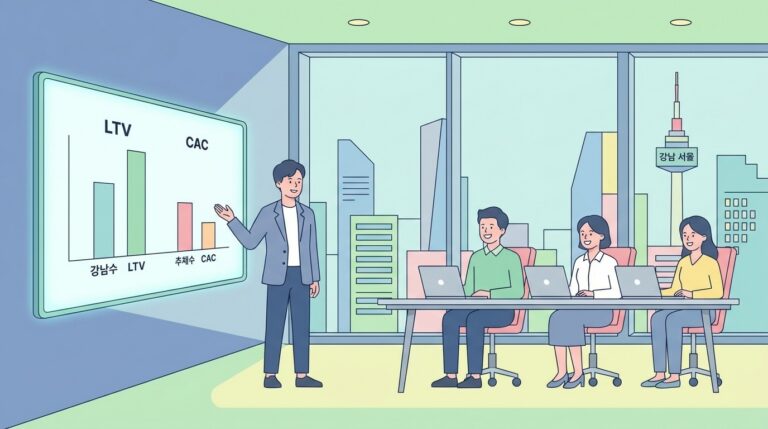
Picture this: You are standing inside a sleek, glass-walled conference room in Teheran-ro, the vibrant beating heart of Seoul’s Gangnam startup ecosystem. Across the long walnut table sit four venture capitalists in minimalist black blazers, tapping their laptops. If you have ever watched the K-Drama Start-Up, you know this exact tension—Nam Do-san clutching his presentation clicker while Sandbox mentors squint at unit projections. You click to slide nine, ready to drop the hammer: your Customer Lifetime Value (LTV) is four times your Customer Acquisition Cost (CAC).
Yet, your tongue suddenly freezes. How do you say “We proved unit economics where Customer Lifetime Value exceeds Acquisition Cost fourfold” without sounding like an online translator spitting out textbook jargon? If you simply say “돈을 많이 법니다” (we make lots of money), the partners will mentally tune out. Pitching corporate valuation is not just about translating financial vocabulary; it is about projecting high-context executive confidence. In this guide, tailored from real feedback with foreign startup founders pitching in Korea, we will master the exact C1-level business cadence you need to win over local investors.
Phase 2: Top 3 Core Expressions in Depth
1. 고객획득비용 대비 생애가치를 4배 이상으로 방어하고 있습니다 (Gogaek-hoekdeuk-biyong daebi saeng-ae-gachireul ne bae isang-euro bang-eohago itseumnida)
- Pronunciation: [Go-gaek hoek-deuk bi-yong dae-bi saeng-ae ga-chi-reul ne bae i-sang-eu-ro bang-eo-ha-go it-seum-ni-da] (Think: “Go-get hook-duke bee-yong day-bee…”)
- Meaning: Literally “We are defending customer lifetime value at over four times compared to customer acquisition cost.” In native startup context: “We consistently sustain a 4x+ LTV to CAC ratio.”
- K-Culture Moment: Echoing the iconic investor pitch scenes in Start-Up, where founders defend their burn rate against skeptical seed stage evaluators.
- Editor’s Insight: Notice the verb 방어하다 (bang-eohada), which literally means “to defend.” In Korean financial discussions, sustaining margins against inflation or competition is viewed as a strategic defense. Using “방어하다” instantly gives you the polished veneer of a seasoned CFO.
- Situation Spectrum: Casual 🚫 | Semi-formal ⚠️ | Formal ✅
- 🤔 Think About It: Why does Korean business speak view maintaining financial margins as “defense” (방어)? What does this reveal about market volatility in Korea’s dynamic tech sector?
2. 유닛 이코노믹스의 건전성을 입증했습니다 (Yunit ikonomikseueui geonjeonseong-eul ipjeunghaetseumnida)
- Pronunciation: [Yu-nit i-ko-nom-ik-seu-ui geon-jeon-seong-eul ip-jeung-haet-seum-ni-da] (Think: “You-neat eco-nomics-eui gun-jeon-sung…”)
- Meaning: Literally “We have verified the healthiness/soundness of unit economics.” Real nuance: “We have proven solid, repeatable unit economics.”
- K-Culture Moment: Heard frequently during Pangyo Demo Days or when Series A founders appear on Korean tech YouTube channels like EO (Eoeo).
- Editor’s Insight: 건전성 (geonjeonseong) combines ‘건전’ (sound/healthy) with ‘-성’ (-ity/nature). Foreign founders often say “우리의 숫자는 좋습니다” (Our numbers are good), which sounds amateur. “건전성을 입증했다” positions your data as bulletproof.
- Situation Spectrum: Casual 🚫 | Semi-formal ⚠️ | Formal ✅
- 🤔 Think About It: How does the word 건전 (wholesome/sound) bridge the gap between financial stability and corporate moral responsibility in East Asian business ethics?
3. 지표 기반으로 밸류에이션의 타당성을 설득하고자 합니다 (Jipyo giban-euro baellyueisyeon-eui tadangseong-eul seoldeukhagoja hamnida)
- Pronunciation: [Ji-pyo gi-ban-eu-ro bael-lyu-ei-syeon-ui ta-dang-seong-eul seol-deuk-ha-go-ja ham-ni-da]
- Meaning: “We intend to demonstrate the validity of our valuation based on clear metrics.”
- K-Culture Moment: The climactic turn in high-stakes negotiations where the board presses for a discount, and the founder stands firm with operational metrics.
- Editor’s Insight: The connective ending -고자 합니다 (-goja hamnida) represents the pinnacle of executive decorum. It conveys firm intent without aggressive arrogance, essential when negotiating term sheets with senior Korean partners.
- Situation Spectrum: Casual 🚫 | Semi-formal ⚠️ | Formal ✅
- 🤔 Think About It: How does “설득하고자 합니다” soften the assertiveness of valuation demands while preserving founder authority?
Phase 3: Textbook Korean vs. Real Korean
Situation 1: Talking about profit margins
- 📖 교과서 한국어: 우리 회사의 이익률은 매우 좋습니다. (Uri hoesaeui iingnyureun maeu joseumnida. / Our company’s profit rate is very good.)
- 🗣️ 진짜 한국어: 유닛 마진이 견고하게 받쳐주고 있습니다. (Yunit majini gyeon-gohage batchyeojugo itseumnida. / Our unit margins are solidly supporting the bottom line.)
- 💡 왜 다를까? Textbook Korean leans on generic adjectives like ‘좋다’ (good). Real executives use structural metaphors like 받쳐주다 (batchyeojuda)—signifying that foundational operational numbers are actively holding up the company’s valuation.
Situation 2: Discussing acquisition spending efficiency
- 📖 교과서 한국어: 마케팅 비용을 많이 줄였습니다. (Maketing biyongeul mani juryeotseumnida. / We reduced marketing expenses a lot.)
- 🗣️ 진짜 한국어: CAC를 획기적으로 낮추면서 효율을 뽑아냈습니다. (CACreul hoekgijeogeuro natchumyeonseo hyoyureul ppobanaetseumnida. / We slashed CAC dramatically while maximizing operational efficiency.)
- 💡 왜 다를까? Korean founders use expressive action verbs like 효율을 뽑아내다 (hyoyureul ppobanaeda – literally: to extract/pull out efficiency) to show proactive optimization rather than passive cost-cutting.
Phase 4: K-Culture Deep Dive & Non-Verbal Manners
4-1. 눈치 (Nunchi) & Pitch Room Gestures
In a Korean IR room, aggressive American-style “stage prowling” can come across as theatrical or insincere. Korean VCs value 진정성 (jinjeongseong – authenticity/sincerity) and grounded composure. Keep both feet firmly planted. When advancing slides with a laser clicker, avoid pointing it casually toward partners. Hold your clicker with your dominant hand and gently support your wrist or elbow with your non-dominant hand when gesturing toward the screen. Make steady eye contact not just with the Managing Partner (대표 파트너), but also with the Junior Associates sitting at the table’s edge—they often write the initial investment review memos!
4-2. Cultural Code: Pangyo vs. Teheran-ro Dynamics
Korea’s tech ecosystem is divided into two major clusters: Teheran-ro (finance, early-stage accelerators, institutional VCs) and Pangyo Techno Valley (scale-ups, engineering giants, gaming hubs). In Teheran-ro, valuation discussions center on rapid capital efficiency and aggressive global expansion. Showing humility regarding local market nuances while maintaining fierce confidence in unit economics hits the exact cultural sweet spot known as 외유내강 (Oeyunaegang – gentle on the outside, resolute on the inside).
Phase 5: Real-Life Roleplay Scenario
Setting: A sunlit demo conference room at an accelerator near Yeoksam Station. Investor Min-woo Park is scrutinizing your Series A deck.
- 박민우 심사역 (VC Min-woo): [의자를 앞으로 당겨 앉으며 서류를 넘긴다] 대표님, 현재 초기 마케팅 비용 지출이 과도해 보입니다. 이 밸류에이션이 정당화될 수 있을까요?
(Daepyoniim, hyeonjae chogi maketing biyong jichuri gwadohae boimnida. I baellyueisyeoni jeongdanghwadoel su isseulkkayo?)
🎭 [Pulls chair forward and turns the deck page] Founder, your initial marketing spend seems excessive. Can this valuation be justified? -
창업자 알렉스 (Founder Alex): [미소를 머금고 고개를 정중히 끄덕인다] 우려하시는 점 충분히 이해합니다, 심사역님. 하지만 전환 데이터를 확인해 주시겠습니까?
(Uryeohasineun jeom chungbunhi ihaehamnida, simsayeongnim. Hajiman jeonhwan deiteoreul hwaginhae jusigesseumnika?)
🎭 [Smiles slightly and nods respectfully] I completely understand your concern, Director. However, could we look at the conversion data? -
창업자 알렉스 (Founder Alex): [화면의 9번 슬라이드를 가리키며] 보시는 바와 같이, 고객획득비용 대비 생애가치를 4배 이상으로 방어하고 있습니다.
(Bosineun bawa gachi, gogaekhoekdeukbiyong daebi saengaegachireul ne bae isangeuro bangeohago itseumnida.)
🎭 [Points to slide 9 with open palm] As you can see, we consistently sustain an LTV over four times our CAC. -
박민우 심사역 (VC Min-woo): [안경을 만지며 화면 도표를 응시한다] 4배라… 코호트별 유지율(Retention) 지표도 안정적인가요?
(Ne baera… Kohoteubyeol yujiyul jipyodo anjeongjeong-ingayo?)
🎭 [Adjusts glasses and inspects the chart] 4x… Are your retention numbers across cohorts equally stable? -
창업자 알렉스 (Founder Alex): [자신감 넘치는 눈빛으로] 네, 6개월 차 리텐션이 52%에서 평탄화되며 유닛 이코노믹스의 건전성을 입증했습니다.
(Ne, yuk-gae-wol cha ritensyeoni osip-i-peosenteueseo pyeongtanhwadoemyeo yunit ikonomikseueui geonjeonseongeul ipjeunghaetseumnida.)
🎭 [With firm confidence] Yes, retention flattens at 52% at month six, demonstrating solid unit economics. -
박민우 심사역 (VC Min-woo): [만족스러운 듯 고개를 끄덕인다] 초기 진입 장벽을 넘으면 마진율 개선 속도가 가파르겠군요.
(Chogi jinip jangbyeogeul neomeumyeon majinyul gaeseon sokdoga gapareugetgunyo.)
🎭 [Nods approvingly] So once you pass initial entry barriers, margin expansion should accelerate rapidly. -
창업자 알렉스 (Founder Alex): [두 손을 모아 테이블 위에 얹으며] 맞습니다. 따라서 이번 라운드에서는 이 지표를 기반으로 밸류에이션의 타당성을 설득하고자 합니다.
(Matseumnida. Ttaraseo ibeon raundeueseoneun i jipyoreul gibaneuro baellyueisyeoneui tadangseongeul seoldeukhagoja hamnida.)
🎭 [Clasps hands gently on the table] Precisely. Therefore, in this round, we intend to establish the validity of our valuation based on these metrics. -
박민우 심사역 (VC Min-woo): [미소를 지으며 펜을 내려놓는다] 좋습니다. 세부 재무 모델링 시트를 함께 검토해 보시죠.
(Joseumnida. Sebu jaemu modelling siteureul hamkke geomtohae bosijo.)
🎭 [Smiles and puts down his pen] Sounds good. Let us examine the detailed financial modeling sheet together.
🔀 Interactive Choice Point
How would you answer if the VC asks: “경쟁사가 비슷한 기능을 출시하면 CAC가 급등하지 않을까요?” (If a competitor launches a similar feature, won’t CAC skyrocket?)
- Selection A: “경쟁사는 기술력이 부족해서 우리를 절대 못 따라옵니다.” (Competitors lack tech stack and can never catch up.)
- ❌ Bad: Sounds arrogant and dismissive of market realities. Korean VCs value sober competitor analysis.
- Selection B: “CAC 상승 압력이 있을 수 있으나, 독점적 락인(Lock-in) 구조로 LTV를 동반 상승시켜 방어할 계획입니다.” (While there may be CAC pressure, we plan to defend by elevating LTV through proprietary lock-in.)
- 🏆 Best: Acknowledges market risks while countering with strategic structural remedies.
- Selection C: “마케팅비를 두 배로 올려서 시장을 먼저 다 먹겠습니다.” (We will double marketing spend to take the entire market first.)
- ⚠️ Risk: Suggests unsustainable cash burn without addressing the unit economics root cause.
Phase 6: 10-Second Emotional Shadowing Drill
Read aloud, matching the pause bars (/) and emotional tone indicators:
[💼 객관적인 수치로 좌중을 압도하듯 차분하게]
보시는 바와 같이 / 고객획득비용 대비 생애가치를 / 4배 이상으로 / 안정적으로 방어하고 있습니다.
(Bosineun bawa gachi / gogaekhoekdeukbiyong daebi saengaegachireul / ne bae isangeuro / anjeongjeogeuro bangeohago itseumnida.)-
[📊 데이터의 신뢰성을 단호하게 어필하며]
코호트 유지율 데이터가 받쳐주고 있어 / 유닛 이코노믹스의 건전성은 / 이미 입증되었습니다.
(Kohoteu yujiyul deiteoga batchyeojugo isseo / yunit ikonomikseueui geonjeonseongeun / imi ipjeungdoeeotseumnida.) -
[🤝 정중하면서도 흔들림 없는 파트너십을 제안하듯]
검증된 지표를 기반으로 / 이번 밸류에이션의 타당성을 / 정중히 설득하고자 합니다.
(Geomjeungdoen jipyoreul gibaneuro / ibeon baellyueisyeoneui tadangseongeul / jeongjunghi seoldeukhagoja hamnida.)
Phase 7: K-Culture Mini Dictionary
- 지표 (Jipyo) | Quantitative Metrics / Indicators
- Essential in venture spaces. Korean founders rarely say “숫자” (numbers) in pitch decks; they refer to north-star metrics as “핵심 지표” (Core metrics).
- 밸류 (Baellyu) | Corporate Valuation
- Loanword abbreviation for valuation. You will hear “이번 라운드 밸류 얼마로 보시나요?” (What valuation are you looking for in this round?).
- 런웨이 (Reon-wei) | Cash Runway
- Used exactly like Silicon Valley lingo to denote months of operating survival before running out of capital (e.g., “런웨이가 10개월 남았습니다”).
- 리텐션 (Ritensyeon) | User Retention Rate
- Often combined with “방어” (defense) or “개선” (improvement). High retention is affectionately referred to as having a sticky “락인 효과” (Lock-in effect).
Phase 8: Traveler & Business Explorer Survival Kit
Top 3 Business Survival Phrases
- 명함 한 장 건네 드려도 되겠습니까? (Myeongham han jang geonne deuryeodo doegesseumnikka?)
- Meaning: May I offer you my business card?
- Pro Tip: Always present your card with both hands, text facing the recipient.
- 오늘 미팅 내용 요약해서 IR 덱과 함께 메일로 송부드리겠습니다. (Oneul miting naeyong yoyakhaeseo IR daek-gwa hamkke meillo songbudeurigesseumnida.)
- Meaning: I will summarize today’s meeting and send it via email along with our updated IR deck.
- 다음 라운드 클로징 일정에 맞춰 팔로업 드리겠습니다. (Daeum raundeu keullojing iljeonge matchwo pallo-eop deurigesseumnida.)
- Meaning: I will follow up in accordance with your next round closing timeline.
Editor’s Travel Note
Heading to an investor meeting in Pangyo or Gangnam? Never rely solely on global map apps, which often lack up-to-date indoor layouts in Korea. Make sure you use the Naver Map app download for transit to navigate high-rise office towers and underground subway transfer gates seamlessly. When meeting VCs in Korea, punctuality is paramount: arriving 10 minutes early at the office lobby lounge shows immense professional respect.
Phase 9: “One Step Deeper” (Critical Thinking)
In Western business cultures, pitch pitches often celebrate unapologetic boldness and high-stakes vision. However, in Korean corporate discourse, valuation negotiation is deeply rooted in 신뢰 (Sinroe – reciprocal trust) and 객관적 근거 (Gaekgwanjeok geongeo – objective grounds). If an entrepreneur makes audacious claims without demonstrating how operational metrics back up that claim, it triggers deep cultural skepticism. By framing your valuation around “입증된 지표” (proven metrics) and framing your argument as “설득하고자 합니다” (seeking to convince with respect), you balance ambitious startup dynamism with corporate humility.
💬 Your Turn: In your home market, is it customary to fight aggressively for every penny of valuation, or do founders soften their stance to build long-term relationships with lead investors? Share your thoughts below!
Phase 10: FAQ & Avoiding Misunderstandings
Q: Can I use the English acronyms CAC and LTV directly in Korean pitches?
A: Yes! Korean venture investors, accelerators, and startup operators use ‘CAC’ (씨에이씨) and ‘LTV’ (엘티비) on a daily basis. However, spelling out 고객획득비용 (Customer Acquisition Cost) and 생애가치 (Lifetime Value) during formal key slides elevates your pitch narrative to executive caliber.
Q: Is it rude to push back when an investor challenges my unit valuation?
A: Not at all, provided you use the formula: Acknowledge + Pivot + Data. Start with “충분히 우려하실 수 있는 부분입니다” (That is a completely understandable concern), then pivot with “하지만 코호트 지표를 보시면…” (However, if you look at our cohort metrics…).
Q: How do I address the VC lead partner formally during the meeting?
A: Address them by their official title: 심사역님 (Simsayeongnim – Investment Analyst/Manager), 수석님 (Suseongnim – Senior Principal), or 파트너님 / 대표님 (Pateuneonim / Daepyoniim – Partner / Managing Director). Never use informal titles or drop the honorific suffix -님 (-nim).
🚨 Common Mistakes Warning Board
- Saying “우리 회사는 가치가 100억입니다” (Our company is worth 10 billion KRW):
- Better: “이번 라운드 포스트 밸류는 100억 원으로 산정했습니다.” (We have projected a post-money valuation of 10 billion KRW for this round.)
- Using “방어” incorrectly for physical objects:
- Note: In startup Korean, “방어하다” is used abstractly for maintaining metrics, margins, and market share—not for everyday defense against people!
- Using overly casual agreement like “맞아요” in an IR session:
- Correct Action: Always upgrade to formal boardroom speech: “맞습니다” (Matseumnida) or “지적해 주신 바가 정확합니다” (Your point is precisely accurate).
Phase 11: Action Missions
- 🥉 Bronze Mission: Record a 15-second voice memo on your phone reciting the phrase: 고객획득비용 대비 생애가치를 4배 이상으로 방어하고 있습니다. Focus on pausing cleanly after 대비 and 이상으로.
- 🥈 Silver Mission: Write a mock LinkedIn or business update post in Korean describing a project metric using the vocabulary word 건전성을 입증했다.
- 🥇 Gold Mission: Roleplay the 8-turn IR scenario from Phase 5 with a language exchange partner or Korean colleague, choosing branching Path B for the counter-argument!
🎮 K-Culture Mission: Watch Episode 5 of the K-Drama Start-Up (or a founder pitch on YouTube’s EO channel). Spot at least three times the speakers use 지표 (metrics) or 입증 (proof) in their presentation!
Phase 12: Interactive Quiz Challenge
1. Situational Judgement:
You are concluding your unit economics slide. Which phrase sounds most polished to senior Korean investors?
* (A) 돈 많이 벌 수 있으니까 투자해 주세요.
* (B) 지표 기반으로 이번 밸류에이션의 타당성을 설득하고자 합니다.
* (C) 우리 밸류는 비싸지만 무조건 사야 합니다.
Check Answer
Correct Answer: (B)
Explanation: (B) uses the formal boardroom phrase “타당성을 설득하고자 합니다”. (A) sounds childlike and unprofessional, while (C) is unacceptably blunt for an IR presentation pitch.
2. Fill in the Blank:
LTV와 CAC 지표를 통해 우리 비즈니스의 유닛 이코노믹스 _______을 입증했습니다.
* (A) 건전성 (Soundness/Health)
* (B) 신선함 (Freshness)
* (C) 친절함 (Kindness)
Check Answer
Correct Answer: (A) 건전성
Explanation: In Korean corporate valuation contexts, the soundness or financial health of unit economics is expressed as 건전성 (Geonjeonseong).
3. True or False Cultural Quiz:
In Korean IR rooms, maintaining eye contact solely with the senior representative partner while ignoring junior associates is considered the best power move.
* (A) True
* (B) False
Check Answer
Correct Answer: (B) False
Explanation: Junior associates and managers (심사역) conduct in-depth data due diligence and author preliminary investment memos. Dismissing them is a critical cultural faux pas.







