

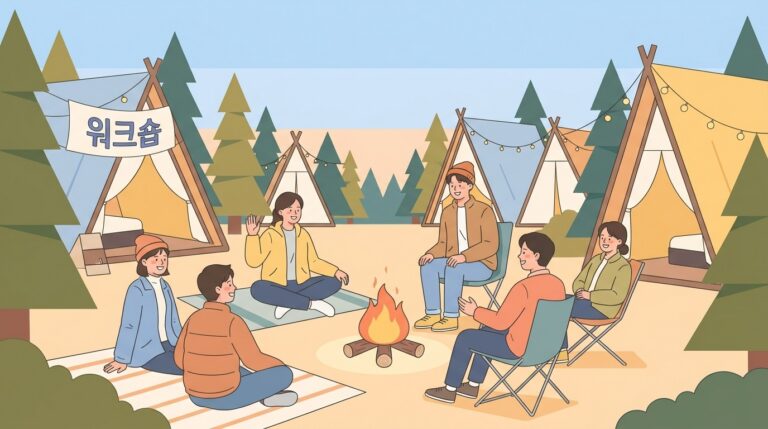
Planning the Perfect Team Workshop in Korea: How to Write Announcements That Teammates Actually Love
Phase 1: Empathy (Immersive Opening)
안녕하세요! 매일한글 에디터입니다. (Annyeonghaseyo! Maeil Hangul editeo-imnida. – “Hello! I’m your Daily Hangul editor.”)
Picture this: Your team just survived a grueling first half of the year. Product launches, intense sprint reviews, endless spreadsheets, and late nights fueled by iced Americanos. Your team manager (팀장님 – timjangnim) walks over to your desk, claps a hand on your shoulder, and says with a bright smile: “Our team deserves a break. Why don’t you plan a quick 1-night, 2-day workshop so everyone can bond and recharge?”
Panic sets in. If you’ve watched K-dramas like Misaeng or Kkondae Intern, you know the delicate tightrope of the Korean company workshop (워크숍 – wokeusyop). If you make it sound too stiff, team members dread it as “unpaid weekend overtime disguised as fun.” If you make it too casual, leadership wonders where the strategic value is. How do you craft an announcement proposal that balances professional tact with genuine refreshment?
Don’t worry—you don’t have to navigate this office minefield alone. Based on real feedback from international professionals thriving in Korean workplaces, this B2-level guide will teach you the exact phrases, cultural nuances, and communicative tact you need to plan a memorable, stress-free team workshop that wins over both your boss and your peers.
Phase 2: Core Expressions Deep Dive
1. 상반기 동안 고생 많으셨습니다 (Sangbangi dongan gosaeng maneusyeotseumnida)
- Pronunciation: [Sang-bahn-gee don-gahn go-saeng mah-neu-syeot-seum-nee-dah] (Sounds like song + bon + ghee, smoothly connecting into gosaeng)
- Meaning: Literal: “You suffered much during the first half of the year.” | Nuance: “Thank you so much for all your hard work and dedication throughout the first half of the year.”
- K-Culture Moment: Heard at the beginning of corporate town halls, quarterly review dinners (회식 – hoesik), and opening lines of company-wide memos.
- Editor’s Insight: In Korean business culture, acknowledging shared struggle (gosaeng) builds immediate psychological safety. It signals that leadership or the organizer recognizes the team’s effort before asking for their time.
- Situation Spectrum: Casual (🚫) / Semi-formal (⚠️ 고생 많았어요) / Formal (✅)
- 🤔 Think About It: Why does Korean culture value acknowledging hardship before proposing relaxation? How does this contrast with Western workplace announcements that typically jump straight to “Let’s celebrate”?
2. 리프레시 겸 단합 도모를 위해 (Ripeuresi gyeom danhap domoreul wihae)
- Pronunciation: [Ree-peu-reh-shee gyum dahn-hahp doh-moh-reul wee-hae] (Gyeom sounds like a swift “gy-um”, joining two intentions)
- Meaning: Literal: “For the sake of refresh as well as promoting unity.” | Nuance: “To recharge our batteries while building stronger teamwork.”
- K-Culture Moment: The classic mission statement in any corporate retreat proposal in modern Korean companies like Naver, Kakao, or CJ.
- Editor’s Insight: The grammatical connector
겸 (gyeom)means “both X and Y simultaneously.” Pairing loanword 리프레시 (refresh) with Sino-Korean 단합 도모 (promoting harmony/unity) balances employee wellbeing with organizational benefit. - Situation Spectrum: Casual (🚫) / Semi-formal (✅) / Formal (✅)
- 🤔 Think About It: How does framing an event as mutually beneficial (individual rest + collective strength) change how team members perceive mandatory attendance?
3. 부담 없이 편안하게 힐링하고 오시죠 (Budam eopsi pyeonanhage hillinghago osijyo)
- Pronunciation: [Boo-dahm uhp-shee pyun-ahn-hah-geh heel-leeng-hah-goh oh-shee-jyoh] (Budam rhymes with “who done” said quickly)
- Meaning: Literal: “Without burden, comfortably heal and come back, shall we?” | Nuance: “Let’s take it easy, recharge with zero pressure, and just enjoy ourselves.”
- K-Culture Moment: Used by an empathetic team leader or a savvy organizer wrapping up a pitch to reassure introverted teammates.
- Editor’s Insight: The word 힐링 (healing) in Korea denotes escaping burnout, breathing fresh air, and savoring delicious food. Preceding it with 부담 없이 (without pressure/burden) relieves anxiety about forced drinking or awkward team games.
- Situation Spectrum: Casual (⚠️) / Semi-formal (✅) / Formal (✅ – in spoken context)
- 🤔 Think About It: Why has “healing” become such an indispensable buzzword in modern high-speed Korean society?
Phase 3: Textbook Korean vs. Real Korean
Situation 1: Surveying dates and venue preferences
- 📖 교과서 한국어 (Textbook): 워크숍 참가 여부와 원하시는 장소를 작성하여 제출해 주십시오. (Wokeusyop chamga yeobuwa wonhasineun jangshoreul jakseonghayeo jechulhae jusipsio. – “Please write and submit whether you will attend the workshop and your desired location.”)
- 🗣️ 진짜 한국어 (Real Korean): 팀원분들의 의견을 반영하고자 하니, 편하신 일정과 선호하시는 활동을 자유롭게 남겨주세요! (Timwonbundeurui uigyeoneul banyeonghagoja hani, pyeonhasin iljeonggwa seonhohasineun hwaldongeul jayuropge namgyeojuseyo! – “We’d love to incorporate everyone’s thoughts, so please feel free to drop your preferred dates and favorite activities!”)
- 💡 왜 다를까?: The textbook version sounds like a mandatory tax audit. Real Korean workplace announcements use inclusive grammar like
-고자 하다and soft requests like남겨주세요to maximize positive participation.
Situation 2: Explaining the event’s vibe
- 📖 교과서 한국어 (Textbook): 본 행사는 직원들의 결속력을 강화하기 위한 단합 대회의 일환입니다. (Bon haengsaneun jigwondeurui gyeolsongnyeogeul ganghwahagi wihan danhap daehoeui ilhwanimnida. – “This event is part of a unity rally to strengthen employee cohesion.”)
- 🗣️ 진짜 한국어 (Real Korean): 거창한 프로그램보다는 맛있는 거 먹고 푹 쉬는 힐링 컨셉으로 준비해 봤습니다. (Geochanghan peurogeuraembodaneun masinneun geo meokgo puk swineun hilling keonsebeuro junbihae bwatseumnida. – “Rather than grandiose programs, we planned a relaxed healing concept where we can eat great food and thoroughly rest.”)
- 💡 왜 다를까?: The term “단합 대회” (unity rally) reminds modern Korean workers of intense military-style hikes or forced marathon drinking. Pitching it as “맛있는 거 먹고 쉬는” (eating tasty food and resting) immediately lowers resistance.
Phase 4: K-Culture Deep Dive & Non-Verbal Manners
4-1. 눈치 (Nunchi) & Non-Verbal Etiquette
When proposing a team workshop in Korea, nunchi (the art of gauging unspoken workplace vibes) is critical:
* The “Voluntary” Paradox: In Korea, even when an announcement says “참여는 자유입니다” (attendance is optional), juniors often feel pressure to attend. Mitigate this by actively offering a low-pressure agenda (e.g., day trip option or personal free time blocks).
* Eye Contact & Modesty: When presenting your draft proposal to your manager, use two hands to present the document or tablet (두 손으로 건네기), nod slightly (mokrye), and phrase the pitch as: “팀원들의 피로도를 고려해 이런 방향으로 잡아봤습니다” (I framed it in this direction, keeping the team’s fatigue levels in mind).
4-2. The Evolution of Korean Workshop Culture
Historically, Korean company retreats meant heading to Gapyeong (가평), climbing a mountain, playing group relay games, and doing rounds of somaek (beer + soju) until 3 AM. Today’s workforce, especially the MZ generation (밀레니얼+Z세대), prioritizes work-life balance (워라밸 – worabal).
Modern retreats focus on 글램핑 (glamping), boutique pension stays with private BBQ, sensory barista workshops, or serene Hanok stays in Gangneung or Yangpyeong. If your announcement highlights “개인 휴식 시간 보장” (Guaranteed individual rest time), team engagement will skyrocket.
Phase 5: Real-World Roleplay Scenario
- Setting: Seoul IT office, afternoon coffee area.
- Characters:
- 민 팀장 (Team Manager Min): Pragmatic, values team morale, wants a smooth event.
- Alex (You): Intermediate Korean speaker, tasked with drafting the retreat announcement.
Turn 1: Alex
팀장님, 상반기 팀 워크숍 초안 기획서 작성해 봤습니다. (Timjangnim, sangbangi tim wokeusyop choan gihoekseo jakseonghae bwatseumnida.)
“Manager Min, I’ve drafted the initial proposal for our first-half team workshop.”
🎭 Both hands holding the tablet, offering a polite bow.
Turn 2: 민 팀장
오, 알렉스 씨. 빨라서 좋네. 이번 워크숍 주요 컨셉이 뭐예요? (O, Allekseu ssi. Ppallaseo jonne. Ibeon wokeusyop juyo keonsebi mwoyeyo?)
“Oh, Alex. Fast work, I like it. What’s the main concept for this workshop?”
🎭 Takes the tablet, scanning the screen with interest.
Turn 3: Alex
팀원분들이 상반기 동안 고생 많으셨잖아요. 그래서 리프레시 겸 단합을 목표로 잡았습니다. (Timwonbundeuri sangbangi dongan gosaeng maneusyeotjanayo. Geuraeseo ripeuresi gyeom danhabeul mokpyoro jabatseumnida.)
“Our teammates worked so hard during the first half. So I set our goal as recharging alongside team bonding.”
🎭 Calm, warm smile with steady eye contact.
Turn 4: 민 팀장
좋지. 근데 1박 2일이면 다들 부담스러워하지 않을까? (Jotji. Geunde ilbak i-irimyeon dadeul budamseureowohaji aneulkka?)
“Sounds good. But if it’s 1-night, 2-days, won’t everyone feel burdened?”
🎭 Frowning slightly with concern about team resistance.
Turn 5: Alex
네, 그래서 강제 참여 프로그램은 줄이고, 바비큐와 개별 힐링 시간을 넉넉히 넣었습니다. (Ne, geuraeseo gangje chamyeo peurogeuraemeun jurigo, babikyuwa gaebyeol hilling siganeul neokneoki neoeotseumnida.)
“Yes, which is why I reduced mandatory programs and included plenty of time for BBQ and personal healing.”
🎭 Pointing clearly to the afternoon schedule section on the screen.
Turn 6: 민 팀장
센스 있네! 당일치기로 복귀 원하는 인원 배려 방안도 있나? (Senseu inne! Dang-ilchigiro bokgwi wonhaneun inwon baeryeo bangan-do inna?)
“Thoughtful! Do we have a plan for folks who prefer to return the same day?”
🎭 Nodding approvingly.
Turn 7: Alex
네! 서울 근교 가평으로 정해서, 대중교통으로 당일 복귀도 가능하도록 구성했습니다. (Ne! Seoul geungyo Gapyeong-euro jeonghaeseo, daejunggyotong-euro dang-il bokgwido ganeunghadorok guseonghaetseumnida.)
“Yes! I selected Gapyeong near Seoul so same-day return by public transit is also easy.”
🎭 Confident posture and clear tone.
Turn 8: 민 팀장
완벽해요. 공지문 다듬어서 슬랙 채널에 바로 공유해 줘요! (Wanbyeokhaeyo. Gongjimun dadeumeoseo Seullaek chaeneore baro gongyuhae jwoyo!)
“Perfect. Polish the announcement and share it in the Slack channel right away!”
🎭 Smiling warmly with a thumbs up.
🔀 Interactive Decision Point
When posting the announcement to Slack, how do you phrase your closing sentence to encourage sign-ups?
- Option A: 이번 주 금요일까지 무조건 전원 참석 여부를 체크해 주시기 바랍니다. (Everyone must verify attendance by this Friday without exception.)
- Feedback (Risk): Too authoritative! Sounds like a military roll call; teammates will feel coerced and secretly resent the event.
- Option B: 즐거운 리프레시를 위해 소중한 의견 기다릴게요. 편하게 일정 확인 부탁드립니다! (Looking forward to your valuable opinions for a fun refresh. Please check the schedule comfortably!)
- Feedback (Best): Excellent! Warm, welcoming, uses polite business honorifics (
부탁드립니다), while fostering a collaborative vibe.
- Feedback (Best): Excellent! Warm, welcoming, uses polite business honorifics (
- Option C: 안 오면 팀장님이 서운해하시니까 웬만하면 다 오세요~ (Manager Min will be sad if you skip, so pretty much everyone better come~)
- Feedback (Bad): Passive-aggressive guilt-tripping disguised as casual humor. Creates uncomfortable social pressure.
Phase 6: 10-Second Emotion Shadowing Drill
Practice these lines out loud! Follow the pause markers (/) and embody the bracketed emotions.
[😊 따뜻하고 진정성 있게 - Warmly and sincerely]
상반기 동안 / 팀을 위해 달려와 주신 팀원분들께 / 진심으로 감사드립니다.
(Sangbangi dongan / timeul wihae dallyeowa jusin timwonbundeulkke / jinsimeuro gamsadeurimnida.)
“My heartfelt thanks / to our teammates / who ran so hard for our team throughout the first half.”-
[🤝 배려 깊고 부드럽게 - Considerately and softly]
이번 워크숍은 / 업무 스트레스를 내려놓고 / 온전히 충전하는 시간이 되었으면 합니다.
(Ibeon wokeusyobeun / eommu seuteureseureul naeryeonotgo / onjeonhi chungjeonhaneun sigani doeosseumyeon hamnida.)
“For this workshop, / we hope everyone can set aside work stress / and completely recharge.” -
[🎉 활기차고 독려하며 - Cheerful and encouraging]
부담 없이 편안하게 쉬다 올 수 있도록 / 알차게 준비했으니 / 많은 참여 부탁드립니다!
(Budam eopsi pyeonanhage swida ol su itdorok / alchage junbihaesseuni / maneun chamyeo butakdeurimnida!)
“We prepared thoroughly / so everyone can rest comfortably without burden, / so we look forward to your active participation!”
Phase 7: K-Culture Mini Dictionary
- 워크숍 (Wokeusyop): Modern team retreat. While borrowed from “workshop”, in Korea it rarely means sitting in chairs listening to lectures; it usually implies group excursions, delicious regional meals, and evening drinks.
- 리프레시 (Ripeuresi): Corporate loanword meaning personal and professional renewal. Often used in HR contexts like “리프레시 휴가” (refresh sabbatical leave).
- 단합 (Danhap): Solidarity / Unity. Historically associated with unison chanting and strenuous activities, but now reinterpreted as deepening mutual empathy over good food and shared downtime.
- 회식 연장선 (Hoesik yeonjangseon): “An extension of after-work dinners.” A feared phrase among Korean employees describing events where formal hierarchy persists overnight. An organizer’s main task is assuring teammates the workshop is not this!
Phase 8: Traveler & Professional Survival Kit
Top 3 Survival Phrases for Retreat Planning
- 혹시 못 드시는 음식이 있으실까요? (Hoksi mot deusineun eomsigi isseusilkkayo?)
Pro Tip: Crucial when ordering BBQ or booking group menus. Accommodates vegetarians, halal diets, or seafood allergies gracefully. - 개인 일정으로 당일 복귀하셔도 괜찮습니다. (Gaein iljeong-euro dang-il bokgwihasyeodo gwaenchansseumnida.)
Pro Tip: Instantly defuses stress for working parents or introverts who can’t sleep away from home. - 숙소 주변 산책로가 아주 잘 되어 있습니다. (Sukso jubyeon sanchaekroga aju jal doeeo itseumnida.)
Pro Tip: Highlighting peaceful walking trails signals that this is a rejuvenating nature getaway.
Editor’s Logistics Note
When booking group accommodations in suburban Gyeonggi or Gangwon province, search for group pensions or glamping spots using Naver Map Application Search. Use search terms like 워크숍 펜션 (workshop pension) or 독채 글램핑 (private detached glamping). For transportation, carpooling or reserving a 15-passenger van via Kakao T Shuttle Service will make your logistics shine.
Phase 9: A Step Deeper (Cultural Reflection)
In many Western workplaces, professional performance and private downtime are strictly compartmentalized. However, traditional Korean business philosophy views the team as a dynamic, collective family (sikgu – people who eat together). While this historically led to overbearing after-hours obligations, modern Korean offices are evolving. Today’s successful workshop is not about forced togetherness, but mutual gratitude—creating a shared memory of good food and laughter outside the sterile office walls.
💬 Your Turn: How does your home culture handle company team-building? Would an overnight countryside retreat with your direct supervisor feel exciting, or stressful? Share your thoughts below!
Phase 10: FAQ & Avoiding Misunderstandings
Q: Is attendance at a Korean company workshop legally mandatory?
A: Under Korean Labor Law, if a workshop takes place during official working hours or involves mandatory work-related training, it is paid work time. However, weekend workshops without overtime pay technically cannot be forced. As an organizer, emphasize convenience and voluntary participation to respect both legal and interpersonal dynamics.
Q: Can I use informal Banmal (반말) during the evening workshop BBQ?
A: Only if your manager explicitly declares an official “Yaja Time” (야자타임 – a short party game where ranks temporarily flip). Otherwise, maintain polite 존댓말 (jondaetmal). Even if drinks are flowing, sudden informality can cause awkward friction on Monday morning.
Q: What should I prepare if someone doesn’t drink alcohol?
A: Always prepare high-end non-alcoholic beverages, craft sodas, or zero-sugar teas alongside beer and soju. The modern trend in Korean offices is zero-pressure drinking (non-al-col hoesik).
🚨 Common Mistakes Alert
- Mistake: Booking activities with mandatory physical competition (mountain summit races, foot volleyball tournaments).
- Correct Action: Offer relaxed, low-impact options like board games, rail biking, coffee tasting, or casual fire-pit chats (bulmeong).
- Mistake: Announcing the date just 3 days prior.
- Correct Action: In Korean corporate culture, give at least 2 to 3 weeks’ notice (
사전 공지) so teammates can arrange childcare or personal plans.
- Correct Action: In Korean corporate culture, give at least 2 to 3 weeks’ notice (
- Mistake: Forgetting to schedule unstructured free time.
- Correct Action: Explicitly block out 2–3 hours as “자유 휴식 시간” (free rest time) in the written agenda.
Phase 11: Action Missions
- 🥉 Bronze Mission (Solo Drill): Read Phase 6 Shadowing Drill out loud 3 times. Record your voice on your smartphone and check if your tone sounds empathetic and inviting.
- 🥈 Silver Mission (Community Output): Draft a 3-sentence workshop announcement in Korean in the comments below using the phrase
리프레시 겸 단합 도모! - 🥇 Gold Mission (Real-world Challenge): If you work in Korea, suggest a relaxing venue (like a rooftop cafe or scenic park) to your team leader using: “팀장님, 이번엔 가볍게 힐링 컨셉으로 다녀오는 건 어떠실까요?”
- 🎮 K-Culture Mission: Watch an episode of a Korean workplace variety show or drama (e.g., Hangout with Yoo or Gaus Electronics). Spot how junior employees react when a company retreat is mentioned!
Phase 12: Interactive Quiz Challenge
Question 1: Situation Judgment
You are writing a Slack notice to invite team members to vote on retreat dates. Which sentence sounds most natural and encouraging at a B2 level?
* A) 무조건 이번 주까지 날짜 골라서 보고하세요.
* B) 상반기 동안 고생 많으셨던 만큼, 편하게 쉬실 수 있는 일정을 투표해 주세요!
* C) 워크숍에 가기 싫으신 분은 사유서를 제출하십시오.
Question 2: Fill in the Blank
Complete this classic proposal sentence:
“팀원들의 피로를 풀고 (________) 겸 단합 도모를 위해 이번 행사를 기획했습니다.”
* A) 스트레스 (seuteureseu)
* B) 리프레시 (ripeuresi)
* C) 야간근무 (yagangeunmu)
Question 3: Cultural True or False
True or False: In modern Korean corporate culture, it is best practice to schedule intense team-building games from 9 AM to midnight to maximize team cohesion.
🔍 Click to reveal answers & explanations!
- Question 1 Answer: B
- Explanation: B acknowledges their hard work (고생 많으셨던 만큼) and gently invites them to vote for a restful date. A and C sound punitive and cold.
- Question 2 Answer: B (리프레시)
- Explanation:
리프레시 겸 단합 도모(recharging while promoting unity) is the gold standard formula for modern team-building proposals.
- Explanation:
- Question 3 Answer: False
- Explanation: Modern Korean teams place huge value on
힐링(healing) and personal downtime. Cramming the schedule with mandatory games causes fatigue and negative feedback.
- Explanation: Modern Korean teams place huge value on







