

Phase 1: Empathy (Story-Driven Opening)
안녕하세요! I’m your Daily Hangul editor.
Imagine this: your ultimate K-Pop bias group announces an encore world tour concert in Seoul. You set three alarms, prepare high-speed internet at a PC bang, and hold your breath as the countdown reaches zero. You click—only to see that dreaded queue number: 58,492. Sold out in less than a minute.
Heartbroken, you scroll through social media and secondhand platforms. Suddenly, you spot a post: “VIP Floor ticket transfer, selling at near original price because of a sudden schedule conflict.” Desperate to see your idols live, you immediately send a direct message. The seller asks you to wire money directly to their private bank account, promising to transfer the mobile ticket immediately. You send the money. You wait five minutes. Ten minutes. You send another message, but the text bubble remains unread. You refresh the profile—Account Deleted.
You have just experienced what Koreans call 먹튀 (meoktwi) or 잠적 (jamjeok)—the infamous “take the money and ghost” scam.
In South Korea’s vibrant fan culture (덕질), snagging concert tickets and rare photo cards (포카) is practically an Olympic sport. But with high demand comes crafty scammers who specifically target foreign fans unfamiliar with local transaction norms. Based on countless real-life experiences from our international learners and verified advice from local concert-goers, this guide will arm you with the precise Korean vocabulary, cultural instincts (눈치), and safety tactics you need. Master these phrases, and you’ll never let your excitement blind you to a scam again!
Phase 2: Top 3 Core Expressions Deep Dive
1. 직거래 가능할까요? (Jikgeorae ganeunghalkkayo?)
- Pronunciation: [Jik-geo-rae ga-neung-hal-kka-yo?] (Sounds like: Jeek-guh-reh gah-neung-hahl-kkah-yo)
- Meaning:
- Literal: Is direct transaction possible?
- Real Nuance: “Can we meet face-to-face in a public place to trade?”
- K-Culture Moment: Fans meeting at Exit 3 of Olympic Park Station before an idol concert, carefully checking the physical paper ticket under the station lights before handing over cash.
- Editor’s Insight: The word 직거래 (jikgeorae) blends 직접 (directly/in-person) and 거래 (transaction). If an online seller refuses 직거래 for high-value items like concert tickets claiming they are “too busy” or “live on Jeju Island,” treat this as a major red flag. In Korea, genuine sellers understand buyer anxiety and usually agree to in-person meetups.
- Situation Spectrum:
- Casual: ⚠️ 직거래 돼? (Jikgeorae dwae? – Friends only)
- Semi-formal: ✅ 직거래 가능해요? (Jikgeorae ganeunghaeyo?)
- Formal: ✅ 직거래 가능할까요? (Jikgeorae ganeunghalkkayo? – Recommended for sellers)
- 🤔 Think About It: In many Western countries, mailing items is the default because of geographic distances. Why do you think Korea’s compact urban layout and extensive subway system made subway station meetups the standard for safe trading?
2. 안전결제로 진행해도 될까요? (Anjeongyeoljero jinhaenghaedo doelkkayo?)
- Pronunciation: [An-jeon-gyeol-je-ro jin-haeng-hae-do doel-kka-yo?] (Sounds like: Ahn-juhn-gyuhl-jeh-roh jeen-hang-heh-doh dwel-kkah-yo)
- Meaning:
- Literal: May we proceed with safe payment?
- Real Nuance: “I prefer using the platform’s escrow service instead of direct bank transfer so my money stays protected.”
- K-Culture Moment: Negotiating on secondhand platforms like Bunjang (번개장터) or Joonggonara (중고나라) where the buyer requests Bungae Pay (번개페이) to prevent wire fraud.
- Editor’s Insight: 안전결제 (safe payment / escrow) holds the buyer’s money securely in the platform’s system. The seller only receives the payout after the buyer receives the item and clicks “Confirm Purchase” (구매 확정). Scammers hate this system because they cannot run away with your funds. Common scammer excuses include: “The fee is too high” or “My escrow account is currently blocked.”
- Situation Spectrum:
- Casual: 🚫 안전결제로 해. (Too blunt and risky)
- Semi-formal: ✅ 안전결제로 해도 돼요? (Anjeongyeoljero haedo dwaeyo?)
- Formal: ✅ 안전결제로 진행해도 될까요? (Anjeongyeoljero jinhaenghaedo doelkkayo? – Ideal)
- 🤔 Think About It: Why does offering to cover the escrow service fee (수수료) demonstrate both politeness and smart self-defense in Korean transactional culture?
3. 입금 확인 후에 바로 티켓 전달해 주세요. (Ipgeum hwag-in hue baro tiket jeondalhae juseyo.)
- Pronunciation: [Ip-geum hwa-gin hu-e ba-ro ti-ket jeon-dal-hae ju-se-yo.] (Sounds like: Eep-geum hwah-geen hoo-eh bah-roh tee-ket juhn-dahl-heh joo-seh-yoh)
- Meaning:
- Literal: After deposit confirmation, please deliver the ticket right away.
- Real Nuance: “I am setting a firm timeline: once you see the funds, send the ticket or mobile transfer instantly without delay.”
- K-Culture Moment: Standing face-to-face or chatting in real-time when transferring digital tickets via official ticketing apps like Melon Ticket or Interpark.
- Editor’s Insight: The keyword here is 바로 (baro – immediately). In Korean fast-paced (빨리빨리) culture, establishing immediate delivery expectations is completely normal. If someone says “I will send it in a few hours after I finish work,” step back—legitimate transfers should happen concurrently.
- Situation Spectrum:
- Casual: ⚠️ 돈 보냈으니 바로 줘. (Don bonaesseuni baro jwo. – Too aggressive)
- Semi-formal: ✅ 입금했으니 바로 보내주세요. (Ipgeumhaesseuni baro bonaejuseyo.)
- Formal: ✅ 입금 확인 후에 바로 티켓 전달해 주세요. (Standard respectful transaction tone)
- 🤔 Think About It: Setting boundaries respectfully is an art in Korean. How does pairing a polite ending like ~해 주세요 with an urgent adverb like 바로 balance courtesy and firmness?
Phase 3: Textbook Korean vs Real Korean
Situation 1: Asking if an item or concert ticket is still available
- 📖 교과서 한국어 (Textbook Korean):
- 이 티켓을 아직 판매하고 계십니까? (I tikeseul ajik panmaehago gyesimnikka? / Are you still selling this ticket?)
- 🗣️ 진짜 한국어 (Real Korean):
- 혹시 티켓 아직 양도 중인가요? 쿨거래 원해요. (Hoksi tiket ajik yangdo jung-ingayo? Kulgeorae wonhaeyo. / Is the ticket still up for transfer? Looking for a smooth, quick deal.)
- 💡 왜 다를까? (Why the difference?):
Textbooks teach generic commerce words like 판매 (sale). However, within K-pop fandoms and secondhand communities, people use 양도 (transfer/handover) for tickets and goods. Furthermore, offering a 쿨거래 (cool deal = immediate payment without endless haggling) instantly makes you a preferred buyer.
Situation 2: Warning against direct bank transfers
- 📖 교과서 한국어 (Textbook Korean):
- 개인 은행 계좌로 송금하는 것은 위험할 수 있습니다. (Gaein eunhaeng gyejwaro songgeumhaneun geoseun wiheomhal su itseumnida. / Remitting money to a personal bank account can be dangerous.)
- 🗣️ 진짜 한국어 (Real Korean):
- 계좌 입금은 먹튀 위험 커서 무조건 직거래나 안전결제로만 해요. (Gyejwa ipgeumeun meoktwi wiheom keoseo mujogeon jikgeoraena anjeongyeoljeroman haeyo. / Direct bank wire has a huge ghosting scam risk, so I strictly do in-person or escrow only.)
- 💡 왜 다를까? (Why the difference?):
Real native speakers rarely use textbook-heavy declarative warnings. Instead, they use vivid slang like 먹튀 (eating and running / scamming) and the absolute adverb 무조건 (unconditionally / strictly) to set ironclad boundaries.
Phase 4: K-Culture Deep Dive & Non-Verbal Manners
4-1. 눈치 (Nunchi) & Gestures for In-Person Trades (직거래)
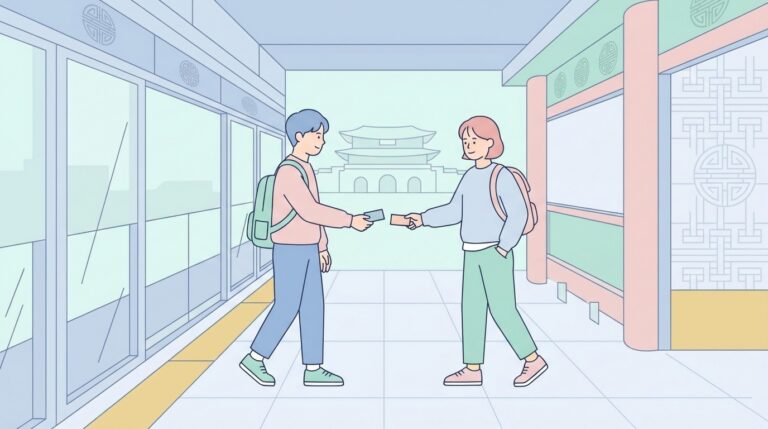
When you agree to meet a seller in Korea, the default meeting place is almost always a subway station exit—specifically, near the ticket gate or just outside a numbered exit (e.g., 강남역 11번 출구 앞).
- The Subtle Smartphone Identification: Do not shout someone’s name. As you approach the agreed exit, hold your phone at chest level with the chat screen open. Make gentle eye contact, nod slightly (about 15 degrees), and ask:
- 혹시 번개장터…? (Hoksi Beongaejangteo…? / Excuse me, are you from Bunjang…?)
- The Two-Handed Inspection: When they hand over the concert ticket or lightstick, receive it with both hands. It shows respect, but more importantly, it gives you a stable grip to inspect the item thoroughly. Take 30 seconds to check ticket dates, seat numbers, holographic seals, and fan-club identity verification requirements.
- Do Not Walk Away Before Payment Clears: If transferring money on the spot via a mobile banking app, keep your phone tilted slightly so they can see the confirmation screen, and wait until they say “입금 확인되었습니다” (Deposit confirmed). Finish with a polite 30-degree bow and:
- 감사합니다! 공연 잘 볼게요! (Gamsahamnida! Gong-yeon jal bolgeyo! / Thank you! I’ll enjoy the concert!)
4-2. Cultural Code Analysis: 덕질 (Deokjil) & The “Transfer” (양도) Ecosystem
In Korea, idol fandom culture is built on deep community solidarity, but high-stakes ticketing (피켓팅 – blood ticketing) creates an illicit secondary market. You will often see terms like:
* 원가양도 (Wonga-yangdo): Transferring the ticket at face value without any markup (the gold standard of good karma among fans).
* 플미 (Peulmi): Short for “premium”—scalper markups. Korean ticketing platforms and agencies actively cancel tickets caught being sold with 플미.
* 아옮 (A-om): Short for 아이디 이동 (Account Transfer)—a risky service where a hacker or broker attempts to cancel a ticket and re-snatch it onto your personal ticketing account using automated macros. Scammers frequently take upfront fees for 아옮 and disappear.
Knowing these subculture terms signals to sellers that you are not a naive tourist who can be easily duped.
Phase 5: Real-World Roleplay Scenario
Setting: Outside Exit 3 of Olympic Park Station on a chilly Saturday afternoon. You are meeting 지민 (Jimin), a seller who posted a standing ticket for an idol concert starting in two hours.
Dialogue
- 지민 (Jimin): 🎭 (Looking around the station exit, holding a transparent ticket sleeve) 혹시 번개장터 맞으세요? (Hoksi Beongaejangteo majeuseyo? / Excuse me, are you from Bunjang?)
- You: 🎭 (Approaching with a slight polite nod) 네, 맞아요! 티켓 양도받기로 한 사람입니다. (Ne, majayo! Tiket yangdobatgiro han saram-imnida. / Yes, that’s right! I’m the person here for the ticket transfer.)
- 지민 (Jimin): 🎭 (Hands over the envelope with both hands) 여기 실물 티켓이에요. 좌석이랑 날짜 한번 확인해 보세요. (Yeogi silmul tiket-ieyo. Jwaseog-irang naljja hanbeon hwag-inhae boseyo. / Here is the physical ticket. Please check the seat and date.)
- You: 🎭 (Examining the date, hologram, and venue carefully) 네, 오늘 공연 맞네요! 상태 깨끗하네요. (Ne, oneul gong-yeon manneyo! Sangtae kkaekkeuthaneyo. / Yes, it’s today’s concert! It’s in great condition.)
- 지민 (Jimin): 🎭 (Smiles, holding up her phone banking QR code) 확인하셨으면 이 계좌로 바로 송금해 주시겠어요? (Hwag-inhaseosseumyeon i gyejwaro baro songgeumhae jusigesseoyo? / Now that you’ve checked, could you wire the money to this account right away?)
- You: 🎭 (Taking out your smartphone banking app) 네, 지금 바로 보낼게요. 금액 15만 원 맞죠? (Ne, jigeum baro bonaelkkeyo. Geumaek siboman won matjyo? / Yes, I will send it right now. The amount is 150,000 KRW, right?)
- 지민 (Jimin): 🎭 (Refreshes her bank app notification) 네, 입금 확인됐습니다! (Ne, ipgeum hwag-indwaesseumnida! / Yes, deposit confirmed!)
- You: 🎭 (Bowing slightly with a bright smile) 감사합니다! 공연 재미있게 잘 볼게요! (Gamsahamnida! Gong-yeon jaemi-itge jal bolgeyo! / Thank you! I’ll enjoy the concert!)
🔀 Interactive Decision Point
What if, right before meeting, Jimin sent you this message:
“갑자기 급한 일이 생겨서 못 나갈 것 같아요. 모바일 티켓 링크로 보내드릴 테니 먼저 계좌 입금해 주시면 10분 뒤에 링크 쏴드릴게요!”
(Something sudden came up so I can’t meet in person. I will send the mobile ticket link, so if you wire the money to my account first, I’ll send the link 10 minutes later!)
How will you respond?
- Option A: “네, 알겠습니다! 바쁘시니까 지금 바로 계좌로 입금할게요.” (Yes, understood! Since you are busy, I’ll transfer to your account right away.)
- Option B: “아, 직거래가 아니면 불안해서요. 번개장터 안전결제로 결제창 열어주시면 바로 결제할게요.” (Ah, I feel uneasy if it’s not in-person. If you open an escrow safe payment window on Bunjang, I will pay immediately.)
- Option C: “사기꾼이죠? 경찰에 바로 신고할 겁니다!” (You’re a scammer, right? I’m reporting you to the police right now!)
💡 Feedback on Your Choice:
- If you chose Option A (Bad / Extreme Risk): 🚨 Danger! This is the classic “bait and ghost” maneuver. Once you wire the funds directly, the seller has zero incentive to send the link, and banking reversals are nearly impossible in fraud cases. Never send money on a promise.
- If you chose Option B (Best Choice): 🌟 Perfect! You stayed calm, polite, and uncompromising on safety. If the seller is legitimate, they will gladly use the platform escrow. If they make up excuses and refuse, you just saved yourself hundreds of dollars.
- If you chose Option C (Risk / Premature Escalation): ⚠️ While your suspicion is likely justified, accusing them directly burns the bridge instantly if there was a genuine misunderstanding, and offers no constructive resolution.
Phase 6: 10-Second Emotion Shadowing Drill
Practice these three key survival lines out loud. Pay close attention to the pause breaks (/) and the emotional mindset markers!
[🛡️ Firm, polite, and cautious]- 직거래 아니면 / 거래하기 어려울 것 같아요.
- (Jikgeorae animyeon / georaehagi eoryeoul geot gat-ayo.)
- “If it’s not an in-person trade / I don’t think I can proceed with the transaction.”
[🤝 Cooperative and reassuring]- 안전결제 수수료는 / 제가 전부 부담할게요.
- (Anjeongyeolje susuryoneun / jega jeonbu budamhalkkeyo.)
- “As for the safe payment escrow fee / I will cover it completely.”
[😊 Relieved and courteous]- 티켓 확인했습니다! / 지금 바로 입금해 드릴게요.
- (Tiket hwag-inhaetseumnida! / Jigeum baro ipgeumhae deurilkkeyo.)
- “I’ve verified the ticket! / I will transfer the payment to you right now.”
Phase 7: K-Culture Mini Dictionary
- 직거래 (Jikgeorae)
- Meaning: Direct in-person transaction.
- Usage: The safest way to buy concert tickets and high-value electronics. Usually takes place at high-traffic subway station exits or outside event venues.
- 양도 (Yangdo)
- Meaning: Transfer / Handover (of rights, tickets, or merchandise).
- Usage: When searching for tickets on social media or Korean apps, search
[Artist Name] + 티켓 양도instead of티켓 판매.
- 먹튀 (Meoktwi)
- Meaning: “Eat and run” (Ghosting scam after taking money).
- Usage: Used widely across gaming, dining, and secondhand commerce to describe someone who vanishes immediately after receiving payment.
- 안전결제 (Anjeongyeolje) / 번개페이 (Bungae Pay)
- Meaning: Escrow safe payment system.
- Usage: Built-in platform payment features that withhold funds until the buyer physically receives and approves the merchandise.
Phase 8: Traveler’s Survival Kit
Top 3 Survival Phrases
- 더치트에서 계좌번호 조회해 봐도 될까요?
- (Deochiteu-eseo gyejwabeonho johwoehae bwado doelkkayo?)
- Pro Tip: Asking if you can look up their bank account on “The Cheat” (Korea’s primary fraud-record database) instantly scares off 90% of amateur scammers.
- 포카 인증 사진에 오늘 날짜 적은 포스트잇 붙여주세요.
- (Poka injeung sajine oneul naljja jeogeun poseuteu-it buchyeojuseyo.)
- Pro Tip: Scammers steal other people’s photos of rare photo cards. Demanding a photo with today’s date and your nickname on a sticky note proves physical possession.
- 지하철 개찰구 안쪽에서 거래 가능할까요?
- (Jihacheol gaechalgu anjjog-eseo georae ganeunghalkkayo?)
- Pro Tip: If you are traveling between stations, you don’t even need to exit the turnstile! Sellers will often meet you right at the ticket gate (개찰구).
Editor’s Travel Note: Safe Secondhand Apps & Tools
- Verify Seller Phone Numbers on The Cheat 사기 피해 방지 검색 서비스: This is Korea’s collective fraud database. Before wiring a single won, paste the seller’s phone number and bank account number into The Cheat app or website.
- Use Official Escrow Apps: When using platforms like Bunjang 글로벌 번개장터 앱, always transact via their built-in 번개페이 (Bungae Pay). Never click external links sent in chat messages claiming to be “Naver Pay Safe Escrow Links”—these are classic phishing sites designed to clone your login credentials.
- Subway Stations as Safe Zones: Korean subway stations are covered by high-definition CCTV. Conducting 직거래 right next to the station customer service center or station exit camera is the safest physical location.
Phase 9: Step Deeper (한 발 더 깊이)
South Korea ranks among the safest countries in the world; people leave laptops on cafe tables and smartphones in open bags without a second thought. Yet ironically, online ticket and merchandise fraud remains persistent. Why this stark contrast?
This paradox lies in the shift from relational physical community to digital anonymity. In physical Korean society, social accountability and high surveillance create immense safety. But in anonymous cyberspace, opportunists exploit the intense passion and urgency of K-Pop fans. Recognizing this duality is key: Koreans trust each other deeply in face-to-face interactions—which is precisely why 직거래 remains the golden standard of transaction etiquette. Meeting in person restores the human social contract that anonymous internet transfers dissolve.
💬 Your Turn: Have you ever tried buying tickets or rare collectibles from another fan online? What safety rules do you swear by? Share your story in the comments below!
Phase 10: FAQ & Common Mistakes
Q: What should I do if a seller sends an external link for “Safe Escrow Payment” via chat?
A: Never click it. Genuine platforms like Bunjang or Joonggonara have their escrow checkout buttons integrated directly inside the app interface. Scammers frequently send phishing links that look 99% identical to Naver Pay or KakaoPay to steal your banking credentials.
Q: Can I buy a ticket that requires Fan Club Identity Verification (본인 확인)?
A: Be extremely careful. Many major idol concerts in Korea check your physical ID (passport) against the original buyer’s name printed on the ticket. If the ticket has the seller’s name and says “본인 확인 필수” (Identity verification mandatory), entering the venue without the seller physically standing with you at the gate is nearly impossible.
Q: Why do sellers refuse escrow (안전결제) even when they are not scammers?
A: Some casual sellers find the withdrawal waiting period (which can take 2–3 business days after buyer confirmation) inconvenient, or they want immediate cash for an urgent purchase. In such cases, suggest meeting for an in-person trade (직거래) instead of wiring money blindly.
🚨 Common Mistakes Alert Board
| Foreign Learner Mistake | What Happens | Correct Action |
|---|---|---|
| Mistake 1: Wiring full payment via bank transfer based solely on a photo of a ticket. | Scammers use stolen photos from Twitter and immediately delete their account. | Demand a video timestamp or insist strictly on 직거래 (In-person trade). |
| Mistake 2: Clicking external payment links sent in direct messages. | Enters a fake phishing site; bank account emptied. | Only click payment buttons located natively within the verified app. |
| Mistake 3: Failing to check the seller’s account number on fraud databases. | Fall victim to repeat serial scammers with dozens of active police reports. | Always check the account number and phone number on The Cheat before sending funds. |
Phase 11: Action Mission & Engagement
- 🥉 Bronze Mission (Solo Shadowing): Say out loud three times with confident Korean intonation: “직거래 아니면 거래 안 해요.” (If it’s not in-person, I don’t trade.)
- 🥈 Silver Mission (Community Share): Go to your favorite K-pop forum or social media feed and share the difference between 원가양도 (face-value transfer) and 먹튀 (scam ghosting) to help protect fellow global fans.
- 🥇 Gold Mission (Real-World Application): The next time you browse secondhand goods online or in Korea, practice initiating a conversation politely using: “혹시 안전결제 가능할까요?”
🎮 K-Culture Mission: Search Twitter (X) for your favorite idol group followed by the Korean keyword 티켓 양도 (e.g., 세븐틴 티켓 양도). Observe how many fans mention 직거래 or 원가양도 in their posts!
Phase 12: Interactive Quiz Challenge
1. Situational Judgment
You find a seller offering a sold-out concert ticket for a reasonable price. They message you: “I have many buyers waiting. If you bank wire the deposit right now, I’ll reserve it for you.” What is the safest response in Korean?
* A) 지금 바로 입금할 테니 제발 저한테 파세요! (I will deposit right now, please sell it to me!)
* B) 죄송하지만 계좌 입금은 어렵고, 안전결제나 직거래 가능할까요? (I’m sorry, but bank deposit is difficult; would safe escrow or in-person trade be possible?)
* C) 사기 치지 마세요. 신고합니다. (Don’t scam. I’m reporting you.)
2. Fill-in-the-Blank
Complete the sentence to protect yourself during a merchandise exchange:
* “온라인 입금은 _______ 위험이 있으니 지하철역에서 직접 만나요.”
(Online bank transfers carry a risk of ghosting/scamming, so let’s meet directly at the subway station.)
3. True / False Cultural Nuance Quiz
- Statement: In Korea, if a seller transfers a mobile ticket via a chat app link, you are 100% guaranteed entry into the concert venue even if your passport name does not match the ticket name. (True / False?)
👉 Click to reveal answers & explanations!
- Answer: B
- Explanation: Creating false urgency (“Many buyers waiting!”) is the #1 tactic used by scammers to pressure you into impulsive direct bank transfers. Calmly proposing escrow or an in-person trade weeds out fraudulent sellers immediately.
- Answer: 먹튀 (Meoktwi)
- Explanation: 먹튀 refers to taking someone’s money and disappearing into thin air without delivering the goods.
- Answer: False
- Explanation: Many major K-Pop concerts strictly verify the buyer’s name against their government ID/passport (본인 확인). If the name on the ticket does not match your identification, security will deny entry regardless of whether the mobile ticket is legitimate.
- Explanation: Many major K-Pop concerts strictly verify the buyer’s name against their government ID/passport (본인 확인). If the name on the ticket does not match your identification, security will deny entry regardless of whether the mobile ticket is legitimate.







