Phase 1: Empathy & Cultural Context
안녕하세요! 매일한글 에디터입니다. (Hello! It’s your Daily Hangul editor.)
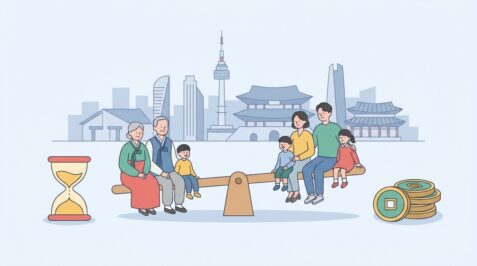
Imagine sitting in a quiet, minimalist cafe in Seongsu-dong on a rainy Tuesday afternoon. Across the small wooden table, your Korean friend Min-woo swirls the melting ice cubes in his Americano. You casually mention an international news article you read that morning: South Korea breaks its own record for the world’s lowest fertility rate at 0.72. Curious, you ask him, “Min-woo, are you thinking about getting married or having kids anytime soon?”
Min-woo chuckles softly, but his eyes look a little tired. He pauses before answering, “결혼이요? 나 하나 건사하기도 벅찬데요.” (Marriage? It’s overwhelming just taking care of myself.)
If you follow Korean media, you already know that low birthrates and an aging society are dominant national concerns. Yet, textbook Korean only teaches stiff, academic phrases like “출산율 저하” (decline in birthrates) or “고령화 현상” (aging phenomenon). When global learners try to join real-life conversations about this topic, they often feel frozen—afraid of sounding like a robotic news reporter or unintentionally asking questions that sound insensitive.
Over the past ten years of coaching learners, I’ve seen that understanding how young Koreans actually feel about their future is the ultimate key to forming deep, meaningful relationships. Today, we’re moving past dry statistics and diving into the raw, honest vocabulary young Koreans use to articulate their reality. By the end of this guide, you will be able to discuss complex social topics with nuance, respect, and natural Korean flair.
Phase 2: 3 Core Expressions Deep Dive
1. 현실적으로 쉽지 않아요 (Hyeon-sil-jeo-geu-ro swip-ji a-na-yo)
- Pronunciation: [Hyeon-sil-jeo-geu-ro swip-ji a-na-yo] (Sounds like: hyon-sheel-juh-geu-ro sheep-jee ah-nah-yo)
- Meaning:
- Literal: Realistically, it is not easy.
- Real Nuance: “Given the economic and social circumstances, it’s practically impossible, though I wish it were different.”
- K-Culture Moment: You will hear this phrase constantly in realistic slice-of-life K-dramas like Because This Is My First Life (이번 생은 처음이라) or My Liberation Notes (나의 해방일지) whenever characters calculate rent, wedding costs, or career goals.
- Editor’s Insight: Koreans value harmony and rarely say an outright “No” (안 돼요) or “Impossible” (불가능해요). Adding “현실적으로” (realistically) softens the statement while attributing the obstacle to structural factors rather than personal weakness.
- Situation Spectrum: Casual ✅ | Semi-formal ✅ | Formal ✅
- 🤔 Think About It: In your native language, do you soften difficult social realities by blaming “circumstances” rather than personal capability?
2. N포세대 (En-po-se-dae)
- Pronunciation: [En-po-se-dae] (Sounds like the English letter N + poh-seh-deh)
- Meaning:
- Literal: The “N-Give-Up” Generation.
- Real Nuance: A generation of youth forced to give up an infinite number (N) of traditional life milestones—dating, marriage, home ownership, childbirth, and career stability—due to hyper-competition.
- K-Culture Moment: Regularly featured on youth-centered variety shows, news panels, and even socially conscious K-pop lyrics (such as BTS’s earlier tracks addressing generational exhaustion).
- Editor’s Insight: It started as Sampo-sedae (giving up 3 things: dating, marriage, children), expanded to Opo-sedae (5 things: including home ownership and jobs), and finally became N-po because the list of forfeitures became endless. Using this term shows you deeply understand the collective fatigue of Korean Gen Z and millennials.
- Situation Spectrum: Casual ✅ | Semi-formal ✅ | Formal ⚠️
- 🤔 Think About It: Why do you think Korean society coined a collective sociological word for “giving up,” rather than blaming individuals for not trying hard enough?
3. 나 하나 건사하기도 벅차요 (Na ha-na geon-sa-ha-gi-do beok-cha-yo)
- Pronunciation: [Na ha-na geon-sa-ha-gi-do beok-cha-yo] (Sounds like: nah hah-nah gun-sah-hee-doh buck-chah-yoh)
- Meaning:
- Literal: Taking care of just myself is overwhelming.
- Real Nuance: “I’m pouring every ounce of energy into surviving on my own; bringing a family into this equation is out of the question.”
- K-Culture Moment: A staple line in independent lifestyle YouTube vlogs and candid podcast conversations among 20-somethings living in one-room apartments in Seoul.
- Editor’s Insight: The verb ‘건사하다’ (to look after/feed/maintain) carries the weight of daily survival. Combined with ‘벅차다’ (exceeding one’s emotional or physical capacity), it conveys vulnerable honesty without sounding overly dramatic or aggressive.
- Situation Spectrum: Casual ✅ | Semi-formal ✅ | Formal 🚫
- 🤔 Think About It: How do working adults in your culture express the feeling of living paycheck to paycheck without losing their dignity?
Phase 3: Textbook Korean vs. Real Korean
Situation 1: Explaining why young adults delay marriage
- 📖 교과서 한국어 (Textbook):
“저는 출산율 저하 문제 때문에 결혼을 하지 않겠습니다.”
(Jeoneun chulsanyul jeoha munje ttaemune gyeolhoneul haji ankkesseumnida. / “I will not get married because of the problem of declining birth rates.”) - 🗣️ 진짜 한국어 (Real-Life):
“요즘은 제 코가 석 자라 결혼은 꿈도 못 꿔요.”
(Yojeumeun je koga seok jara gyeolhoneun kkumdo mot kwoyo. / “Lately my own problems are overwhelming, so marriage is something I can’t even dream of.”) - 💡 왜 다를까? (Why the difference?): Textbooks treat the speaker like a spokesperson for government statistics. Real Koreans use the vivid idiom ‘내 코가 석 자’ (literally, “my own nose is three feet long,” meaning “I have too many troubles of my own”) to express personal precarity.
Situation 2: Discussing the rapid aging population
- 📖 교과서 한국어 (Textbook):
“노인 인구가 증가하여 사회적 문제가 되고 있습니다.”
(Noin inguga jeunggahayeo sahoejeok munjega doego isseumnida. / “The elderly population is increasing, becoming a social issue.”) - 🗣️ 진짜 한국어 (Real-Life):
“앞으로 저희 세대가 짊어질 부양 부담이 너무 커서 걱정이에요.”
(Apeuro jeohui sedaega jilmeojil buyang budami neomu keoseo geokjeong-ieyo. / “I’m worried because the burden of supporting the elderly on our generation is getting way too heavy.”) - 💡 왜 다를까? (Why the difference?): Young Koreans don’t talk about demographic statistics abstractly; they discuss the tangible fear of rising national pension taxes and healthcare costs (부양 부담) that they will personally have to shoulder.
Phase 4: K-Culture Deep Dive & Non-Verbal Manners
4-1. 눈치 (Nunchi) & Body Language
When discussing low birthrates and aging with Koreans, remember that this topic touches upon private finances, familial guilt, and career burnout.
* Never ask directly: “왜 결혼 안 해요?” (Why aren’t you getting married?) or “아기는 언제 낳을 거예요?” (When will you have a baby?). This is considered intrusive, especially coming from a peer.
* Use the Sympathetic Nod: Keep your pitch slightly lower, lean in slightly, and nod slowly (고개 끄덕임).
* Validating Sigh: Don’t hesitate to give a light sigh accompanied by “그러게요…” (I know, right…) or “참 쉽지 않네요” (It’s really not easy). In Korean culture, shared sighs over harsh realities build instant solidarity.
4-2. Cultural Code: The Burden of Perfection
Why is Korea’s birthrate dropping faster than anywhere else? It isn’t a lack of love for family; it is the immense societal standard for raising a child. In hit dramas like Sky Castle and Crash Course in Romance, you witness the reality of Korea’s private tutoring fever (사교육비) and hyper-competitive education race. Young Koreans often express that if they cannot provide a comfortable home and elite education for their child in Seoul’s soaring real estate market, bringing a child into the world feels irresponsible. Choosing not to have children is frequently seen by youth as an ethical refusal to pass down systemic stress.
Phase 5: Real-Life Roleplay Scenario
- Setting: A quiet rooftop cafe overlooking Euljiro’s printing alleys.
- Character: Min-woo (민우), a 31-year-old Korean office worker who has been working at a tech startup for four years.
Turn 1
Me: 민우 씨, 요즘 한국 뉴스 보면 저출생 얘기가 진짜 많이 나와요.
(Min-u ssi, yojeum hanguk nyuseu bomyeon jeochulsaeng yaegiga jinjja mani nawayo. / “Min-woo, watching Korean news these days, low birthrates are mentioned constantly.”)
🎭 [호기심 어린 표정으로 커피잔을 내려놓으며 / Looking curious while gently setting down the coffee cup]
Turn 2
Min-woo: 아, 맞아요. 체감상 진짜 심각해요. 제 주변 친구들도 다들 비혼 선언했어요.
(A, majayo. Chegamsang jinjja simgakaeyo. Je jubyeon chingudeoldo dadeul bihon seoneonhaesseoyo. / “Ah, that’s right. In daily life, it feels really serious. Almost all my friends have declared they won’t marry.”)
🎭 [씁쓸한 미소를 지으며 안경을 고쳐 쓴다 / Smiling wryly while readjusting his glasses]
Turn 3
Me: 집값이나 물가 부담 때문에 그런 걸까요?
(Jipgapsina mulga budam ttaemune geureon geolkkayo? / “Is it mostly because of housing prices and the cost of living?”)
🎭 [조심스럽고 진지한 눈빛으로 물어보며 / Asking with a careful, attentive gaze]
Turn 4
Min-woo: 그것도 크고, 사실 나 하나 건사하기도 벅차니까요. 퇴근하면 그냥 기절해요.
(Geugeotdo keugo, sasil na hana geonsahagido beokchanikkayo. Toegeunhamyeon geunyang gijeolhaeyo. / “That’s a big part of it, but honestly, even looking after myself is overwhelming. When I finish work, I just pass out.”)
🎭 [가벼운 한숨을 내쉬며 고개를 절레절레 흔든다 / Giving a soft sigh while shaking his head slightly]
Turn 5
Me: 한국 청년들이 짊어진 부담이 현실적으로 만만치 않군요.
(Hanguk cheongnyeondeuri jilmeojin budami hyeon-sil-jeo-geu-ro manmanchi ankgunyo. / “The burden Korean youth carry is realistically no joke.”)
🎭 [깊이 공감하며 천천히 고개를 끄덕인다 / Nodding slowly with deep empathy]
Turn 6
Min-woo: 네, 게다가 고령화도 너무 빨라서 나중에 우리 세대 세금이 엄청 늘 거래요.
(Ne, gedaga goryeonghwado neomu ppallaseo najunge uri sedae segeumi eomcheong neul georaeyo. / “Yeah, and on top of that, society is aging so fast that taxes for our generation will skyrocket down the road.”)
🎭 [먼 곳을 응시하며 턱을 괸다 / Staring into the distance while resting his chin in his hand]
Turn 7
Me: 듣고 보니 미래에 대한 불안감이 클 수밖에 없겠어요.
(Deutgo boni miraee daehan bul-an-gami keul subakke eopgetseoyo. / “Hearing that, it’s completely understandable why the anxiety about the future is so high.”)
🎭 [따뜻하고 위로하는 목소리 톤으로 / Speaking in a warm, comforting tone]
Turn 8
Min-woo: 이해해 줘서 고마워요. 외국인 친구한테 이런 깊은 얘기 하니까 속이 다 시원하네요!
(Ihaehae jwoseo gomawoyo. Oegugin chinguhante ireon gipeun yaegi hanikka sogi da siwonhaneyo! / “Thank you for understanding. Talking about this deeply with a foreign friend makes me feel so unburdened!”)
🎭 [표정이 한결 밝아지며 환하게 웃는다 / Face brightening up with a warm smile]
🔀 Interactive Decision Point
When Min-woo sighs about how overwhelming adult life is in Seoul, how would you respond?
* Choice A: “그래도 애는 낳아야 나라가 살죠! 힘내세요!” (Still, people must have kids so the country survives! Cheer up!)
* Choice B: “정말요? 현실적으로 여러 고민이 겹쳐서 쉽지 않겠네요.” (Really? Realistically, with so many overlapping worries, it must not be easy.)
* Choice C: “그러면 그냥 시골로 내려가서 농사지으면 어때요?” (Then why don’t you just move to the countryside and farm?)
- Feedback:
- Choice A (Bad): Invalidates his lived experience. Sounds like an unsolicited, patronizing lecture from a stranger.
- Choice B (Best!): Shows genuine empathy, acknowledges the structural complexity, and utilizes our key B1 expression naturally.
- Choice C (Risk): Tone-deaf. Suggesting someone abandon their career overlooks the urban economic realities of modern Korea.
Phase 6: 10-Second Emotional Shadowing Drill
Practice matching the rhythm / and emotional milestones below:
[😔 지치고 씁쓸한 목소리로 / Tired and bitter tone]
나 하나 / 건사하기도 / 솔직히 / 벅차요.
(Na hana / geonsahagido / soljiki / beokchayo.)-
[🤝 차분하고 진지하게 공감하며 / Calm and earnest empathetic tone]
현실적으로 / 생각하면 / 진짜 / 쉽지 않아요.
(Hyeon-sil-jeo-geu-ro / saenggakamyeon / jinjja / swipji anayo.) -
[💭 따뜻한 위로의 눈빛으로 / Warm comforting expression]
미래에 대한 / 청년들의 부담이 / 정말 / 클 것 같아요.
(Miraee daehan / cheongnyeondeurui budami / jeongmal / keul geot gatayo.)
Phase 7: K-Culture Mini Dictionary
- 저출생 (Jeo-chul-saeng) | Low birthrate (structural perspective)
Usage: Modern Koreans increasingly prefer ‘저출생’ over the traditional ‘저출산’ (low childbirth centered on mothers) to highlight that demographic drops are a systemic societal outcome, not a female responsibility. - 초고령 사회 (Cho-go-ryeong sa-hoe) | Super-aged society
Usage: A demographic term frequently appearing in news broadcasts designating that over 20% of the population is aged 65 and above, an imminent reality for South Korea. - 딩크족 (Ding-keu-jok) | DINK (Double Income, No Kids) couple
Usage: Widely used by couples in their 20s and 30s who marry for companionship and financial partnership while mutually agreeing not to have children. - 비혼 (Bi-hon) | Conscious non-marriage
Usage: Replaces the dated word ‘미혼’ (unmarried / “not yet married”). It asserts singlehood as a valid, deliberate lifestyle choice rather than a temporary status waiting for marriage.
Phase 8: Traveler’s Survival Kit
Survival Expressions TOP 3
- 공감이 많이 돼요. (Gonggami mani dwaeyo. / “I empathize with that a lot.”)
Pro Tip: The ultimate conversation connector. Use this whenever a Korean friend shares personal challenges about work or life. - 사는 게 다 비슷한가 봐요. (Saneun ge da biseuthanga bwayo. / “I guess living life is similar everywhere.”)
Pro Tip: A comforting phrase that bridges cultural gaps, reassuring your Korean companion that youth in your home country share similar anxieties. - 다들 치열하게 사네요. (Dadeul chiyeolhage saneyo. / “Everyone lives so intensely.”)
Pro Tip: A respectful way to comment on Korea’s bustling, fast-paced work environment without sounding critical.
Editor’s Travel Note
If you want to observe Korea’s thoughtful cafe culture and creative youth scene outside the usual tourist traps, take the subway to Hapjeong or Mangwon. Use the KakaoMap route finder to navigate quiet alleyway bookstores and independent talk salons. When buying your brew, check the Naver Pay foreigners setup guide to easily pay cashless with your foreign credit card!
Phase 9: A Step Deeper (Reflective Insight)
In less than six decades, South Korea transformed from a war-torn nation into an economic and technological powerhouse. However, this miraculous compressed growth came at a price: the societal expectation that every citizen must run an endless sprint of educational and professional achievement. In the past, self-sacrifice was accepted for the sake of the collective family. Today’s youth, however, are choosing personal balance over societal pressure. For many young Koreans, embracing ‘비혼’ (independent life) or ‘딩크’ (child-free life) is not an act of indifference, but a quiet, conscious pursuit of sustainable happiness.
💬 Your Turn: What is the primary pressure facing young adults in your country regarding dating, marriage, or starting a family? Share your thoughts below in English or simple Korean!
Phase 10: FAQ & Common Mistakes
Q: Is it considered offensive to ask a Korean friend why they aren’t having children?
A: Yes, it is often seen as invasive. Asking “왜 아이를 안 낳아요?” (Why aren’t you having children?) touches on deeply private health, financial, and personal choices. Instead, frame your curiosity around general trends: “요즘 한국 청년들은 이 문제에 대해 어떻게 생각해요?” (How do Korean young adults feel about this issue these days?).
Q: Why do young Koreans prefer the word ‘비혼’ over ‘미혼’?
A: The prefix ‘미’ (未) in ‘미혼’ (mi-hon) means “not yet,” subtly implying that marriage is an inevitable duty everyone must complete eventually. The prefix ‘비’ (非) in ‘비혼’ (bi-hon) means “non-“, indicating an active, autonomous lifestyle choice.
Q: Can I use the slang term ‘N포세대’ in professional business settings?
A: It is acceptable during informal business lunches or creative presentations regarding market demographics, but in formal corporate contracts or official speeches, opt for professional phrasing like “청년 세대의 사회경제적 부담” (socioeconomic burdens of the youth generation).
🚨 Common Mistakes Alert
- Mistake: Offering overly simplistic toxic positivity like “노력하면 다 돼요!” (If you just try harder, everything works out!).
Correct Action: Acknowledge systemic struggles by saying, “구조적인 문제라 현실적으로 쉽지 않죠.” (It’s a structural problem, so realistically it’s not easy.) - Mistake: Misusing ‘저출산’ when speaking with socially conscious university students or colleagues.
Correct Action: Use ‘저출생’ to place the focus on broader socioeconomic conditions. - Mistake: Assuming that choosing not to marry means they dislike children.
Correct Action: Recognize that economic prudence and personal lifestyle values are usually the primary motivators.
Phase 11: Action Missions
- 🥉 Bronze Mission (Solo): Stand in front of your mirror and practice the 10-Second Shadowing Drill from Phase 6 three times. Focus on relaxing your shoulders during the word ‘벅차요’.
- 🥈 Silver Mission (Social): Leave a comment on a Korean news clip or vlog about youth culture using the sentence: “현실적으로 쉽지 않은 문제네요. 공감합니다.” (It’s realistically not an easy problem. I empathize.)
- 🥇 Gold Mission (Real-Life): In your next online language exchange or casual coffee meeting with a Korean friend, ask: “요즘 한국에서는 비혼이나 딩크족에 대해 어떻게 생각해요?” (What do people in Korea think about being single or DINK couples these days?)
- 🎮 K-Culture Mission: Watch an episode of a contemporary K-drama like Because This Is My First Life and spot how the main characters calculate monthly housing budgets before deciding to live together!
Phase 12: Interactive Quiz Challenge
Test your cultural and linguistic reflexes!
1. Situation Judgment
Your Korean friend is complaining about the astronomical cost of housing in the Seoul capital area. Which response demonstrates the best emotional empathy and natural Korean?
* (A) 노력해서 돈 더 벌면 되잖아요!
* (B) 현실적으로 서울에서 집 구하기가 진짜 벅차죠.
* (C) 아기 안 낳으면 집이 작아도 상관없지 않아요?
2. Fill-in-the-Blank
A married couple that both work and intentionally choose not to have children is referred to in modern Korea as a (____)족.
3. True or False
True or False: The term ‘비혼’ implies that someone plans to get married as soon as their financial situation improves.
👉 Click here to reveal the answers and explanations!
1. Answer: (B)
Explanation: (B) accurately combines ‘현실적으로’ (realistically) and ‘벅차다’ (overwhelming), validating your friend’s reality. (A) sounds like dismissive toxic positivity, while (C) is tactless.
2. Answer: 딩크 (DINK)
Explanation: ‘딩크족’ stems from the English acronym Double Income, No Kids combined with the Korean suffix ‘족’ (tribe/group).
3. Answer: False
Explanation: That describes ‘미혼’ (yet to marry). ‘비혼’ (非婚) indicates an intentional, proactive decision to remain single regardless of circumstance.