Warm Comfort in Korean: How to Be There When Words Aren’t Enough
Phase 1: 공감 (Story-Driven Opening)
안녕하세요! 매일한글 에디터입니다. (Hello! This is your Daily Hangul editor.)
Picture this classic K-Drama scene: It’s 10:30 PM on a chilly Tuesday in Seoul. You meet your Korean close friend at a neighborhood convenience store. Under the fluorescent glow of the plastic outdoor tables, they place a warm can of honey-black tea in front of you. Their head is down, shoulders slumped after a grueling day at work or a heartbreaking personal setback. They sigh deeply, murmuring, “진짜 지친다…” (Jinjja jichinda… / I’m truly exhausted…).
You want so badly to comfort them. You open your mouth, and your brain frantically searches for the only supportive Korean phrase you know: “화이팅!” (Hwaiting!) or “힘내세요!” (Himnaeseyo! / Cheer up!).
But wait—something stops you. Telling someone who is already completely drained to “have strength” or “fight” feels hollow. Sometimes, it even feels like an accidental burden. In Korean culture, true comfort often isn’t about pushing someone to conquer their problems; it’s about holding space for their pain without judgment.
Over the past ten years coaching global learners, the number one frustration I’ve heard is: “Editor, I want to say ‘I can’t fix this for you, but I will listen to anything you need to say’ without sounding like an emotionless translation machine!”
Today, we are unlocking the most heartfelt, culturally nuanced ways to comfort a Korean friend. By the end of this guide, you will know how to be the warmest presence in your friend’s corner—using natural A2-level Korean that hits right in the heart.
Phase 2: 핵심 표현 3선 심층 분석 (Top 3 Comfort Expressions)
1. 내가 해 줄 수 있는 건 없지만 언제든 네 이야기 다 들어줄게
- Pronunciation: Naega hae jul su inneun geon eopjiman eonjedeun ne iyagi da deureojulge (Sounds like: Nay-ga heh jool soo eenn-eun geon eop-ji-man un-jeh-deun neh ee-yah-gi dah deu-ruh-jool-geh)
- Meaning: Literal: “There is nothing I can do for you, but whenever, I will listen to all your stories.” / Real Nuance: “I may not have the answers, but I’m here for you no matter what, and my ears are always open.”
- K-Culture Moment: Think of the tender moments in My Mister or Twenty-Five Twenty-One where two weary souls sit quietly on a staircase. No lectures, no fake cheer—just pure, unwavering presence.
- Editor’s Insight: The phrase “해 줄 수 있는 건 없지만” (hae jul su inneun geon eopjiman) shows deep modesty (Gyeomsun). Instead of acting like a superhero who can fix their life, you humble yourself, acknowledging their heavy burden while offering steady support.
- Situation Spectrum:
- Casual (Close Friends): ✅ 내가 해 줄 수 있는 건 없지만 언제든 네 이야기 다 들어줄게. (Naega hae jul su inneun geon eopjiman eonjedeun ne iyagi da deureojulge.)
- Semi-formal (Polite): ⚠️ 제가 해 드릴 수 있는 건 없지만 언제든 이야기 다 들어드릴게요. (Jega hae deuril su inneun geon eopjiman eonjedeun iyagi da deureodeurilgeyo.)
- Formal (Strict Business): 🚫 (Too intimate for purely professional ties)
- 🤔 Think About It: In English, we often say “Let me know if you need anything.” Why might promising active listening (이야기 다 들어줄게) feel more reassuring than offering general help?
2. 무슨 일 있으면 언제든 편하게 말해
- Pronunciation: Museun il isseumyeon eonjedeun pyeonhage malhae (Sounds like: Moo-seun eel ee-sseu-myun un-jeh-deun pyun-ha-geh mahl-heh)
- Meaning: Literal: “If anything happens, whenever, comfortably speak.” / Real Nuance: “Don’t bottle it up. You can talk to me whenever you feel ready.”
- K-Culture Moment: A scene in a webtoon where a sunbae slides a hot drink across the desk and softly drops this line before leaving, giving the person space without pressure.
- Editor’s Insight: The word “편하게” (pyeonhage – comfortably) relieves the pressure of having to explain things logically. You are giving your friend permission to ramble, vent, or even cry.
- Situation Spectrum:
- Casual: ✅ 무슨 일 있으면 언제든 편하게 말해. (Museun il isseumyeon eonjedeun pyeonhage malhae.)
- Semi-formal: ✅ 무슨 일 있으시면 언제든 편하게 말씀하세요. (Museun il isseusimyeon eonjedeun pyeonhage malsseumhaseyo.)
- Formal: ⚠️ 어려운 점이 있으시면 편히 말씀해 주십시오. (Eoryeoun jeomi isseusimyeon pyeonhi malsseumhae jusipsio.)
- 🤔 Think About It: Notice how Korean attaches 언제든 (anytime). How does removing a time limit build psychological safety?
3. 무리해서 참지 않아도 돼
- Pronunciation: Murihaeseo chamji anado dwae (Sounds like: Moo-ree-heh-suh chahm-jee ahn-ah-doh dweh)
- Meaning: Literal: “You don’t have to overdo holding it in.” / Real Nuance: “You don’t have to put on a brave face. It’s okay to let it out.”
- K-Culture Moment: When an idol in a reality show breaks down after months of smiling for cameras, and a fellow member hugs them and whispers this line.
- Editor’s Insight: Korean society prizes perseverance (Innae / 인내). Because people are trained to hold back tears (참다), validating that they don’t have to endure is the ultimate emotional release.
- Situation Spectrum:
- Casual: ✅ 무리해서 참지 마. (Murihaeseo chamji ma.) / 무리해서 참지 않아도 돼. (Murihaeseo chamji anado dwae.)
- Semi-formal: ✅ 너무 무리해서 참지 마세요. (Neomu murihaeseo chamji maseyo.)
- Formal: 🚫 (Personal emotional advice is rare in formal settings)
- 🤔 Think About It: Have you ever felt exhausted from pretending to be okay? How does hearing “you don’t have to endure” feel different from “cheer up”?
Phase 3: 교과서 한국어 vs 진짜 한국어 (Textbook vs. Real Korean)
Situation 1: Inviting them to vent their worries
- 📖 교과서 한국어 (Textbook Korean):
- 당신의 고민을 저에게 말해 주십시오. (Dangsin-ui gomin-eul jeo-ege malhae jusipsio. / Please tell me your troubles.)
- 🗣️ 진짜 한국어 (Real Korean):
- 힘든 거 있으면 편하게 털어놔. (Himdeun geo isseumyeon pyeonhage teoreonwa. / If something’s tough, just pour it all out comfortably.)
- 💡 왜 다를까? (Why is it different?):
Textbooks often rely on stiff pronouns like 당신 (which can sound awkward or confrontational in spoken Korean). Real Koreans use vivid verbs like 털어놓다 (literally: to shake off and spill out), which invites a cathartic emotional release.
Situation 2: When your friend starts tearing up
- 📖 교과서 한국어 (Textbook Korean):
- 울지 마세요. 모든 것이 괜찮아질 것입니다. (Ulji maseyo. Mmodeun geosi gwaenchanajil geosimnida. / Do not cry. Everything will become okay.)
- 🗣️ 진짜 한국어 (Real Korean):
- 울어도 돼. 괜찮아. (Ureodo dwae. Gwaenchana. / It’s okay to cry. You’re alright.)
- 💡 왜 다를까? (Why is it different?):
Telling an overwhelmed person 울지 마세요 (Don’t cry) can unintentionally invalidate their sorrow. Natural Korean empathy recognizes tears as a healthy healing process.
Phase 4: K-Culture 딥다이브 & 비언어적 매너 (Deep Dive & Non-Verbal Manners)
4-1. 눈치 (Nunchi) & Listening Manners
Comforting in Korean culture is 70% atmosphere and 30% words. When someone is opening up, keep these non-verbal cues in mind:
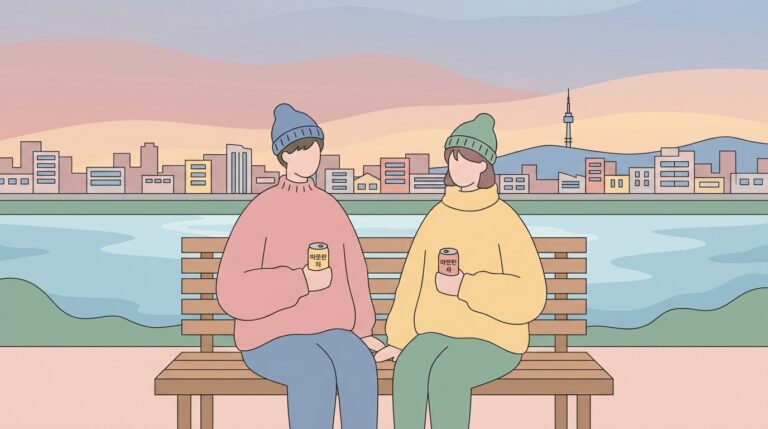
* Side-by-Side Seating: Instead of cornering someone face-to-face across a table—which can feel like a police interrogation—Koreans often comfort friends sitting side-by-side (bench, pojangmacha, riverbank).
* The Gentle Back Pat (토닥토닥 – Todak-todak): Avoid aggressive bear hugs unless you are super close. A gentle, rhythmic patting on the shoulder or upper back creates warmth without crowding their personal space.
* Match Their Silence: If they trail off and look away, don’t rush to fill the silence with advice. Just sip your drink and wait. This shared silence is called Gonggam (공감 – emotional resonance).
4-2. The Healing Power of Warm Food & Drink
In Korea, emotions are deeply connected to the stomach. Asking “밥은 챙겨 먹었어?” (Babeun chaenggyeo meogeosseo? / Have you been eating well?) isn’t just about nutrition; it means “I care whether you are surviving this emotional storm.”
Handing a friend a warm drink (like warm soy milk, yuzu tea, or can coffee from a heated display box) warms their cold hands first, signaling physical and psychological safety.
Phase 5: 실전 롤플레이 시나리오 (Real-Life Roleplay)
Setting: 9:30 PM outside a CU convenience store in Mapo-gu. Autumn breeze. Your friend Minjun (민준) has been silent for 15 minutes, holding an unopened soda.
- You: 민준아, 안색이 너무 안 좋아. 무슨 일 있어?
(Minjun-a, ansaegi neomu an joa. Museun il isseo?)
🎭 [Softly handing him a hot canned coffee]
(Minjun, your complexion looks really rough. Did something happen?) -
Minjun: 아… 그냥. 회사 일도 꼬이고, 집안일도 그렇고… 다 그만두고 싶다.
(A… geunyang. Hoesa ildo kkoigo, jibanildo geureoko… da geumandugo sipda.)
🎭 [Sighs deeply, staring at his sneakers]
(Ah… just everything. Work is tangled up, family stuff too… I just want to quit it all.) -
You: 많이 버거웠구나. 혼자서 참느라 힘들었지?
(Mani beogeowotguna. Honjaseo chamneura himdeureotji?)
🎭 [Sitting closer, matching his low tone]
(It must have been so overwhelming. It was hard enduring it all alone, wasn’t it?) -
Minjun: 솔직히 누구한테 말해야 할지도 모르겠고… 너한테 부담 주기 싫었어.
(Soljiki nugu-hante malhaeya haljido moreugetgo… neohante budam jugi sireosseo.)
🎭 [Eyes turning slightly red]
(Honestly, I didn’t even know who to tell… and I didn’t want to burden you.) -
You: 부담은 무슨! 내가 해 줄 수 있는 건 없지만 언제든 네 이야기 다 들어줄게.
(Budameun museun! Naega hae jul su inneun geon eopjiman eonjedeun ne iyagi da deureojulge.)
🎭 [Gently patting his shoulder twice]
(Burden, nonsense! There may not be much I can do, but I’ll always listen to everything you have to say.) -
Minjun: 진짜 고맙다… 그런 말 해 줘서.
(Jinjja gomapda… geureon mal hae jwoseo.)
🎭 [Takes a long sip of the hot coffee and looks up]
(Thank you so much, truly… for saying that.) -
You: 무리해서 괜찮은 척하지 말고, 편하게 털어놔. 난 네 편이야.
(Murihaeseo gwaenchaneun cheokhaji malgo, pyeonhage teoreonwa. Nan ne pyeon-iya.)
🎭 [Warm reassuring smile]
(Don’t pretend to be okay by pushing yourself. Spill it out comfortably. I’m on your side.) -
Minjun: 응… 사실 오늘 부장님이랑 회의에서…
(Eung… sasil oneul bujangnim-irang hoe-i-eseo…)
🎭 [Finally lets his guard down and begins opening up]
(Yeah… actually, today in the meeting with the department manager…)
🔀 Interactive Choice Point
When Minjun says: “너한테 부담 주기 싫었어” (I didn’t want to be a burden to you), how will you respond?
- Choice A: “야, 힘내! 내일은 내일의 태양이 떠오르잖아!” (Ya, himnae! Naeireun naeirui taeyangi tteo-oreujana! / Hey, cheer up! Tomorrow is another day!)
- Choice B: “부담 전혀 아니야. 내가 다 해결해 줄 테니까 걱정 마.” (Budam jeonhyeo aniya. Naega da haegyeolhae jul tenikka geokjeong ma. / No burden at all. Don’t worry, I will fix everything for you.)
- Choice C: “전혀 부담 아니야. 내가 해결은 못 해 줘도 네 이야기 끝까지 들어줄게.” (Jeonhyeo budam aniya. Naega haegyeoreun mot hae jwodo ne iyagi kkeutkkaji deureojulge. / It’s not a burden at all. Even if I can’t solve it, I’ll listen to your story until the very end.)
Feedback:
* Choice A (Bad): ❌ Toxic positivity alert! In Korean, overly dramatic motivational quotes can sound dismissive when someone is experiencing real distress.
* Choice B (Risk): ⚠️ Well-intentioned, but making empty promises to “solve” complex life issues can lead to disappointment or make the person feel like a problem to be solved.
* Choice C (Best): ✅ Perfect score! You validate their concern, set realistic boundaries, and provide the exact emotional shelter they crave.
Phase 6: 10초 감정 섀도잉 드릴 (10-Second Emotional Shadowing Drill)
Practice reading these out loud. Pay attention to the / pause marks and emotional directions:
[🥺 따뜻하고 진심 어린 목소리로 / Warm & Heartfelt]
내가 해 줄 수 있는 건 없지만 / 언제든 네 이야기 / 다 들어줄게.
(Naega hae jul su inneun geon eopjiman / eonjedeun ne iyagi / da deureojulge.)-
[🫂 다독거리며 안심시키듯 / Soothing & Reassuring]
힘들면 / 무리해서 참지 않아도 돼. / 울어도 괜찮아.
(Himdeulmyeon / murihaeseo chamji anado dwae. / Ureodo gwaenchana.) -
[☕ 든든하고 단단하게 / Grounded & Reliable]
천천히 말해. / 난 밤새 네 편이니까.
(Cheoncheonhi malhae. / Nan bamsae ne pyeon-inikka.)
Phase 7: K-Culture 미니 사전 (Key Vocabulary)
-
털어놓다 (Teoreonota)
Literal Meaning: To shake out and lay flat.
Real Context: Used when confessing a hidden worry, pain, or secret that was heavy on your heart.
Example: 마음속 고민을 다 털어놓았어. (Maeumsok gomineul da teoreonoasseo. / I poured out all my inner worries.) -
토닥토닥 (Todak-todak)
Literal Meaning: Light patting sounds.
Real Context: An onomatopoeia for comforting someone with affectionate pats on the back. Often sent in KakaoTalk as a text emote.
Example: 오늘 하루도 수고했어, 토닥토닥. (Oneul harudo sugohaesseo, todak-todak. / Great job today too, pat pat.) -
내 편 (Nae pyeon)
Literal Meaning: My side / My team.
Real Context: Declaring loyalty. In competitive Korean society, knowing that at least one person unconditionally stands on your side brings immense comfort.
Example: 세상이 다 등을 돌려도 난 네 편이야. (Sesangi da deungeul dollyeodo nan ne pyeon-iya. / Even if the world turns its back, I am on your side.) -
눈치 (Nunchi)
Literal Meaning: Eye measure.
Real Context: Quick emotional radar. Knowing when a friend needs a listening ear versus when they need silence.
Example: 눈치 있게 조용히 기다려 주자. (Nunchi itge joyonghi gidaryeo juja. / Let’s read the room and quietly wait for them.)
Phase 8: 여행자를 위한 생존 키트 (Traveler’s Survival Kit)
Top 3 Survival Phrases for Heartfelt Moments
- 천천히 말씀하세요 (Cheoncheonhi malsseumhaseyo)
Pro Tip: If an elder, local host, or tour buddy gets emotional or distressed, use this respectful phrase: “Please take your time speaking.” - 따뜻한 물 한 잔만 부탁드립니다 (Ttatteutan mul han janman butakdeurimnida)
Pro Tip: At any restaurant or café, this gets you warm water to soothe nerves. - 신경 써 주셔서 정말 감사합니다 (Singyeong sseo jusyeoseo jeongmal gamsahamnida)
Pro Tip: When a local checks on you or offers quiet assistance, this means: “Thank you so much for caring for me.”
Editor’s Travel Note
When your travel partner is feeling overstimulated or burnt out in bustling Seoul, search for calm green spaces. You can look up quiet riverside spots or neighborhood walking trails by downloading 카카오맵 앱 다운로드 (Download KakaoMap App). Finding a bench under the willow trees at Mangwon Hangul Park works ten times better than any lecture.
Phase 9: “한 발 더 깊이” (One Step Deeper)
In Western communication, when someone shares a problem, the natural instinct is often problem-solving: “Have you tried calling HR? Did you take vitamins?” In Korea, however, rushing to provide solutions can feel dismissive, as if you’re trying to wrap up the conversation quickly. True Korean comfort rests on the concept of 함께 (Hamkke – Togetherness). By simply saying, “내가 해 줄 수 있는 건 없지만…”, you validate that their pain is significant and that you are willing to sit in the heavy emotional rain with them until the storm passes.
💬 Your Turn: Have you ever had a friend who just listened without trying to solve everything? How did that make you feel? Drop a comment below!
Phase 10: FAQ & 오해 방지 (FAQ Schema & Common Mistakes)
Q: Can I use this phrase with my boss or manager?
A: Not quite in this exact form! “내가 해 줄 수 있는 건 없지만” uses informal plain language (반말 / Banmal). With a boss or senior, use polite honorific forms: “제가 큰 도움이 되어 드리지는 못하지만, 말씀 주시면 귀담아듣겠습니다” (Jega keun doumi doe-eo deorijineun mothajiman, malsseum jusimyeon gwidamadutgetseumnida).
Q: Does saying this make me sound weak or unhelpful?
A: Not at all! In Korean cultural psychology, acknowledging your limitations while offering your full presence is considered an act of profound honesty and respect (진정성 / Jinjeongseong).
Q: What if I don’t know enough Korean to understand their whole story?
A: Don’t panic! You don’t need to understand every vocabulary word. Just nodding, maintaining gentle eye contact, and saying “그랬구나…” (Geuraetguna… / I see, that must have been hard…) or “진짜 힘들었겠다” (Jinjja himdeureotgetda / That must have been really tough) will give them the relief they need.
🚨 Common Mistakes Alert (외국인 학습자의 흔한 실수 TOP 3)
- Overusing “화이팅!” (Hwaiting!) when someone is grieving or depressed
Why it’s wrong: It sounds like telling someone running a marathon with a broken ankle to just run faster.
Correct Action: Switch to “무리하지 마” (Don’t overexert yourself) or “울어도 돼” (It’s okay to cry). - Asking “왜 그래?” (Wae geurae? / Why are you being like that?) aggressively
Why it’s wrong: With the wrong intonation, it sounds like an accusation: “What’s your problem?”
Correct Action: Say softly: “무슨 일 있어?” (Museun il isseo? / Did something happen?). - Using textbook “당신” (Dangsin)
Why it’s wrong: Translating “your story” literally into “당신의 이야기” sounds like a book title or a dispute between strangers.
Correct Action: Use their name (민준이 이야기) or simply “네 이야기” (Ne iyagi).
Phase 11: 액션 미션 & 참여 유도 (Action Missions)
- 🥉 Bronze Mission (Solo Practice): Record yourself saying “내가 해 줄 수 있는 건 없지만 언제든 네 이야기 다 들어줄게” in voice memo. Make sure your tone sounds soft and warm.
- 🥈 Silver Mission (Social Share): Leave a comment below using the word “토닥토닥” to comfort another community member who had a rough week.
- 🥇 Gold Mission (Real Life Application): The next time your Korean study buddy or pen pal sighs on KakaoTalk, send them: “힘든 일 있으면 편하게 말해. 다 들어줄게!”
- 🎮 K-Culture Mission: Watch an episode of a healing drama like Hospital Playlist or Daily Dose of Sunshine. Spot a scene where characters sit eating together without talking, and note the non-verbal comfort cues!
Phase 12: 인터랙티브 퀴즈 챌린지 (Interactive Quiz)
Q1. Which response is the most empathetic when a close Korean friend is crying from burnout?
1) 화이팅! 울지 말고 힘내세요!
2) 내가 다 해결해 줄 테니까 걱정하지 마.
3) 무리해서 참지 마. 네 이야기 다 들어줄게.
👉 정답 및 해설 확인하기 (Click to reveal answer)
정답: 3번!
해설: Telling someone not to endure and offering to listen validates their emotions without the pressure of empty optimism (1번) or unrealistic problem-solving (2번).
Q2. Fill in the blank:
무슨 일 있으면 언제든 _________ 말해. (If anything happens, speak comfortably anytime.)
Hint: The word for “comfortably” derived from 편하다.
👉 정답 및 해설 확인하기 (Click to reveal answer)
정답: 편하게 (Pyeonhage)
해설: 편하게 is the adverb form meaning “comfortably” or “at ease.” It frees the listener from worrying about whether their words sound neat or organized.
Q3. True or False?
In Korean culture, maintaining continuous intense eye contact and asking rapid “Why?” questions is the most polite way to comfort someone going through personal sorrow.
👉 정답 및 해설 확인하기 (Click to reveal answer)
정답: False!
해설: Intense staring and rapid questioning can feel overwhelming. Giving emotional space, sitting side-by-side, and reading their non-verbal cues (Nunchi) is the true Korean way to comfort a friend.