

Phase 1: Empathy (Story-Driven Opening)
안녕하세요! 매일한글 에디터입니다. (Hello! I’m your Daily Hangul editor.)
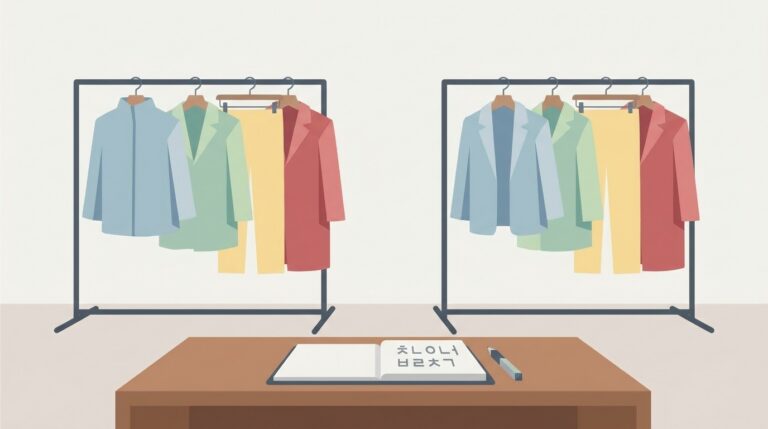
Picture this: You are walking down the vibrant, brick-paved alleys of Seongsu-dong or exploring the neon-lit indie boutiques in Hongdae. You spot an exquisite, structured blazer hanging by the display. It screams “effortless Seoul street style.” Eagerly, you slip your arms into the sleeves, but when you look in the mirror, the shoulder seams are dropping past your shoulders and the cuffs swallow your hands. You freeze. Is this jacket meant to have an ultra-relaxed, trendy Korean silhouette, or did you accidentally pull a triple-extra-large off the rack?
In Korea, clothing labels rarely follow uniform international sizing, and the line between an intentional “streetwear drop-shoulder” and simply being “way too big” can be confusing. Many foreign shoppers end up putting the item back and walking out empty-handed simply because they do not know how to ask the store clerk about the silhouette. Based on real feedback from dozens of our Daily Hangul learners, mastering just one key question about fit instantly transforms your shopping anxiety into an authentic, confidence-boosting Seoul retail experience.
Phase 2: Top 3 Core Expressions Deep Dive
1. 이 자켓은 정사이즈로 나왔나요, 오버핏인가요? (I jaket-eun jeongsaijeuro nawannayo, obepit-ingayo?)
- Pronunciation: [Ee jah-ket-eun jeong-sah-ee-jeu-ro nah-wahn-nah-yo, oh-beo-pit-eeng-gah-yo?] (Tip: “Jeong” sounds like the English name “Jung”, and “pit” sounds like “fit” with a soft ‘p’ sound.)
- Meaning: Literal: “Did this jacket come out as true to size, or is it an over-fit?” / Nuance: “Does this jacket run true to size, or is it designed to be oversized?”
- K-Culture Moment: You often hear stylish celebrities in behind-the-scenes fitting vlogs asking their stylists if an outfit is tailored close to the body or styled with dramatic “overfit” proportions.
- Editor’s Insight: In Korea, “오버핏 (over-fit)” is a widely accepted fashion loanword. The verb phrase “~로 나오다 (~ro naoda, to come out as)” is the natural, native way to describe how a manufactured product was released into the market.
- Situation Spectrum: Casual: ✅ | Semi-formal: ✅ | Formal: ✅
- 🤔 Think About It: In English, we usually ask “Does this run large?”, treating the garment as active. In Korean, people say “Did it come out as…?”, focusing on the manufacturer’s creative design intent. How does this subtle shift change your perspective on clothing?
2. 한 치수 크게 입어야 하나요? (Han chisu keuge ibeoya hanayo?)
- Pronunciation: [Hahn chee-soo keu-geh ee-beo-yah hah-nah-yo?] (Tip: “Chisu” rhymes with “sea-sue”, meaning size or measurement.)
- Meaning: Literal: “Must I wear it one size bigger?” / Nuance: “Should I size up for this?”
- K-Culture Moment: Often seen in online shopping haul videos on YouTube when creators review snug boots or outerwear.
- Editor’s Insight: “치수 (chisu)” specifically refers to garment measurement or sizing increments. You can swap “크게 (keuge, bigger)” with “작게 (jakge, smaller)” if you suspect the item runs huge.
- Situation Spectrum: Casual: ✅ | Semi-formal: ✅ | Formal: ⚠️
- 🤔 Think About It: Notice the polite obligation ending “~해야 하나요 (~haeya hanayo, should/must I do?)”. It politely invites the clerk’s expert guidance rather than demanding a simple yes or no.
3. 입어봐도 되나요? (Ibeobwado doenayo?)
- Pronunciation: [Ee-beo-bwah-doh dweh-nah-yo?] (Tip: “Ibeo” sounds like “ee-buh”, and “bwa” sounds like the “bwoi” in bistro.)
- Meaning: Literal: “Even if I try wearing it, is it okay?” / Nuance: “May I try this on?”
- K-Culture Moment: A staple phrase used in K-dramas whenever a character is shopping for a date or a makeover montage in a department store.
- Editor’s Insight: Never enter a fitting room in Korea without asking this first. Some delicate fabrics (like white knitwear or silk) cannot be tried on, making this question both respectful and necessary.
- Situation Spectrum: Casual: ✅ | Semi-formal: ✅ | Formal: ✅
- 🤔 Think About It: Asking permission via “~도 되나요 (~do doenayo)” acknowledges the shared boundary between the shopper and the boutique owner.
Phase 3: Textbook Korean vs Real Korean
Situation A: Asking about the fit
- 📖 교과서 한국어: 이 옷의 크기는 표준 크기입니까? (I os-ui keugineun pyojun keugi-imnikka? / Is the size of this clothing standard size?)
- 🗣️ 진짜 한국어: 이거 정사이즈예요? (Igeo jeongsaijeu-yeyo? / Is this true to size?)
- 💡 왜 다를까?: Textbook Korean often relies on literal translations like “표준 크기 (standard size)”, which sounds like a military manual. Real shoppers use the loanword “정사이즈 (jeongsaijeu)”.
Situation B: Asking if you can try it on
- 📖 교과서 한국어: 피팅룸에서 착용해 보아도 되겠습니까? (Pitingrum-eseo chak-yonghae boado doegesseumnikka? / Would it be permissible for me to wear this inside the fitting room?)
- 🗣️ 진짜 한국어: 이거 입어봐도 돼요? (Igeo ibeobwado dwaeyo? / Can I try this on?)
- 💡 왜 다를까?: The Sino-Korean verb “착용하다 (chakyonghada)” is used in written policies, signs, or formal announcements. In spoken conversation, the native Korean construction “입어보다 (ibeoboda)” is much warmer and natural.
Phase 4: K-Culture Deep Dive & Non-Verbal Manners
4-1. 눈치 (Nunchi) & Gestures
When shopping in Korea, eye contact paired with a gentle nod is the gold standard of politeness. When asking a clerk about fit, avoid snapping your fingers or waving from across the shop. Instead, hold the hanger slightly forward with both hands and make soft eye contact.
Crucial Fitting Room Rule: Look down at the entrance of the fitting room! If there is a raised wooden step or a small mat, take off your shoes before stepping inside. If you are trying on tops or pullovers (especially in women’s fashion boutiques), the staff will hand you a white spun-cloth pouch called a “페이스 커버 (peiseu keobeo, face cover)”. Slip this over your head before trying on the shirt to prevent makeup or hair products from staining the collar.
4-2. Cultural Code Analysis: The K-Fashion “Overfit” Aesthetic
Why is everyone in Seoul wearing boxy jackets and relaxed silhouettes? The Korean “오버핏 (over-fit)” craze isn’t just about comfort; it is rooted in K-Pop dance practice looks and the genderless tailoring popular in contemporary Seoul street style. An oversized blazer creates the optical illusion of a smaller face—a coveted beauty standard in Korea often referred to as “소두 (sodu, small head/face)”. Understanding this helps you appreciate that the droopy shoulders on that jacket were crafted with precise architectural intent!
Phase 5: Real-Life Roleplay Scenario
- Setting: “Acro Studio”, a sleek, minimalist boutique along a quiet side street in Seongsu-dong.
- Character: Min-ji (Staff), wearing an oversized linen blazer and a neat silver name tag, folding shirts attentively.
Turn 1
* Customer: 저기요, 실례지만 이것 좀 여쭤봐도 될까요? (Jeogiyo, sillyejiman igeot jom yeojjwo-bwado doelkkayo?)
* “Excuse me, but may I ask you something about this?”
* 🎭 Holding up a dark navy jacket lightly with both hands.
Turn 2
* Min-ji: 네, 고객님! 편하게 말씀하세요. (Ne, gogaeknim! Pyeonhage malsseumhaseyo.)
* “Yes, customer! Please feel free to ask.”
* 🎭 Smiling warmly and stepping closer.
Turn 3
* Customer: 이 자켓은 정사이즈로 나왔나요, 오버핏인가요? (I jaket-eun jeongsaijeuro nawannayo, obepit-ingayo?)
* “Does this jacket run true to size, or is it an oversized fit?”
* 🎭 Looking at the shoulders of the jacket curiously.
Turn 4
* Min-ji: 그 제품은 어깨선이 살짝 내려온 세미 오버핏으로 나왔어요! (Geu jepum-eun eokkaeseon-i saljjak naeryeoon semi obepit-euro nawasseoyo!)
* “That piece is designed as a semi-overfit with slightly dropped shoulders!”
* 🎭 Pointing gently to the shoulder seam.
Turn 5
* Customer: 아, 그렇군요! 그럼 제 체형에는 한 치수 작게 입어야 할까요? (A, geureokgunyo! Geureom je chehyeong-eneun han chisu jakge ibeoya halkkayo?)
* “Ah, I see! Then for my body frame, should I wear one size smaller?”
* 🎭 Tilting head slightly in thought.
Turn 6
* Min-ji: 아니요, 정사이즈로 가셔도 자연스럽고 예쁘게 떨어져요. (Aniyo, jeongsaijeuro gasyeodo jayeonseureopgo yeppeuge tteoreojyeoyo.)
* “No, even if you go with your regular size, it falls very naturally and nicely.”
* 🎭 Demonstrating the drape with a hand motion.
Turn 7
* Customer: 다행이네요. 이거 한번 입어봐도 되나요? (Dahaeng-ineyoyo. Igeo hanbeon ibeobwado doenayo?)
* “What a relief. May I try this on?”
* 🎭 Looking toward the fitting curtain.
Turn 8
* Min-ji: 네! 저쪽 피팅룸으로 안내해 드릴게요. 신발 벗고 들어가시면 돼요! (Ne! Jeojjok pitingrum-euro annaehae deurilgeyo. Sinbal beotgo deureogasimyeon dwaeyo!)
* “Sure! I will guide you to that fitting room over there. You can take off your shoes and step inside!”
* 🎭 Guiding the way with an open palm.
🔀 Interactive Decision Point
Min-ji just told you the jacket is a “세미 오버핏 (semi-overfit)”. You want to see how your normal size feels. What do you say?
- Option A: “그냥 이거 입어볼게요. 피팅룸 어디예요?” (Geunyang igeo ibeobolgeyo. Pitingrum eodi-yeyo?)
Result: Risk. Grammatically correct, but “그냥 (just)” combined with an abrupt question can sound blunt or impatient to Korean service workers. - Option B: “입어봐도 되나요? 제 사이즈로 피팅해 보고 싶어요.” (Ibeobwado doenayo? Je saijeu-ro pitinghae bogo sipeoyo.)
Result: Best! Polite, clear, and perfectly hits native retail cadence. - Option C: “야, 이거 나한테 너무 큰 거 아니야?” (Ya, igeo nahante neomu keun geo aniya?)
Result: Bad. Highly informal (반말, banmal) slang like “야 (Hey)” used with a stranger will create instant awkwardness.
Phase 6: 10-Second Emotion Shadowing Drill
Practice these natural rhythm pauses (marked with /) and mimic the recorded emotions:
[🤔 호기심 가득하고 정중하게 / Curious & Polite]
저기요, / 이 자켓은 / 정사이즈로 나왔나요, / 오버핏인가요?
(Jeogiyo, / i jaket-eun / jeongsaijeuro nawannayo, / obepit-ingayo?)-
[💡 깨달음을 얻고 안도하며 / Enlightened & Relieved]
아, / 세미 오버핏이군요! / 정사이즈로 입어볼게요.
(A, / semi obepit-igunyo! / Jeongsaijeuro ibeobolgeyo.) -
[😊 밝고 조심스럽게 부탁하며 / Bright & Polite Request]
혹시 / 한 치수 작은 것도 / 입어봐도 될까요?
(Hoksi / han chisu jageun geotdo / ibeobwado doelkkayo?)
Phase 7: K-Culture Mini Dictionary
-
정사이즈 (Jeongsaijeu) | True to size / Standard sizing
A compound word combining Chinese character “正 (jeong, right/proper)” and English “size”. Used when asking if a garment matches standard body measurements. -
오버핏 (Obepit) | Oversized silhouette
Refers to clothes deliberately tailored with exaggerated chest, drop shoulders, or loose sleeves for a relaxed, fashionable drape. -
피팅룸 (Pitingrum) | Fitting room / Dressing room
Commonly displayed on store directional signs. You can ask: “피팅룸이 어디에 있어요? (Pitingrum-i eodie isseoyo? / Where is the fitting room?)” -
드라이클리닝 (Deuraikeullining) | Dry cleaning
Essential when checking clothing care tags (세탁 탭, setak taep). If a jacket says “드라이클리닝 전용”, it means dry-clean only.
Phase 8: Traveler’s Survival Kit
Survival Expressions TOP 3
- 1. 다른 사이즈 있어요? (Dareun saijeu isseoyo?)
Do you have another size?
Pro Tip: Use this when the display piece is either too tight or too loose. - 2. 세탁은 어떻게 해야 해요? (Setak-eun eotteoke haeya haeyo?)
How should I wash/care for this?
Pro Tip: Great for knitwear or wool jackets before finalizing your purchase. - 3. 텍스 리펀 돼요? (Tekseu ripeon dwaeyo?)
Is tax refund available?
Pro Tip: Keep your physical passport ready; stores in areas like Myeongdong or Seongsu often process instant tax refunds at the register.
Editor’s Travel Note
When navigating shopping hotspots like Seongsu-dong, Garosu-gil, or Hannam-dong, Google Maps often shows inaccurate walking routes. Make sure to download the Naver Map app or the KakaoMap application ahead of time to find hidden second-floor designer showrooms and basement vintage shops without getting lost.
Phase 9: One Step Deeper (Reflection Question)
In many Western cultures, fashion fit is heavily focused on personal body contouring and tailoring to accentuate individual shape. In contemporary Korea, however, clothing fit often reflects fluid social trends, subcultural belonging, and silhouette harmony. When you slip into an “overfit” blazer in Seoul, you are not just wearing a loose piece of fabric; you are participating in a collective visual dialogue centered on effortless elegance and modern street aesthetics.
💬 Your Turn: When you shop for clothes, do you prefer a sharp true-to-size look, or do you enjoy experimenting with Korean-style oversized fits? Share your thoughts below!
Phase 10: FAQ & Avoiding Misunderstandings
Q: Can I try on white shirts or graphic t-shirts in Korean clothing stores?
A: In many independent boutiques and department stores, trying on white t-shirts, delicate knitwear, or silk blouses is restricted to prevent collar stretching and makeup marks. Always ask “이거 입어봐도 돼요? (Can I try this on?)” first, and look out for signs saying “착용 불가 (Chakyong bulga, Fitting not allowed)”.
Q: How do Korean women’s clothing sizes compare to international sizes?
A: Korea often uses the numbers 44 (XS), 55 (S), 66 (M), and 77 (L), or sells items labeled “프리사이즈 (Free size / One size fits all)”. Note that “Free size” in Korea usually corresponds to a snug US 4-6 (Small/Medium). If you are unsure, asking about “오버핏 (over-fit)” will help you determine if it will fit comfortably.
Q: What should I do if there are no size tags on the rack?
A: Many indie boutiques only display one sample piece per rack. Simply pick up the item and ask the clerk: “혹시 라지 사이즈 있어요? (Do you happen to have this in a Large?)” They will happily check their stockroom for you.
🚨 Common Mistakes Warning Board
- Mistake: Stepping straight onto the fitting room floor with your outdoor shoes on.
Correct Action: Check for a floor mat or raised platform; remove your shoes and leave them outside the curtain before stepping in. - Mistake: Forgetting to use the face cover (페이스 커버) when provided.
Correct Action: Place the non-woven cover over your head before pulling garments over your face to protect makeup and the merchandise. - Mistake: Saying “오버사이즈 (Oversize)” instead of “오버핏 (Over-fit)”.
Correct Action: While clerks might guess what you mean, using the native fashion term “오버핏 (obepit)” guarantees instant understanding.
Phase 11: Action Missions & Community Engagement
- 🥉 Bronze Mission (Solo Practice): Stand in front of your home mirror with your favorite jacket. Say out loud three times: “이 자켓은 정사이즈로 나왔나요, 오버핏인가요?”
- 🥈 Silver Mission (Social Engagement): Snap a photo of your favorite oversized or tailored outfit, post it on social media, and tag it with
#DailyHangul #KoreanFashionusing the phrase “오늘의 핏: 오버핏! (Today’s fit: Overfit!)”. - 🥇 Gold Mission (Real-Life Application): Visit an offline Korean fashion brand (like Spao, Musinsa Standard, or 8Seconds) or a local boutique, and ask a clerk about a jacket’s fit using our core questions.
- 🎮 K-Culture Mission: Watch an episode of a recent K-drama or an idol’s vlog. Spot an actor or idol wearing an oversized tailored blazer and comment on whether you think it’s a “정사이즈 (true to size)” or “오버핏 (oversized fit)”.
Phase 12: Interactive Quiz Challenge
Test your real-world shopping readiness with these 3 quick challenges!
Question 1: Situational Judgment
You are in a Hongdae shop and want to know whether a coat is designed to be worn oversized. Which phrase is the most natural to use?
* A) 이 옷은 진짜 큰 치수입니까? (I os-eun jinjja keun chisu-imnikka?)
* B) 이 코트는 정사이즈로 나왔나요, 오버핏인가요? (I koteu-neun jeongsaijeuro nawannayo, obepit-ingayo?)
* C) 코트가 왜 이렇게 커요? (Koteu-ga wae ireoke keoyo?)
👉 Click here to reveal the answer and explanation!
Correct Answer: B
Explanation: Option B accurately uses natural fashion vocabulary (“정사이즈” vs “오버핏”) and the idiomatic expression “~로 나오다”. Option A sounds stiff and unidiomatic, while Option C sounds accusatory (“Why is this coat so huge?”).
Question 2: Fill in the Blanks
Complete the sentence to ask if you should size down:
“제 체형에는 한 치수 ______ 입어야 하나요?” (Should I wear one size smaller for my body frame?)
* A) 크게 (keuge)
* B) 작게 (jakge)
* C) 넓게 (neolbge)
👉 Click here to reveal the answer and explanation!
Correct Answer: B (작게 / jakge)
Explanation: “작게 (jakge)” means “smaller”. “크게 (keuge)” means bigger, and “넓게 (neolbge)” means wider.
Question 3: Cultural True or False
In all Korean clothing stores, you can freely walk into any fitting room with your street shoes on as long as the curtain is drawn.
* True
* False
👉 Click here to reveal the answer and explanation!
Correct Answer: False
Explanation: Most Korean boutiques have raised platforms, carpets, or mats inside the fitting room stalls where you are expected to take off your outdoor footwear before stepping inside.







