

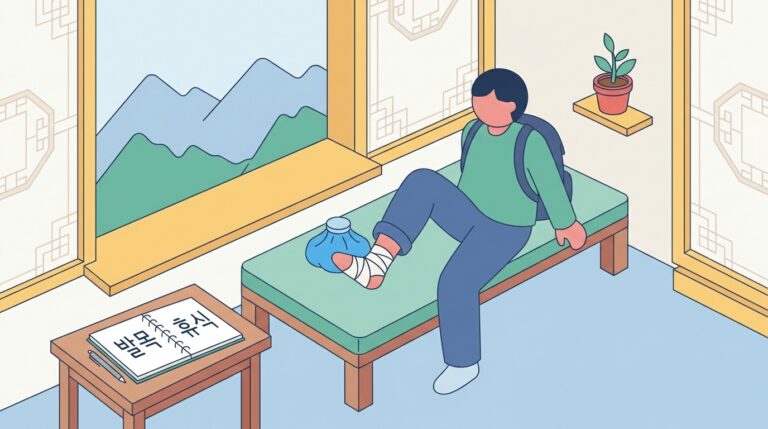
Don’t Panic at the Korean Orthopedic Clinic: How to Say You Sprained Your Ankle in Simple Steps
Phase 1: Empathy (Story-Driven Opening)
안녕하세요! 매일한글 에디터입니다! (Hello! I’m your Daily Hangul editor!)
Picture this: You are having the dream day in Seoul. You just ate some warm tteokbokki in Hongdae, snapped aesthetic photos under the autumn trees, and rushed down the subway stairs to catch Line 2. But suddenly—snap. You miss your footing on the edge of the granite step, your right ankle twists inwards, and a sharp pain shoots right up your calf.
If this was a classic K-Drama, your handsome or dashing co-star would magically appear from the crowd, offer a warm piggyback ride (어부바 – eobuba), and carry you straight to the nearest clinic. But in real life? You are sitting on the cold subway platform holding your foot, wondering: “Where do I go? How do I even explain ‘I missed a step and sprained my ankle’ in Korean? Will they understand me if my Korean is only beginner level?”
Take a deep breath—your Korean best friend is right here! Getting hurt abroad is terrifying, but South Korea actually has one of the world’s fastest, most accessible, and most foreigner-friendly neighborhood clinic systems. You don’t need a massive emergency room (응급실 – eunggeubsil) for a twisted ankle; you simply need a neighborhood 정형외과 (jeonghyeong-oegwa – orthopedic clinic).
This guide was built directly from real student stories and emergency experiences. By the end of this 10-minute guide, you will know exactly what words to say at the reception desk, how to tell the doctor precisely how you tripped, and how to comfortably receive physical therapy without breaking a sweat.
Phase 2: Top 3 Core Expressions Deep Dive
Here are the three golden phrases you need to survive and thrive at a Korean orthopedic clinic.
1. 계단에서 발을 헛디뎠어요 (Gedaneseo bareul heotdideyeosseoyo)
- Pronunciation: [Gye-dan-e-seo ba-reul heot-di-dyeo-sseo-yo] (Sounds like: Gay-dahn-eh-suh bah-reul hut-dee-dyuh-ssuh-yo — imagine saying “hut” quickly for ‘헛’)
- Meaning: Literal: “On the stairs, I stepped in vain.” / Actual: “I missed a step walking down the stairs.”
- K-Culture Moment: In K-Dramas like Crash Landing on You or Business Proposal, characters often hurry down apartment stairs or office staircases during dramatic encounters, missing a step right before a fateful cliffhanger.
- Editor’s Insight: The magic prefix here is 헛- (heot-), which implies an action done in vain, missed, or mistakenly (like 헛소리 – nonsense words). Combined with 디디다 (to step on/tread), 발을 헛디디다 is the most accurate and natural way to describe losing your footing.
- Situation Spectrum:
- Casual: 계단에서 발 헛디뎠어 (Gedaneseo bal heotdideyeosseo) ⚠️ (Friends only)
- Semi-formal: 계단에서 발을 헛디뎠어요 (Gedaneseo bareul heotdideyeosseoyo) ✅ (Perfect for doctors and clinic desks)
- Formal: 계단에서 발을 헛디뎠습니다 (Gedaneseo bareul heotdideosseumnida) ✅ (Very formal)
- 🤔 Think About It: In English, we focus on the object (“I missed a step“), but Korean focuses on the body’s movement (발을 헛디뎠어요 – “I mistakenly placed my foot”). What does this tell you about how Korean frames personal bodily actions?
2. 오른쪽 발목을 접질렸어요 (Oreunjjok balmogeul jeobjillyeosseoyo)
- Pronunciation: [Oh-reun-jjok bal-mo-geul jeop-jil-lyeo-ssyo] (Sounds like: Oh-reun-jjoak bahl-moh-geul jup-jeel-lyuh-ssuh-yo)
- Meaning: Literal: “I sprained/twisted my right ankle.” / Actual: “I sprained my right ankle.”
- K-Culture Moment: Athletes in variety shows like Physical: 100 or idol dancers on music show rehearsals frequently use this exact medical verb when explaining practice injuries to their choreographers.
- Editor’s Insight: You might also hear people say 삐었어요 (ppieosseoyo). While 삐었어요 is super common in daily casual speech, 접질렸어요 (jeobjillyeosseoyo) sounds slightly more descriptive and clinical, explaining that the joint folded or twisted abruptly under body weight.
- Situation Spectrum:
- Casual: 발목 접질렸어 (Balmok jeobjillyeosseo) ⚠️
- Semi-formal: 오른쪽 발목을 접질렸어요 (Oreunjjok balmogeul jeobjillyeosseoyo) ✅
- Formal: 오른쪽 발목을 접질렸습니다 (Oreunjjok balmogeul jeobjillyeosseumnida) ✅
- 🤔 Think About It: Do you usually specify right (오른쪽 – oreunjjok) or left (왼쪽 – oenjjok) first in your native language, or do you wait for the doctor to touch the spot and ask?
3. 발을 디딜 때 찌릿하고 아파요 (Bareul dideul ttae jjorithago apayo)
- Pronunciation: [Ba-reul di-deul ttae jji-rit-ha-go a-pa-yo] (Sounds like: Bah-reul dee-deul tay jjee-reet-hah-go ah-pah-yo)
- Meaning: Literal: “When I tread with my foot, it feels electric/sharp and hurts.” / Actual: “It gives a sharp, shooting pain whenever I put weight on it.”
- K-Culture Moment: Korean webtoons and animations regularly use the sound effect word 찌릿 (jjirit) with yellow lightning bolt illustrations when a character touches static electricity or feels a sharp twinge of joint pain.
- Editor’s Insight: Korean is extraordinarily rich in mimetic and onomatopoeic words for pain! 찌릿 (jjirit) indicates sharp, electric, shooting pain, whereas 욱신욱신 (uksin-uksin) represents dull, throbbing pain. Using 찌릿 tells the doctor immediately that nerve or ligament strain is involved.
- Situation Spectrum:
- Casual: 디딜 때 찌릿해 (Dideul ttae jjirithae) ⚠️
- Semi-formal: 발을 디딜 때 찌릿하고 아파요 (Bareul dideul ttae jjorithago apayo) ✅
- Formal: 발을 디딜 때 통증이 심합니다 (Bareul dideul ttae tongjeung-i simhamnida) ✅
- 🤔 Think About It: Notice how onomatopoeic words like 찌릿 (jjirit) aren’t just for children in Korea—adults use them naturally in medical examinations to communicate sensations clearly!
Phase 3: Textbook Korean vs. Real Korean
Foreign textbooks often teach stiff expressions translated directly from formal English. Let’s look at how Koreans actually talk in the clinic.
Case 1: Describing the Injury
- 📖 Textbook Korean: 저는 발목 관절 부위에 극심한 통증이 발생했습니다. (Jeoneun balmok gwanjeol buwie geuksimhan tongjeung-i balsaenghaesseumnida. – “Severe pain has occurred in my ankle joint area.”)
- 🗣️ 진짜 한국어 (Real Korean): 계단 내려오다 삐끗해서 걷기가 힘들어요. (Gedan naeryeooda ppikkeuthaeseo geotgiga himdeureoyo. – “I twisted it coming down the stairs, so it’s really hard to walk.”)
- 💡 왜 다를까? (Why is it different?): The textbook version sounds like a formal insurance claim report! In real life, Korean speakers use vivid verbs like 삐끗하다 (ppikkeuthada – to tweak/twist suddenly) followed by daily functional limitations like 걷기가 힘들어요 (it is tough to walk).
Case 2: Asking for Physical Therapy
- 📖 Textbook Korean: 물리치료 처방을 요구합니다. (Mullichiryo cheobang-eul yoguhamnida. – “I demand a prescription for physical therapy.”)
- 🗣️ 진짜 한국어 (Real Korean): 오늘 물리치료도 같이 받을 수 있을까요? (Oneul mullichiryodo gachi badeul su isseulkkayo? – “Could I get physical therapy together with the consultation today?”)
- 💡 왜 다를까? (Why is it different?): Demanding (요구합니다) sounds combative. In Korea, asking politely with ~받을 수 있을까요? softens the request while clearly indicating your interest in the clinic’s therapy facilities.
Phase 4: K-Culture Deep Dive & Non-Verbal Manners
4-1. 눈치 (Nunchi) & Clinic Body Language
When you enter a neighborhood orthopedic clinic in Korea, keep these cultural gestures in mind:
* The Two-Handed ID Handover: When the receptionist asks for your ID, passport, or Alien Registration Card (신분증 – sinbunjeung), hand it over using both hands (or support your right elbow with your left hand). It shows respect and gets you started on the friendliest foot.
* Point with Open Hands, Not Single Fingers: When the doctor asks “어디가 아프세요? (Where does it hurt?)”, lightly cradle your injured ankle or cup your hand around the swollen bone rather than aggressively poking the tender spot with one stiff finger.
* Slippers Culture: Most orthopedic clinics ask you to swap your outdoor sneakers for sanitized indoor slippers at the entrance or inside the therapy room. Look down at the floor when you enter: if you see shoe racks (신발장 – sinbaljang), change into slippers immediately!
4-2. The Korean Physical Therapy Experience (물리치료)
In many Western countries, visiting physical therapy requires weeks of waiting for a specialist referral. In Korea, almost every private orthopedic clinic houses a dedicated 물리치료실 (mullichiryosil – physical therapy suite) right in the same building!
Right after your X-ray (엑스레이 – ekseurei), the doctor will likely say: “물리치료 받고 가세요” (Get physical therapy before you head out). You will lie down on a heated treatment bed with private curtains, where staff apply a warm towel wrap (온찜질 – onjjimjil), electric pulse stimulation pads (전기치료 – jeongichiryo), and soothing ultrasound jelly. It feels almost like a mini medical spa, showcasing Korea’s famous 빨리빨리 (ppalli-ppalli – fast and efficient) culture aimed at relieving discomfort on day one.
Phase 5: Real-Life Roleplay Scenario
Setting: Seoul Gangnam Orthopedic Clinic (서울 정형외과). You are limping into the consultation room to meet Dr. Kim, a gentle specialist.
- 의사 (Doctor): 어서 오세요. 어디가 불편해서 오셨어요?
(Eoseo oseyo. Eodiga bulpyeonhaeseo osyeosseoyo?)
“Welcome. What brings you in today?”
🎭 Friendly smile, gesturing toward the patient chair. -
나 (You): 계단 내려오다가 발을 헛디뎠어요.
(Gedan naeryeoodaga bareul heotdideyeosseoyo.)
“I missed a step while coming down the stairs.”
🎭 Sitting down carefully, pointing gently at the right foot. -
의사 (Doctor): 아이고, 언제 다치셨어요? 오른쪽인가요?
(Aigo, eonje dachisyeosseoyo? Oreunjjogingayo?)
“Oh no, when did you hurt it? Is it the right side?”
🎭 Leaning down with concern to examine your foot. -
나 (You): 네, 어제 저녁에 오른쪽 발목을 접질렸어요.
(Ne, eoje jeonyeoge oreunjjok balmogeul jeobjillyeosseoyo.)
“Yes, I twisted my right ankle yesterday evening.”
🎭 Nodding with a slight grimace of pain. -
의사 (Doctor): 지금 발을 바닥에 디딜 수 있나요?
(Jigeum bareul badage dideul su innayo?)
“Can you put your foot on the floor right now?”
🎭 Lightly tapping around the outer ankle bone. -
나 (You): 딛을 때 찌릿하고 너무 아파요. 많이 부었어요.
(Dideul ttae jjorithago neomu apayo. Mani bueosseoyo.)
“It gives a sharp shock and hurts so much when I step. It’s swollen a lot.”
🎭 Wincing slightly to show the exact tender point. -
의사 (Doctor): 뼈에 이상이 있는지 엑스레이 먼저 찍어볼게요.
(Ppyeoe isang-i inneunji ekseurei meonje jjigeobolgeyo.)
“Let’s take an X-ray first to make sure the bone is fine.”
🎭 Typing on the chart and handing a routing slip. -
나 (You): 네, 감사합니다. 잘 부탁드립니다.
(Ne, gamsahamnida. Jal butakdeurimnida.)
“Yes, thank you. Please take good care of me.”
🎭 Bowing politely with both hands on knees.
🔀 Interactive Choice Point
The doctor finishes reviewing your X-ray and says: “뼈는 괜찮은데 인대가 조금 늘어났네요. (The bone is intact, but the ligament is slightly strained.)” What do you respond?
- Choice A: “깁스 해야 돼요? 물리치료도 받을 수 있나요?” (Gipseu haeya dwaeyo? Mullichiryodo badeul su innayo? – “Do I need a cast? Can I also get physical therapy?”)
- Choice B: “괜찮아요. 약만 주세요. 바로 술 마시러 가도 되죠?” (Gwaenchanhayo. Yangman juseyo. Baro sul masireo gado doejo? – “It’s fine. Just give me medicine. I can go drink alcohol right away, right?”)
- Choice C: “몰라요. 아프니까 주사 놔줘요.” (Mollayo. Apeunikka jusa nwajwoyo. – “I don’t know. It hurts so just give me a shot.”)
Feedback on Your Choice:
- Choice A (Best! 🌟): Outstanding! You checked whether you need stabilization (깁스 – gipseu / splint) and proactively asked for same-day physical therapy. The doctor will appreciate your clear communication.
- Choice B (Risk! ⚠️): Asking to drink alcohol right after spraining an ankle will earn you a stern scolding from any Korean doctor! Alcohol increases swelling and inflammation immediately.
- Choice C (Bad! 🚫): Using informal language (반말 – banmal) like 몰라요 and demanding injections bluntly can come across as rude to medical professionals.
Phase 6: 10-Second Emotion Shadowing Drill
Practice these lines out loud with the pauses (/) and emotional cues!
[🥺 아프고 당황스럽게 - Painful & distressed]
계단 내려오다가 / 발을 헛디뎠어요.
(Gedan naeryeoodaga / bareul heotdideyeosseoyo.)
“While coming down the stairs… / I lost my footing.”-
[😣 욱신거리는 고통을 호소하며 - Describing sharp pain]
발을 디딜 때 / 너무 찌릿해요.
(Bareul dideul ttae / neomu jjirithae-yo.)
“Whenever I step down… / it feels so sharp and shooting.” -
[🙏 차분하고 정중하게 - Polite & hopeful]
물리치료실이 / 몇 층에 있어요?
(Mullichiryosiri / myeot cheung-e isseoyo?)
“The physical therapy room… / which floor is it on?”
Phase 7: K-Culture Mini Dictionary
Here are 4 must-know words for health emergencies in Korea:
- 정형외과 (Jeonghyeong-oegwa) | Orthopedic Clinic
- Usage: Look for signs ending in 정형외과 on building facades near any subway exit. This is your go-to clinic for sprains, muscle soreness, fractured toes, or back stiffness.
- 물리치료 (Mulli-chiryo) | Physical Therapy
- Usage: Combines electrical pads, hot wraps, and ultrasound healing. Simply say: “물리치료 받고 싶어요” (I’d like to get physical therapy).
- 반깁스 (Ban-gipseu) | Removable Half-Cast / Splint
- Usage: Unlike a full plaster cast (통깁스), a 반깁스 is an open Velcro splint commonly given in Korea for minor ankle sprains so you can take it off to shower.
- 파스 (Paseu) | Medicated Pain Relief Patch
- Usage: From convenience stores to pharmacies, Koreans love 파스! You can ask for 붙이는 파스 (stick-on patch) or 뿌리는 파스 (spray-on cooling mist).
Phase 8: Traveler’s Survival Kit
Survival Expressions Top 3
- “발목을 삐어서 걸을 수가 없어요.” (Balmogeul ppieoseo georeul suga eopseoyo.)
- Meaning: “I sprained my ankle, so I can’t walk.”
- Pro Tip: Use this when asking a taxi driver or hotel concierge for assistance.
- “보험 청구용 서류 발급해 주세요.” (Boheom cheongguyong seoryu balgeuphae juseyo.)
- Meaning: “Please issue paperwork for my overseas travel insurance claim.”
- Pro Tip: Say this at checkout to receive an English diagnosis sheet (진단서) and itemized receipt (진료비 세부내역서).
- “파스랑 진통제 좀 주세요.” (Paseurang jintongje jom juseyo.)
- Meaning: “Please give me pain relief patches and painkillers.”
- Pro Tip: Hand this line to any local pharmacy (약국 – yakguk) worker if the clinic is already closed.
Editor’s Travel Note
- Clinic Navigation: Google Maps struggles with pedestrian paths in Korea. Download and search “정형외과” on the Naver Map App for English Navigation to find clinic operating hours, wheelchair accessibility, and user reviews.
- Pharmacy Routine: Korean clinics don’t dispense oral prescription medication inside. They give you a paper prescription (처방전 – cheobangjeon). Walk into any neighboring pharmacy with the iconic 약 (Yak) symbol right outside the clinic building to collect your medicine within 3 minutes.
Phase 9: “Going One Step Deeper”
Have you ever noticed how older Koreans or medical staff instinctively gasp “아이고 (Aigo)!” the moment you limp into the room? This isn’t cold judgment; it is the ultimate verbal manifestation of 정 (Jeong – communal affection and empathy). In Korean culture, acknowledging someone else’s physical pain with vocal warmth bridges social distance instantly. When you tell a doctor “발목을 접질렸어요,” and they reply with “아이고, 많이 아프셨겠어요 (Oh dear, that must have hurt so much),” you are experiencing Korea’s unique bedside manner—where prompt care and emotional validation go hand-in-hand.
💬 Your Turn: Have you ever tripped or had an unexpected health mishap while traveling overseas? How did you manage to get treatment without knowing the local language fluently? Tell me your story in the comments below!
Phase 10: FAQ & Mistake Prevention
Q: Do I need an appointment or Korean National Health Insurance to visit a local clinic?
A: No appointment is needed! Most local orthopedic clinics welcome walk-ins (당일 접수 – dang-il jeopsu). If you don’t have Korean national insurance, bring your passport. You will pay the non-insured foreigner rate, which is typically between 30,000 KRW to 70,000 KRW (~$25–$55 USD) for an exam, X-rays, and basic physical therapy—still remarkably affordable compared to many Western countries.
Q: What is the difference between 한의원 (Oriental clinic) and 정형외과 (Orthopedic clinic)?
A: A 정형외과 focuses on Western medicine: digital X-rays, splints, anti-inflammatory medications, and electrical physical therapy. A 한의원 (Han-ui-won) focuses on traditional Korean medicine: acupuncture (침 – chim), cupping (부항 – buhang), and herbal poultices. If you want to check for hairline bone fractures first, always head to a 정형외과 first.
Q: Can I take off my 반깁스 (splint) when sleeping?
A: Doctors usually recommend keeping the velcro splint fastened securely during the first 48–72 hours to prevent your ankle from rolling sideways while you toss and turn in bed. Always ask: “잘 때 풀어도 돼요? (Jal ttae pureodo dwaeyo? – Can I take it off when sleeping?)” to be certain.
🚨 Common Mistakes Alert
- Mistake: Going straight to a university ER (대학병원 응급실) for a routine sprain.
- Correct Action: University ERs charge massive triage fees (often 100,000+ KRW just to register) and prioritize critical traumas. Head to a local neighborhood 정형외과 의원 instead for faster, cheaper treatment.
- Mistake: Saying “다리가 부러졌어요” (My leg is broken/fractured) when it’s just a sprain.
- Correct Action: Don’t say 부러졌어요 unless the bone is snapped! Say 접질렸어요 (twisted) or 삐었어요 (sprained) so staff assess the urgency accurately.
- Mistake: Forgetting to ask for the diagnosis receipt before leaving.
- Correct Action: Always request the 진료비 영수증 (clinic receipt) and 처방전 (prescription copy) at the front desk before leaving so your travel insurance provider reimburses you.
Phase 11: Action Missions
- 🥉 Bronze Mission (Solo Practice): Stand in front of your mirror, hold your ankle, and say out loud three times with feeling: “계단에서 발을 헛디뎠어요!”
- 🥈 Silver Mission (Social Media Share): Save this post or share the phrase “오른쪽 발목을 접질렸어요” on your Instagram story / language study journal, tagging
#DailyHangul. - 🥇 Gold Mission (Real-life Execution): Next time you visit Korea, locate the nearest 정형외과 and 약국 on your neighborhood map as a safety precaution.
- 🎮 K-Culture Mission: Watch an episode of a medical K-Drama (like Hospital Playlist or Dr. Romantic) and listen for the words 아파요 (it hurts), 엑스레이 (X-ray), or 다쳤어요 (got hurt)!
Phase 12: Interactive Quiz Challenge
Test your knowledge with these three quick questions!
Q1. Situation Judgment
You just tripped on a bus step and your left ankle hurts. How do you describe this politely at the clinic reception desk?
a) 왼쪽 발목 삐었음! 약 줘.
b) 왼쪽 발목을 접질려서 걸을 때 아파요.
c) 왼쪽 발목이 완전히 부러져서 죽겠어요.
Q2. Fill in the Blank
Complete the sentence meaning: “I lost my footing on the stairs.”
“계단에서 발을 ______.”
Q3. True or False
In Korea, you must always schedule a doctor’s appointment weeks in advance to get an ankle X-ray and physical therapy. (True / False)
👉 Click to reveal Answers & Explanations!
Answers:
1. b) 왼쪽 발목을 접질려서 걸을 때 아파요. (Option A is informal and demanding; Option C exaggerates that your leg is completely broken and that you are dying!)
2. 헛디뎠어요 (heotdideyeosseoyo) (From the verb 발을 헛디디다).
3. False! Korean neighborhood orthopedic clinics (정형외과) operate primarily on convenient walk-in systems with same-day X-rays and physical therapy.







