

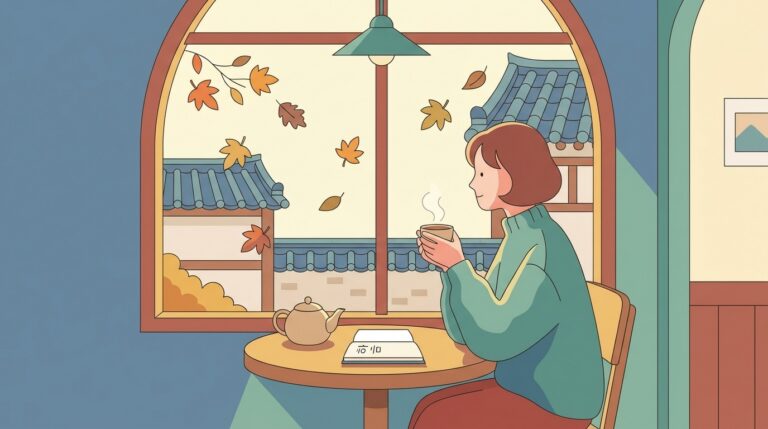
Phase 1: 공감 (Opening Heart to Heart)
안녕하세요! 매일한글 에디터입니다. (Hello! It’s your Daily Hangul editor.)
Have you ever opened your KakaoTalk or messaging app late at night, scrolled through your chat history, and felt a sudden sting in your chest? You see the name of a person who used to be your absolute everything—the one you shared cheap Tteokbokki with after school, gossiped about K-Drama crushes until 3 AM, and promised would be the godparent to your future pets. Yet today, your conversation history has stopped at an awkward “Happy New Year!” sent seven months ago, answered with a generic thumbs-up sticker.
In dramas like Thirty-Nine (서른, 아홉) or My Liberation Notes (나의 해방일지), Korean storytellers often capture this bittersweet reality: growing up often means quietly letting people slip away. In Western culture, we frequently obsess over “closure” or feel guilty when friendships fade, assuming someone must have done something wrong. But in Korea, there is a much gentler, almost poetic perspective on this inevitable rhythm of life.
Today, we are going to explore how native speakers articulate this quiet transition. When one door closes in your social circle, it leaves behind a quiet space—and that void isn’t a failure. It is simply room for someone new whose “texture” matches who you have grown to be. Drawing directly from real classroom reflections and heartfelt feedback from intermediate learners like you, this lesson will guide you through expressing these deep emotions with elegance, maturity, and cultural nuance at the B1 level.
Phase 2: 핵심 표현 3선 심층 분석 (Top 3 Core Expressions)
1. 결이 맞다 (Gyeori matda)
- Pronunciation: [Gyeo-ri mat-da] (Think of gyeo like “gear” with a soft ‘y’ sound, and mat-da sounding like “maht-dah”)
- Meaning: Literal: “The wood grain/texture matches.” | Nuanced: “To be on the exact same wavelength; to share the same temperament and core values.”
- K-Culture Moment: In intimate Korean talk shows like You Quiz on the Block, guests often describe a soulmate or lifelong colleague by saying, “그 친구랑은 처음부터 결이 참 잘 맞았어요” (With that friend, our wavelengths matched right from the beginning).
- Editor’s Insight: Unlike just “having common hobbies” (취미가 같다), 결 (gyeol) refers to the innate texture of one’s personality—how you react to sadness, how softly you speak to servers, or your worldview. When a friendship fades, it is often because your gyeol changed as you matured.
- Situation Spectrum: Casual: ✅ | Semi-formal: ✅ | Formal: ⚠️
- 🤔 Think About It: In your native tongue, do you describe compatibility using physical textures like wood grain? What does this reveal about the Korean sensory way of perceiving relationships?
2. 자연스럽게 멀어지다 (Jayeonseureopge meoreojida)
- Pronunciation: [Ja-yeon-seu-reop-ge meo-reo-ji-da] (Jayeon sounds like “jah-yeon”, meoreojida flows smoothly like water)
- Meaning: Literal: “To naturally become distant.” | Nuanced: “To drift apart without any drama, fight, or bad blood.”
- K-Culture Moment: Frequently heard in slice-of-life melodramas when two former best friends bump into each other on the subway, exchange polite smiles, and later tell their partner, “싸운 건 아닌데, 그냥 자연스럽게 멀어졌어” (We didn’t fight; we just naturally grew apart).
- Editor’s Insight: This is the ultimate “guilt-free” closure phrase. Using “자연스럽게” (naturally) acknowledges that life changes, jobs relocate, priorities shift, and nobody is at fault.
- Situation Spectrum: Casual: ✅ | Semi-formal: ✅ | Formal: ✅
- 🤔 Think About It: Why does Korean culture value framing relationship fade-outs as “natural laws of nature” rather than individual shortcomings?
3. 빈자리가 생기다 (Binjariga saenggida)
- Pronunciation: [Bin-ja-ri-ga saeng-gi-da] (Bin like “been”, jari like “jah-ree”, saeng-gi-da rhymes with “spring-ee-dah”)
- Meaning: Literal: “An empty seat/spot appears.” | Nuanced: “To feel a noticeable void left behind by someone’s departure.”
- K-Culture Moment: Used poignantly in K-pop ballad lyrics and poetry. When a regular at your weekend coffee ritual stops coming, the café table feels strikingly vacant: “그 사람이 떠나고 큰 빈자리가 생겼어요” (A big void was left after that person parted).
- Editor’s Insight: Koreans view human relationships spatial-dynamically. A 빈자리 (empty space) is not just a reminder of loss; it is prerequisite architecture. Without an empty seat at the table, nobody new can pull up a chair.
- Situation Spectrum: Casual: ✅ | Semi-formal: ✅ | Formal: ✅
- 🤔 Think About It: Is emptiness a negative void in your culture, or a welcoming canvas for future possibilities?
Phase 3: 교과서 한국어 vs 진짜 한국어 (Textbook vs. Real-Life Korean)
Situation 1: Explaining why you don’t hang out with an old college buddy anymore
- 📖 교과서 한국어 (Textbook):
“우리는 더 이상 친구가 아닙니다. 만나는 횟수가 줄었습니다.” (Uri-neun deo isang chin-gu-ga animnida. Mannaneun hoessuga jureosseumnida. / “We are no longer friends. The frequency of our meetings has decreased.”) - 🗣️ 진짜 한국어 (Real-Life):
“서로 사는 게 바쁘다 보니까, 그냥 자연스럽게 멀어졌어요.” (Seoro saneun ge bappeuda bonikka, geunyang jayeonseureopge meoreojyeosseoyo. / “Since we’re both busy living our lives, we just naturally drifted apart.”) - 💡 왜 다를까?: Textbook phrasing sounds excessively cold, clinical, and accusatory, almost like declaring a legal termination of friendship. Native Koreans prefer softening statements by citing mutual busyness (사는 게 바빠서), preserving the dignity and fond memories of both parties.
Situation 2: Describing a new friend who instantly clicks with your lifestyle
- 📖 교과서 한국어 (Textbook):
“그 사람은 저와 성격과 취미가 일치합니다.” (Geu sarameun jeowa seonggyeokgwa chwimiga ilchihamnida. / “That person corresponds with my personality and hobbies.”) - 🗣️ 진짜 한국어 (Real-Life):
“그 친구랑은 대화할 때마다 결이 참 잘 맞는다고 느껴요.” (Geu chin-gurang-eun daehwahal ttaemada gyeori cham jal matneundago neukkyeoyo. / “Whenever I talk with that friend, I really feel our vibes and wavelengths match so well.”) - 💡 왜 다를까?: Having identical hobbies doesn’t guarantee a deep emotional bond. Natural Korean conversationalists invoke 결이 맞다 to highlight that subtle, intangible harmony in worldview and emotional rhythm.
Phase 4: K-Culture 딥다이브 & 비언어적 매너 (Deep Dive & Non-Verbal Manners)
4-1. 눈치 (Nunchi) & Somber Respect: Non-Verbal Cues
When discussing relationships that have drifted away, your body language carries just as much weight as your grammar:
* The Bitter-Sweet Smile (씁쓸한 미소 – Sseupsseulhan miso): Never scowl, roll your eyes, or speak with harsh contempt when saying “자연스럽게 멀어졌어요.” A gentle, slightly nostalgic micro-smile conveys emotional maturity and respect for past memories.
* Softened Eye Contact & Gazing Down: Instead of locking intense, confrontational eye contact, native speakers often cast their eyes downward toward their tea or coffee cup while pausing, then look back up when concluding with hopeful resolve.
* The Empathetic Head Tilt: When listening to someone share their grief over a distant friend, tilt your head slightly and issue slow, warm nodding (끄덕임) with muffled comfort syllables like “그렇죠…” (Geureotjyo… / “Indeed…”).
4-2. Cultural Code: The Tapestry of 인연 (In-yeon) and 비움 (Emptying)
In Korean thought—heavily influenced by Buddhist philosophy—relationships are governed by 인연 (In-yeon): karmic destiny or predestined connection. Koreans believe that every human encounter requires thousands of layers of past-life connections.
However, In-yeon is not static; it flows like the Han River. When a relationship reaches the end of its seasonal cycle, forcing it to remain active creates suffering. This aligns with the traditional Korean aesthetic of 여백의 미 (Yeobaek-ui mi – The Beauty of Empty Space) found in Joseon porcelain and ink paintings. By accepting that someone has drifted away, you cultivate a respectful 빈자리 (void). It is precisely into this curated void that new 인연—people whose current 결 matches your evolved self—can gently arrive.
Phase 5: 실전 롤플레이 시나리오 (Real-World Roleplay)
Setting: A warm, rainy evening at a quiet aesthetic café in Yeonnam-dong (연남동). Soft acoustic lofi jazz plays from vintage speakers.
Characters:
* Minji (민지): Your thoughtful 30-something Korean coworker and confidante.
* You (학습자): Opening up about feeling anxious after seeing old friends drift away.
- 민지: “요즘 무슨 고민 있어요? 아까부터 커피만 만지작거리고 있네요.”
(Yojeum museun gomin isseoyo? Kkabuteo keopiman manjijakgeorigo itneyo.)
“Is something on your mind lately? You’ve just been fidgeting with your coffee cup for a while.”
🎭 Gently tilts her head with a caring, warm gaze. -
You: “사실… 예전 제일 친했던 친구한테 오랜만에 연락해 봤는데, 대화가 뚝뚝 끊기더라고요.”
(Sasil… yejeon jeil chinhaetdeon chin-guhante oraenmane yeollakhaebwatneunde, daehwaga ttukttuk kkeun-gideoragoyo.)
“To be honest… I reached out to my former best friend after a long time, but the conversation kept awkwardly stalling.”
🎭 Looking down at the table with a bittersweet sigh. -
민지: “아… 저도 그런 적 많아요. 혹시 무슨 안 좋은 일이라도 있었던 거예요?”
(A… jeodo geureon jeok manayo. Hoksi museun an joeun irirado isseotdeon geoyeyo?)
“Ah… I’ve experienced that a lot too. Did something bad happen between you two?”
🎭 Sets down her teacup with genuine concern. -
You: “아니요, 싸운 건 전혀 아닌데… 그냥 자연스럽게 멀어진 것 같아요.”
(Aniyo, ssaun geon jeonhyeo aninde… geunyang jayeonseureopge meoreojin geot gatayo.)
“No, we didn’t fight at all… It just feels like we naturally drifted apart.”
🎭 Shrugging gently with a quiet smile. -
민지: “나이가 들면 다들 삶의 속도나 방향이 달라지잖아요. 너무 자책하지 마요.”
(Naiga deulmyeon dadeul salm-ui sokdona banghyang-i dallajijanh-ayo. Neomu jachaekhaji mayo.)
“As we get older, everyone’s pace and direction in life change. Don’t blame yourself too much.”
🎭 Nods reassuringly, patting the edge of the table. -
You: “그래도 마음 한구석에 빈자리가 생겨서 그런지 좀 쓸쓸하네요.”
(Geuraedo maeum hanguseoge binjariga saenggyeoseo geureonji jom sseulsseulhaneyo.)
“Still, maybe because an empty space opened up in a corner of my heart, it feels a bit lonely.”
🎭 Softly exhales, meeting Minji’s eyes. -
민지: “그 빈자리는 꼭 슬픈 것만은 아니에요. 그 공간이 있어야 지금의 나와 결이 맞는 새로운 인연이 찾아오거든요.”
(Geu binjarineun kkok seulpeun geommaneun anieyo. Geu gong-gani isseoya jigeum-ui nawa gyeori matneun saeroun in-yeoni chaja-ogeodeunyo.)
“That empty space isn’t necessarily sad. Only when that space exists can a new connection that resonates with who you are today come find you.”
🎭 Offers a serene, uplifting smile. -
You: “듣고 보니 그렇네요. 비워진 만큼 더 좋은 인연으로 채워지겠죠?”
(Deutgo boni geureonneyo. Biwojin mankeum deo joeun in-yeon-euro chaewojigetjyo?)
“Now that you mention it, that’s true. As much as it emptied out, it will be filled with an even better connection, right?”
🎭 Nods with renewed brightness and takes a warm sip of coffee.
🔀 인터랙티브 분기점 (Interactive Choice)
Imagine Minji asks: “그 친구에게 다시 억지로 연락해 볼 생각이에요?” (Are you thinking of forcing another contact with that friend?)
- Option A: “네, 왜 나를 피하는지 따져 묻고 끝내려고요.” (Ne, wae nareul pihaneunji ttajyeo mutgo kkeutnaeryeogoyo. / “Yes, I will interrogate them on why they are avoiding me and end it.”)
- Feedback: [Bad 🚫] Way too aggressive! Demanding answers violates nunchi and burns bridges unnecessarily when friendships simply run their natural course.
- Option B: “아니요, 흘러가는 대로 두고 지금 내 곁의 사람들에게 집중하려고요.” (Aniyo, heulleoganeun daero dugo jigeum nae gyeot-ui saramdeure-ge jipjungharyeogoyo. / “No, I’ll let things flow as they are and focus on the people by my side right now.”)
- Feedback: [Best ✅] Beautiful! This showcases high emotional maturity, perfectly embracing the concept of letting nature take its course while cherishing current in-yeon.
- Option C: “그냥 그 친구 번호 바로 차단하고 인스타도 언팔할래요.” (Geunyang geu chin-gu beonho baro chadanhago inseutado eonpalhallae-yo. / “I’ll just immediately block their number and unfollow their Instagram.”)
- Feedback: [Risk ⚠️] A bit extreme. In Korean social circles, abrupt burning of bridges (손절) over natural drifting can make you seem reactive or petty unless someone explicitly harmed you.
Phase 6: 10초 감정 섀도잉 드릴 (10-Second Emotional Shadowing Drill)
Practice speaking these lines aloud. Focus on the pauses (/) and embody the assigned emotion!
[🥺 아쉽지만 담담하게 / Bittersweet yet calm acceptance]
“싸운 건 아닌데… / 사는 게 바빠서 / 자연스럽게 멀어졌어요.”
(Ssaun geon aninde… / saneun ge bappeoseo / jayeonseureopge meoreojyeosseoyo.)
“We didn’t fight… / but because life got busy / we naturally drifted apart.”-
[☕ 깊은 공감과 위로를 담아 / Deep empathy and warm comfort]
“너무 자책하지 마요. / 누구나 나이가 들면 / 결이 바뀌니까요.”
(Neomu jachaekhaji mayo. / nuguna naiga deulmyeon / gyeori bakkwinikkayo.)
“Don’t blame yourself too much. / As anyone grows older / their life texture changes.” -
[🌱 따뜻한 희망을 품고 / Hopeful, gentle realization]
“비워진 자리에는 / 지금의 나와 / 결이 맞는 사람이 올 거예요.”
(Biwojin jari-eneun / jigeum-ui nawa / gyeori matneun sarami ol geoyeyo.)
“Into that emptied space / someone who matches my wavelength today / will surely come.”
Phase 7: K-Culture 미니 사전 (Mini Dictionary)
-
결 (Gyeol)
- Translation: Texture / Grain / Intrinsic Wavelength
- Usage: Beyond wood or skin texture, modern Koreans use it to describe personality alignment: “그 사람이랑 나는 결이 달라” (He and I have different life frequencies/textures).
- 인연 (In-yeon)
- Translation: Karmic Tie / Predestined Bond
- Usage: Used everywhere from romantic matches to chance meetings with helpful strangers or beloved pets: “우리가 이렇게 만난 것도 다 인연이에요” (Our meeting like this is all thanks to in-yeon).
- 서운하다 (Seounhada)
- Translation: To feel sad, slighted, or emotionally disappointed
- Usage: Used when someone close doesn’t give you the warmth you expected, without entering full anger: “연락이 안 와서 솔직히 조금 서운했어” (I honestly felt a bit slighted because you didn’t contact me).
- 비우다 (Biuda)
- Translation: To empty out / To clear
- Usage: Metaphorically used for emotional decluttering: “마음을 비우다” (to empty one’s expectations/mind) to achieve peace.
Phase 8: 여행자를 위한 생존 키트 (Traveler’s Survival Kit)
Survival Expressions TOP 3
- “요즘 어떻게 지내요?” (Yojeum eotteoke jinaeyo?)
- Meaning: “How have you been doing these days?”
- Pro Tip: The ultimate low-pressure reconnect message on KakaoTalk. Avoids demanding explanations for long silences.
- “언제 시간 맞을 때 밥 한번 먹어요.” (Eonje sigan majeul ttae bap hanbeon meogeoyo.)
- Meaning: “Let’s grab a meal together sometime when our schedules line up.”
- Pro Tip: The famous Korean social lubricant. It leaves the door open without imposing an immediate commitment.
- “인연이 닿으면 또 만나겠죠.” (In-yeoni daeumyeon tto mannagetjyo.)
- Meaning: “If destiny wills it, our paths will cross again.”
- Pro Tip: The most poetic and graceful farewell to use when parting ways with a hostel mate, barista, or fellow traveler in Korea.
Editor’s Travel Note
When feeling overwhelmed by bustling Seoul, take an emotional afternoon stroll along the stone walls of Deoksugung Stonewall Path (덕수궁 돌담길) or the peaceful green benches of Gyeongui Line Book Street (경의선 책거리). To navigate these serene alleys like a local without getting lost, make sure to read our curated guide on 네이버 지도 앱 다운로드.
Phase 9: “한 발 더 깊이” (Deep Reflection: The Porosity of Korean Bonds)
In many Western cultures, a relationship is conceived somewhat like a contract: you invest time, you expect clear reciprocal communication, and silence often feels like a breach. In traditional Korean thought, however, relationships are porous, resembling the wooden veranda (maru – 마루) of a Hanok house. The wooden planks expand in the summer humidity and shrink during winter chills, breathing naturally with the climate.
Friendships in Korea follow the seasons of life. Recognizing that someone has drifted away is not an admission of defeat; it is acknowledging that their season in your life has transitioned from summer to winter. By allowing the leaves to fall without desperately gluing them back onto the branches, you honor what was, and prepare your soil for the fresh blossoms of spring.
💬 Your Turn: Have you ever experienced a friendship naturally drifting apart? How would you explain that feeling using the word 자연스럽게 in the comments below?
Phase 10: FAQ & 오해 방지 (FAQ & Common Mistakes)
Q: Does “결이 맞다” mean you both must agree on all political or lifestyle opinions?
A: Not at all! 결이 맞다 isn’t about ideological clones. It means your underlying temperament, gentleness, emotional tempo, and fundamental ethics feel harmonious. You could have different jobs and music tastes, yet still share the exact same 결.
Q: Is it considered impolite to tell an acquaintance “자연스럽게 멀어졌어요”?
A: Not impolite at all—in fact, it is considered very mature! It signals that you are not speaking ill of someone behind their back (뒷담화). It gracefully protects the other person’s reputation while explaining the situation.
Q: Can “인연” be used for simple platonic friendships, or is it strictly romantic?
A: 인연 applies to all human relationships! You can have an 인연 with your neighborhood convenience store owner, an inspiring teacher, a stray cat that visits your porch, or a friend you met randomly on a KTX train.
🚨 흔한 실수 (Common Mistakes) 경고판
- Mistake: Using “헤어지다” (Heeojida) for platonic friendships drifting apart.
- Why it’s wrong: 헤어지다 in this conversational context strongly implies a romantic breakup or a dramatic falling out.
- Correct Action: Use 자연스럽게 멀어지다 (Naturally grew distant).
- Mistake: Using “손절하다” (Sonjeolhada) casually.
- Why it’s wrong: 손절하다 comes from financial stock trading (“cutting your losses”). Saying you “손절했다” someone implies you aggressively severed ties with a toxic person.
- Correct Action: If it was peaceful, stick to 연락이 뜸해졌어요 (Contact became infrequent).
- Mistake: Saying “성격이 똑같아요” when describing deep soul connections.
- Why it’s wrong: Saying you have the “identical personality” sounds childish and is rarely true.
- Correct Action: Elevate your expression to 결이 잘 맞아요 (Our wavelengths align).
Phase 11: 액션 미션 & 참여 유도 (Action Missions)
- 🥉 Bronze Mission (Solo Practice):
Record a 10-second voice memo on your phone saying: “사는 게 바빠서 자연스럽게 멀어졌지만, 좋은 추억이에요.” (We naturally drifted apart because life was busy, but they are fond memories.) Focus on the bittersweet smile intonation! - 🥈 Silver Mission (Social Media/Journal):
Write a 2-sentence journal entry reflecting on your current friendships using the word 결이 맞다 or 빈자리. - 🥇 Gold Mission (Real-Life Dialogue):
The next time your Korean tutor or language exchange partner asks about an old friend you haven’t seen, respond with: “자연스럽게 멀어졌어요.” - 🎮 K-Culture Discovery Mission:
Listen to the song “To You Who Don’t Love Me Anymore” or slice-of-life K-Drama OSTs and spot if the lyric uses the word 인연 or 빈자리!
Phase 12: 인터랙티브 퀴즈 챌린지 (Quiz Challenge)
1. Situational Judgment
Your Korean friend asks: “그 동창이랑 요즘은 왜 안 만나요?” (Why don’t you meet that classmate these days?) You had no fight, but your paths simply diverged. What is the most culturally graceful response?
* (A) “그 친구 성격이 나빠서 손절했어요.”
* (B) “싸운 건 아닌데, 사는 게 바빠서 자연스럽게 멀어졌어요.”
* (C) “우리는 이제 영원히 친구가 아닙니다.”
2. Fill in the Blank
“처음 만났을 때부터 대화도 편하고 가치관도 비슷해서, 우리는 참 ( )이/가 잘 맞는다고 느꼈어요.”
* (A) 빈자리
* (B) 인연
* (C) 결
3. True / False Cultural Check
- Koreans view the empty space (빈자리) left by an old friend exclusively as a shameful social failure.
- [ True / False ]
👉 정답 확인하기 (Click to View Answers & Explanations)
- Answer: (B)
- Explanation: Option B gracefully explains the divergence without placing blame or generating awkward drama.
- Answer: (C) 결
- Explanation: When sharing similar core values, emotional tempo, and smooth conversations, the phrase is 결이 맞다.
- Answer: False
- Explanation: As explored in the lesson, an empty void (빈자리) is recognized as natural life seasonality and an essential space for new, fitting in-yeon to emerge!
- Explanation: As explored in the lesson, an empty void (빈자리) is recognized as natural life seasonality and an essential space for new, fitting in-yeon to emerge!







