

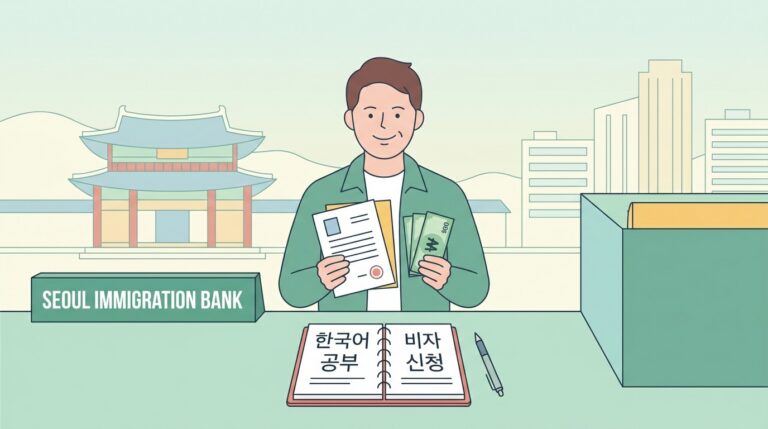
The Ultimate HiKorea Visa Guide: Why Korea’s Cashless Society Demands Cash at Immigration
Phase 1: Empathy (스토리 몰입형 오프닝)
안녕하세요! 매일한글 에디터입니다. (Hello! This is your Daily Hangul editor.)
Picture this: You spent three weeks checking HiKorea every midnight to book an appointment slot. You neatly arranged your passport, certificate of enrollment, lease contract, and application form in a pristine plastic folder. You arrive at the Immigration Office (출입국·외국인관서) thirty minutes early, feeling like a responsible K-drama lead who has their entire life together. You tap your contactless card for your morning iced Americano, you breeze through the subway gates with your smartphone—Korea is, after all, the world capital of contactless payments.
Then, your calling number dings on the LED board. You sit across from the officer. The officer examines your papers, nods approvingly, and slides a piece of paper back to you: “수입인지 사 오셨어요? 현금만 돼요. 지하 은행 다녀오세요.” (Did you buy the government revenue stamp? It’s cash only. Please go downstairs to the bank.)
Panic sets in. Cash? In Seoul? In 2026? You haven’t touched a physical 10,000 KRW bill in six months. Your phone has 15% battery, your appointment number might be cancelled if you take too long, and you have to navigate an automated kiosk and a bank queue with unfamiliar bureaucratic words.
Don’t worry—almost every expat and international student in Korea has stared blankly at an immigration ATM at least once. Today, we’re unlocking the exact phrases, cultural logic, and step-by-step strategies you need so you can breeze through your visa extension like an administrative master.
Phase 2: 핵심 표현 3선 심층 분석 (Top 3 Key Expressions)
1. 수입인지 어디서 사요? (Su-ip-in-ji eo-di-seo sa-yo?)
- Pronunciation: [Su-ip-in-ji eo-di-seo sa-yo?] (Think: “Soo-eep-een-jee uh-dee-suh sah-yo?”)
- Meaning: Literally “Where do I buy the revenue stamp?” / Real Nuance: “Where can I pay the official government visa fee on-site?”
- K-Culture Moment: In office and legal dramas like Stranger (비밀의 숲), civil servants handle stacks of documents with small official blue-and-gold stamp receipts. That stamp is the 수입인지 (revenue stamp)—tangible proof of tax or administrative processing payment.
- Editor’s Insight: 수입 (su-ip) here does not mean “import”; it comes from Hanja 收入 (revenue/income to the state). 인지 (in-ji) means a revenue stamp. Asking this phrase signals immediately to any security guard or guide that you are looking for the dedicated bank window or fee kiosk.
- Situation Spectrum:
- Casual: 🚫 (Do not use with officials)
- Semi-formal: ✅ 수입인지 어디서 사요? (Polite, natural)
- Formal: ✅ 수입인지는 어디에서 구입할 수 있나요? (Polite honorific)
- 🤔 Think About It: In many Western countries, government fees are simply processed on the same desk card reader as a grocery store. Why do you think Korea maintains a separated bank-stamp system for immigration?
2. 현금만 결제 가능해요? (Hyeon-geum-man gyeol-je ga-neung-hae-yo?)
- Pronunciation: [Hyeon-geum-man gyeol-je ga-neung-hae-yo?] (Think: “Hyun-geum-mahn gyul-jeh gah-neung-hae-yo?”)
- Meaning: Literally “Is payment possible only with cash?” / Real Nuance: “Can I really not use a card or mobile pay?”
- K-Culture Moment: You’ll hear this asked by surprised foreigners and locals alike in traditional markets like Mangwon Market (망원시장) or Pojangmacha (포장마차) street food carts, where street tteokbokki tastes best with crisp paper won.
- Editor’s Insight: The particle -만 (-man) means “only.” When attached to 현금 (hyeon-geum), it highlights your surprise while confirming the limitation without sounding confrontational.
- Situation Spectrum:
- Casual: ⚠️ 현금만 돼? (Only with close friends)
- Semi-formal: ✅ 현금만 결제 가능해요? / 현금만 돼요?
- Formal: ✅ 현금 결제만 지원됩니까?
- 🤔 Think About It: Why does a country with 98% card adoption require cash for state revenue stamps? (Hint: Legal stamp duty laws treat stamps as fiscal securities, not retail transactions!)
3. ATM으로 수수료 납부할게요. (Ei-ti-em-eu-ro su-su-ryo nap-bu-hal-ge-yo.)
- Pronunciation: [Ei-ti-em-eu-ro su-su-ryo nap-bu-hal-ge-yo.] (Think: “A-T-M-oo-ro soo-soo-ryo nahp-boo-hahl-geh-yo.”)
- Meaning: Literally “I will pay the fee via ATM.” / Real Nuance: “I’ll handle the fee at the automated machine right away.”
- K-Culture Moment: In modern immigration halls (like Mokdong or Sejongno branch), bank branch lines can take 20 minutes, while ATM kiosks designated exclusively for 전자수입인지 (electronic revenue stamps) take 45 seconds.
- Editor’s Insight: 납부하다 (nap-bu-ha-da) is the formal term for paying duties, taxes, or statutory fees, whereas 내다 (nae-da) is everyday paying. Using 납부할게요 shows a great command of intermediate B1 administrative Korean!
- Situation Spectrum:
- Casual: 🚫 ATM으로 수수료 낼래. (Not suitable for desk staff)
- Semi-formal: ✅ ATM으로 수수료 낼게요.
- Formal: ✅ ATM으로 수수료 납부하겠습니다.
- 🤔 Think About It: How does switching from everyday verbs (내다) to administrative verbs (납부하다) alter how professionals view your fluency?
Phase 3: 교과서 한국어 vs 진짜 한국어 (Textbook vs. Real-Life Korean)
Situation 1: Asking the Desk Officer Where to Pay
- 📖 교과서 한국어 (Textbook):
- 수입인지를 구매할 수 있는 금융기관 창구가 어디에 위치합니까? (Su-ip-in-ji-reul gu-mae-hal su it-neun geum-yung-gi-gwan chang-gu-ga eo-di-e wi-chi-ham-ni-kka? – “Where is the financial institution counter located where I can purchase revenue stamps?”)
- 🗣️ 진짜 한국어 (Real-Life):
- 인지대 어디서 내면 돼요? / 수입인지 어디서 사 와요? (In-ji-dae eo-di-seo nae-myeon dwae-yo? / Su-ip-in-ji eo-di-seo sa wa-yo? – “Where should I pay the stamp fee? / Where do I buy the revenue stamp?”)
- 💡 왜 다를까? (Why the difference?): Koreans rarely say “financial institution counter” (금융기관 창구). They shorten “revenue stamp fee” to 인지대 (in-ji-dae) and use the natural causative pattern -면 돼요? (“is it okay if I do X?”).
Situation 2: Asking if ATM Accepts International Cards
- 📖 교과서 한국어 (Textbook):
- 이 자동화기기에서 해외 발행 신용카드로 결제가 지원됩니까? (I ja-dong-hwa-gi-gi-e-seo hae-oe bal-haeng sin-yong-ka-deu-ro gyeol-je-ga ji-won-doem-ni-kka? – “Is payment supported with an overseas-issued credit card at this automated machine?”)
- 🗣️ 진짜 한국어 (Real-Life):
- 이 기계 해외 카드도 돼요? (I gi-gye hae-oe ka-deu-do dwae-yo? – “Does this machine take foreign cards too?”)
- 💡 왜 다를까? (Why the difference?): In daily conversational Korean, 되다 (doe-da) (“to work / to be acceptable”) replaces complex verbs like 지원되다 (to be supported) or 결제되다 (to be processed).
Phase 4: K-Culture 딥다이브 & 비언어적 매너 (Deep Dive & Body Language)
4-1. 눈치 (Nunchi) & Office Manners
- The Two-Hand Handover: When handing the paper revenue stamp (or the small ATM printed slip) to the immigration officer, always use two hands (두 손) or support your right wrist with your left hand. This subtle gesture changes the entire tone of the counter interaction from transactional to respectful.
- The “Hold My Slot” Eye Contact: If the officer tells you to buy the stamp, don’t just dash away in silence! Look them in the eyes, bow slightly (about 15 degrees), and say: “네! 얼른 사 올 테니 잠깐만 기다려 주세요!” (Yes! I will go buy it quickly, please wait just a moment!). This preserves your turn so they don’t call the next ticket number while you’re at the ATM.
4-2. The Paradox of the Digital Giant: Why Cash Revenue Stamps Still Exist
South Korea ranks consistently near #1 globally in cashless digital transaction ratios. Yet, visit Seoul Southern Immigration (서울출입국·외국인청) or Incheon Immigration, and you will see an in-house Shinhan, Woori, or Hana Bank branch with long lines of people clutching 10,000 won bills.
Under Korean fiscal legislation (the Stamp Tax Act / 인지세법), government revenue stamps are considered statutory instruments representing state revenue rather than retail services. Private credit card processors take a 1.5% to 3% interchange transaction fee—and by law, public administrative tax revenues cannot easily be discounted or shaved down by third-party card processing fees unless specialized municipal portals are arranged. That is why dedicated bank kiosks or ATMs collect physical banknotes inside the building! Knowing this prevents frustration: it isn’t an inconvenience directed at foreign residents; it is rooted in strict public treasury protocol.
Phase 5: 실전 롤플레이 시나리오 (Interactive Roleplay Scenario)
- Setting: Immigration Office 2nd floor, Counter 7.
- Characters:
- Alex (알렉스): An exchange student renewing their D-2 student visa.
- Officer Kang (강 계장님): An experienced, brisk, but helpful immigration officer.
Turn 1
* Officer Kang: 서류 다 확인했습니다. 체류기간 1년 연장 가능하세요. (Seo-ryu da hwa-gin-haet-seum-ni-da. Che-ryu-gi-gan il-nyeon yeon-jang ga-neung-ha-se-yo.)
* English: “I’ve reviewed all your documents. You’re eligible for a 1-year stay extension.”
* 🎭 행동 지문: (Stamps the approval section on the screen and looks up at Alex expectantly.)
Turn 2
* Alex: 감사합니다! 여기서 바로 카드 결제하면 되나요? (Gam-sa-ham-ni-da! Yeo-gi-seo ba-ro ka-deu gyeol-je-ha-myeon doe-na-yo?)
* English: “Thank you! Can I pay by card right here?”
* 🎭 행동 지문: (Pulls out a sleek credit card from their phone wallet.)
Turn 3
* Officer Kang: 아, 수수료는 창구 결제가 안 돼요. 1층 우리은행이나 옆 ATM에서 수입인지 6만 원짜리 사 오셔야 해요. (A, su-su-ryo-neun chang-gu gyeol-je-ga an dwae-yo. Il-cheung U-ri-eun-haeng-i-na yeop ei-ti-em-e-seo su-ip-in-ji yuk-man-won-jja-ri sa o-syeo-ya hae-yo.)
* English: “Ah, fees cannot be paid at the counter. You have to buy a 60,000 KRW revenue stamp at the 1st-floor Woori Bank or the ATM next door.”
* 🎭 행동 지문: (Points with a pen toward the hallway.)
Turn 4
* Alex: 아, 그렇군요! 혹시 ATM에서도 현금만 되나요? (A, geu-reot-gun-yo! Hok-si ei-ti-em-e-seo-do hyeon-geum-man dwae-yo?)
* English: “Oh, I see! By any chance, is the ATM cash-only as well?”
* 🎭 행동 지문: (Tilts head slightly with polite curiosity.)
Turn 5
* Officer Kang: 네, 국내 체크카드가 있으면 계좌이체도 되는데, 해외 카드는 현금 인출만 돼요. 현금 뽑아서 넣으시면 됩니다. (Ne, guk-nae che-keu-ka-deu-ga it-seu-myeon gye-jwa-i-che-do doe-neun-de, hae-oe ka-deu-neun hyeon-geum in-chul-man dwae-yo. Hyeon-geum ppo-ba-seo neo-eu-si-myeon doem-ni-da.)
* English: “Yes, if you have a domestic check card, bank transfers work, but foreign cards can only withdraw cash. You can just withdraw cash and insert it.”
* 🎭 행동 지문: (Hands Alex a yellow temporary pass slip.)
Turn 6
* Alex: 알겠습니다! 지금 바로 1층 가서 인지 사 올게요. 제 번호 지나가나요? (Al-get-seum-ni-da! Ji-geum ba-ro il-cheung ga-seo in-ji sa ol-ge-yo. Je beon-ho ji-na-ga-na-yo?)
* English: “Understood! I’ll go buy the stamp on the 1st floor right now. Will my turn pass?”
* 🎭 행동 지문: (Gathers phone and wallet quickly.)
Turn 7
* Officer Kang: 이 노란색 대기표 가지고 계시다가, 인지 사서 7번 창구로 바로 오세요. 다음 분 부르고 있을게요. (I no-ran-saek dae-gi-pyo ga-ji-go gye-si-da-ga, in-ji sa-seo chil-beon chang-gu-ro ba-ro o-se-yo. Da-eum bun bu-reu-go it-seul-ge-yo.)
* English: “Keep this yellow waiting slip, and once you purchase the stamp, come straight back to Counter 7. I’ll be calling the next person in the meantime.”
* 🎭 행동 지문: (Smiles reassuringly and nods.)
Turn 8
* Alex: 네, 5분 안에 얼른 다녀오겠습니다! 감사합니다! (Ne, o-bun an-e eol-leun da-nyeo-o-get-seum-ni-da! Gam-sa-ham-ni-da!)
* English: “Yes, I’ll be back within 5 minutes! Thank you so much!”
* 🎭 행동 지문: (Bows politely with two hands clasped in front, then walks briskly to the elevator.)
🔀 인터랙티브 분기점 (Branching Decision Point)
At the 1st-floor ATM lobby, there is a line of 4 people at the revenue stamp kiosk. You check your wallet: you only have a 50,000 KRW bill and your foreign debit card, but the fee is 60,000 KRW. What do you say to the bank security assistant standing beside the machine?
- Option A: “저기요, 카드 안 돼요? 빨리 해야 돼요!” (Jeo-gi-yo, ka-deu an dwae-yo? Ppal-li hae-ya dwae-yo! – Hey, cards don’t work? I need to hurry!)
- Option B: “실례합니다, 만 원이 모자란데 해외 카드로 여기서 바로 현금 뽑을 수 있나요?” (Sil-lye-ham-ni-da, man won-i mo-ja-ran-de hae-oe ka-deu-ro yeo-gi-seo ba-ro hyeon-geum ppo-beul su it-na-yo? – Excuse me, I am short 10,000 won. Can I withdraw cash here with a foreign card?)
- Option C: “그냥 옆 사람한테 10,000원 계좌이체 해주고 현금 받을게요.” (Geu-nyang yeop sa-ram-han-te man-won gye-jwa-i-che hae-ju-go hyeon-geum ba-deul-ge-yo. – I’ll just transfer 10,000 won to the person next to me and take cash.)
💡 Branching Feedback
- Option A (Bad): 🚫 Demanding tone and impatient phrasing will stress the assistant. In government branches, staff respond best to composed politeness.
- Option B (Best): ✅ Perfect! Clear, humble, and addresses the exact issue. The assistant will immediately direct you to the dedicated “Global ATM” (글로벌 ATM) machine right next to the stamp kiosk so you can withdraw a 10,000 KRW bill without losing your spot.
- Option C (Risk): ⚠️ Asking total strangers inside a government bank to do informal account transfers can trigger fraud prevention alerts (Voice Phishing / 보이스피싱 paranoia is very high in Korea).
Phase 6: 10초 감정 섀도잉 드릴 (10-Second Emotional Shadowing Drill)
Practice reading these out loud, observing the slash marks (/) for natural breath breaks!
- [😳 당황했지만 공손하게 – Flustered yet polite]
- 아, 현금만 돼요? / 지갑에 5만 원밖에 없는데 / 바로 밑에 은행 다녀와도 될까요?
- (A, hyeon-geum-man dwae-yo? / Ji-gab-e o-man-won-bak-ke eop-neun-de / ba-ro mit-e eun-haeng da-nyeo-wa-do doel-kka-yo?)
- “Ah, is it cash only? / I only have 50,000 won in my wallet… / May I quickly go to the bank downstairs?”
- [🏃♂️ 서두르며 다짐하듯 – Urgently and reassuringly]
- 대기표 가지고 / 5분 안에 / 인지 사서 바로 돌아오겠습니다!
- (Dae-gi-pyo ga-ji-go / o-bun an-e / in-ji sa-seo ba-ro dol-a-o-get-seum-ni-da!)
- “Holding this queue slip, / within 5 minutes, / I’ll buy the stamp and come right back!”
- [😊 안도하며 감사하는 톤 – Relieved and grateful]
- 영수증 여기 있습니다! / 친절하게 기다려 주셔서 / 정말 감사합니다.
- (Yeong-su-jeung yeo-gi it-seum-ni-da! / Chin-jeol-ha-ge gi-da-ryeo ju-syeo-seo / jeong-mal gam-sa-ham-ni-da.)
- “Here is the receipt! / For waiting so kindly, / thank you so much.”
Phase 7: K-Culture 미니 사전 (Core Vocabulary Dictionary)
- 수입인지 (Su-ip-in-ji) | Government Revenue Stamp
- The official physical sticker or barcoded paper certificate issued when paying state-mandated administrative duties. Without this paper clipped to your application, the officer cannot process your new visa sticker or residence card.
- 수수료 (Su-su-ryo) | Service / Administrative Commission Fee
- Distinct from taxes (세금). Visa extensions (연장: typically 60,000 KRW) and alien registration card re-issues (외국인등록증 발급: 30,000 KRW) each carry standardized 수수료.
- 현금 인출기 (Hyeon-geum in-chul-gi) | Cash Dispenser / ATM
- Frequently marked simply as ATM or CD기. Look specifically for “Global ATM” (글로벌 ATM) if your card is issued by Visa, Mastercard, or UnionPay outside Korea.
- 영수증 (Yeong-su-jeung) | Proof of Payment / Official Receipt
- After inserting banknotes into the revenue stamp kiosk, it prints out a small receipt slip. Never discard this; this receipt is your stamp!
Phase 8: 여행자 & 거주자를 위한 생존 키트 (Survival Kit)
서바이벌 표현 TOP 3 (Top 3 Survival Expressions)
- “만원짜리 몇 장 필요해요?” (Man-won-jja-ri myeot jang pil-yo-hae-yo?)
- Meaning: “How many 10,000-won bills do I need?”
- Pro Tip: ATM stamp machines do not accept 5,000 or 1,000 won bills. Always check if you need 30,000 KRW (three 10,000 KRW bills) or 60,000 KRW.
- “글로벌 카드 되는 ATM 어디 있어요?” (Geul-ro-beol ka-deu doe-neun ei-ti-em eo-di it-seo-yo?)
- Meaning: “Where is the ATM that accepts international cards?”
- Pro Tip: Standard domestic ATMs will spit your overseas card out with an error code. Look for machines with multilingual flags.
- “영수증 창구에 바로 갖다 주면 되나요?” (Yeong-su-jeung chang-gu-e ba-ro gat-da ju-myeon doe-na-yo?)
- Meaning: “Can I hand this receipt directly to the counter?”
- Pro Tip: Confirms whether you need to take a fresh waiting ticket or bypass the line.
Editor’s Travel Note: Practical Protocol
- Cash Preparation Rule: Do not rely on the on-site ATM! Immigration office ATMs often run out of cash during peak turnover periods (March and September university intake seasons). Always visit a convenience store ATM and withdraw 100,000 KRW in cash beforehand.
- Essential Navigation: Check your regional jurisdiction branch beforehand using the HiKorea Official Portal Website or search immigration locations through the Naver Map navigation mobile application.
Phase 9: “한 발 더 깊이” (Cultural Reflection Essay)
In South Korea, almost every transaction—from a 700-won candy bar at a self-checkout shop to a high-end luxury handbag in Gangnam—is mediated through NFC, QR codes, and digital ledgers. Yet, inside the hall of the Immigration Bureau, the physical exchange of printed paper stamps and crisp currency remains resolute.
This is not bureaucratic stagnation; it is an enduring reflection of administrative accountability in Korean civic life. The tangible weight of a revenue stamp (수입인지) preserves a physical trace of sovereign administrative record-keeping that predates the internet era. When you hand that small slip across the glass partition with both hands, you are participating in a solemn ritual of mutual contract between a foreign resident and the Republic of Korea.
💬 Your Turn: Have you ever experienced a surprising “cash-only” moment in Korea or your home country despite living in a digital age? Share your story in the comments below!
Phase 10: FAQ & 오해 방지 (FAQ Schema)
Q: Can I pay the immigration revenue stamp fee with KakaoPay, Toss, or Samsung Pay?
A: No. The automated revenue stamp kiosks and bank counters inside Korean immigration branches do not accept domestic mobile wallets (KakaoPay/Toss) or foreign credit cards. You must insert physical Korean Won cash or pay via a domestic Korean bank account card transfer at the kiosk.
Q: Exactly how much cash should I bring to my visa appointment?
A: Standard visa extension fees are usually 60,000 KRW. If you also need a new plastic Alien Registration Card (ARC / 외국인등록증), an additional 30,000 KRW fee applies (or 34,000 KRW if you choose postal delivery). We strongly recommend bringing at least 100,000 KRW in 10,000 KRW banknotes to cover all eventualities.
Q: What should I do if my number ticket gets called while I am down at the bank buying stamps?
A: Do not panic and do not pull a brand-new number ticket! Keep your original number ticket. Return directly to the counter officer who handled your folder, bow slightly, present your stamp receipt, and say: “아까 인지 사 오라고 하셔서 사 왔습니다!” (You told me to buy the stamp earlier, so I bought it!). They will usually process your final step immediately between callers.
🚨 흔한 실수 (Common Mistakes) 경고판
- Mistake: Inserting 50,000 KRW bills when the kiosk requires exact 10,000 KRW increments.
- Correct Action: Exchange 50,000 won bills at the bank counter or kiosk change dispenser before joining the stamp queue.
- Mistake: Throwing away the printed ATM voucher thinking it is merely a trash receipt.
- Correct Action: That printout is your electronic revenue stamp (전자수입인지). Hand it directly to the immigration officer.
- Mistake: Arriving right at 5:30 PM for a late appointment without cash.
- Correct Action: In-office bank branch counters close at 4:00 PM! If you don’t have cash after 4:00 PM and the ATM malfunctions, you will forfeit your entire booking slot.
Phase 11: 액션 미션 & 참여 유도 (Action Missions)
- 🥉 Bronze Mission (Solo Shadowing): Practice saying “수입인지 6만 원짜리 한 장 주세요.” (One 60,000-won revenue stamp, please) 5 times in front of the mirror with two hands held forward.
- 🥈 Silver Mission (Wallet Prep): Check your wallet right now. Put two 50,000 KRW or ten 10,000 KRW bills in an envelope labelled “출입국 비상금 (Immigration Emergency Fund)” alongside your passport.
- 🥇 Gold Mission (Live Action): On your next visit to immigration or a district community office (주민센터), greet the staff with “안녕하세요, 인지 어디서 사면 돼요?” and complete your payment entirely in Korean without switching to English!
- 🎮 K-Culture Mission: Watch Episode 1 of any Korean workplace drama (like Misaeng or Good Manager), and spot how many times characters hand documents over with two hands versus one hand.
Phase 12: 인터랙티브 퀴즈 챌린지 (Interactive Quiz)
Test your knowledge before you head to the immigration office!
Q1. Which of the following payment methods is ALWAYS accepted at the immigration revenue stamp counter/kiosk?
(A) Apple Pay with an overseas Mastercard
(B) Korean Won cash (현금)
(C) Foreign currency cash (USD / EUR)
(D) KakaoPay QR code
🔍 Click here to reveal the answer & explanation!
Correct Answer: (B)
Explanation: Revenue stamp (수입인지) transactions are strictly regulated under national stamp duty acts. Foreign cards, foreign cash, and mobile quick-pay options are not supported directly at the stamp kiosks. Cash in Korean Won is required.
Q2. Complete the blank: “체류자격 연장 수수료는 은행에서 ( ) 사서 제출해야 해요.”
(A) 티머니 (T-money)
(B) 온누리상품권 (Onnuri Gift Certificate)
(C) 수입인지 (Revenue Stamp)
(D) 종량제봉투 (Standard Garbage Bag)
🔍 Click here to reveal the answer & explanation!
Correct Answer: (C)
Explanation: 수입인지 is the official government fee stamp required for immigration administrative procedures like visa extensions.
Q3. [True or False] If you leave your counter for 3 minutes to buy a stamp at the on-site ATM, your entire visa appointment is automatically cancelled and you must make a new HiKorea appointment for next month.
🔍 Click here to reveal the answer & explanation!
Correct Answer: FALSE!
Explanation: Officers routinely direct applicants to the on-site bank counter or kiosk to buy the stamp. As long as you notify them politely (“얼른 사 올게요!”) and hold onto your designated number slip, they will attend to you when you return.







