

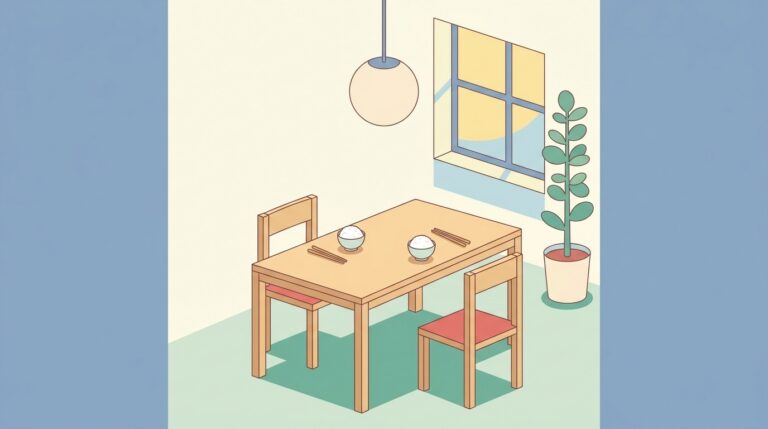
Phase 1: Empathy (Story-Driven Opening)
안녕하세요! 매일한글 에디터입니다. (Annyeonghaseyo! This is your Daily Hangul editor.)
Have you ever watched a cozy scene in a K-drama like Reply 1988 or Hospital Playlist, where friends gather around a table overflowing with steaming stew and side dishes, and wished you knew how to join in naturally? Many of our beginner students tell us they freeze up when visiting a Korean friend’s apartment: “Do I sit on the floor or the chair? What do I call this table? How do I say I am ready to eat without sounding like a textbook robot?”
Talking about everyday rooms and furniture is where true everyday fluency begins. Today, we will guide you through the heart of the Korean home—the dining space. Based on feedback from hundreds of beginner learners at Daily Hangul, mastering just a few simple phrases for sitting at the table and enjoying a meal will instantly make you feel like a welcomed guest rather than an awkward stranger. Let’s make your next Korean mealtime warm, comfortable, and full of confidence!
Phase 2: 3 Core Expressions Deep Dive
1. 식탁에 앉아요 (Siktage anjayo)
- Pronunciation: [Sik-tah-ge an-ja-yo] (Sounds like seek-tah-geh ahn-jah-yo)
- Meaning: Literal: “I sit at the dining table” | Nuance: “I am taking a seat at the table (to get ready to eat).”
- K-Culture Moment: Commonly heard when a family member calls everyone from the kitchen: “식탁에 앉아!” (Sit at the table!).
- Editor’s Insight: In Korean, the particle -에 (-e) indicates the destination or location where your action ends. Remember that 식탁 (siktak) specifically refers to a dining or kitchen table, not a study desk (책상, chaeksang)!
- Situation Spectrum: Casual (✅ with friends) / Semi-formal (✅ with colleagues) / Formal (⚠️ use ‘앉으세요’ or honorifics for elders)
- 🤔 Think About It: In English, you say “sit at the table.” Korean uses “-에 앉다” (sit on/onto the spot). How does thinking about the physical surface change how you visualize your action?
2. 밥을 먹어요 (Babeul meogeoyo)
- Pronunciation: [Ba-beul meo-geo-yo] (Sounds like bah-beul muh-guh-yo)
- Meaning: Literal: “I eat cooked rice” | Nuance: “I am having a meal / Let’s eat!”
- K-Culture Moment: In almost every drama reunion scene, someone warmly asks, “밥 먹었어요?” (Did you eat?), which functions as a heartfelt “How are you?”
- Editor’s Insight: 밥 (Bap) literally means cooked rice, but culturally it stands for an entire meal. Skipping rice still counts as 밥 if it is breakfast, lunch, or dinner!
- Situation Spectrum: Casual (✅) / Semi-formal (✅) / Formal (⚠️ with respected elders, use ‘식사하세요’ or ‘진지 잡수세요’)
- 🤔 Think About It: Why do you think a culture uses the word for its staple grain (rice) to represent the concept of food and well-being as a whole?
3. 의자에 앉으세요 (Uijae anjeuseyo)
- Pronunciation: [Ui-ja-e an-jeu-se-yo] (Sounds like wee-jah-eh ahn-jeuh-seh-yo)
- Meaning: Literal: “Please sit on the chair” | Nuance: “Please have a seat / Make yourself comfortable on this chair.”
- K-Culture Moment: When welcoming guests into a modern Korean apartment dining room, hosts gesture politely toward the dining chairs.
- Editor’s Insight: The ending -(으)세요 [-(eu)seyeo] makes your request polite and warm. It is the gold standard for polite social interactions when inviting someone to do something.
- Situation Spectrum: Casual (🚫 too polite for very close peers) / Semi-formal (✅ perfect for hosts) / Formal (✅ respectful)
- 🤔 Think About It: Polite invitations in Korean often soften verbs into welcoming actions. How does asking someone to sit differ in hospitality across cultures?
Phase 3: Textbook Korean vs. Real Korean
Situation 1: Calling people to the meal
- 📖 교과서 한국어 (Textbook Korean): 식사를 하십시오. (Siksareul hasipsio. – Please partake in the meal.)
- 🗣️ 진짜 한국어 (Real Korean): 밥 먹어요! (Bap meogeoyo! – Let’s eat! / Dinner’s ready!)
- 💡 왜 다를까? (Why is it different?): The textbook phrase is overly rigid and military-like for home life. At home, Koreans keep it warm and casual with “밥 먹어요!”
Situation 2: Asking someone to take a seat at the table
- 📖 교과서 한국어 (Textbook Korean): 식탁으로 이동하십시오. (Siktageuro idonghasipsio. – Please proceed to the dining table.)
- 🗣️ 진짜 한국어 (Real Korean): 여기 앉으세요! (Yeogi anjeuseyo! – Please sit right here!)
- 💡 왜 다를까? (Why is it different?): Nobody says “move towards the dining table” in real life. Pointing gently to a chair and saying “여기 앉으세요!” is both natural and considerate.
Phase 4: K-Culture Deep Dive & Non-Verbal Manners
4-1. 눈치 (Nunchi) & Gestures
When sitting down at a dining table in Korea, meal etiquette begins before the first bite:
* Wait for the eldest: Never sit down first or pick up your spoon before the eldest person at the table sits and touches their utensils.
* Two-Hand Rule: When someone passes you a side dish or water at the table, receive the bowl or cup with both hands (or place your left hand gently under your right wrist) as a subtle sign of respect.
* Chopstick Placement: Never stick your chopsticks upright into a bowl of rice. That mimics ritual incense burners used in ancestral memorial services (제사, jesa).
4-2. Cultural Code Analysis: The Modern Dining Table vs. Floor Bapsang
Historically, Korean homes featured low portable wooden tables called 밥상 (bapsang) where family members sat cross-legged on heated floors (온돌, ondol). Today, most urban Korean apartments boast modern Western-style 식탁 (siktak) with chairs in the kitchen area. However, the cultural feeling of closeness remains identical. Sharing side dishes (반찬, banchan) placed in the center of the table embodies the community spirit known as 정 (Jeong)—the unspoken warmth and connection between people sharing life together.
Phase 5: Real-Life Roleplay Scenario
Setting: You are visiting your Korean friend Minji’s cozy apartment in Mapo-gu, Seoul. Her mother has set a delicious spread on the kitchen table.
- Turn 1 (Minji): 어서 와요! 배고프죠? (Eoseo wayo! Baegopeujyo? – Welcome! You must be hungry, right?)
🎭 Smiling brightly and taking your coat. - Turn 2 (You): 네, 조금 배고파요. 감사합니다! (Ne, jogeum baegopayo. Gamsahamnida! – Yes, a little hungry. Thank you!)
🎭 Bowing politely at 30 degrees. - Turn 3 (Minji’s Mom): 식탁에 앉아서 밥 먹어요. (Siktage anjaseo bap meogeoyo. – Sit at the dining table and let’s eat.)
🎭 Setting down a warm pot of doenjang-jjigae on the trivet. - Turn 4 (You): 네! 식탁에 앉을게요. (Ne! Siktage anjeulgeyo. – Yes! I will sit at the table.)
🎭 Walking gently toward the dining area. - Turn 5 (Minji): 여기 의자에 앉으세요. 편해요. (Yeogi uijae anjeuseyo. Pyeonhaeyo. – Please sit on this chair. It is comfortable.)
🎭 Pulling out a dining chair for you with two hands. - Turn 6 (You): 고마워요, 민지 씨. (Gomawoyo, Minji ssi. – Thank you, Minji.)
🎭 Sitting down comfortably and adjusting your posture. - Turn 7 (Minji’s Mom): 맛있게 먹어요! (Mas-itge meogeoyo! – Eat deliciously!)
🎭 Picking up her spoon first to begin the meal. - Turn 8 (You): 잘 먹겠습니다! (Jal meokkkessumnida! – I will eat well / Thank you for the meal!)
🎭 Clasping hands together briefly in polite gratitude before picking up your spoon.
🔀 Interactive Decision Branch
What should you do right after sitting down on the chair before the meal begins?
- Option A: Pick up your spoon immediately and taste the stew because it smells amazing.
- Option B: Pour water into the cups for Minji and her mother first, and wait for Minji’s mother to lift her spoon.
- Option C: Leave your phone on the middle of the table and start scrolling social media while waiting.
Feedback:
* Choice A (Risk): While your appreciation of the food is sweet, starting before the eldest host breaks etiquette and might startle them!
* Choice B (Best): Perfect! Pouring water for others and waiting for the elder to eat shows top-tier Nunchi and manners.
* Choice C (Bad): Looking at your phone at a Korean dining table signals that you are uninterested in the company and the meal.
Phase 6: 10-Second Emotional Shadowing Drill
Practice matching the rhythm (/) and emotional tone of these everyday dining phrases:
[😊 Welcoming and warm]
식탁에 / 앉아서 / 밥 먹어요!
(Siktage / anjaseo / bap meogeoyo! – Sit at the table and eat!)-
[🤗 Polite and accommodating]
여기 / 편한 의자에 / 앉으세요.
(Yeogi / pyeonhan uijae / anjeuseyo. – Please sit here in this comfy chair.) -
[😋 Excited and grateful]
와, / 정말 맛있겠어요! / 잘 먹겠습니다!
(Wa, / jeongmal mas-itgesseoyo! / Jal meokkkessumnida! – Wow, it looks so delicious! Thank you for the food!)
Phase 7: K-Culture Mini Dictionary
- 식탁 (Siktak) | Dining Table
Usage: The elevated table accompanied by chairs used for meals in kitchens and dining rooms. - 의자 (Uija) | Chair
Usage: Everyday seating furniture. Essential in phrases like “의자에 앉으세요” (Please sit in the chair). - 밥상 (Bapsang) | Traditional Low Dining Table
Usage: Often seen in historical dramas or homestays where diners sit on the floor cushions (방석, bangseok). - 수저 (Sujeo) | Spoon & Chopstick Set
Usage: A portmanteau of 숟가락 (spoon) and 젓가락 (chopsticks). You will often hear: “수저 놔 주세요” (Please set out the spoons and chopsticks).
Phase 8: Survival Kit for Travelers
Top 3 Dining Furniture Survival Expressions
- 의자 자리 있어요? (Uija jari isseoyo?)
Pronunciation: [Ui-ja ja-ri it-sseo-yo?]
Pro Tip: Useful at traditional restaurants that have both floor-seating (좌식, jwasik) and chair-seating (입식, ipsik). Use this if your knees hurt from sitting on the floor! - 식탁 닦아 주세요. (Siktak dakk-a juseyo.)
Pronunciation: [Sik-tak dakk-ah joo-seh-yo]
Pro Tip: If you sit down at a busy street food joint or restaurant and the table needs a quick wipe, use this polite request. - 아기 의자 있어요? (Agi uija isseoyo?)
Pronunciation: [Ah-gi ui-ja it-sseo-yo?]
Pro Tip: Crucial for family travelers asking for a high chair for toddlers.
Editor’s Travel Note
When traveling across Korea, look for restaurants using the official Naver Map app navigation. Many restaurant profiles specifically state whether they offer chair seating (테이블석) or traditional floor seating (좌식), saving you and your joints any surprises!
Phase 9: One Step Deeper (Reflective Insight)
In Korean culture, the dining table is far more than an item of furniture; it is the spiritual anchor of the household. Traditionally, to belong to a family meant being a 식구 (sikgu), which literally translates to “eating mouths”—the people who share meals under one roof. When a Korean invites you to sit at their 식탁 (siktak), they are not just providing calories; they are inviting you into their circle of warmth and intimacy.
💬 Your Turn: Does your culture have a special word for dining furniture or people who eat together? Leave a comment below and share your home traditions with us!
Phase 10: FAQ & Avoiding Misunderstandings
Q: What is the difference between 식탁 (siktak) and 책상 (chaeksang)?
A: 식탁 (Siktak) is composed of the Hanja characters for food (食) and table (卓), meaning dining table. 책상 (Chaeksang) combines book (冊) and table (床), referring specifically to a study desk or office work desk. Do not say “책상에서 밥을 먹어요” unless you are eating alone at your computer desk!
Q: Can I say “밥을 먹어요” if I am eating noodles or bread?
A: Yes! While 밥 (bap) means cooked rice, in daily casual speech “밥 먹었어요?” or “밥 먹자” represents having a meal in general, whether pizza, ramen, or salad.
Q: What should I say before and after sitting down to eat with Koreans?
A: Say 잘 먹겠습니다 (Jal meokkkessumnida) (“I will eat well”) before taking your first bite, and 잘 먹었습니다 (Jal meogeosseumnida) (“I ate well”) when you are done.
🚨 Common Mistakes Alert
- Mistake: Calling all tables 테이블 (te-i-beul).
- Correct Action: While understood in cafes, use 식탁 (siktak) for dining tables and 책상 (chaeksang) for desks in homes.
- Mistake: Sitting down while elderly family members are still standing.
- Correct Action: Stand near your designated chair and sit after the elders have taken their seats.
- Mistake: Using “먹어!” with people older than you.
- Correct Action: Always add polite endings like “드세요 (Deuseyo)” or “맛있게 드세요 (Mas-itge deuseyo)”.
Phase 11: Action Mission & Engagement
- 🥉 Bronze Mission (Solo Practice): Point to your kitchen dining table right now and say aloud 3 times: “식탁에 앉아서 밥을 먹어요!”
- 🥈 Silver Mission (Social Media): Take a photo of your meal today, post it to Instagram or your study journal, and caption it with: “오늘 식탁에서 밥을 먹어요! (Eating at the dining table today!)” Tagging @DailyHangul.
- 🥇 Gold Mission (Real Life Application): Next time you visit a Korean restaurant or eat with Korean friends, volunteer to set the 수저 (sujeo) on the table and politely say “여기 앉으세요!”
🎮 K-Culture Mission: Watch an episode of a Korean drama this week. Count how many times characters gather around either a 식탁 (siktak) or a low 밥상 (bapsang). Notice who sits down first!
Phase 12: Interactive Quiz Challenge
Test your knowledge with these 3 quick checks!
- Situational Check: You are having dinner with your Korean friend’s parents. What phrase should you say right before eating?
- A) 잘 먹었습니다
- B) 잘 먹겠습니다
- C) 책상에 앉아요
- Fill in the Blank: Please choose the right word for a dining table.
- “부엌에 있는 _______에 앉아서 저녁을 먹어요.”
- A) 의자
- B) 침대
- C) 식탁
- True or False: In traditional Korean etiquette, sticking chopsticks straight up into rice is considered good luck.
- True / False
👉 Click to reveal answers and explanations!
-
Answer: B (잘 먹겠습니다)
Explanation: “잘 먹겠습니다” is said before eating to express gratitude for the upcoming meal. “잘 먹었습니다” is said after you finish. -
Answer: C (식탁)
Explanation: 식탁 (siktak) means dining table. 침대 (chimdae) means bed, and 의자 (uija) means chair. -
Answer: False
Explanation: Chopsticks stuck upright into a bowl of rice resemble incense sticks burned for spirits during memorial rites. Always lay your chopsticks flat on a rest or on the side of your plate!







