

Phase 1: 공감 (Story-Driven Opening)
안녕하세요! 매일한글 에디터입니다.
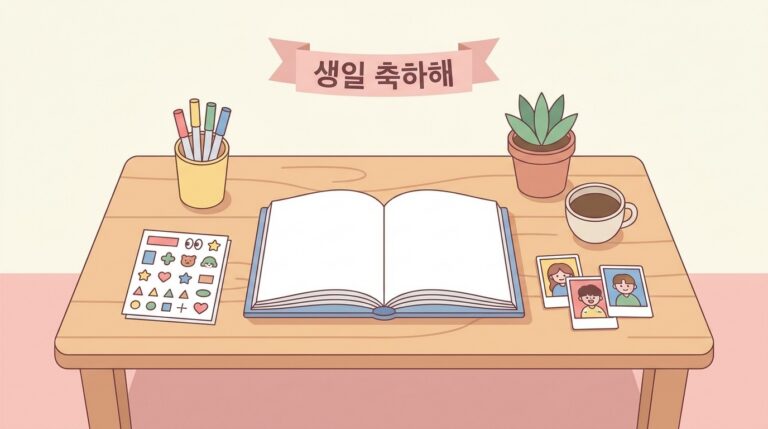
Picture this: You are standing in a vibrant, cup-sleeve decorated cafe tucked away in an alley of Hongdae or Seongsu. The music of your favorite idol fills the air, banners hang from the ceiling, and fans from around the world are smiling together. You’ve grabbed your special beverage, collected the cup sleeve, and tested your luck at the lucky draw (럭키드로우) machine. Then, you spot it in a sunlit corner: a beautifully decorated desk covered with stickers, pastel pens, and a thick, bound book labeled “메시지 북 (Message Book)”.
A handwritten note left by international fans will actually be delivered to your idol’s agency! Your heart races. You sit down, pick up a gel pen, and suddenly your mind goes completely blank. You know how to say “생일 축하해요 (Happy birthday)”, but you want to say something more meaningful, warm, and natural—without sounding like a robotic machine translation or making an awkward honorific slip.
Don’t worry! Leaving a heartfelt message doesn’t require a master’s degree in Korean literature. Today, based on feedback from hundreds of K-pop fan learners in our Daily Hangul community, we will equip you with 3 must-have emotional phrases and cafe manners so you can leave a sweet, memorable note with absolute confidence.
Phase 2: 핵심 표현 3선 심층 분석 (Top 3 Expressions)
1. 태어나 줘서 고마워요 (Tae-eo-na jwo-seo go-ma-wo-yo)
- Pronunciation: Tae-eo-na jwo-seo go-ma-wo-yo (Think of “Tae” like Ted without the ‘d’, and “jwo” like jaw with a quick ‘w’ sound).
- Meaning: Literally “Thank you for giving the act of being born” ➔ “Thank you for being born.”
- K-Culture Moment: This is the golden phrase of K-pop birthday culture! You will see it emblazoned across LED subway ads, handwritten on fan cakes, and trending as Twitter hashtags every time an idol celebrates a birthday.
- Editor’s Insight: While in English saying “Thank you for being born” might sound overly dramatic, in Korean it is the ultimate expression of pure gratitude and unconditional support for someone’s existence.
- Situation Spectrum:
- Casual (to close friends/same-age idols): 태어나 줘서 고마워! (✅)
- Polite/Semi-formal (in message books): 태어나 줘서 고마워요! (✅)
- Formal business settings: (🚫 Inappropriate for formal office settings)
- 🤔 Think About It: In many Western cultures, birthdays celebrate aging or milestones (“Happy 24th!”). Why do you think Korean fans emphasize gratitude toward the idol’s very existence?
2. 늘 응원하고 있어요 (Neul eung-won-ha-go iss-eo-yo)
- Pronunciation: Neul eung-won-ha-go iss-eo-yo (“Neul” rhymes with dull; “eung” sounds like a gentle humming sound ‘ung’).
- Meaning: Literally “I am always doing cheering” ➔ “I am always rooting for you.”
- K-Culture Moment: Celebrities often mention reading this exact sentence during burnout or difficult tour schedules. It delivers a calming, dependable presence rather than demanding anything in return.
- Editor’s Insight: The word 늘 (neul) means “always/constantly” and carries a softer, more poetic emotional texture than the daily conversational word 항상 (hang-sang).
- Situation Spectrum:
- Casual: 늘 응원하고 있어! (✅)
- Semi-formal (Cafe book, Weverse comments): 늘 응원하고 있어요! (✅)
- Formal: 늘 응원하고 있습니다! (✅)
- 🤔 Think About It: Notice how Korean uses the present continuous form (~고 있어요) to emphasize an enduring, unbroken bond between fan and artist.
3. 항상 건강하고 행복하세요 (Hang-sang geon-gang-ha-go haeng-bok-ha-se-yo)
- Pronunciation: Hang-sang geon-gang-ha-go haeng-bok-ha-se-yo (“Geon-gang” sounds like gun-gahng).
- Meaning: “Please always stay healthy and happy.”
- K-Culture Moment: The closing sentence of almost 90% of fan letters! When fans realize how demanding idol schedules are, their biggest wish is simply health and happiness.
- Editor’s Insight: Notice that 행복하세요 is technically treating the descriptive adjective ‘행복하다’ as an imperative verb. While strict prescriptive grammar textbooks frown upon this, native Koreans use it every single day as a heartfelt blessing.
- Situation Spectrum:
- Casual: 항상 건강하고 행복해! (✅)
- Polite standard: 항상 건강하고 행복하세요! (✅)
- Very formal: 항상 건강하시고 행복하시기를 바랍니다. (✅)
- 🤔 Think About It: Why is asking about someone’s physical wellness (건강) considered the deepest form of affection in Korean culture?
Phase 3: 교과서 한국어 vs 진짜 한국어 (Textbook vs. Real Korean)
Situation 1: Wishing happy birthday in a visitor message book
- 📖 교과서 한국어: 당신의 생일을 진심으로 축하드립니다. (Dang-sin-ui saeng-il-eul jin-sim-eu-ro chuk-ha-deu-rim-ni-da.)
- 🗣️ 진짜 한국어: 생일 축하해요! 오늘 세상에서 제일 행복하길! (Saeng-il chuk-ha-hae-yo! O-neul se-sang-e-seo je-il haeng-bok-ha-gil! – “Happy Birthday! Wishing you the happiest day in the whole world!”)
- 💡 왜 다를까?: The textbook pronoun “당신 (dang-sin)” can sound detached, awkward, or even confrontational in modern Korean! Real fans skip the pronoun entirely and end with “~하길 (wishing that…)” for a warm, lyrical vibe.
Situation 2: Telling the organizer you wrote in the message book
- 📖 교과서 한국어: 저는 방명록에 편지를 작성했습니다. (Jeo-neun bang-myeong-rok-e pyeon-ji-reul jak-seong-haess-eum-ni-da.)
- 🗣️ 진짜 한국어: 메시지 북에 짧게 편지 남겼어요! (Me-si-ji buk-e jjalb-ge pyeon-ji nam-gyeoss-eo-yo! – “I left a short letter in the message book!”)
- 💡 왜 다를까?: “방명록 (visitor register)” sounds like signing in at a government conference or a funeral. In modern K-pop spaces, people use the loanword “메시지 북 (message book)” and the natural verb “남기다 (to leave behind)”.
Phase 4: K-Culture 딥다이브 & 비언어적 매너
4-1. 눈치 (Nunchi) & Table Manners at the Message Desk
- The Gel Pen Dry Time Check: Fan message books use glossy paper decorated with photos. Before closing the book or turning the page, wave your hand gently over the ink for 5 seconds. Smudging someone else’s calligraphy is a major faux pas!
- The 3-Minute Rule: You may want to write a novel, but other fans are lining up. If your letter is long, draft it on your smartphone’s memo app first, then neatly copy it into the book in under 3 minutes.
- Capping the Markers: The event organizers (총대) purchase those cute pastel markers with their own fan funds. Always double-click the caps back on so the ink doesn’t dry out.
4-2. Cultural Code: The Evolution of 생카 (Saeng-ka)
An idol birthday cafe is not organized by the entertainment agency; it is 100% crowdfunded and curated by passionate fans known as 홈마 (fansite masters) or 총대 (organizing heads). They rent cafes, design custom paper cup sleeves, order special macaron sets, and bind collected letters into a hardcover book to mail to the idol. Participating in the message book means you are literally co-authoring a piece of your fandom’s collective memory.
Phase 5: 실전 롤플레이 시나리오 (Real-Life Roleplay)
Setting: A cozy cafe in Mapo-gu. Soft indie pop plays. You are standing beside the message book desk, holding a cute photocard.
Characters: You (Fan) & Min-ji (Volunteer Event Organizer wearing an idol badge).
- Min-ji: 안녕하세요! 음료 주문하셨으면 특전이랑 럭키드로우 먼저 안내해 드릴까요? (An-nyeong-ha-se-yo! Eum-ryo ju-mun-ha-syeoss-eu-myeon teuk-jeon-i-rang reok-ki-deu-ro-u meon-jeo an-nae-hae deu-ril-kka-yo?)
🎭 [Holds out a decorated tray with photo cards and stickers]
“Hello! If you ordered your drink, should I guide you to the special perks and lucky draw first?” -
You: 네, 좋아요! 혹시 저쪽에 있는 책에 글 써도 되나요? (Ne, jo-a-yo! Hok-si jeo-jjok-e inn-neun chaek-e geul sseo-do doe-na-yo?)
🎭 [Politely pointing toward the table with two open palms]
“Yes, please! By any chance, may I write something in that book over there?” -
Min-ji: 네, 그럼요! 생일 축하 메시지 북이에요. 편하게 한 페이지 작성해 주세요. (Ne, geu-reom-yo! Saeng-il chuk-ha me-si-ji buk-i-e-yo. Pyeon-ha-ge han pe-i-ji jak-seong-hae ju-se-yo.)
🎭 [Hands you a pastel glitter pen with a warm smile]
“Yes, of course! That’s the birthday message book. Feel free to fill in a page.” -
You: 한국어를 잘 못하는데, 영어로 써도 괜찮을까요? (Han-gug-eo-reul jal mot-ha-neun-de, yeong-eo-ro sseo-do gwaen-chan-eul-kka-yo?)
🎭 [Scratching cheek shyly with an apologetic grin]
“I am not very good at Korean, would it be okay if I write in English?” -
Min-ji: 당연하죠! 마음이 전해지는 게 제일 중요해요. 스티커도 마음껏 쓰세요! (Dang-yeon-ha-jyo! Ma-eum-i jeon-hae-ji-neun ge je-il jung-yo-hae-yo. Seu-ti-keo-do ma-eum-kkeot sseu-se-yo!)
🎭 [Pushes the sticker box closer to you encouragingly]
“Of course! What matters most is sharing your heart. Use as many stickers as you like!” -
You: 와, 감사합니다. 메시지 북에 짧게 편지 남겼어요! (Wa, gam-sa-ham-ni-da. Me-si-ji buk-e jjalb-ge pyeon-ji nam-gyeoss-eo-yo!)
🎭 [Bows head slightly at 15 degrees after placing the pen back]
“Wow, thank you. I left a short letter in the message book!” -
Min-ji: 정성껏 써주셔서 감사해요! 멤버한테 꼭 잘 전달할게요. (Jeong-seong-kkeot sseo-ju-syeo-seo gam-sa-hae-yo! Meom-beo-han-te kkok jal jeon-dal-hal-ge-yo.)
🎭 [Carefully checks that the marker cap is clicked shut]
“Thank you for writing with such love! We will make sure it gets delivered safely to our member.” -
You: 수고 많으세요! 예쁜 이벤트 열어주셔서 고마워요. (Su-go man-eu-se-yo! Ye-ppeun i-ben-teu yeol-eo-ju-syeo-seo go-ma-wo-yo.)
🎭 [Beaming warmly with two hands holding your cafe tray]
“Thank you for your hard work! Thank you for hosting such a lovely event.”
🔀 인터랙티브 분기점 (Interactive Choice)
You sit down with the marker. What will your opening sentence be?
- Option A: “야! 너 생일이지? 축하해!” (Ya! Neo saeng-il-i-ji? Chuk-ha-hae!)
- ❌ Bad: “야 (Ya)” and “너 (Neo)” are very blunt and informal. Even if your idol is younger than you, public fan letters should maintain respectful polite tone (
-해요or-존댓말).
- ❌ Bad: “야 (Ya)” and “너 (Neo)” are very blunt and informal. Even if your idol is younger than you, public fan letters should maintain respectful polite tone (
- Option B: “귀하의 탄신일을 축하하며 번영을 기원합니다.” (Gwi-ha-ui tan-sin-il-eul chuk-ha-ha-myeo beon-yeong-eul gi-won-ham-ni-da.)
- ⚠️ Risk: This sounds like an official telegram from the Prime Minister! While grammatically correct, it lacks personal emotional warmth.
- Option C: “생일 축하해요! 태어나 줘서 정말 고마워요.” (Saeng-il chuk-ha-hae-yo! Tae-eo-na jwo-seo jeong-mal go-ma-wo-yo.)
- 🏆 Best: Polite, heartfelt, natural, and hits the emotional core of K-pop fan culture!
Phase 6: 10초 감정 섀도잉 드릴 (Shadowing Drill)
Practice these lines out loud with the emotional rhythm markers (/ = brief pause):
[😊 밝고 진심 어린 목소리로]
생일 축하해요! / 태어나 줘서 / 정말 고마워요.
(Saeng-il chuk-ha-hae-yo! / Tae-eo-na jwo-seo / jeong-mal go-ma-wo-yo.)-
[✨ 든든하고 다정한 어조로]
언제 어디서나 / 늘 응원하고 있어요.
(Eon-je eo-di-seo-na / neul eung-won-ha-go iss-eo-yo.) -
[🥺 애정 어린 간절함으로]
아프지 말고, / 항상 건강하고 / 행복하세요!
(A-peu-ji mal-go, / hang-sang geon-gang-ha-go / haeng-bok-ha-se-yo!)
Phase 7: K-Culture 미니 사전 (4 Key Terms)
- 생카 (Saeng-ka) | Idol Birthday Cafe
- Short for “생일 카페 (Saeng-il Ka-pe)”. Refers to cafes leased by fans to celebrate an idol or actor’s birthday with decorations and exclusive fan-made merchandise.
- 럭키드로우 (Reok-ki-deu-ro-u) | Lucky Draw
- Often shortened to ‘럭드 (Reok-deu)’. A scratch card or coin machine at the cafe counter where every draw wins a tiered prize (e.g., sticker sheet, acrylic keyring, rare photocard).
- 메시지 북 (Me-si-ji Buk) | Fan Message Book
- A physical scrapbook or guestbook provided at the event where visitors write personal notes, later assembled and shipped directly to the idol’s entertainment agency.
- 총대 (Chong-dae) | Fan Event Organizer
- Originates from the idiom “총대를 메다” (to take the lead / shoulder responsibility). Refers to the dedicated head fan who spends months planning the cafe event.
Phase 8: 여행자를 위한 생존 키트 (Traveler’s Survival Kit)
Survival Expressions TOP 3
- 메시지 북 어디에 있어요? (Me-si-ji buk eo-di-e iss-eo-yo?)
- Meaning: “Where is the message book?”
- Pro Tip: Useful if the cafe is crowded and the writing desk is tucked into a corner.
- 펜 빌려도 될까요? (Pen bil-lyeo-do doel-kka-yo?)
- Meaning: “May I borrow a pen?”
- Pro Tip: Say this to nearby fans when the desk markers are occupied. K-pop fans will happily share their stationery!
- 스티커 써도 돼요? (Seu-ti-keo sseo-do dwae-yo?)
- Meaning: “Can I use these stickers?”
- Pro Tip: Always ask before using deco stickers on the table, as some are free for all while others might belong to an individual fan’s pencil case.
Editor’s Travel Note
Before embarking on your tour, verify cafe schedules on social media (specifically X/Twitter using hashtags like #아이돌이름_생일카페). Don’t rely solely on Google Maps in Korea; instead, install the 네이버 지도 앱 다운로드 to search cafe addresses down to the exact basement or second-floor doorway.
Phase 9: “한 발 더 깊이” (Cultural Essay)
In many global pop cultures, the boundary between celebrity and fan remains formal and distant. However, Korean fandom culture is powered by 정 (Jeong)—a deep, communal affection that grows through shared emotional investment. When fans gather at a birthday cafe to write in a message book, they aren’t treating the star as an untouchable commodity, but as someone whose youth, struggles, and triumphs they walk beside. Leaving a handwritten note is a quiet declaration: “In this bustling metropolis, your existence brought joy to my ordinary days, and I wish the same joy for you.”
💬 Your Turn: Have you ever written a fan letter or attended an idol cafe in Korea? What is the one word you would want your favorite artist to read? Share your thoughts in the comments below!
Phase 10: FAQ & 오해 방지 (FAQ & Common Mistakes)
Q: Can I write in English if my Korean handwriting or grammar isn’t perfect?
A: Absolutely! Most idols study foreign languages to communicate with international fans and treasure handwritten English, Japanese, or Spanish notes. A great formula is writing one short opening greeting in Korean (like 태어나 줘서 고마워요!) and following it with your native language.
Q: What should I avoid writing in a public message book?
A: Avoid private contact information (phone numbers, personal SNS handles), overly possessive romantic declarations (“You belong to me only”), or gossip about other members. Keep the focus entirely on cheering for their dreams and wellness.
Q: Is there an extra fee to write in the message book?
A: No! The message book is free for anyone who purchases a beverage or event set at the cafe. You do not need to pay extra to use the pens, stickers, or message pages.
🚨 흔한 실수 (Common Mistakes) 경고판
- Mistake: Addressing the idol as “당신 (Dang-sin)”.
- Correct Action: Refer to them by name with a polite honorific (e.g., 민우 님 (Min-woo nim)) or simply drop the pronoun altogether.
- Mistake: Writing in extreme banmal (반말) like “야, 밥 잘 먹어라!”.
- Correct Action: Use standard polite language (해요체). Write “밥 잘 챙겨 먹어요! (Make sure to eat well!)” to sound caring without crossing etiquette boundaries.
- Mistake: Taking the sticker sheets or pens from the message table as personal souvenirs.
- Correct Action: Only take designated freebies (나눔/무나) placed in open baskets labeled “자유롭게 가져가세요 (Feel free to take)”. Table stationery belongs to the community.
Phase 11: 액션 미션 & 참여 유도 (Action Missions)
- 🥉 Bronze Mission: Write the phrase “태어나 줘서 고마워요! (Thank you for being born!)” on a post-it note right now and place it on your study desk.
- 🥈 Silver Mission: Leave a warm comment on your favorite artist’s latest Instagram or Weverse post using “늘 응원하고 있어요! (I’m always rooting for you!)”.
- 🥇 Gold Mission: Next time you visit a Saeng-ka in Korea, comfortably ask the staff “메시지 북 어디에 있어요?” and leave a 2-sentence note in Korean!
🎮 K-Culture Mission: Watch a birthday celebration YouTube Live or Weverse Live of any K-pop star. Listen closely: within the first 10 minutes, can you spot how many times the idol reads the comment “태어나 줘서 고마워요” from the chat?
Phase 12: 인터랙티브 퀴즈 챌린지 (Interactive Quiz)
Q1. Situational Judgment: You are sitting at the message table and want to wish your bias good health. Which sentence is the most natural for an A2 learner?
* (A) 당신은 매일 병원에 가세요.
* (B) 항상 건강하고 행복하세요!
* (C) 아프면 안 되는 것을 명령합니다.
Q2. Fill in the Blank: Complete this beloved birthday phrase:
* “________ 줘서 고마워요!” (Hint: “Thank you for being born!”)
Q3. True or False:
* The organizers of an idol birthday cafe are official employees of the idol’s entertainment agency. (True / False)
👉 Click to reveal answers & explanations!
- A1 Answer: (B) 항상 건강하고 행복하세요!
- Explanation: (A) literally commands them to go to a hospital daily, and (C) commands them not to be sick like a military officer! (B) is the universally loved warm blessing.
- A2 Answer: 태어나 (Tae-eo-na)
- Explanation: “태어나다” means to be born. Combined with “~어 주다” (to do something as a favor/grace), it becomes “태어나 줘서 고마워요”.
- A3 Answer: False
- Explanation: Saeng-ka events are planned, paid for, and organized independently by passionate fans (총대/홈마), not entertainment companies!
- Explanation: Saeng-ka events are planned, paid for, and organized independently by passionate fans (총대/홈마), not entertainment companies!







