

Entering a Korean Restaurant: Do I Take Off My Shoes to Enter?
Phase 1: Empathy (Story-Driven Opening)
안녕하세요! 매일한글 에디터입니다. (Hello! I’m the editor of Daily Hangul.)
Picture this: After walking 15,000 steps through the historic alleys of Bukchon Hanok Village, your stomach begins to rumble. You spot an inviting neighborhood restaurant with steaming pots of Kimchi-jjigae and glowing warm light. You slide open the glass door, ready to devour a delicious meal, but suddenly freeze right at the doorstep.
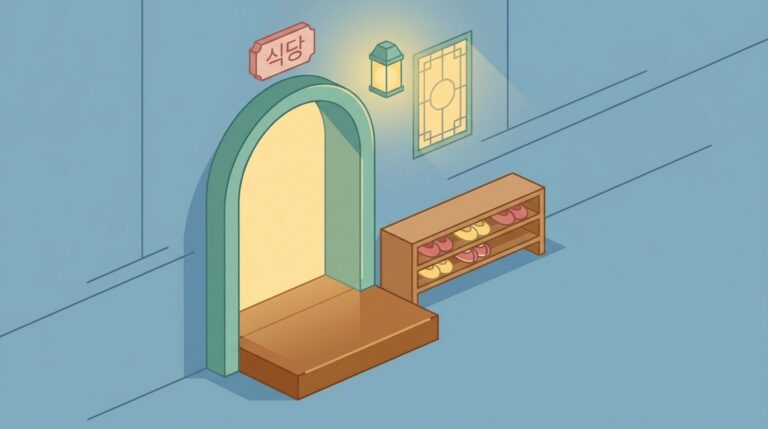
Ahead of you lies a raised polished wooden platform. You see rows of chairs and tables, yet there is a wooden cabinet by the entryway with pairs of sneakers tucked inside. A diner walks past wearing bright yellow socks. Your brain instantly enters emergency mode: Wait, there are regular tables with chairs, but do I take off my shoes? Do I keep them on? What if I step on this floor with dusty sneakers and everyone gasps?!
Take a deep breath! As someone who has coached hundreds of beginner learners navigating their very first trips to South Korea, I can reassure you that this exact “shoe freeze” is the #1 most common dining panic. Korean dining layouts can be delightfully confusing, blending ancient floor traditions with modern convenience. Master this one simple phrase today, and you will walk into any eatery with effortless confidence!
Phase 2: Top 3 Core Expressions
1. 신발 벗고 들어가요? (Sinbal beotgo deureogayo?)
- Pronunciation: Sin-bal beot-go deu-reo-ga-yo? (Sounds like: Seen-bahl buht-go doo-ruh-gah-yo?)
- Meaning: Literal: “Do I take off shoes and enter?” | Real Nuance: “Should I take off my shoes before going in?”
- K-Culture Moment: Seen in hit slice-of-life dramas like Hospital Playlist, where the doctors arrive at a rustic kalguksu (noodle) restaurant and pause at the doorstep to check with the owner.
- Editor’s Insight: This is your golden A1 survival key. The grammar pattern -고 connects two actions (“take off” AND “enter”), sounding polite and natural.
- Situation Spectrum: Casual ⚠️ | Semi-formal ✅ | Formal ✅
- 🤔 Think About It: In many Western homes, shoes stay on even inside. Why does Korean culture treat crossing a restaurant threshold like entering a private, clean living room?
2. 신발 신어요? (Sinbal sineoyo?)
- Pronunciation: Sin-bal sin-eo-yo? (Sounds like: Seen-bahl sheen-uh-yo?)
- Meaning: Literal: “Wear shoes?” | Real Nuance: “Can I keep my shoes on?”
- K-Culture Moment: Stepping into a newly remodeled retro café in Ikseon-dong where the floors look like vintage hanok wood, but patrons are actually keeping their boots on.
- Editor’s Insight: When your mind goes completely blank from hunger or jet lag, this two-word shortcut paired with a questioning inflection gets the job done instantly!
- Situation Spectrum: Casual ⚠️ | Semi-formal ✅ | Formal ⚠️
- 🤔 Think About It: In Korean, the verb for “wearing” footwear (신다, sinda) is completely different from wearing clothes (입다, ipda) or hats (쓰다, sseuda). Precision matters!
3. 그냥 들어가면 돼요? (Geunyang deureogamyeon dwaeyo?)
- Pronunciation: Geu-nyang deu-reo-ga-myeon dwae-yo? (Sounds like: Goo-nyahng doo-ruh-gah-myuhn dway-yo?)
- Meaning: Literal: “Is it okay if I just go in?” | Real Nuance: “Can I just walk straight in as I am?”
- K-Culture Moment: Entering a busy lunch-rush soup diner where the owner enthusiastically waves you toward a table from across the room.
- Editor’s Insight: The word 그냥 (geunyang = just / as is) is a conversational powerhouse in Korea. Combining it with ~면 돼요? creates an instant polite inquiry.
- Situation Spectrum: Casual ⚠️ | Semi-formal ✅ | Formal ✅
- 🤔 Think About It: Rather than asking for rigid permission (“May I enter?”), Koreans ask if the action is “convenient/okay” (돼요?), reflecting a focus on communal harmony.
Phase 3: Textbook Korean vs. Real Korean
Situation 1: Asking if shoes must be removed
- 📖 교과서 한국어: 신발을 벗어야 합니까? (Sinbaleul beoseoya hamnikka?)
- 🗣️ 진짜 한국어: 신발 벗어요? (Sinbal beoseoyo?)
- 💡 왜 다를까?: Textbook formal forms like -합니까 sound stiff, almost like a military inspection or a courtroom hearing! Real everyday Korean at cozy restaurants uses friendly -요 with omitted particles (을/를).
Situation 2: Asking where to place your footwear
- 📖 교과서 한국어: 신발을 신발장에 보관해야 합니까? (Sinbaleul sinbaljange bogwanhaeya hamnikka?)
- 🗣️ 진짜 한국어: 신발 여기 둬요? (Sinbal yeogi dwoyo?)
- 💡 왜 다를까?: The textbook word 보관하다 (to store in official custody) sounds like a banking deposit. Real locals simply point to a shelf and use 두다 (to place/leave).
Phase 4: K-Culture Deep Dive & Non-Verbal Manners
4-1. 눈치 (Nunchi) & Gestures
Before opening your mouth, activate your dining Nunchi (quick social situational awareness):
1. The Floor Step (턱, teok): If there is a raised step between the door and the tables, that is a red alert that shoes likely come off.
2. Hand Gesture: If you are unsure, pause below the step. Point gently toward your shoes using an open palm with your fingers together (never point with an aggressive single index finger at staff!) and make polite eye contact.
3. Slipper Detection: Look down near the step. If you see neat pairs of plastic or rubber slippers waiting, those are for indoor wear.
4-2. Cultural Code: The Ondol Legacy
Why do Koreans take their shoes off even in restaurants with modern chairs? It all traces back to 온돌 (Ondol), Korea’s thousand-year-old underfloor heating system. Traditionally, Korean life took place on heated floors: people ate, socialized, and slept directly on pristine oiled-paper surfaces (장판, jangpan).
In recent years, many traditional soup and BBQ joints replaced low floor tables (좌식, jwasik) with tables and chairs (입식, ipsik) to help elderly diners with knee pain. However, the cultural reverence for floor cleanliness stayed intact! Walking on dining room floors with outside street shoes feels culturally equivalent to stomping muddy boots across someone’s bedsheet.
Phase 5: Real-World Roleplay Scenario
Setting: A fragrant Gamjatang (pork backbone stew) restaurant in an alley near Euljiro, Seoul. Rain is drizzling outside.
Characters: You (Curious foodie) & Imo-nim (The friendly restaurant auntie).
- Imo-nim: 어서 오세요! 몇 분이세요? (Eoseo oseyo! Myeot bun-iseyo?)
Welcome! How many people in your party?
🎭 [Wiping down a clean table with a welcoming grin] - You: 안녕하세요! 두 명이요. (Annyeonghaseyo! Du myeong-iyo.)
Hello! Table for two, please.
🎭 [Politely holding up two fingers near your chest] - Imo-nim: 네, 안쪽 자리로 들어가세요! (Ne, anjjok jariro deureogaseyo!)
Sure, head right inside to that back table!
🎭 [Gesturing toward a raised platform with wooden tables] - You: 저기… 신발 벗고 들어가요? (Jeogi… sinbal beotgo deureogayo?)
Excuse me… do I take off my shoes to enter?
🎭 [Pausing cautiously right in front of the raised wooden step] - Imo-nim: 네! 신발 벗고 신발장에 넣어주세요. (Ne! Sinbal beotgo sinbaljange neoeojuseyo.)
Yes! Take off your shoes and put them into the shoe rack, please.
🎭 [Pointing toward the open wooden cubbies on the side] - You: 아, 신발 여기 둬요? 감사합니다! (A, sinbal yeogi dwoyo? Gamsahamnida!)
Ah, I put my shoes here? Thank you!
🎭 [Neatly placing your sneakers into an open shelf] - Imo-nim: 그래요, 편한 자리에 앉아요! (Geuraeyo, pyeonhan jarie anjayo!)
That’s it! Take any comfortable seat!
🎭 [Handing you cold water and menus with a satisfied nod] - You: 네, 감사합니다! (Ne, gamsahamnida!)
Yes, thank you!
🎭 [Stepping onto the platform in your socks with a relieved smile]
🔀 Interactive Branching Point
You have taken off your expensive white sneakers. Where do you put them?
- Option A: Leave them sitting right in the center of the walkway because you want to sit down immediately.
👉 Feedback [Bad]: High risk! Other guests will trip over them, and busy waitstaff carrying boiling hot stone pots could stumble. Always clear the path! - Option B: Slide them neatly into an open cubby of the shoe rack (신발장), or use a locker with a key if provided.
👉 Feedback [Best]: Flawless manners! This keeps the entryway organized and prevents your shoes from accidentally being kicked or swapped. - Option C: Change your mind, keep your shoes on, and quickly walk to the table hoping nobody cares.
👉 Feedback [Risk]: Cultural disaster! Imo-nim will shout “손님, 신발 벗으세요!” (Customer, take your shoes off!) from across the dining room, leaving you blushing in front of everyone.
Phase 6: 10-Second Emotion Shadowing Drill
Practice matching the exact rhythm and feeling of native speakers using pause breaks (/):
- [🤔 Hesitant & Inquiring]
저기요… / 신발 / 벗고 들어가요?
(Jeogiyo… / sinbal / beotgo deureogayo?) -
[💡 Relieved & Clarifying]
아! / 그냥 / 신고 들어가면 돼요?
(A! / geunyang / sin-go deureogamyeon dwaeyo?) -
[😊 Cheerful & Respectful]
네! / 신발장에 / 예쁘게 넣을게요!
(Ne! / sinbaljange / yeppeuge neoeulgeyo!)
Phase 7: K-Culture Mini Dictionary
- 신발장 (Sinbaljang) | Shoe rack / Shoe cabinet
The wooden shelving unit located right at the entrance. In higher-end or crowded traditional eateries, these cubbies often feature individual locks with numbered plastic wristbands. - 좌식 (Jwasik) | Floor seating
The traditional dining style where you sit cross-legged on floor cushions (방석, bangseok). While becoming rarer, it is still common in classic Korean barbecue and braised dish spots. - 입식 (Ipsik) | Table and chair seating
Standard Western-style elevated tables and chairs. Remember: many Korean restaurants feature 입식 furniture while still enforcing a strict “shoes-off” policy! - 이모님 (Imo-nim) | “Auntie” (Affectionate staff title)
Literally meaning “maternal aunt,” this warm, respectful title is used to call middle-aged female restaurant staff instead of the cold, robotic “저기요” (excuse me).
Phase 8: Traveler’s Survival Kit
Top 3 Survival Phrases
- 몇 분이세요? (Myeot bun-iseyo?) — How many people in your party?
Pro Tip: Always answer by holding up fingers while speaking (e.g., holding up two fingers while saying “두 명이요”) to avoid confusion during loud dining hours. - 두 명이요 (Du myeong-iyo) — Two people, please.
Pro Tip: For solo travelers, say 혼자예요 (Honjayeyo) or 한 명이요 (Han myeong-iyo). - 슬리퍼 있어요? (Seullipeo isseoyo?) — Do you have slippers?
Pro Tip: Useful if you feel cold on wooden floors or need to step into the restroom without lacing your shoes back up.
Editor’s Travel Note
- Sock Etiquette: Always make sure your socks are clean and hole-free when traveling in Korea! Pack slip-on shoes (loafers or laceless sneakers) on days when you plan to visit traditional foodie alleys.
- Tech Tip: Before picking a spot, download the [Naver Map app for restaurant reviews] and glance through user interior photos to check whether the restaurant is 좌식 (floor seating) or 입식 (table seating).
Phase 9: “One Step Deeper” (Cultural Reflection)
In Korean architecture, the threshold (문턱, munteok) is far more than wood and nails—it represents a spiritual boundary between the chaotic, dusty outside world and the clean, safe interior sanctuary. Removing your footwear before stepping across this line is an act of trust and communal respect. By taking off your shoes, you symbolically shed the grime of the street and agree to treat the public dining area with the exact same purity you would afford a private family living room.
💬 Your Turn: Have you ever visited a home or restaurant where you were asked to remove your shoes? How did it feel compared to keeping them on? Let me know in the comments below!
Phase 10: FAQ & Common Mistakes
Q: What should I do if I am wearing sandals with bare feet?
A: Many restaurants provide communal indoor slippers (실내화, silnae-hwa) right beside the shoe rack. However, if bare skin on shared floors makes you uncomfortable, keep a lightweight pair of ankle socks inside your day backpack during your travels.
Q: How do I know for sure if a restaurant wants shoes off if no staff is standing by?
A: Look at the floor level! If there is a raised step (typically 5 to 15 centimeters high) and you spot a shoe rack with other customers’ footwear, it is 100% a shoes-off space. If the floor is unbroken tile or concrete flush with the street, keep your shoes on.
Q: Do I need to turn my shoes around facing outward when taking them off?
A: In traditional Korean homes, turning your shoes around so the toes point toward the outside door is considered polite because it makes leaving seamless. While older Koreans still do this, modern restaurant cubbies just require you to place them safely inside a slot.
🚨 Common Mistakes (경고판)
- Mistake 1: Stepping on the wooden threshold (문턱, munteok).
Correct Action: In traditional belief, stepping directly on the threshold brings bad luck and damages the wood seal. Always step cleanly over the raised wooden border. - Mistake 2: Leaving expensive boots in open floor piles.
Correct Action: If you are wearing expensive limited-edition sneakers, ask staff for a shoe bag (비닐봉지, binil-bongji) or place them in a lockable cubby so they don’t get mixed up. - Mistake 3: Wearing bathroom slippers back into the dining room.
Correct Action: Korean restaurant restrooms have dedicated wet-rubber slippers inside the stall. Never wear these out into the main dining area!
Phase 11: Action Missions & Engagement
- 🥉 Bronze Mission (Solo Practice): Stand at your bedroom doorway, pause, and practice saying out loud: “신발 벗고 들어가요?” (Sinbal beotgo deureogayo?) 3 times until the rhythm feels smooth.
- 🥈 Silver Mission (Social Share): Snap a quick photo of your favorite comfy travel socks and post it on your social media with the caption: “Ready for Korean dining! 신발 벗고 들어가요? #DailyHangul”
- 🥇 Gold Mission (Real World): Visit an authentic Korean restaurant or K-Town eatery in your area and ask the server today’s question before taking your seat!
- 🎮 K-Culture Mission: In the next K-Drama episode you watch, watch carefully when characters enter a home or local soup shop. Count how many seconds it takes them to slip out of their shoes!
Phase 12: Interactive Quiz Challenge
1. Situational Judgment:
You enter a restaurant and see tables with chairs. However, there is a 10cm raised wooden platform and an open shoe rack with shoes inside. What do you say to the server?
(A) 신발 신어요? (Sinbal sineoyo?)
(B) 신발 벗고 들어가요? (Sinbal beotgo deureogayo?)
(C) 안녕! (Annyeong!)
2. Fill-in-the-Blank:
Complete the polite inquiry:
“신발 ______ 들어가요?”
(A) 먹고 (meokgo)
(B) 입고 (ipgo)
(C) 벗고 (beotgo)
3. True or False:
In Korea, it is considered polite to step firmly on the wooden threshold (문턱) while walking into a dining area.
(A) True
(B) False
Click here for answers and explanations!
- Answer: (B) 신발 벗고 들어가요? (Sinbal beotgo deureogayo?)
Explanation: Even with chairs present, the raised platform and shoe rack indicate that footwear must come off. Asking (B) confirms polite awareness! - Answer: (C) 벗고 (beotgo)
Explanation: 벗다 (beotda) is the specific verb for removing clothing and footwear. - Answer: (B) False
Explanation: You should always step over the threshold (문턱), never directly on top of it!







