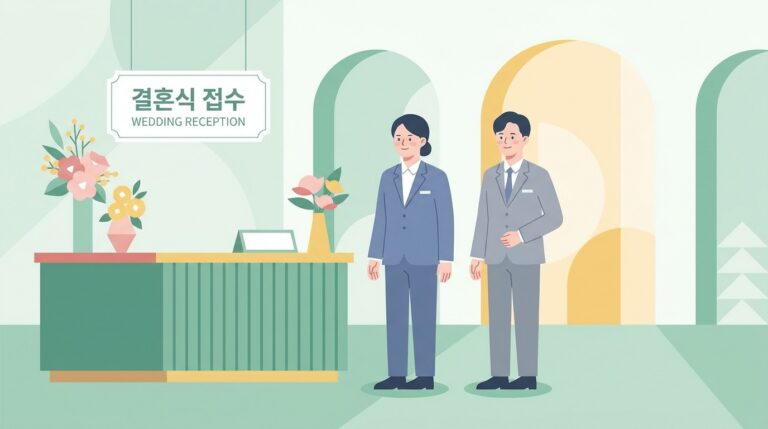
Phase 1: Empathy & Storytelling Opening
안녕하세요! 매일한글 에디터입니다. (Annyeonghaseyo! I’m the editor from Daily Hangul.)
Have you ever received a delicate mobile wedding invitation (cheongcheopjang) from a Korean coworker or friend and immediately felt a wave of gentle panic? You stare at your closet wondering: Is this dress too bright? Is white really completely forbidden? And why does everyone tell me to show up a whole 30 minutes before the ceremony even starts?!
If you have ever watched K-dramas like Crash Landing on You or Business Proposal, you know that a Korean wedding hall lobby can feel like an elegant, high-speed runway. Family, coworkers, and old university buddies mingle, exchange crisp envelopes, and take photos. It looks dazzling, but when you are attending your first wedding as a guest, the unspoken rules can feel intimidating.
Don’t worry! Arriving 30 minutes early in a neat jacket or dress is the ultimate secret code to being an adored wedding guest in Korea. This guide is crafted from real learner questions and hands-on experience to help you navigate outfits, envelope etiquette, and the legendary wedding buffet with total confidence!
Phase 2: Core Expressions Deep Dive
1. 단정하게 입고 왔어요 (Danjeong-hage ipgo wasseoyo)
- Pronunciation: [Dahn-jeong-hah-geh eep-goh wah-sseo-yo] (Think: “Dahn” rhyming with dawn, “jeong” rhyming with song, and “eep” like beep)
- Meaning: Literal: “I came dressed neatly.” / Real Nuance: “I made sure to dress respectfully and appropriately for your special day.”
- K-Culture Moment: You’ll hear this when colleagues spot each other at the reception foyer: “오늘 다들 단정하게 입고 왔네요!” (Everyone dressed so neatly today!)
- Editor’s Insight: The word 단정하다 (danjeonghada) means neat, tidy, and unobtrusive. In Korean wedding guest fashion (hagaek-look), looking polished without stealing the spotlight from the bride is the ultimate virtue.
- Situation Spectrum: Casual ⚠️ | Semi-formal ✅ | Formal ✅
- 🤔 Think About It: In many Western weddings, guests wear vibrant, expressive colors. Why does Korean culture emphasize restrained neatness over standing out?
2. 결혼식 30분 전에 도착했어요 (Gyeolhonsik samsip-bun jeone dochakhaesseoyo)
- Pronunciation: [Gyeol-hon-shik sahm-sheep-boon jeon-eh doh-chahk-hae-sseo-yo] (Sounds like: Gyeol-hon-sheek + sahm-sheep)
- Meaning: Literal: “I arrived 30 minutes before the wedding.” / Real Nuance: “I arrived with plenty of time to pay respects, greet the couple, and take photos.”
- K-Culture Moment: Arriving early is essential to visit the bridal suite (sinbu daegisil) before the bride walks down the aisle.
- Editor’s Insight: Korean wedding ceremonies are notoriously fast—often wrapped up in 30 to 45 minutes! If you arrive right when the music starts, you miss gifting the envelope and visiting the couple.
- Situation Spectrum: Casual ✅ | Semi-formal ✅ | Formal ✅
- 🤔 Think About It: How does arriving 30 minutes early show care for the host rather than just convenience for yourself?
3. 축하드려요, 오늘 정말 멋지세요/아름다우세요 (Chukhadryeoyo, oneul jeongmal meotjiseyo / areumdauseyo)
- Pronunciation: [Choo-kah-deu-ryeo-yo, oh-neul jeong-mahl meot-jee-seh-yo / ah-reum-dah-oo-seh-yo]
- Meaning: Literal: “Congratulations, you look very cool/beautiful today.” / Real Nuance: “Heartfelt congratulations! You look absolutely breathtaking on your big day.”
- K-Culture Moment: Shaking hands with the groom at the lobby door or greeting the bride inside her flower-filled room.
- Editor’s Insight: Use 멋지세요 (meotjiseyo) for the groom and 아름다우세요 (areumdauseyo) for the bride. Both honorific endings show heartfelt politeness.
- Situation Spectrum: Casual ⚠️ | Semi-formal ✅ | Formal ✅
- 🤔 Think About It: Notice how honorifics add extra warmth and respect during life milestones in Korean society.
Phase 3: Textbook Korean vs. Real Korean
Situation 1: Describing what you’re wearing to the wedding
- 📖 교과서 한국어 (Textbook): 저는 예복을 입었습니다. (Jeoneun yebogeul ibeotseumnida. – “I have donned formal ceremonial garb.”)
- 🗣️ 진짜 한국어 (Real-Life): 깔끔하게 자켓 입고 왔어요. (Kkalkkeumhage jaket ipgo wasseoyo. – “I wore a neat jacket.”)
- 💡 왜 다를까? (Why the difference?): “예복 (yebok)” sounds ancient or implies you are the one getting married! Real guests simply mention wearing a neat jacket (jaket) or dress (wonpiseu).
Situation 2: Asking where to give the money envelope
- 📖 교과서 한국어 (Textbook): 축의금 접수처가 어디에 위치합니까? (Chug-uigeum jeopsucheoga eodie wichi-hamnikka? – “Where is the monetary congratulatory reception counter located?”)
- 🗣️ 진짜 한국어 (Real-Life): 봉투 어디에 내면 돼요? (Bongtu eodie naemyeon dwaeyo? – “Where should I hand in the envelope?”)
- 💡 왜 다를까? (Why the difference?): In the bustling hall, natural native speakers keep it brief and conversational by asking where to submit the “envelope” (bongtu).
Phase 4: K-Culture Deep Dive & Non-verbal Manners
4-1. 눈치 (Nunchi) & Polite Gestures
- The Golden Color Rule: Never wear an all-white dress or stark white suit. White is reserved exclusively for the bride. Opt for navy, beige, charcoal, soft pastels, or dark muted tones.
- Two-Handed Delivery: When handing your cash envelope (chug-uigeum) to the desk attendant, present it using both hands with a gentle 15-degree bow. When they hand you your meal ticket (sik-gwon), receive it with both hands as well.
- Timing the Bridal Visit: Head straight to the bridal waiting room (sinbu daegisil) 25-30 minutes before showtime. Give a brief compliment, smile for the camera, and gracefully exit so the next guest can enter.
4-2. Cultural Code: The Legendary Wedding Buffet
In Korean wedding culture, the celebration is closely tied to dining together. The phrase “국수 언제 먹여줄 거야?” (When will you feed us noodles?) historically meant “When are you getting married?” Today, noodles have evolved into grand hotel or venue buffets with hundreds of dishes, ranging from steak and sashimi to freshly made galbi-tang (short rib soup). Enjoying your meal heartily is considered a genuine blessing to the newly married couple!
Phase 5: Real-Life Roleplay Scenario
Setting: The sunlit marble lobby of a wedding hall in Gangnam. You bump into your Korean coworker, Ji-min, near the reception desk.
- 지민 (Ji-min): 어, 앤디 씨! 일찍 오셨네요! 자켓 입으니까 정말 단정하고 멋져요!
(Eo, Aendi ssi! Iljjik osyeotneyo! Jaket ibeunikka jeongmal danjeonghago meotjyeoyo!)
🎭 Smiling brightly and clasping hands.
“Oh, Andy! You came early! Wearing a jacket makes you look so neat and sharp!” -
나 (You): 고마워요, 지민 씨. 결혼식 30분 전에 도착했어요.
(Gomawoyo, Ji-min ssi. Gyeolhonsik samsip-bun jeone dochakhaesseoyo.)
🎭 Bowing politely with a confident smile.
“Thanks, Ji-min. I arrived 30 minutes before the wedding ceremony.” -
지민 (Ji-min): 잘하셨어요! 축의금 봉투는 준비하셨어요? 저기 접수대에 내면 돼요.
(Jalhasyeosseoyo! Chug-uigeum bongtuneun junbihasyeosseoyo? Jeogi jeopsudaee naemyeon dwaeyo.)
🎭 Pointing towards the reception tables labeled ‘신랑측’ (Groom) and ‘신부측’ (Bride).
“Well done! Did you prepare your cash gift envelope? You can hand it over at that desk.” -
나 (You): 네, 준비했어요. 봉투 내고 올게요!
(Ne, junbihaesseoyo. Bongtu naego olgeyo!)
🎭 Holding the clean white envelope with both hands.
“Yes, I prepared it. I will go hand in the envelope!” -
접수대 직원 (Clerk): 축하해 주셔서 감사합니다. 여기 식권 받으세요.
(Chukhahae jusyeoseo gamsahamnida. Yeogi sik-gwon badeuseyo.)
🎭 Accepting the envelope and extending a meal ticket with both hands.
“Thank you for celebrating with us. Here is your meal ticket.” -
나 (You): 감사합니다! 수고하세요.
(Gamsahamnida! Sugohaseyo.)
🎭 Receiving the ticket with two hands and nodding respectfully.
“Thank you! Keep up the good work.” -
지민 (Ji-min): 이제 우리 같이 신부대기실 가서 사진 찍을까요?
(Ije uri gachi sinbu-daegisil gaseo sajin jjigeulkkayo?)
🎭 Gesturing toward the floral hallway.
“Shall we go to the bridal waiting room together now to take a photo?” -
나 (You): 좋아요! 신부님께 축하드린다고 인사해요.
(Jowayo! Sinbunimkke chukhadeurindago insahaeyo.)
🎭 Walking enthusiastically toward the suite.
“Sounds great! Let’s go say our congratulations to the bride.”
🔀 Interactive Choice Point
You just handed in the envelope and received your meal ticket (식권), but the ceremony starts in 20 minutes. What do you do?
- Option A: Head straight down to the buffet dining hall immediately and begin eating before the vows.
- Feedback (Bad): 🚫 While some guests do this if in a rush, sneaking out before the couple even enters the hall is frowned upon if you’re a friend or colleague!
- Option B: Visit the bridal room with Ji-min, take a quick commemorative photo, and then take a seat in the main hall.
- Feedback (Best): ✅ Perfect Nunchi! The bride will remember you came to cheer her on, and you’ll see the full wedding entry.
- Option C: Put on a bright white jacket you brought in your bag because you felt a little chilly.
- Feedback (Risk): ⚠️ Disaster alert! Putting on an all-white outerwear piece can make you look like you’re competing with the wedding dress in group photos.
Phase 6: 10-Second Emotional Shadowing Drill
Practice out loud with these natural pause markers (/) and emotional cues:
[😊 Polished & Proud]
단정하고 / 깔끔한 자켓을 / 입고 왔어요.
(Danjeonghago / kkalkkeumhan jakeseul / ipgo wasseoyo.)
“I came wearing / a neat and / clean jacket.”-
[⏰ Prompt & Reassuring]
결혼식 시작 / 30분 전에 / 도착했어요!
(Gyeolhonsik sijak / samsip-bun jeone / dochakhaesseoyo!)
“I arrived / 30 minutes before / the wedding started!” -
[🎉 Sincere & Heartfelt]
결혼 진심으로 / 축하드려요, / 오늘 정말 멋지세요!
(Gyeolhon jinsimeuro / chukhadryeoyo, / oneul jeongmal meotjiseyo!)
“Heartfelt congratulations / on your wedding, / you look amazing today!”
Phase 7: K-Culture Mini Dictionary
-
하객룩 (Hagaek-luk)
Literal translation: Guest Look (Wedding Guest Outfit)
Real-World Usage: A huge fashion category in Korea every spring and autumn. It refers to smart-casual or semi-formal clothing (blazers, tailored slacks, midi dresses) that looks sophisticated without being overly flashy. -
축의금 (Chug-uigeum)
Literal translation: Congratulatory cash gift
Real-World Usage: Clean banknotes gifted in a white envelope. Typical baseline amounts follow odd numbers (50,000 KRW, 70,000 KRW, 100,000 KRW, or 150,000+ KRW for close friends) due to traditional beliefs in auspicious numbers. -
신부대기실 (Sinbu-daegisil)
Literal translation: Bride Waiting Room
Real-World Usage: A lavishly decorated private suite beside the hall where the bride sits in her gown. Guests line up to greet her and snap photos before the ceremony. -
식권 (Sik-gwon)
Literal translation: Meal ticket
Real-World Usage: A paper coupon handed to you at the reception desk in exchange for your gift envelope. You present this ticket at the buffet entrance to enjoy the feast!
Phase 8: Traveler’s Survival Kit
Survival Phrases TOP 3
- 축의금 봉투 있어요? (Chug-uigeum bongtu isseoyo?)
Translation: “Do you have cash gift envelopes?”
Pro Tip: Don’t worry if you forgot to buy an envelope! Look near the reception desk; there are almost always free envelopes and pens provided. - 식권 한 장 주세요. (Sik-gwon han jang juseyo.)
Translation: “Please give me one meal ticket.” - 신부대기실이 어디예요? (Sinbu-daegisiri eodiyeyo?)
Translation: “Where is the bridal waiting room?”
Editor’s Travel Note
- Cash is King: Wedding desks do not accept credit cards or mobile bank transfers on the spot! Stop by an ATM inside a convenience store or subway station beforehand to withdraw clean 50,000 KRW bills.
- Finding the Hall: Korean wedding venues often share buildings with department stores or convention centers. Check your destination in advance via the Naver Map app download to find the correct building exit and elevator lobby.
Phase 9: One Step Deeper (Reflection)
In Korean society, a wedding is not simply an individual celebration of two people; it is a profound gathering of families and communities. The tradition of gifting cash (chug-uigeum) stems from 품앗이 (Pumasi)—an ancient custom of mutual communal aid where neighbors pooled resources during major life events. When you arrive early, dress neatly, and offer a gift, you are actively participating in this warm cycle of reciprocal support.
💬 Your Turn: In your home country, what is the most important unspoken rule when attending a wedding? Share your stories in the comments below!
Phase 10: FAQ & Common Mistakes
Q: Can I wear dark colors like black or navy to a Korean wedding?
A: Yes, absolutely! Unlike in some cultures where black is associated only with mourning, dark navy, charcoal, and black suits or dark dresses are very popular for Korean wedding guests because they make the bride’s white dress stand out clearly in group photos.
Q: How much money should I put in the envelope?
A: For casual acquaintances or distant coworkers, 50,000 KRW is standard if you don’t eat at the buffet, or 70,000–100,000 KRW if you stay for the meal. For close friends or close team members, 100,000 to 200,000 KRW is customary.
Q: Where do I write my name on the cash envelope?
A: Write your name vertically on the back of the envelope on the bottom left side. If you are representing a company or school club, write your organization’s name to the right of your name.
🚨 Common Mistakes Alert!
- Mistake 1: Wearing pure white. (Even a white blazer or long white skirt can cause side-eyes.)
Correct Action: Choose beige, pastel pink, soft sky blue, navy, or brown instead. - Mistake 2: Arriving right at the start time.
Correct Action: Always arrive 20 to 30 minutes before the ceremony so you have time to deliver your gift and greet the hosts. - Mistake 3: Forgetting to write your name on the envelope.
Correct Action: The couple’s family logs gifts in an official ledger (chug-uigeum rokhap). Always write your name clearly on the back!
Phase 11: Action Missions
- 🥉 Bronze Mission (Solo Practice): Stand in front of your mirror and say: “결혼 축하드려요, 오늘 정말 멋지세요!” with a bright, respectful smile.
- 🥈 Silver Mission (Social Connection): Check your wardrobe! Pick out your own ideal 하객룩 (hagaek-look), take a photo, and share it on Instagram with the hashtag
#DailyHangulWedding. - 🥇 Gold Mission (Real Life): Next time you attend a Korean wedding or formal event, hand over an item or greeting using both hands while slightly bowing!
- 🎮 K-Culture Mission: Watch an episode of a modern K-drama featuring a wedding scene (like Queen of Tears or Because This Is My First Life) and notice what the guests in the background are wearing!
Phase 12: Interactive Quiz Challenge
Quiz 1: Situation Judgment
You arrive at the wedding hall wearing sneakers, ripped jeans, and a bright white lace cardigan. Why might your Korean friend look surprised?
* A) Because you arrived too early.
* B) Because ripped jeans and white tops break the traditional guest etiquette of looking neat and avoiding white.
* C) Because you didn’t bring flowers.
👉 Click here for the Answer & Explanation
Correct Answer: B
Jeans are considered too casual for Korean wedding venues, and white tops conflict with the bride’s gown. Opt for neat trousers and a neutral-colored jacket instead!
Quiz 2: Fill in the Blank
결혼식 시작 30분 ______ 도착했어요. (I arrived 30 minutes before the wedding started.)
* A) 후에 (hue – after)
* B) 전에 (jeone – before)
* C) 동안 (dongan – during)
👉 Click here for the Answer & Explanation
Correct Answer: B (전에)
“전에 (jeone)” means “before.” Arriving 30 minutes before (30분 전에) gives you the perfect amount of time to greet the couple!
Quiz 3: True or False Culture Check
True or False: In Korea, you must buy a gift from a newlywed registry at a department store rather than giving cash in an envelope.
👉 Click here for the Answer & Explanation
Correct Answer: False
Unlike in some Western cultures, gift registries are extremely rare in Korea. Cash gifts in envelopes (축의금) are the universal standard standard way to support the newly married couple!