

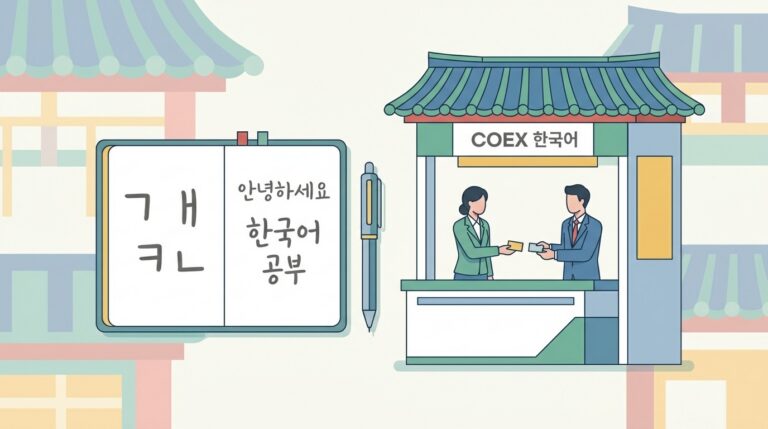
Phase 1: 공감 (Story-Driven Opening)
안녕하세요! 매일한글 에디터입니다.
Picture this: You are standing under the dazzling halogen lights of COEX in Seoul. Around you, hundreds of attendees swarm the aisles, neon banners flash, and you have just handed out your fifty-seventh company catalog. Your voice is a little raspy, your smile muscles are aching, but your badge holder is stuffed with crisp, newly exchanged Korean business cards (myeongham). At this moment, you might think the hardest part of the trade show is over. But here is the candid truth from someone who has navigated Korean exhibition floors for a decade: the real sale does not happen at the booth. It happens in the 48 hours right after the venue lights turn off.
Many international professionals nail the in-person charisma, yet they lose high-value deals because their follow-up feels either too robotic or arrives too late. In Korean business culture, combining the raw, respectful energy of an in-person encounter with rapid, highly personalized digital follow-up is the ultimate formula for winning trust. Today, we are breaking down the exact intermediate-level expressions and etiquette you need to turn casual booth conversations into signed contracts.
Phase 2: 핵심 표현 3선 심층 분석 (Core Expressions)
1. 저희 부스에 귀한 걸음 해 주셔서 진심으로 감사드립니다. (Jeohui buseue gwihan georeum hae jusyeoseo jinsimeuro gamsadeurimnida.)
- Pronunciation: [Jeo-hee boo-seu-eh gwee-hahn geor-eum hae joo-shyeo-seo jin-shim-eu-roh gahm-sah-deu-rim-nee-dah] (Think of gwihan like ‘gwee-hahn’ meaning precious, spoken with smooth elegance).
- Meaning: “Thank you sincerely for making the precious journey to visit our booth.” (Literal: ‘making precious steps’).
- K-Culture Moment: Seen frequently in business K-dramas like Misaeng or Start-Up when representatives welcome influential partners or buyers with utmost respect.
- Editor’s Insight: Saying gwihan georeum (귀한 걸음) honors the visitor’s time and physical effort in navigating a massive expo floor. It elevates a standard ‘thank you’ into executive-level hospitality.
- Situation Spectrum: Casual: 🚫 | Semi-formal: ⚠️ | Formal: ✅
- 🤔 Think About It: In your native culture, do you usually thank people simply for showing up, or do you have a specific idiom that treats someone’s footsteps as ‘precious’?
2. 말씀해 주신 요구 사항을 바탕으로, 박람회 직후 상세 견적서를 송부해 드리겠습니다. (Malsseumhae jusin yogu sahangeul batangeuro, bangnamhoe jikhu sangse gyeonjeokseoreul songbuhae deurigessseumnida.)
- Pronunciation: [Mahl-sseum-hae joo-shin yoh-goo sah-hahng-eul bah-tahng-eu-roh, bahng-nahm-hweh jeek-hoo sahng-seh gyeon-jeok-seo-reul song-boo-hae deu-ree-get-sseum-nee-dah].
- Meaning: “Based on the requirements you mentioned, I will send you a detailed quotation right after the expo.”
- K-Culture Moment: An essential promise made right before tucking a newly acquired business card into your card case.
- Editor’s Insight: Songbu-hada (송부하다) is a high-register business term meaning ‘to dispatch/send documents.’ Using it instead of the casual bonaeda (보내다) immediately signals your professional caliber.
- Situation Spectrum: Casual: 🚫 | Semi-formal: ⚠️ | Formal: ✅
- 🤔 Think About It: How does switching to formal corporate vocabulary alter the client’s perception of your company’s reliability?
3. 현장의 열기를 이어 온라인으로 후속 미팅을 모시고자 합니다. (Hyeonjang-ui yeolgireul ieo onraineuro husok mitingeul mosigoja hamnida.)
- Pronunciation: [Hyeon-jahng-eui yeol-gee-reul ee-uh ohn-rah-een-eu-roh hoo-sohk mee-ting-eul moh-shee-goh-jah hahm-nee-dah].
- Meaning: “Building on the great energy from the venue, we would like to invite you to an online follow-up meeting.”
- K-Culture Moment: The signature opening line of a successful B2B follow-up email sent within 24 to 48 hours post-event.
- Editor’s Insight: Yeolgi (열기) translates to ‘heat’ or ‘enthusiastic energy.’ Acknowledging that live connection bridges the gap between a chaotic hall and a structured Zoom call.
- Situation Spectrum: Casual: 🚫 | Semi-formal: ✅ | Formal: ✅
- 🤔 Think About It: Why is emotional momentum (yeolgi) considered a tangible sales asset in relationship-driven business environments?
Phase 3: 교과서 한국어 vs 진짜 한국어 (Textbook vs. Real Korean)
Situation 1: Collecting a Buyer’s Contact at the Booth
- 📖 교과서 한국어: “명함을 주시면 나중에 이메일로 연락하겠습니다.” (Myeonghameul jusimyeon najunge I-meillo yeonrakhagessseumnida. / If you give me your card, I will contact you by email later.)
- 🗣️ 진짜 한국어: “명함 한 장 남겨주시면, 박람회 끝나고 정리해서 목요일 전에 먼저 자료 올리겠습니다.” (Myeongham han jang namgyeojusimyeon, bangnamhoe kkeutnago jeongrihaeseo mogyoil jeone meonjeo jaryo olligessseumnida. / If you leave a card with us, I will organize everything and send our materials over before Thursday.)
- 💡 왜 다를까?: Korean business partners value specificity and proactive speed (Palli-Palli). Vague promises like najunge (later) sound non-committal. Providing a definite timeline like mogyoil jeone (before Thursday) conveys dependable competence.
Situation 2: Following Up via Email
- 📖 교과서 한국어: “지난주에 만났습니다. 계약하고 싶습니다.” (Jinan-jue mannassseumnida. Gyeyakhago sipseumnida. / We met last week. I want to make a contract.)
- 🗣️ 진짜 한국어: “지난 코엑스 부스에서 인사드렸던 [회사명]의 [이름]입니다. 바쁘신 일정 중에도 유익한 대화 나눠주셔서 감사했습니다.” (Jinan Ko-ek-seu buseueseo insadeuryeotdeon [Hoesamyeong]-ui [Ireum]imnida. Bappeusin iljeong jung-edo yuikhan daehwa nanwojusyeoseo gamsahaessseumnida. / This is [Name] from [Company], who greeted you at the COEX booth. Thank you for sharing such an insightful conversation despite your busy schedule.)
- 💡 왜 다를까?: Jumping straight to closing a deal feels abrupt and insensitive (cheolbuji). Acknowledging the buyer’s hectic expo schedule and expressing gratitude establishes essential mutual rapport (Jeong and Ye-ui).
Phase 4: K-Culture 딥다이브 & 비언어적 매너 (Culture Deep Dive & Manners)
4-1. 눈치 (Nunchi) & Expo Body Language
- The Two-Handed Business Card Ritual (Myeongham Gyohwan): Never flick your business card across a counter. Present your card with both hands, with the text facing the recipient so they can read it instantly. When receiving their card, take it with both hands, read the name and title quietly for 3 to 5 seconds, nod, and rest it gently on top of your presentation pad. Writing notes on someone’s business card in front of their eyes is considered disrespectful; step aside or write notes on a separate notepad.
- Reading Fatigue Levels: B2B attendees walk upwards of 15,000 steps a day. Use your Nunchi (social intuition). If their shoulders are slouched and their eyes wander toward the aisle, avoid holding them hostage with a 20-minute pitch. Deliver a concise 90-second value proposition, secure their card, and pivot to a digital follow-up.
4-2. The Synergy of On-Site Energy and Digital Follow-Up
In South Korea’s high-velocity corporate ecosystem, offline trade shows serve as a catalyst for trust verification. Decision-makers attend events like World IT Show or Seoul Food to see who has real market presence and authentic passion. However, execution is measured by how fast that live energy converts into clear digital follow-up. A prompt email sent within 24 hours proves that your on-site enthusiasm was not mere showmanship, but genuine commitment.
Phase 5: 실전 롤플레이 시나리오 (Real-World Roleplay)
Setting: COEX Hall B, K-Beauty & Wellness Expo. Manager Park (박 팀장), a seasoned buyer from a nationwide retailer, pauses at your booth to inspect your smart cosmetic dispenser.
- You: 안녕하세요! 저희 부스에 귀한 걸음 해 주셔서 감사합니다. (Annyeonghaseyo! Jeohui buseue gwihan georeum hae jusyeoseo gamsahamnida.)
🎭 Bright smile, bowing at 30 degrees, open posture.
Hello! Thank you sincerely for making the precious journey to visit our booth. - Manager Park: 아, 네. 제품 디자인이 꽤 독특해서 눈길이 가네요. 어떤 방식인가요? (A, ne. Jepum dijaini kkwae dokteukhaeseo nungiri ganeyo. Eotteon bangsikingayo?)
🎭 Glances at the prototype and picks up a sample device.
Ah, yes. The product design is quite unique and caught my eye. How does it operate? - You: 센서 기반 자동 토출 방식이라 위생적이고 화장품 산화를 방지합니다. 현장 반응이 뜨겁습니다! (Senseo giban jadong tochul bangsik-ira wisaengjeok-igo hwajangpum sanhwareul bangjihamnida. Hyeonjang baneung-i tteugeopseumnida!)
🎭 Demonstrating the dispenser fluidly with your right hand.
It operates via an automatic sensor-based dispensing system, keeping it hygienic and preventing oxidation. The response here today has been incredible! - Manager Park: 흥미롭군요. 납기 일정이나 최소 주문 수량(MOQ) 조건은 어떻게 됩니까? (Heungmiropgunyo. Napgi iljeong-ina choeso jumun suryang jogeoneun eotteoke doemniga?)
🎭 Crossing arms slightly, evaluating your operational scale.
Interesting. What are your lead times and minimum order quantity (MOQ) terms? - You: 명함 한 장 건네주시면, 고객사 맞춤형 MOQ와 견적서를 오늘 행사 직후 바로 메일로 보내드리겠습니다. (Myeongham han jang geonnejusimyeon, gogaeksa matchumhyeong MOQ-wa gyeonjeokseoreul oneul haengsa jikhu baro meillo bonaedeurigessseumnida.)
🎭 Offering two hands forward in a polite receiving posture.
If you could share your business card, I will email you a tailored MOQ and quotation right after today’s event concludes. - Manager Park: 좋습니다. 여기 제 명함입니다. 수요일 전까지 회신 부탁해요. (Jotseumnida. Yeogi je myeongham-imnida. Suyo-il jeonkaji hoesin butakhaeyo.)
🎭 Hands over his card with both hands, nodding respectfully.
Sounds good. Here is my card. Please get back to me before Wednesday. - You: 감사합니다, 팀장님! 현장에서 나눈 긍정적인 논의를 바탕으로 빠른 시일 내에 연락 올리겠습니다. (Gamsahamnida, Timjangnim! Hyeonjang-eseo nanun geungjeongjeogin nonuileul batangeuro ppareun siil naee yeonrak olligessseumnida.)
🎭 Receiving the card with both hands and studying his title carefully.
Thank you, Manager Park! Building on this positive conversation, I will reach out to you very soon. - Manager Park: 네, 정리되는 대로 연락 주세요. 수고하세요. (Ne, jeongridoeneun daero yeonrak juseyo. Sugohaseyo.)
🎭 Giving a satisfied nod before moving down the aisle.
Alright, contact me as soon as you have it ready. Keep up the good work.
🔀 인터랙티브 분기점 (Interactive Choice)
Manager Park gives you his card and asks for materials before Wednesday. What do you do?
- Option A: Send an email that very evening with the subject: “[COEX B2B] 박 팀장님, 부스 방문 감사드립니다 – 맞춤 견적서 송부의 건” including a personalized recap.
- Option B: Wait until Tuesday 5:00 PM to send a generic bulk product PDF without mentioning the specific MOQ discussion.
- Option C: Send a KakaoTalk message to his personal mobile number immediately with a discount coupon.
Feedback:
* Option A is the BEST choice: In Korean B2B environments, matching speed with meticulous personalization shows unmatched professional respect. You will stand out from competitors.
* Option B is a RISK: Waiting until the last minute with a generic email makes you look disorganized or indifferent, wasting the warm rapport built on the expo floor.
* Option C is BAD: Contacting a Korean executive’s personal messenger without prior permission crosses professional boundaries (seon-eul neomda). Always begin with official email.
Phase 6: 10초 감정 섀도잉 드릴 (Shadowing Drill)
Practice these with the designated pauses (/) and emotional tone:
[😊 활기차고 신뢰감 있게 / Cheerful & Confident]
저희 부스에 / 귀한 걸음 해 주셔서 / 진심으로 감사드립니다!
(Jeohui buseue / gwihan georeum hae jusyeoseo / jinsimeuro gamsadeurimnida!)-
[🤝 정중하고 전문적인 톤 / Courteous & Professional]
현장에서 나눈 논의를 바탕으로, / 이번 주 안으로 / 상세 제안서를 송부하겠습니다.
(Hyeonjang-eseo nanun nonuileul batangeuro, / ibeon ju aneuro / sangse jean-seoreul songbuhagessseumnida.) -
[💼 열정적이고 적극적으로 / Passionate & Driven]
현장의 뜨거운 열기를 이어 / 온라인으로 / 후속 미팅을 모시고 싶습니다!
(Hyeonjang-ui tteugeoun yeolgireul ieo / onraineuro / husok mitingeul mosigo sipseumnida!)
Phase 7: K-Culture 미니 사전 (Key Vocabulary)
- 리드 발굴 (Rideu Balgul) | Lead Generation
The active discovery of prospective commercial buyers during exhibitions, pop-ups, and networking conferences. - 사후 관리 (Sahu Gwanli) | Post-Event Follow-up & Account Care
The systematic maintenance, CRM logging, and outreach conducted after an initial business interaction. - 명함 교환 (Myeongham Gyohwan) | Business Card Exchange
The formal business ritual that initiates professional relationships across all Korean industries. - 후속 미팅 (Husok Miting) | Follow-up Meeting
A scheduled secondary conference (in-person or video) to convert booth interest into tangible proposals.
Phase 8: 여행자를 위한 생존 키트 (Business Traveler Survival Kit)
Top 3 Survival Phrases
- 명함 한 장 주실 수 있나요? (Myeongham han jang jusil su innayo?)
Could I have one of your business cards?
Pro Tip: Use this when speaking with potential partners roaming around your booth. - 브로슈어 챙겨드릴까요? (Beurosyueo chaenggyeodeurilkkayo?)
Shall I pack a brochure for you?
Pro Tip: A low-pressure invitation that encourages passersby to stop and engage. - 명함에 메모 남겨도 될까요? (Myeonghame memo namgyeodo doelkkayo?)
May I jot down a quick note on the back of your card?
Pro Tip: Always ask before writing directly on a counterpart’s business card.
Editor’s Travel Note
- Digital Card Management: Download the “Remember” (리멤버) app or CamCard before stepping onto the expo floor. Korean business professionals use Remember extensively to scan, organize, and find company profiles on LinkedIn-style networks.
- Convention Navigation: If attending events at COEX in Samseong-dong or KINTEX in Ilsan, use the official Naver Map navigation service instead of generic global GPS apps for accurate indoor gate and transit directions.
Phase 9: “한 발 더 깊이” (Cultural Insight)
In Korean culture, casual encounters are never seen as purely transactional; they are guided by the philosophical concept of In-yeon (인연)—a meaningful, destined connection. A trade show floor is crowded and noisy, but when two business representatives stop to exchange bows and cards, an In-yeon has been sparked. However, a spark dies without fuel. Following up with punctuality, tailored quotations, and thoughtful greetings is how Korean professionals demonstrate Jeongseong (정성)—devoted sincerity and meticulous care. Without rapid follow-up, the live booth energy is seen as empty showmanship.
💬 Your Turn: Have you ever attended an overseas trade show or networking event? What is the standard timeline for following up with leads in your country? Share your experiences in the comments below!
Phase 10: FAQ & 오해 방지 (FAQ Schema)
Q: When is the ideal window to send a post-expo follow-up email to a Korean buyer?
A: The golden window is between 24 and 48 hours. If you met them on Friday, ensure your email arrives by Monday morning at 9:30 AM KST. Waiting longer than three business days risks making your company look sluggish.
Q: Should I add the buyer on KakaoTalk or LinkedIn immediately?
A: Stick to formal email first unless the buyer specifically said, “카카오톡으로 연락 주세요” (Please message me on KakaoTalk) or handed you a card displaying their Kakao ID. Keep initial contact professional.
Q: What should I do with business cards received during the trade show?
A: Store them safely in a rigid business card case (myeongham-jip). Shoving cards into your back trousers pocket is seen as disrespectful in Korean business etiquette.
🚨 Common Mistakes Alert
- Mistake: Sending a generic, mass newsletter to all collected badge scans.
Correct Action: Segment your contacts and write personalized first paragraphs referencing specific booth discussions. - Mistake: Addressing the contact simply by their given name (e.g., “Hi Min-jun”).
Correct Action: Address them by company name, surname, and professional title (e.g., “[Company] 박 팀장님”). - Mistake: Forgetting to attach the promised PDF quotation in the first follow-up.
Correct Action: Double-check attachments and ensure file sizes are optimized for corporate firewalls.
Phase 11: 액션 미션 & 참여 유도 (Action Mission)
- Bronze Level: Practice reading the three Core Expressions out loud 5 times using the phonetic guides.
- Silver Level: Write a mock 3-sentence B2B follow-up email intro in Korean and share it in our comments section.
- Gold Level: Roleplay an entire booth exchange with a language partner using the two-handed card presentation technique.
- 🎮 K-Culture Mission: Watch Episode 1 or 2 of the business drama Misaeng (미생) and observe how junior employees hand over and receive documents and cards from senior managers.
Phase 12: 인터랙티브 퀴즈 챌린지 (Quiz Challenge)
1. Situational Judgment:
You meet a director from a Korean retail conglomerate at your booth. What is the most polite way to conclude your chat?
a) “바쁘니까 나중에 메일 보낼게요.”
b) “저희 부스에 귀한 걸음 해 주셔서 감사드리며, 정리해서 곧 자료 올리겠습니다.”
c) “카톡 친구 추가해 주세요!”
2. Fill in the Blank:
“현장의 뜨거운 _______를(을) 이어 온라인으로 후속 미팅을 모시고자 합니다.”
(Hint: Translates to ‘heat’ or ‘passionate energy’.)
3. True or False:
It is acceptable to immediately slide a newly received Korean business card into your back pants pocket as long as you smiled politely. (True / False)
Click to reveal answers & explanations!
- Answer: b) Option b utilizes executive-level honorifics (gwihan georeum, jaryo olligessseumnida). Option a is blunt and informal; Option c violates corporate boundaries.
- Answer: 열기 (yeolgi). The phrase yeolgireul ieo (이어) means ‘building on the momentum/heat of the venue.’
- Answer: False. Putting a business card in your back pants pocket conveys that you are ‘sitting on’ the person’s identity. Always keep it on the table during conversation and place it into a card case or jacket pocket.







