

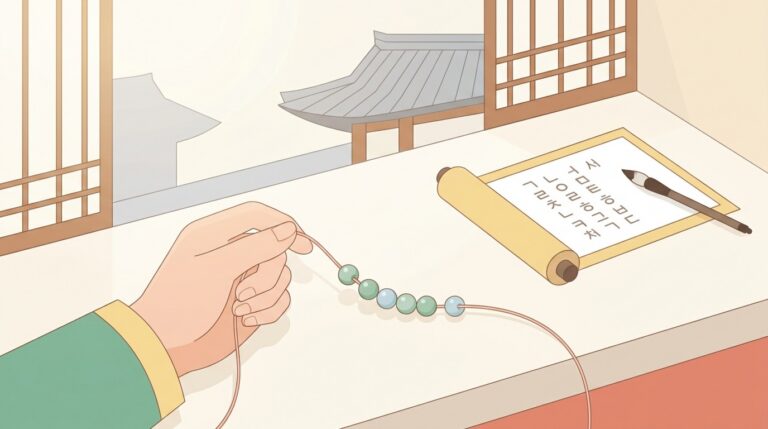
Phase 1: Empathy (Story-Driven Opening)
안녕하세요! 매일한글 에디터입니다. (Hello! I’m the Daily Hangul editor.)
Picture this: You are sitting in a cozy, neon-lit cafe in Seongsu-dong alongside your Korean colleagues or study partners. Your laptop screen is glowing with dozens of color-coded Notion boards, brilliant marketing strategies, and meticulously organized Korean vocabulary flashcards. You feel proud of how much you’ve collected. But suddenly, your team lead sighs, looks at the endless brainstorming notes, and says with a fond smile:
“자, 계획은 완벽하니까 이제 구슬을 꿰어 봅시다!” (Ja, gyehoegeun wanbyeokhannikka ije guseureul kkwoeeo bopsida! – “Well, the plan is perfect, so let’s start stringing the pearls!”)
You blink. Pearls? Stringing? Are we opening a jewelry shop?
If you have ever accumulated endless plans, study notes, or raw materials without knowing how to finalize them into an impactful result, you have hit one of the most relatable pain points in learning and work. In Korea, having potential is respected, but turning that raw potential into a finished masterpiece is celebrated above all. Today, we’ll dive into the legendary proverb 구슬이 서 말이라도 꿰어야 보배 (Guseuri seo marirado kkwoeeoya bobae) and learn how to talk about execution, follow-through, and true craftsmanship like a fluent B2 speaker.
Phase 2: Core 3 Expressions In-Depth
1. 구슬이 서 말이라도 꿰어야 보배 (Guseuri seo marirado kkwoeeoya bobae)
- Pronunciation: [Goo-seul-ee seo ma-ri-ra-do kkweh-eo-ya bo-bae] (Sounds like “Goo-seul-ee”, rolling softly into “kkweh-eo-ya”)
- Meaning:
- Literal: Even if you have three bushels of pearls, they are only a treasure once strung together.
- Nuance: Raw materials, brilliant ideas, and unrealized talents are meaningless unless you take concrete action to connect and finish them.
- K-Culture Moment: In the hit drama Start-Up, when developers boast endless lines of code that have never been tested with real users, a mentor drops this proverb to nudge them toward launching an MVP (Minimum Viable Product).
- Editor’s Insight: 말 (Mal) is an archaic unit of dry volume (about 18 liters), meaning three bushels is an immense fortune in loose pearls! It highlights the contrast between abundance in theory versus value in practice.
- Situation Spectrum: Casual: ⚠️ | Semi-formal: ✅ | Formal: ✅
- 🤔 Think About It: Does your native culture emphasize the initial creative spark or the disciplined finishing touches? How does language reflect that preference?
2. 시작이 반이다 (Sijagi banida)
- Pronunciation: [She-jah-gee bah-nee-da]
- Meaning:
- Literal: Starting is half the journey.
- Nuance: Taking the very first courageous step is often the hardest hurdle; once begun, momentum will carry you forward.
- K-Culture Moment: Frequently quoted by K-pop idols during survival reality shows when trainees hesitate to step onto the stage for freestyle evaluations.
- Editor’s Insight: While Western equivalents say “Well begun is half done,” Koreans use this as an instant anti-procrastination mantra to lower performance anxiety.
- Situation Spectrum: Casual: ✅ | Semi-formal: ✅ | Formal: ✅
- 🤔 Think About It: Why is overcoming inertia treated with as much cultural weight as the completion itself?
3. 유종의 미를 거두다 (Yujong-ui mireul geoduda)
- Pronunciation: [Yoo-jong-eui mee-reul geo-doo-da]
- Meaning:
- Literal: To reap the beauty of the final end.
- Nuance: To bring a project, relationship, or commitment to a graceful, successful, and satisfying finish.
- K-Culture Moment: Used by variety show hosts (Running Man) or Olympic commentators when athletes finish their final match with honor, regardless of score.
- Editor’s Insight: Derived from classical Hanja (有終之美). It balances the rush of modern Korean life (Ppalli-ppalli) with deep respect for closure and dedication.
- Situation Spectrum: Casual: ⚠️ | Semi-formal: ✅ | Formal: ✅
- 🤔 Think About It: How does your workplace or community celebrate finishing something properly rather than just moving instantly to the next task?
Phase 3: Textbook Korean vs. Real Korean
Situation 1: Brainstorming is done; it’s time to start building
- 📖 교과서 한국어 (Textbook Korean):
“좋은 아이디어가 많으니 이제 실제로 실행에 옮기도록 합시다.”
(Joeun aidieoga maneuni ije siljelo silhaeng-e olmgidorok hapsida. / Since we have many good ideas, let us now put them into action.) - 🗣️ 진짜 한국어 (Real Korean):
“말 나온 김에 구슬 좀 꿰어 볼까요? 바로 실행해 봐요!”
(Mal naon gime guseul jom kkwoeeo bolkkayo? Baro silhaenghae bwayo! / Since we’re on the topic, shall we string some pearls? Let’s jump right into action!) - 💡 왜 다를까? (Why is it different?): Native speakers use idiomatic metaphors like “stringing pearls” and the colloquial connector ~말 나온 김에 (while we are on the subject) to create immediate rapport and casual motivation.
Situation 2: Emphasizing the need for a polished conclusion
- 📖 교과서 한국어 (Textbook Korean):
“끝까지 최선을 다해서 프로젝트를 완성해야 합니다.”
(Kkeutkkaji choeseoneul dahaeseo peurojekteureul wanseonghaeya hamnida. / You must do your best until the end to complete the project.) - 🗣️ 진짜 한국어 (Real Korean):
“마무리가 생명이에요. 끝까지 유종의 미를 거둬 봅시다!”
(Mamuriga saengmyeong-ieyo. Kkeutkkaji yujong-ui mireul geodwo bopsida! / The finishing touch is everything. Let’s see this through with flying colors!) - 💡 왜 다를까? (Why is it different?): Saying 마무리가 생명이다 (“finishing touches are life/crucial”) adds punchy urban cadence that resonates instantly in contemporary offices and creative studios.
Phase 4: K-Culture Deep Dive & Non-Verbal Manners
4-1. 눈치 (Nunchi) & Gestures: The Art of Attentive Execution
When using proverbs about perseverance and execution, non-verbal cues carry enormous weight:
* The Rolled-Up Sleeves (팔소매 걷기): When someone declares it is time to string the pearls, you will often see team leaders lightly roll up their cuffs or adjust their posture upright. It signals transition from contemplation to tangible work.
* Nodding with Two Hands on the Desk: Showing commitment to finish (마무리) is paired with maintaining steady eye contact and gently placing both palms on the table, indicating grounded focus.
* Reading the Room (Nunchi): Dropping 구슬이 서 말이라도 꿰어야 보배 when someone is already overwhelmed with tasks will make you sound tone-deaf! Use this idiom specifically when the team is paralyzed by perfectionism and needs permission to start drafting real output.
4-2. Cultural Code: The Trainee to Debut Pipeline
In K-Pop culture, agency trainees spend years polishing dance lines, vocal range, and linguistic abilities. Yet, fans and producers know: 구슬이 서 말이라도 꿰어야 보배. Until those individual skills coalesce into a cohesive debut stage and a synchronized group concept, they remain raw elements. This cultural obsession with execution explains why Korean production cycles are famously thorough and fiercely output-driven.
Phase 5: Real-World Roleplay Scenario
Setting: A sleek co-working lounge in Seongsu-dong.
Characters:
* You (B2 learner & project partner)
* Min-woo (민우, your ambitious creative lead who suffers from chronic over-researching)
- 민우: 자료 조사는 거의 끝났어요. 해외 레퍼런스만 스무 개 넘게 모았거든요!
(Jaryo josaneun geoui kkeutnasseoyo. Haeoe repeoreonseuman seumu gae neomge moatgeodeunyo!)
(🎭 Proudly tapping a 40-page moodboard on his iPad screen)
“The background research is almost done. I’ve gathered over twenty overseas case studies!” -
You: 우와, 준비 진짜 많이 하셨네요! 그런데 우리 발표가 당장 모레잖아요.
(Uwa, junbi jinjja mani hasyeotneyo! Geureonde uri balpyoga dangjang morejanayo.)
(🎭 Peering at the calendar on the phone with slight urgency)
“Wow, you prepared so much! But our presentation is literally the day after tomorrow.” -
민우: 알죠. 그런데 레퍼런스를 조금만 더 다듬으면 더 멋진 기획안이 나올 것 같아서요.
(Aljyo. Geureonde repeoreonseureul jogeumman deo dadeumeumyeon deo meotjin gihoek-ani naol geot gat-aseoyo.)
(🎭 Hesitating, chewing his lip anxiously)
“I know. But if I just polish these references a little more, we could create an even cooler proposal.” -
You: 민우 씨, 구슬이 서 말이라도 꿰어야 보배라고 하잖아요!
(Min-woo ssi, guseuri seo marirado kkwoeeoya bobaerago hajannayo!)
(🎭 Smiling warmly while pulling open a fresh presentation template)
“Min-woo, as the saying goes, even three bushels of pearls are only a treasure once strung together!” -
민우: 아… 듣고 보니 맞네요. 제가 또 완벽주의에 빠졌나 봐요.
(A… deutgo boni matneyo. Jega tto wanbyeokju-uie ppajyeonna bwayo.)
(🎭 Chuckling softly and scratching the back of his neck)
“Ah… hearing that, you’re so right. I think I fell into perfectionism again.” -
You: 이제 수집은 그만하고, 슬라이드 첫 장부터 같이 채워 봐요. 시작이 반이에요!
(Ije sujibeun geumanhago, seullaideu cheot jangbuteo gachi chaewo bwayo. Sijagi ban-ieyo!)
(🎭 Handing him a cup of iced Americano cheerily)
“Let’s stop gathering and fill in the first slide together. Starting is half the battle!” -
민우: 좋아요! 오늘 밤 안에 초안 완성해서 유종의 미를 거둬 봅시다.
(Joayo! Oneul bam ane choan wanseonghaeseo yujong-ui mireul geodwo bopsida.)
(🎭 Straightening his shoulders and cracking his knuckles eagerly)
“Sounds great! Let’s finish the draft tonight and bring this to a stellar close.” -
You: 바로 그 자세예요. 우리 팀 화이팅!
(Baro geu jase-yeyo. Uri tim hwaiting!)
(🎭 Giving a supportive fist bump)
“That’s the spirit. Team, fighting!”
🔀 Interactive Decision Point
When Min-woo asks how you want to compile the raw slides, how do you respond?
* Choice A: “더 완벽한 자료를 찾을 때까지 기다려요.” (Let’s wait until we find more perfect data.)
* Choice B: “구슬은 됐고, 그냥 대충 제출해요.” (Forget the pearls, let’s just submit whatever casually.)
* Choice C: “우선 핵심 내용 3개만 먼저 꿰어서 팀장님께 중간 피드백 받아봐요!” (Let’s string together the top 3 core insights first and get intermediate feedback from the team lead!)
Feedback Guide:
* Choice A (Risk): Traps you in analysis paralysis. Pearls stay scattered on the floor!
* Choice B (Bad): Disregards the second part of the proverb—the goal is still to make a 보배 (treasure), not throw away the beads.
* Choice C (Best!): Perfect B2 strategic communication. Balances execution speed with quality refinement.
Phase 6: 10-Second Emotion Shadowing Drill
Practice reading these sentences aloud. Respect the / pauses and embody the bracketed emotions!
[🔥 단호하고 힘차게 / Decisive & Energized]
구슬이 서 말이라도 / 꿰어야 보배예요. / 지금 당장 시작해요!
(Guseuri seo marirado / kkwoeeoya bobaeyeyo. / Jigeum dangjang sijakhaeyo!)-
[🤝 다정하고 용기를 북돋우며 / Gentle & Encouraging]
너무 걱정하지 마세요. / 시작이 반이니까 / 일단 첫 줄만 써 봐요.
(Neomu geokjeonghaji maseyo. / Sijagi ban-inikka / ildan cheot julman sseo bwayo.) -
[🎯 자부심과 뿌듯함을 담아 / Proud & Accomplished]
끝까지 포기하지 않고 / 해내서 / 유종의 미를 거뒀네요!
(Kkeutkkaji pogihaji anko / haenaeseo / yujong-ui mireul geodwotneyo!)
Phase 7: K-Culture Mini Dictionary
- 실행력 (Silhaengnyeok) | Execution power / Action orientation
The highly prized personal quality in Korean work culture of moving from plans to delivery without hesitating. - 마무리 (Mamuri) | Finishing touches / Wrap-up
Used everywhere from ending a business fiscal quarter (연말 마무리) to ordering fried rice at the end of Korean BBQ (볶음밥으로 마무리). - 디테일 (Diteil) | Attention to fine details
Loanword used like a noun: “디테일이 살아있다” means something demonstrates thoughtful, delicate polish. - 갓생 (Gatsaeng) | God-life (Living diligently and productively)
A blend of God (갓) + Life (생). It describes the trendy youth lifestyle of waking up early, working out, and turning creative goals into daily routines.
Phase 8: Traveler’s Survival Kit
Survival Expressions TOP 3
- “포장 깔끔하게 마무리해 주세요.” (Pojang kkalkkeumhage mamurihae juseyo.)
Pro Tip: Used at bakeries, gift shops, or traditional craft markets in Insadong when you want delicate, ready-to-gift packaging. - “말 나온 김에 지금 결제할게요.” (Mal naon gime jigeum gyeoljehalgeyo.)
Pro Tip: Great for pop-up stores or boutiques when you decide on an impulse purchase while conversing with the owner. - “우선 이것부터 진행해 주세요.” (Useon igeotbuteo jinhaenghae juseyo.)
Pro Tip: Essential when dealing with telecom SIM desks, hotel concierges, or shipping counters to prioritize what to execute first.
Editor’s Travel Note
When traveling across Korea, planning is great, but spontaneity is where the treasure is found. Make sure you complete your digital setup beforehand: check out the Naver Map app download for seamless transit routes and secure a T-money or Climate Card at any subway kiosk so your daily transit is smooth as silk!
Phase 9: “One Step Deeper” (Reflective Thought)
Korean culture is frequently characterized by the word 빨리빨리 (Ppalli-ppalli)—speed, rapid delivery, and instant messaging. However, proverbs like 구슬이 서 말이라도 꿰어야 보배 reveal that pure speed is empty without structural intention. Korean culture honors the artisan who threads each individual pearl, knotting the string securely so the necklace never breaks. It is a philosophy where agility meets dedicated closure.
💬 Your Turn: Have you ever hoarded tons of language notes or creative sketches that you haven’t turned into a project yet? Share in the comments below: What “pearls” are you stringing together this week?
Phase 10: FAQ & Common Mistakes
Q: Can I use “구슬이 서 말이라도 꿰어야 보배” in casual conversations with friends?
A: Absolutely! While it is a traditional proverb, Koreans frequently quote just the core segment—구슬도 꿰어야 보배지!—among close friends when gently teasing someone who buys expensive sports gear or study books but never uses them.
Q: What is the grammatical function of “~라도” in “서 말이라도”?
A: The particle ~(이)라도 indicates “even if it is…” or “at least.” Here, it amplifies the proverb: even if you hold an astonishing quantity of three bushels (서 말), without execution, its practical value remains zero.
Q: How is “유종의 미” different from simply saying “끝” (End)?
A: 끝 (Kkeut) is merely a neutral temporal end point. 유종의 미 (Yujong-ui mi) carries moral and aesthetic value—it implies leaving a clean, honorable, and beautiful legacy after hard work.
🚨 흔한 실수 (Common Mistakes) TOP 3
- Mistake: Confusing “구슬” (bead/pearl) with “보물” (treasure) in the subject position.
Correction: Always start with the raw bead (구슬이 서 말이라도) and conclude with the value (꿰어야 보배). - Mistake: Using this proverb when someone is mourning an irreversible loss.
Correction: This idiom is for inspiring proactive work and completion, not for condolence or comforting deep grief. - Mistake: Saying 구슬을 꿰다 without the connective ~어야 in advice contexts.
Correction: Remember the conditional patternV + ~어야(only if/when one does): 꿰어야 expresses the mandatory condition for value.
Phase 11: Action Missions & K-Culture Hunt
- 🥉 Bronze Mission (Solo Practice): Stand before a mirror and practice reciting Phase 6’s Shadowing Drill 3 times with exaggerated hand gestures.
- 🥈 Silver Mission (Community Share): Post an Instagram story or study tweet showing your current project or Korean study desk with the caption: “구슬이 서 말이라도 꿰어야 보배! Today I’m finishing my chapter.”
- 🥇 Gold Mission (Real-World Use): Use “시작이 반이에요!” or “구슬이 서 말이라도 꿰어야 보배잖아요” during your next 1:1 Korean tutoring session or language exchange meetup.
- 🎮 K-Culture Mission: Watch an episode of a business-oriented K-drama or behind-the-scenes K-Pop choreography practice log. Listen closely for words like 마무리, 실행, or 완성!
Phase 12: Interactive Quiz Challenge
Question 1: Situation Match
Your friend has bought 5 cookbooks, top-tier knife sets, and fresh truffle oil, but has been ordering delivery pizza every night for two weeks. Which proverb best fits your friendly advice?
* (A) 시작이 반이다
* (B) 구슬이 서 말이라도 꿰어야 보배다
* (C) 꿩 대신 닭이다
👉 Click to reveal Answer & Explanation
Correct Answer: (B)
Explanation: Your friend has all the precious materials (the pearls) but hasn’t cooked a single meal (hasn’t strung them). 구슬이 서 말이라도 꿰어야 보배다 is the spot-on match! (A means starting is half the battle; C means settling for a chicken when pheasant is unavailable).
Question 2: Fill-in-the-Blank
“아무리 좋은 기획이라도 ( ) 보배입니다. 오늘부터 바로 제작에 들어갑시다.”
* (A) 먹어야
* (B) 버려야
* (C) 꿰어야
👉 Click to reveal Answer & Explanation
Correct Answer: (C) 꿰어야
Explanation: The verb 꿰다 (to string/thread through) combined with ~어야 forms the quintessential proverb phrase meaning “must string together to make it a jewel.”
Question 3: Cultural True or False
True or False: In contemporary Korean corporate culture, having abundant research and raw references is considered more admirable than actually releasing an MVP on time.
👉 Click to reveal Answer & Explanation
Correct Answer: False!
Explanation: While thorough research is appreciated, Korean business emphasizes 실행력 (Silhaengnyeok) and 마무리 (Mamuri). Ideas left unexecuted carry very little social or professional currency.







