

Defending Your Startup Valuation in Korea: Cross-Applying Peer Multiples and DCF
Phase 1: Empathy (Story Immersion Opening)
안녕하세요! 매일한글 에디터입니다. (Hello! This is your Daily Hangul editor.)
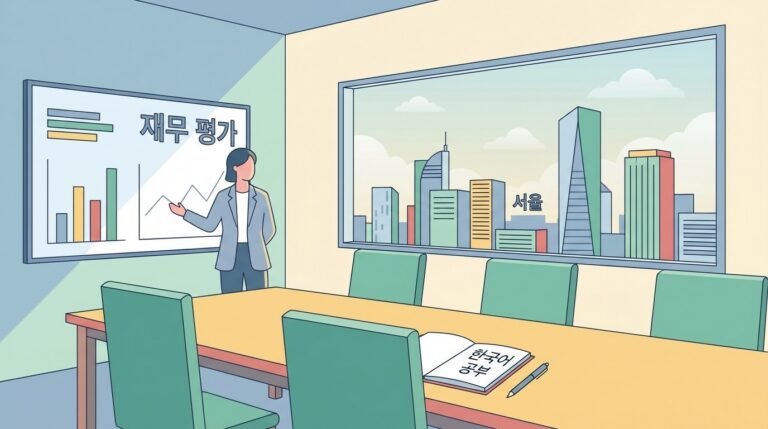
Picture this: You are standing inside a high-floor glass conference room overlooking the buzzing skyline of Teheran-ro in Gangnam—the Silicon Valley of Seoul. Across the sleek mahogany table sit five venture capitalists and institutional partners in tailored dark suits, jotting down notes on their tablets. If you’ve watched K-dramas like Start-Up or Reborn Rich, you know this exact, nail-biting atmosphere. The lead investment partner leans forward, taps his pen, and drops the million-dollar question: “대표님, 솔직히 이 밸류에이션은 시장 상황 대비 다소 과도하게 산정된 것 아닙니까?” (Founder, frankly speaking, isn’t this valuation slightly overcooked given current market conditions?)
Your palms sweat. In English, you could casually defend your unit economics and forecast metrics in your sleep. But doing it in Korean—where business pitch etiquette demands a high-wire balance between unwavering numerical conviction and ultra-respectful corporate humility—feels like a completely different battlefield. Many C-level professionals and startup founders struggle right here: how do you defend complex corporate finance models without sounding either defensively arrogant or timidly apologetic?
That is why this guide exists. Built directly upon field-tested feedback from international tech founders pitching in Seoul’s financial districts, this masterclass will teach you C1-level business Korean to articulate why your valuation is ironclad. By learning how to cross-apply peer multiples with Discounted Cash Flow (DCF) models in natural, high-level Korean, you won’t just survive your Korean IR pitching; you will earn the room’s respect.
Phase 2: Core Expressions Deep Dive
1. 유사 상장사 멀티플과 현금흐름할인법을 교차 적용해 기업가치 산정의 설득력을 높였습니다. (한글)
- Pronunciation: Yusa sangjangsa meoltipeulgwa hyeongeumheureumharinbeobeul gyocha jeok-yonghae gieopgachi sanjeong-ui seoldeukryeogeul nopyeossseumnida. (Think of it as: Yoo-sah sang-jang-sah multiple-gwa hyun-geum-heu-reum-ha-reen-bup cross-application-hae… with smooth liaison on gachi).
- Meaning: Literal: “By cross-applying comparable listed companies’ multiples and the discounted cash flow method, we elevated the persuasiveness of the corporate valuation calculation.” Nuance: We did not pluck these numbers out of thin air; we triangulated both market sentiment and intrinsic cash-generating fundamentals.
- K-Culture Moment: Think of the tense investment committee scenes in Start-Up, where Sandbox mentors grill founders on their financial logic before disbursing seed capital.
- Editor’s Insight: In Korean finance, the term 교차 적용 (cross-application) is a magic word. It signals to Korean VCs that your methodology is balanced and risk-mitigated.
- Situation Spectrum: Casual 🚫 | Semi-formal ⚠️ | Formal ✅
- 🤔 Think About It: In Western pitches, founders often lead with audacious visionary valuations. Korean institutional investors, however, place deep value on defensibility and method-driven humility. How does grounding your numbers in dual valuation methodologies reflect this cultural premium on diligence?
2. 보수적인 추정치를 바탕으로 밸류에이션의 안전마진을 확보했습니다. (한글)
- Pronunciation: Bosujeogin chujeongchireul batangeuro baellyueisyeon-ui anjeonmajineul hwakbohayeossseumnida. (Phonetic rhythm: Boh-soo-jeok-in choo-jung-chee-reul bah-tang-eu-ro…).
- Meaning: Literal: “Based on conservative estimates, we secured a margin of safety for the valuation.” Nuance: Even in the worst-case macroeconomic scenario, your investment will not be underwater.
- K-Culture Moment: Reminiscent of Jin Do-jun in Reborn Rich, methodically explaining why a distressed asset purchase is completely insulated from market downturns.
- Editor’s Insight: Using 보수적 (conservative) in Korean business does not mean outdated or slow; it is the ultimate badge of financial credibility when speaking with corporate LPs.
- Situation Spectrum: Casual 🚫 | Semi-formal ⚠️ | Formal ✅
- 🤔 Think About It: Why does acknowledging downside risk proactively build stronger rapport with Korean decision-makers than simply promising exponential upside?
3. 시장의 오버행 이슈를 감안하더라도 충분히 매력적인 밸류에이션 밴드입니다. (한글)
- Pronunciation: Sijang-ui obeohaeng issyureul gamanhadeorado chungbunhi maeryeokjeogin baellyueisyeon baendeu-imnida. (Sound guide: Shi-jang-ui overhang issue-reul gah-mahn-ha-duh-rah-doh…).
- Meaning: Literal: “Even taking into account potential overhang issues in the market, this is a sufficiently attractive valuation band.” Nuance: We have factored in liquidation pressures, and our entry price still offers lucrative upside.
- K-Culture Moment: Similar to high-stakes board meetings seen in financial thrillers like Default (국가부도의 날), where analysts weigh systemic market overhang against asset intrinsic value.
- Editor’s Insight: Highlighting a 밸류에이션 밴드 (valuation band) instead of a single rigid target figure proves you understand the flexibility needed for shareholder agreements (SHA).
- Situation Spectrum: Casual 🚫 | Semi-formal ⚠️ | Formal ✅
- 🤔 Think About It: Negotiators who offer a structured band rather than a rigid number show room for consensus (합의). How does this honor group harmony in corporate negotiations?
Phase 3: Textbook Korean vs Real-World Korean
Situation 1: Justifying Your Multiples Against Market Peers
- 📖 교과서 한국어 (Textbook Style): 우리 회사의 가격은 다른 상장 회사들과 비교했을 때 비싸지 않습니다. (Uri hoesa-ui gagyeogeun dareun sangjang hoesadeulgwa bigyohaesseul ttae bissaji anseumnida. / Our company’s price is not expensive when compared to other listed companies.)
- 🗣️ 진짜 한국어 (Real-World C1 Executive): 피어 그룹(Peer Group) 멀티플 상단 대비 15% 이상 디스카운트된 합리적인 수준입니다. (Pieo geurup meoltipeul sangdan daebi sib-o peosenteu isang diseukaundeudoen hamnijeogin sujun-imnida. / It is set at a reasonable level, discounted over 15% against the top-quartile multiples of our peer group.)
- 💡 왜 다를까?: Native finance professionals rarely use simplistic words like 가격 (price) or 비싸다 (expensive). They seamlessly integrate global financial vernacular (Peer Group, Discount, Multiple) with high-register Sino-Korean grammar (대비, 산정, 합리적).
Situation 2: Emphasizing Sustainable Cash Generation
- 📖 교과서 한국어 (Textbook Style): 우리 회사는 앞으로 돈을 아주 많이 벌 수 있을 것이라고 생각합니다. (Uri hoesaneun apeuro doneul aju mani beol su isseul geosirago saenggakhamnida. / I think our company will be able to make a lot of money in the future.)
- 🗣️ 진짜 한국어 (Real-World C1 Executive): 견고한 EBITDA 창출 능력을 바탕으로 DCF 모델의 신뢰성을 입증할 수 있습니다. (Gyeon-gohan ebitda changchul neungryeogeul batangeuro disei-epeu moderui sinroeseongeul ipjeunghal su isseumnida. / Based on robust EBITDA generation capacity, we can substantiate the reliability of our DCF model.)
- 💡 왜 다를까?: Professional pitch environments require rigorous accounting metrics (EBITDA, DCF) and formal assertion verbs like 입증하다 (to substantiate) rather than subjective expressions like ~생각합니다 (I think).
Phase 4: K-Culture Deep Dive & Non-Verbal Manners
4-1. 눈치 (Nunchi) & Boardroom Gestures
In a Korean investment committee (투심위, Tusim-wi), body language speaks as loudly as your discounted cash flows:
* The Cushion Pause: When an aggressive partner challenges your numbers, never jump straight into an answer within 0.5 seconds. In Western pitching, rapid fire can signify confidence; in Korea, it can register as combative (따지는 듯한 태도). Pause for 1 to 2 seconds, nod slowly, and begin with a respectful acknowledging phrase: “지적해 주신 부분에 전적으로 공감합니다. 다만…” (I fully empathize with your point. However…).
* Two-Handed Clicker Etiquette: Hold your slide remote or laser pointer with your primary hand while supporting your elbow or forearm lightly with your other hand when pointing towards the main projection screen. This subtle gesture signals high situational respect (예의).
* Eye Contact Distribution: Always address the most senior partner first when answering, but sweep your gaze smoothly across junior associates and investment managers toward the conclusion of your explanation. Neglecting the junior analysts who write the actual investment memorandum (투자 보고서) is a critical tactical error in Korea.
4-2. Corporate Code: The Sand Box Paradigm
South Korea’s venture ecosystem thrives in two epicenters: Yeouido (traditional investment banking, private equity, securities) and Teheran-ro / Pangyo (tech startups, venture capital, growth equity).
While Yeouido relies heavily on rigorous, conservative DCF modeling and hard asset audits, Teheran-ro embraces EV/Sales or GMV multiples—yet retains a fundamentally conservative Korean risk appetite. Founders who blend Yeouido’s numerical conservatism with Pangyo’s growth storytelling capture funding far more successfully than those who rely solely on Silicon Valley-style hype.
Phase 5: Real-World Roleplay Scenario
Setting: The 14th-floor boardroom of a leading VC in Teheran-ro, Seoul.
Characters:
* 박 상무 (Managing Director Park): A seasoned, discerning Korean VC partner known for razor-sharp financial skepticism.
* 김 대표 (CEO Kim / You): Founder pitching a Series B round, balancing innovation with financial discipline.
[Scene Start: Managing Director Park adjusts his glasses, staring down at slide 24 of your pitch deck.]

박 상무: 김 대표님, 제시하신 Pre-money 밸류 500억 원은 현재 위축된 벤처 시장 분위기상 다소 공격적인 수치 같은데요?
(Park Sangmu: Kim Daepyonim, jesihasin Pre-money baellyu obaek-eok woneun hyeonjae wichukdoen bencheo sijang bun-wigisang daso gong-gyeokjeogin suchi gateundeyo?)
(Director Park: CEO Kim, isn't your proposed 50 billion KRW Pre-money valuation somewhat aggressive given the currently contracted VC climate?)
🎭 행동 지문: [안경을 살짝 고쳐 쓰며 냉철하게 슬라이드를 가리킨다]

김 대표: 지적해 주신 시장의 우려에 대해 충분히 인지하고 있습니다.
(Kim Daepyo: Jijeokhae jusin sijang-ui uryeoe daehae chungbunhi injihago isseumnida.)
(CEO Kim: I am fully cognizant of the market concerns you pointed out.)
🎭 행동 지문: [차분하게 고개를 끄덕인 뒤, 슬라이드를 밸류에이션 요약표로 전환한다]

김 대표: 그래서 저희는 유사 상장사 멀티플과 DCF 방식을 교차 적용해 밸류에이션의 객관성을 확보했습니다.
(Kim Daepyo: Geuraeseo jeohuineun yusa sangjangsa meoltipeulgwa disei-epeu bangsigeul gyocha jeok-yonghae baellyueisyeon-ui gaekgwanseongeul hwakbohayeossseumnida.)
(CEO Kim: Therefore, we cross-applied peer group multiples and the DCF method to secure objectivity in our valuation.)
🎭 행동 지문: [두 손으로 포인터를 안정적으로 쥐고 데이터를 제시한다]

박 상무: 상장 피어 그룹 멀티플을 적용했다면, 최근 기술주 디스카운트 폭은 어떻게 반영하셨습니까?
(Park Sangmu: Sangjang pieo geurup meoltipeureul jeok-yonghaetdamyeon, choegeun gisulju diseukaundeu pokeun eotteoke banyeonghasyeossseumnikka?)
(Director Park: If you used listed peer multiples, how did you factor in the recent steep valuation discount across tech stocks?)
🎭 행동 지문: [팔짱을 끼며 답변의 논리적 허점을 테스트하듯 응시한다]

김 대표: 피어 그룹의 최근 3개년 평균 EV/EBITDA 멀티플 하단에 25%의 추가 할인율을 보수적으로 반영했습니다.
(Kim Daepyo: Pieo geurubui choegeun samgaenyeon pyeonggyun i-bui-ebitda meoltipeul hadane isib-o peosenteu-ui chuga harinyureul bosujeogeuro banyeonghaessseumnida.)
(CEO Kim: We conservatively applied an additional 25% discount rate to the lower end of our peer group's trailing three-year average EV/EBITDA multiple.)
🎭 행동 지문: [시선을 이사 전체로 부드럽게 분산시키며 확신에 찬 어조로 설명한다]

박 상무: 음, DCF에 적용된 WACC(가중평균자본비용)과 영구성장률 가정치는 어떠합니까?
(Park Sangmu: Eum, disei-epeue jeok-yongdoen WACC-gwa yeongguseongjangryul gajeongchineun eotteohamnikka?)
(Director Park: Mmm, and what are your assumptions regarding the WACC and terminal growth rate in your DCF?)
🎭 행동 지문: [표정을 누그러뜨리며 태블릿에 메모를 적기 시작한다]

김 대표: 고금리 기조를 감안해 WACC은 13.5%로 상향 조정했고, 영구성장률은 보수적으로 1.5%를 적용했습니다.
(Kim Daepyo: Gogeumri gijoreul gamanhae WACC-eun sipsam-jeom-o peosenteuro sanghyang jojeonghaetgo, yeongguseongjangryureun bosujeogeuro il-jeom-o peosenteureul jeok-yonghaessseumnida.)
(CEO Kim: Reflecting the high interest rate environment, we revised our WACC upward to 13.5% and assumed a very conservative 1.5% terminal growth rate.)
🎭 행동 지문: [신뢰감 있는 미소를 지으며 완벽한 방어 논리를 매듭짓는다]

박 상무: 좋습니다. 단단하게 준비하셨군요. 다음 유닛 이코노믹스 슬라이드로 넘어가시죠.
(Park Sangmu: Joeusseumnida. Dandanhage junbihasyeotgunyo. Daeum yunit ikonomikseu seullaideuro neomeogasi-jyo.)
(Director Park: Good. You prepared this rigorously. Let's move to the next slide on unit economics.)
🔀 Interactive Decision Point
When Director Park asks if the valuation isn’t too high, what is your best strategic response?
- Option A: “저희 기술력은 전 세계 유일무이하므로 현재 멀티플 비교 자체가 무의미합니다.” (Our technology is completely unique globally, so comparing multiples is inherently meaningless.)
- Feedback [Bad 🚫]: Sounds defensive and dismissive of basic institutional due diligence frameworks. VCs will interpret this as financial immaturity.
- Option B: “이사님께서 원하시는 수준으로 밸류를 바로 낮출 용의가 있습니다.” (We are willing to immediately cut our valuation to whatever level you desire, Director.)
- Feedback [Risk ⚠️]: Shows lack of conviction in your own company’s worth and immediately destroys your bargaining power in subsequent rounds.
- Option C: “우려하시는 점에 공감하여, 피어 멀티플과 DCF 모델 양측 모두에 보수적인 안전마진을 반영해 산출했습니다.” (Empathizing with your concerns, we formulated this by applying conservative margins of safety to both peer multiples and DCF models.)
- Feedback [Best ✅]: Balances emotional intelligence (공감), financial rigour, and unwavering founder confidence.
Phase 6: 10-Second Emotion Shadowing Drill
Master the natural cadence, strategic pauses (/), and boardroom emotional inflections.
[🧐 진중하고 확신에 찬 어조로 / Calm, authoritative, and steady]
저희는 유사 상장사 멀티플과 / 현금흐름할인법을 교차 적용하여 / 밸류에이션의 객관성을 / 한층 높였습니다.
(Jeohuineun yusa sangjangsa meoltipeulgwa / hyeongeumheureumharinbeobeul gyocha jeok-yonghayeo / baellyueisyeon-ui gaekgwanseongeul / hancheung nopyeossseumnida.)-
[🤝 정중하게 공감하며 / Respectfully acknowledging feedback]
지적해 주신 시장 우려를 감안하여 / WACC과 영구성장률 모두 / 가장 보수적인 시나리오를 / 전제하였습니다.
(Jijeokhae jusin sijang uryeoreul gamanhayeo / WACC-gwa yeongguseongjangryul modu / gajang bosujeogin sinarioreul / jeonje-hayeossseumnida.) -
[💡 논리적으로 설득하며 / Crisp, professional, and convincing]
피어 그룹 하단 대비 / 20% 이상의 디스카운트를 적용했기 때문에 / 충분한 안전마진이 확보되어 있습니다.
(Pieo geurup hadan daebi / isib peosenteu isang-ui diseukaunteureul jeok-yonghaetgi ttaemune / chungbunhan anjeonmajini hwakbodoeeo isseumnida.)
Phase 7: K-Culture Mini Dictionary
- 밸류에이션 밴드 (Valuation Band / Baellyueisyeon Baendeu)
Context: Rather than fixing a single unyielding pre-money valuation, top Korean startups propose a negotiated corridor (e.g., “400억 ~ 450억 원”) during early term-sheet negotiations to facilitate lead-investor alignment. - 피어 그룹 멀티플 (Peer Group Multiples / Pieo Geurup Meoltipeul)
Context: Valuing a private startup by benchmarking revenue/EBITDA multiples against domestic listed companies on the KOSDAQ or international comps. - 현금흐름할인법 (DCF – Discounted Cash Flow / Hyeongeumheureumharinbeop)
Context: The classic corporate finance valuation method that projects free cash flows discounted back using WACC. In Korea, institutional LPs often demand this for Series B and later rounds to ensure asset backing. - 오버행 (Overhang / Obeohaeng)
Context: The risk of potential heavy selling pressure post-investment from convertible bondholders or early angel investors. Addressing this proactively in your pitch proves seasoned leadership.
Phase 8: Professional Traveler’s Survival Kit
Top 3 Executive Survival Phrases
- “텀시트(Term Sheet) 조항 관련하여 세부 협의를 진행하고 싶습니다.”
(Teomsiteu johang gwanlyeonhayeo sebu hyeob-uireul jinhaenghago sipseumnida.)
Pro Tip: Use this phrase when wrapping up a positive pitch to transition smoothly into formal investment term discussions without sounding pushy. - “추정 재무제표의 세부 가정을 메일로 송부해 드리겠습니다.”
(Chujeong jaemujepyo-ui sebu gajeongeul meillo songbuhae deurigesseumnida.)
Pro Tip: When asked for granular breakdown formulas you don’t have on the spot, offer to email the model promptly. Korean VCs value rapid post-meeting follow-ups (피드백 속도). - “상호 윈윈(Win-Win)할 수 있는 합리적인 접점을 찾기를 희망합니다.”
(Sangho winwinhal su inneun hamnijeogin jeopjeomeul chatgireul huimanghamnida.)
Pro Tip: The ultimate diplomatic phrase when valuations clash during closing negotiations.
Editor’s Travel Note: Business in Seoul
- Getting to Teheran-ro and Yeouido: For navigating Seoul’s tech and finance hubs smoothly between back-to-back meetings, ensure you use the 네이버 지도 앱 다운로드 instead of international map apps, which often lack real-time subway transfer data. For reliable executive transport, set up the 카카오 T 앱 다운로드 for Black/Venti premier taxi bookings.
- The After-Pitch Dinner (회식, Hoesik): If invited to a casual post-pitch dinner near Yeouido Park or Gangnam Station, remember basic dining protocol: never pour your own drink when the table drinks together, use two hands when receiving a glass from an executive, and turn your head slightly to the side when taking your first sip as a sign of respect.
Phase 9: One Step Deeper (Reflective Essay)
In Western business cultures, pitching valuation is frequently treated as a bold zero-sum contest of bravado—anchor high, hold your ground, and sell the dream. In Korea, however, a valuation negotiation is fundamentally a test of your long-term corporate governance character (기업가적 자질).
Korean venture partners want to see both 자신감 (unshakable conviction in your technology) and 겸손 (institutional deference to market risk and capital stewardship). When you demonstrate that you applied dual valuation metrics (multiples alongside DCF) and instituted conservative margins of safety, you are signaling to Korean investors that you will treat their capital with the utmost prudence. True fluency at the C1 level is not just using sophisticated vocabulary; it is adopting the philosophical mindset that corporate sustainability outlasts market exuberance.
💬 Your Turn: Have you ever pitched or negotiated numbers in a cross-cultural environment? Did you find that being conservative or bold worked better? Share your thoughts in the comments below!
Phase 10: FAQ & Common Mistakes
Q: Is it common to use English financial terms like DCF and Multiple during Korean pitches?
A: Yes! Korean venture capital and investment banking circles routinely use Konglish or direct loanwords such as 멀티플 (Multiple), 밸류에이션 (Valuation), 피어 그룹 (Peer Group), and DCF. However, the surrounding syntax, honorific endings, and connective particles must remain impeccably formal and precise.
Q: Can I use informal polite endings like ~해요 during an IR presentation?
A: It is strongly advised to maintain 하십시오체 (the highest formal register: ~ㅂ니다 / ~습니까) during your official slide presentation. You can transition to a polite 해요체 (~해요) later during casual, light-hearted Q&A banter over tea, but formal declarative forms build instant gravitas.
Q: How do Korean VCs perceive aggressive valuation demands from foreign founders?
A: While innovation is celebrated, ungrounded aggressive valuations are often viewed as a lack of situational awareness (눈치 부족). Always bridge aggressive valuations with concrete domestic benchmark data to validate your credibility.
🚨 흔한 실수 (Common Mistakes) 경고판
- Mistake: Using 가격 (Gagyeok – retail price) instead of 기업가치 (Gieopgachi – enterprise value) or 밸류에이션 (Valuation).
Correct Action: Say “저희 기업가치 산정 기준은…” (Our enterprise valuation basis is…). - Mistake: Directly rebutting a partner with “아닙니다, 틀리셨습니다” (No, you are wrong).
Correct Action: Cushion first: “말씀해 주신 우려에 공감하며, 그 점을 보완하기 위해…” (I empathize with the concern you raised, and to complement that point…). - Mistake: Quoting only US comps without referencing Korean or Asian equivalents.
Correct Action: Always include domestic peers (국내 동종업계/유사 상장사) to show you respect the local market context.
Phase 11: Action Mission & Participation
- 🥉 Bronze Mission (Solo Practice): Record yourself reciting Expression 1 from Phase 2 using your phone’s voice memo app. Focus on pausing naturally at the slashes
/and maintaining a composed, executive rhythm. - 🥈 Silver Mission (Social Sharing): Write a 2-sentence mock valuation statement in Korean using the words 유사 상장사 and 안전마진, and post it in the comments below or tag Daily Hangul on LinkedIn.
- 🥇 Gold Mission (Real-World Application): The next time you discuss startup numbers or review a financial deck, practice framing your valuation using dual methods (multiples + DCF) in high-register Korean!
🎮 K-Culture Mission: Watch Episode 5 of the K-drama Start-Up. Observe how the team pitches on Hackathon Demo Day. Note down three non-verbal gestures used when responding to tough judge feedback!
Phase 12: Interactive Quiz Challenge
1. Situational Judgment
During a tense VC meeting, an investor argues that your DCF terminal growth rate is too optimistic. Which response is most professional and culturally attuned?
* A) “DCF는 이론일 뿐이니 크게 신경 쓰지 않으셔도 됩니다.” (DCF is just theory, so you don’t need to care much.)
* B) “지적해 주신 점을 반영하여 영구성장률을 보수적인 1%대로 재조정해 검토하겠습니다.” (Reflecting your valuable point, we will review it by readjusting the terminal growth rate to a conservative 1% range.)
* C) “저희 성장률을 믿지 못하신다면 이번 라운드 참여는 어려우실 것 같습니다.” (If you cannot trust our growth rate, participating in this round might be difficult for you.)
Check Answer & Explanation
Correct Answer: B
Why? Option B gracefully accepts constructive due diligence feedback, demonstrates immediate adaptability, and applies the high-status term 보수적인 (conservative) without sacrificing composure. Option A dismisses financial rigor, while Option C is excessively combative for Korean boardroom culture.
2. Fill-in-the-Blank
Fill in the missing word in this executive sentence:
“저희는 유사 상장사 멀티플과 DCF 방식을 ______ 적용하여 산정 결과의 신뢰도를 높였습니다.”
* A) 무시하고 (ignoring)
* B) 교차 (cross-)
* C) 대충 (carelessly)
Check Answer & Explanation
Correct Answer: B (교차 / Cross-)
Explanation: 교차 적용 (cross-application) is the key technical collocation used when combining multiple financial models to triangulate valuation credibility.
3. True or False Cultural Quiz
True or False: In a formal Korean investment committee (투심위), holding eye contact exclusively with the most vocal junior associate is considered proper etiquette because they do the legwork on the model.
Check Answer & Explanation
Correct Answer: False
Explanation: While junior associates prepare the investment memorandum, hierarchy dictates that you acknowledge the most senior decision-maker (Partner/Managing Director) first and foremost, before sweeping eye contact respectfully across the entire investment panel.







