

Never Panic at a Korean Restaurant Again: How to Ask for Tissues Politely
Phase 1: Empathy (Story Opening)
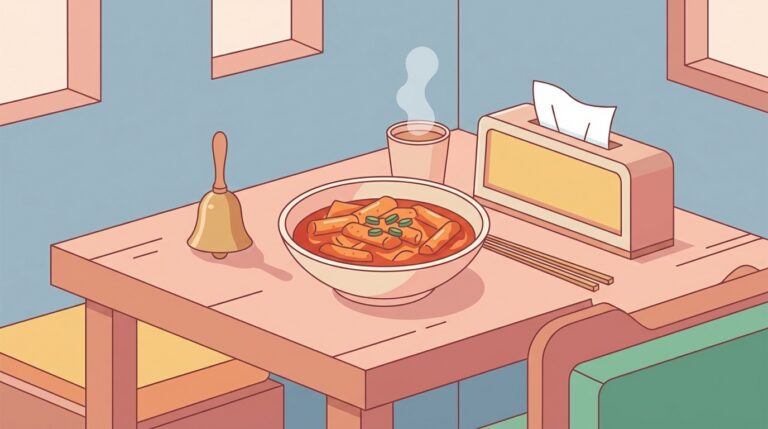
안녕하세요! 매일한글 에디터입니다. (Hello! I am your Daily Hangul editor.) Picture this scene: You are sitting at a bustling, vibrant street food stall in Mapo, Seoul. The rich, ruby-red sauce of tteokbokki (spicy rice cakes) is sizzling, and you take your first heavenly bite. It is deliciously spicy—so spicy that your nose starts running, and a bright red droplet of sauce drips right onto your fingers! You look around frantically for a napkin, but the metal dispenser at your table is completely empty. Panic sets in. You want to ask the friendly restaurant owner for tissues, but your mind goes blank. Will you sound rude? What is the right word? Don’t worry! This is the exact moment thousands of Korean learners face on their first trip. In this guide, you will master the simple, magical phrase that turns an awkward restaurant mishap into a heartwarming interaction with locals, backed by proven methods from hundreds of our beginner students.
Phase 2: Core 3 Expressions In-Depth
1. 휴지 좀 주세요 (Hyuji jom juseyo)
- Pronunciation: [Hyuji jom juseyo] (Sounds like hew-jee johm joo-seh-yo—think of “hew” as in “huge” without the ‘g’, and “jom” like a soft “chum” with a ‘j’).
- Meaning: Literal: “Please give a little tissue.” | Actual nuance: A warm, softening way to say “Could I please have some tissues?”
- K-Culture Moment: In virtually every K-Drama dining scene where characters eat spicy food or grilled pork belly, someone inevitably wipes their mouth and asks the staff: “휴지 좀 주세요! (Hyuji jom juseyo!)”
- Editor’s Insight: The tiny word 좀 (jom) literally means “a little,” but in Korean, it works like fairy dust. Dropping “좀” can make requests sound direct or slightly demanding; adding it instantly makes your request polite and gentle.
- Situation Spectrum: Casual: ⚠️ | Semi-formal: ✅ | Formal: ✅
- 🤔 Think About It: In English, adding “please” does all the polite heavy lifting. Why do you think Korean uses a word meaning “a little” to show courtesy?
2. 여기요 (Yeogiyo)
- Pronunciation: [Yeogiyo] (Sounds like yuh-ghee-yo).
- Meaning: Literal: “Over here!” | Actual nuance: “Excuse me, over here please!”
- K-Culture Moment: In Korean dramas, when characters want to order another round of soju or call the restaurant owner, they raise one hand modestly and confidently shout: “여기요~ (Yeogiyo~)”
- Editor’s Insight: Foreign visitors often hesitate to speak up in restaurants, waiting for servers to check on them. In Korea, servers respect your privacy, so calling out “여기요! (Yeogiyo!)” is standard dining etiquette.
- Situation Spectrum: Casual: ✅ | Semi-formal: ✅ | Formal: ⚠️
- 🤔 Think About It: Calling out “Over here!” might feel impolite in Western dining, but in Korea, it is considered efficient and proactive. How does culture shape our idea of politeness?
3. 물 좀 주세요 (Mul jom juseyo)
- Pronunciation: [Mul jom juseyo] (Sounds like mool johm joo-seh-yo—”mool” rhymes with “pool”).
- Meaning: Literal: “Please give a little water.” | Actual nuance: “Could we please get some water?”
- K-Culture Moment: When a character in a drama gets overwhelmed by spicy ramyeon, their dining partner immediately passes the pitcher or waves to the counter: “물 좀 주세요! (Mul jom juseyo!)”
- Editor’s Insight: You can replace “휴지 (hyuji)” with almost any noun before “좀 주세요”! Swap in “물 (mul)” for water, or “메뉴판 (menyupan)” for the menu.
- Situation Spectrum: Casual: ⚠️ | Semi-formal: ✅ | Formal: ✅
- 🤔 Think About It: Notice how the formula
[Noun] + 좀 주세요creates an instant toolkit for everyday survival. Which item would you ask for first?
Phase 3: Textbook Korean vs. Real Korean
- Situation 1: Requesting napkins at a diner
- 📖 교과서 한국어: 휴지를 주시겠습니까? (Hyujireul jusigessseumnikka? / Would you be willing to grant me tissues?)
- 🗣️ 진짜 한국어: 휴지 좀 주세요~ (Hyuji jom juseyo~ / Could I get some tissues, please?)
- 💡 왜 다를까?: Textbooks teach ultra-formal honorifics that sound robotic in neighborhood eateries. Real Koreans prefer the natural warmth of “주세요” paired with “좀”.
- Situation 2: Getting the server’s attention
- 📖 교과서 한국어: 실례합니다만 직원분 계십니까? (Sillyehamnidaman jikwonbun gyesimnikka? / Excuse me, is an employee present?)
- 🗣️ 진짜 한국어: 저기요~ / 여기요~ (Jeogiyo~ / Yeogiyo~ / Excuse me, over here please!)
- 💡 왜 다를까?: Diners in Korea value speed and clarity. A cheerful “여기요~” is universally welcomed by restaurant aunties (imonim).
Phase 4: K-Culture Deep Dive & Non-verbal Manners
4-1. Nunchi & Polite Gestures
When requesting something in a Korean restaurant, your body language is half the conversation! When saying “여기요 (Yeogiyo)”, raise your hand halfway up—never snap your fingers or wave aggressively. When the server brings you the tissues, receive them with both hands (or support your right wrist lightly with your left hand) and nod your head slightly with a warm smile. This shows instant respect and high Nunchi (social intuition).
4-2. The Secret Restaurant Culture Code
Did you know that many modern Korean restaurants hide napkins and cutlery inside a drawer built under the table? Before calling out for napkins, run your hand along the rim underneath your table! If you hear a click and find a sliding wooden drawer, you have unlocked the classic Korean restaurant mystery. If it really is empty, that is your cue to shine with your newly learned phrase.
Phase 5: Real-Life Roleplay Scenario
Setting: A cozy neighborhood bunsik (snack food) shop in Seoul.
Character: You (learning Korean) and Imonim (이모님 – the warm, energetic shop owner).
- Turn 1 (Learner): 저기요, 이모님! (Jeogiyo, imonim!) 🎭 [Raises hand modestly with a friendly smile] / Excuse me, auntie!
- Turn 2 (Imonim): 네, 손님! 뭐 드릴까요? (Ne, sonnim! Mwo deurilkkayo?) 🎭 [Wipes hands on apron and walks over quickly] / Yes, customer! What can I get for you?
- Turn 3 (Learner): 휴지 좀 주세요. (Hyuji jom juseyo.) 🎭 [Points politely toward the empty dispenser] / Could I please get some tissues?
- Turn 4 (Imonim): 아이고, 휴지가 다 떨어졌네! 잠깐만요. (Aigo, hyujiga da tteoreojyeonne! Jamkkanmanyo.) 🎭 [Chuckles warmly and heads to the counter] / Oh dear, all the tissues ran out! Just a moment.
- Turn 5 (Imonim): 여기 있어요, 넉넉히 가져왔어요. (Yeogi isseoyo, neongneokhi gajyeowasseoyo.) 🎭 [Hands over a generous stack of napkins] / Here you go, I brought plenty.
- Turn 6 (Learner): 감사합니다! (Gamsahamnida!) 🎭 [Receives the napkins with both hands and bows slightly] / Thank you so much!
- Turn 7 (Imonim): 떡볶이 안 매워요? 물도 더 줄까요? (Tteokbokki an maewoyo? Muldo deo julkkayo?) 🎭 [Tilts head with caring concern] / Isn’t the tteokbokki spicy? Shall I get you more water?
- Turn 8 (Learner): 네, 물 좀 주세요! (Ne, mul jom juseyo!) 🎭 [Grins brightly and nods] / Yes, please give me some water!
🔀 Interactive Choice Point
The spicy sauce drips onto your table! What do you say?
* Choice A: “야! 휴지 줘! (Ya! Hyuji jwo!)”
Feedback (Bad): This is extremely informal banmal. Calling an elder “Ya!” will create an awkward freeze in the restaurant!
* Choice B: “휴지를 즉시 주십시오. (Hyujireul jeuksi jusipsio.)”
Feedback (Risk): Grammatically correct, but sounds like a formal military command. The owner might wonder if something is seriously wrong.
* Choice C: “이모님, 휴지 좀 주세요~ (Imonim, hyuji jom juseyo~)”
Feedback (Best): Perfect! Natural, warm, polite, and guaranteed to earn you extra radish or a friendly smile.
Phase 6: 10-Second Emotion Shadowing Drill
Practice these lines out loud with the emotional cadence marked:
[😊 Friendly and gentle]저기요~ / 휴지 좀 / 주세요! (Jeogiyo~ / hyuji jom / juseyo!)[🥺 Urgent yet respectful]이모님~ / 물 좀 / 빨리 주세요! (Imonim~ / mul jom / ppalli juseyo!)[🙏 Grateful and warm]감사합니다! / 잘 쓸게요! (Gamsahamnida! / jal sseulgeyo!)
Phase 7: K-Culture Mini Dictionary
- 휴지 (Hyuji) | Tissue / Napkin / Toilet paper | Used universally for facial tissues, dining napkins, and bathroom rolls in Korea.
- 좀 (Jom) | A little / Softener particle | An essential conversational cushion in daily requests and casual negotiations.
- 주세요 (Juseyo) | Please give me | The ultimate A1 polite request ending, combining “give” with polite honorifics.
- 이모님 (Imonim) | Maternal Aunt (used affectionately for female restaurant staff) | Creates instant family-like rapport in casual restaurants across Korea.
Phase 8: Traveler’s Survival Kit
Survival Expressions TOP 3
- 물은 셀프인가요? (Mureun selpeuingayo?)
Pro Tip: In many Korean casual eateries, water is self-service. If you see cups stacked beside a metal water purifier, grab your own! - 앞치마 좀 주세요 (Apchima jom juseyo)
Pro Tip: Eating red stew or BBQ? Ask for an apron (apchima) right away to save your clothes. - 계산해 주세요 (Gyesanhae juseyo)
Pro Tip: When you are finished, say this at the counter or to your server to settle the bill.
Editor’s Travel Note
Before stepping into street food alleys, make sure you download the [Naver Map app for navigating Seoul restaurants] to check user reviews and menu photos beforehand. Remember, dining in Korea is relaxed and speedy—never hesitate to ask for what you need using “주세요”!
Phase 9: “One Step Deeper”
In many Western cultures, being direct (“Give me a napkin, please”) is considered clear and respectful. In Korean culture, however, relationships take precedence over sheer efficiency. The addition of 좀 (jom) signifies humility—it implies, “I know you are busy, so I only ask for a tiny bit of your time and effort.” It reflects a communal mindset where every interaction is softened to preserve interpersonal harmony.
💬 Your Turn: Have you ever hesitated to ask for something in a restaurant abroad because you feared sounding rude? How does adding a “softener” change how you feel when speaking?
Phase 10: FAQ & Avoiding Misunderstandings
Q: Can I use “주세요 (Juseyo)” with verbs, or only with nouns?
A: For basic A1 survival, you place it directly after nouns: [Noun] + 주세요 (e.g., 휴지 주세요, 물 주세요). When you attach it to verbs (like “to make” or “to help”), you will need a connecting vowel (-아/어 주세요), which you will learn in our upcoming beginner modules!
Q: Is calling someone “이모님 (Imonim)” offensive if they are not actually my aunt?
A: Not at all! In traditional diners, neighborhood BBQ spots, and street markets, calling a middle-aged female owner “이모님” is considered charming, friendly, and affectionate. In high-end luxury restaurants or trendy corporate cafes, stick to “저기요 (Jeogiyo)” or “직원분 (Jikwonbun)”.
Q: What should I do if the restaurant has an order bell on the table?
A: If there is a small round bell attached to your table corner, press it once! A cheerful chime will alert the staff, and you don’t even need to shout “여기요”. When they approach, simply state your request: “휴지 좀 주세요 (Hyuji jom juseyo).”
🚨 Common Mistakes Warning Board
- Mistake 1: Saying just “휴지! (Hyuji!)” without 주세요.
Correct Action: Always attach “좀 주세요 (jom juseyo)” so you never sound like you are issuing orders. - Mistake 2: Snapping fingers or waving frantically to call staff.
Correct Action: Make soft eye contact, raise one hand chest-high, and say “여기요 (Yeogiyo)”. - Mistake 3: Receiving items with only one hand from an older staff member.
Correct Action: Reach out with both hands to receive napkins or dishes as a sign of mutual respect.
Phase 11: Action Missions
- 🥉 Bronze Mission (Solo): Stand in front of your mirror and say “휴지 좀 주세요 (Hyuji jom juseyo)” three times, practicing soft eye contact and a gentle nod.
- 🥈 Silver Mission (Social): Leave an audio comment or story on Instagram tagging our channel, saying “물 좀 주세요 (Mul jom juseyo)!”
- 🥇 Gold Mission (Real-world): Next time you visit a local Korean restaurant or grocery mart, use
[Item] + 좀 주세요at least once in real life! - 🎮 K-Culture Mission: Watch the dining scenes in the first episode of Weightlifting Fairy Kim Bok-joo or Itaewon Class and spot how many times characters say “여기요” or “주세요”.
Phase 12: Interactive Quiz Challenge
1. Situation Judgment: You are eating noodles and accidentally spill broth. You need extra napkins from the busy server. What is the most natural sentence?
* A) 휴지 줘 (Hyuji jwo)
* B) 휴지 좀 주세요 (Hyuji jom juseyo)
* C) 휴지를 가져오십시오 (Hyujireul gajyeoosipsio)
2. Fill in the Blank: Complete the magic formula:
“[Item] + ________ (softener) + 주세요 (please give)”
3. True or False: In Korea, pressing the table call button or saying “여기요 (Yeogiyo)” is considered rude.
🔍 Click to Reveal Answers & Explanations
-
Answer: B (휴지 좀 주세요)
Explanation: Option A is rude banmal to strangers, and Option C sounds like an aggressive command. B strikes the perfect balance of warmth and manners! -
Answer: 좀 (jom)
Explanation: Inserting “좀” immediately softens your tone from a plain demand into a courteous, friendly request. -
Answer: False
Explanation: It is the standard, polite, and preferred system in Korean dining. Servers appreciate clear communication so they can assist you efficiently!







