

Phase 1: Empathy (A Story-Driven Hook)
안녕하세요! 매일한글 에디터입니다. (Hello! This is your Daily Hangul editor.)
Have you ever sat through an intense, late-night discussion at a trendy intellectual book café near Hyehwa or Hongdae, sipping a dark Americano, while someone passionately argues about why K-dramas like Sky Castle or My Mister break our hearts? In the West, justice discussions often stem from John Rawls’s classic thought experiment: the Veil of Ignorance (무지의 베일). Rawls envisioned rational individuals detached from their social identity, class, and heritage to build fair principles of distribution. But then, enter Communitarian philosopher Michael Sandel—whose book Justice: What’s the Right Thing to Do? famously sold millions of copies in South Korea, turning philosophical lectures into stadium-filling events.
Sandel asked a question that strikes at the core of the Korean psyche: Can we truly separate our “self” from our ancestors, our historical trauma, our families, and our neighborhoods? Communitarians argue that Rawls’s rational actor is an unencumbered self (무연고적 자아)—a person completely stripped of moral ties and community history. In Korea, where identity is deeply rooted in “우리” (we/our) rather than “나” (I), the idea of an unencumbered self feels almost unnatural, even alienated.
If you are aiming for true C2-level Korean proficiency, being able to debate socio-political ethics, critique hyper-meritocracy (능력주의 비판), and articulate communitarian civic virtues in sophisticated Korean is the ultimate frontier. Based on real feedback from advanced learners who struggled to express these philosophical nuances during graduate seminars and high-level business forums, this guide will help you master the linguistic and cultural depth of justice debates in modern Korea.
Phase 2: Core Expressions Deep Dive
1. 무연고적 자아 (Mu-yeon-go-jeok ja-a)
- Pronunciation: [Mu-yeon-go-jeok ja-a] (Sound analogy: Think of ‘Moo’ like a cow, ‘Yeon’ like yearning, ‘Go’ like let’s go, ‘Jeok’ like chalk, and ‘Ja-ah’ like jar without the r)
- Meaning: Literal: “Self without ties/connections”; Actual Philosophical Nuance: The “unencumbered self”—an individual conceived as prior to and independent of their social, historical, and communal commitments.
- K-Culture Moment: In high-brow television debates or essays analyzing legal dramas like Stranger (비밀의 숲), critics use this phrase to describe bureaucratic characters who claim total neutrality while detaching themselves from moral responsibility to society.
- Editor’s Insight: The root “연고” (緣故 – yeon-go) traditionally refers to familial, regional, or alumni ties. In everyday speech, “무연고자” refers to someone without living relatives, but in academic and philosophical discourse, “무연고적 자아” serves as the precise Korean terminology for Michael Sandel’s critique of the atomized liberal individual.
- Situation Spectrum: Casual: 🚫 | Semi-formal: ⚠️ | Formal/Academic: ✅
- 🤔 Think About It: Does your native language view total detachment from family and community history as “ultimate freedom” or as “profound alienation”? How does this alter the definition of a fair society?
2. 공동체적 유대감 (Gong-dong-che-jeok yu-dae-gam)
- Pronunciation: [Gong-dong-che-jeok yu-dae-gam] (Sound analogy: ‘Gong’ like a brass gong, ‘Dong’ as in Ding-dong, ‘Che’ like checkers, ‘Yu’ like you, ‘Dae’ like day, ‘Gam’ like gummy)
- Meaning: Literal: “Community-like bond feeling”; Actual Nuance: Shared moral ties, civic solidarity, and intergenerational mutual belonging.
- K-Culture Moment: Seen in documentaries covering the 1997 Asian Financial Crisis Gold-Collecting Campaign (금모으기 운동), where citizens gave away family heirlooms to rescue the national economy, embodying communal solidarity beyond self-interest.
- Editor’s Insight: Koreans do not view community simply as an aggregate of social contracts. “유대감” (yu-dae-gam) involves emotional warmth, shared destiny, and reciprocal obligation. In a debate, invoking this term immediately elevates your argument from dry legalism to humanistic ethics.
- Situation Spectrum: Casual: ⚠️ | Semi-formal: ✅ | Formal/Debate: ✅
- 🤔 Think About It: Can state policies mandate civic virtue, or must solidarity emerge organically through cultural heritage?
3. 각자도생 (Gak-ja-do-saeng)
- Pronunciation: [Gak-ja-do-saeng] (Sound analogy: ‘Gak’ like cockatoo without -too, ‘Ja’ like jar, ‘Do’ like dough, ‘Saeng’ like sang)
- Meaning: Literal: “Each person seeks their own life”; Actual Nuance: “Every person for themselves” in a cutthroat, atomized society where institutional trust has collapsed.
- K-Culture Moment: A keyword frequently headline-quoted in socio-critical Korean films such as Parasite (기생충) and Squid Game (오징어 게임) to critique unrestrained meritocratic competition where communitarian support nets have dissolved.
- Editor’s Insight: This four-character idiom (사자성어) is the dark antithesis of communitarianism. When critiquing extreme libertarianism or the side effects of modern competitive meritocracy, saying “우리가 각자도생의 사회로 내몰리고 있다” (We are being driven into a society where everyone fends for themselves) will make you sound like an elite editorial columnist.
- Situation Spectrum: Casual: ✅ | Semi-formal: ✅ | Formal/Debate: ✅
- 🤔 Think About It: Is hyper-individual survival a natural consequence when individuals are stripped of communal safety nets?
Phase 3: Textbook Korean vs. Real Korean
Situation 1: Critiquing absolute meritocracy in an intellectual debate
- 📖 교과서 한국어 (Textbook Korean):
“능력주의는 공정한 것처럼 보이지만 사실은 많은 문제점이 있습니다.”
(Neung-ryeok-ju-ui-neun gong-jeong-han geos-cheo-reom bo-i-ji-man sa-sil-eun man-eun mun-je-jeom-i it-seum-ni-da. / Meritocracy seems fair, but actually it has many problems.) - 🗣️ 진짜 한국어 (Authentic C2 Korean):
“능력주의의 맹점은 승자의 오만과 패자의 굴욕을 정당화하여 공동체적 연대를 와해시킨다는 데 있습니다.”
(Neung-ryeok-ju-ui-ui maeng-jeom-eun seung-ja-ui o-man-gwa pae-ja-ui gul-yok-eul jeong-dang-hwa-ha-yeo gong-dong-che-jeok yeon-dae-reul wa-hae-si-kin-da-neun de it-seum-ni-da. / The blind spot of meritocracy lies in justifying the hubris of winners and the humiliation of losers, thereby unraveling communal solidarity.) - 💡 왜 다를까? (Why the difference?):
At a C2 level, broad words like “문제점” (problems) are replaced by conceptual analytical vocabulary like “맹점” (blind spot), “승자의 오만” (winner’s hubris), and “와해” (unraveling/breakdown). This reflects the high-level philosophical syntax used by Korean academics and public intellectuals.
Situation 2: Expressing Sandel’s critique of the unencumbered self
- 📖 교과서 한국어 (Textbook Korean):
“샌델은 인간이 사회와 상관없이 혼자 살 수 없다고 말했습니다.”
(Saen-del-eun in-gan-i sa-hoe-wa sang-gwan-eop-si hon-ja sal su eop-da-go mal-haet-seum-ni-da. / Sandel said that humans cannot live alone regardless of society.) - 🗣️ 진짜 한국어 (Authentic C2 Korean):
“샌델은 개인이 자신이 속한 공동체의 역사적 맥락과 도덕적 서사로부터 결코 자유로울 수 없음을 역설합니다.”
(Saen-del-eun gae-in-i ja-sin-i sok-han gong-dong-che-ui yeok-sa-jeok maek-rak-gwa do-deok-jeok seo-sa-ro-bu-teo gyeol-ko ja-yu-ro-ul su eop-seum-eul yeok-seol-ham-ni-da. / Sandel emphasizes that an individual can never be free from the historical context and moral narrative of the community to which they belong.) - 💡 왜 다를까? (Why the difference?):
Using “도덕적 서사” (moral narrative) and the literary verb “역설하다” (to strongly emphasize/argue) conveys philosophical authority and deep comprehension of Sandel’s narrative conception of the self.
Phase 4: K-Culture Deep Dive & Non-Verbal Manners
4-1. 눈치 (Nunchi) & Non-Verbal Manners in High-Level Debates
When debating delicate philosophical topics like justice, fairness (공정), and redistribution in Korean academic or formal settings, blunt disagreement (“틀렸습니다” – You are wrong) is considered crude and intellectually immature.
* The Reflective Nod (숙고의 끄덕임): Tilt your head slightly down, pause for 1–2 seconds, and nod slowly before speaking. This signals that you have deeply considered the other person’s philosophical standpoint.
* Softening Prefaces: Even when strongly refuting a Rawlsian stance from a communitarian angle, open with an acknowledgment of their logic:
* “말씀하신 차등의 원칙도 일리가 있습니다만…” (What you said about the difference principle has merit, however…)
* Eye Contact: Avoid a piercing, unblinking glare. Maintain composed, respectful eye contact, occasionally shifting your gaze slightly downward to deliberate on complex abstract concepts, showing humility alongside intellectual depth.
4-2. Cultural Code: Why Michael Sandel Became a Sensation in Korea
In 2010, Michael Sandel filled an open-air amphitheater with over 14,000 Korean students and citizens. Why did a Harvard political philosopher become a rockstar in Seoul?
South Korea underwent hyper-speed industrialization and democratization in just half a century. While this rapid development propelled the country to global technological and cultural leadership, it left deep societal scars: hyper-competitive college entrance exams, skyrocketing real estate, and a relentless culture of meritocracy where success is perceived as purely earned and failure as entirely deserved.
Sandel’s communitarian critique gave Korean society a vocabulary to articulate their collective fatigue. It questioned whether radical individualism and meritocracy were actually fair, reigniting the traditional Korean value of Jeong (정 – relational affection and collective responsibility) within a modern philosophical framework. In K-Dramas like My Mister, the healing of the protagonist doesn’t come through individual triumph or wealth; it comes from the messy, enduring solidarity of an old neighborhood pub—the absolute real-life manifestation of an encumbered, loving communitarian self.
Phase 5: Real-World Roleplay Scenario
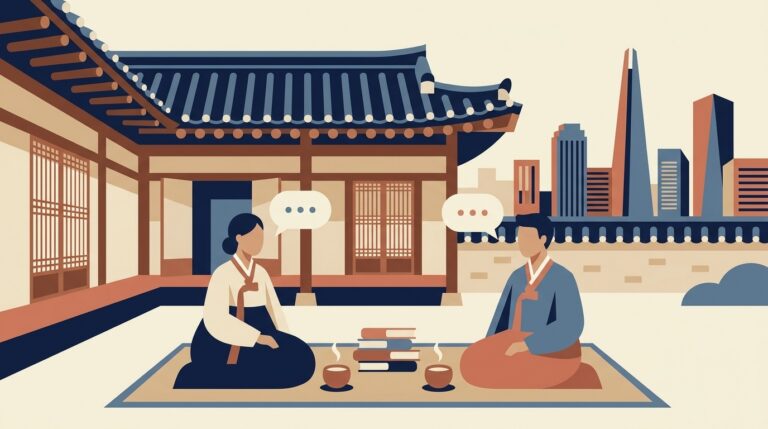
Setting: A quiet second-floor seminar room in a Hanok café near Bukchon Hanok Village. You are participating in an advanced political philosophy salon with Min-jun (민준), a doctoral candidate in political theory, and Su-jin (수진), a human rights attorney.
Dialogue (8 Turns)
Turn 1
* 민준: 롤스의 무지의 베일은 사회적 약자를 보호하기 위한 가장 완벽하고 객관적인 사고실험 아닐까요?
(Rol-seu-ui mu-ji-ui be-il-eun sa-hoe-jeok yak-ja-reul bo-ho-ha-gi wi-han ga-jang wan-byeok-ha-go gaek-gwan-jeok-in sa-go-sil-heom a-nil-kka-yo?)
“Isn’t Rawls’s veil of ignorance the most perfect and objective thought experiment designed to protect the socially disadvantaged?”
🎭 행동 지문: 안경을 고쳐 쓰며 도표가 그려진 노트를 가리킨다. (Adjusts his glasses and points to a notebook with drawn diagrams.)
Turn 2
* 나 (You): 이론적으로는 이상적이지만, 인간을 공동체의 도덕적 서사에서 완전히 분리할 수 있을까요?
(I-ron-jeok-eu-ro-neun i-sang-jeok-i-ji-man, in-gan-eul gong-dong-che-ui do-deok-jeok seo-sa-e-seo wan-jeon-hi bun-ri-hal su iss-eul-kka-yo?)
“It is theoretically ideal, but can human beings truly be detached completely from the moral narrative of their community?”
🎭 행동 지문: 찻잔을 천천히 내려놓으며 민준과 눈을 차분히 맞춘다. (Slowly places down the teacup and maintains calm eye contact with Min-jun.)
Turn 3
* 수진: 맞아요. 샌델이 지적했듯, 우리는 아무런 연고도 없는 진공 상태에서 정의를 규정할 수 없죠.
(Maj-a-yo. Saen-del-i ji-jeok-haet-deut, u-ri-neun a-mu-reon yeon-go-do eom-neun jin-gong sang-tae-e-seo jeong-ui-reul gyu-jeong-hal su eopt-jyo.)
“Exactly. As Sandel pointed out, we cannot define justice in a vacuum devoid of any shared ties.”
🎭 행동 지문: 고개를 끄덕이며 턱을 괴고 깊은 생각에 잠긴다. (Nods and rests her chin on her hand, lost in deep contemplation.)
Turn 4
* 민준: 하지만 역사나 공동체의 특수성을 너무 강조하면 보편적 인권이나 개인의 자유가 침해될 위험이 있지 않습니까?
(Ha-ji-man yeok-sa-na gong-dong-che-ui teuk-su-seong-eul neo-mu gang-jo-ha-myeon bo-pyeon-jeok in-gwon-i-na gae-in-ui ja-yu-ga chim-hae-doel wi-heom-i it-ji an-seum-ni-kka?)
“However, if we overemphasize history or the particularity of community, isn’t there a risk of infringing upon universal human rights and individual liberty?”
🎭 행동 지문: 펜을 가볍게 두드리며 신중한 반론을 제기한다. (Lightly taps his pen while raising a prudent counterargument.)
Turn 5
* 나 (You): 그 우려도 타당합니다. 하지만 롤스적 개인은 역사적 부채나 연대 의무를 망각한 ‘무연고적 자아’로 전락하기 쉽습니다.
(Geu u-ryeo-do ta-dang-ham-ni-da. Ha-ji-man Rol-seu-jeok gae-in-eun yeok-sa-jeok bu-chae-na yeon-dae ui-mu-reul mang-gak-han ‘mu-yeon-go-jeok ja-a’ro jeon-rak-ha-gi swip-seum-ni-da.)
“That concern is valid. However, the Rawlsian individual easily degenerates into an ‘unencumbered self’ who forgets historical debts and duties of solidarity.”
🎭 행동 지문: 양손을 모으며 포용적인 어조로 목소리의 톤을 안정시킨다. (Folds both hands together, stabilizing the vocal tone with an inclusive demeanor.)
Turn 6
* 수진: 전적으로 동의해요. 특히 한국 사회처럼 능력주의가 극단화된 곳에선 공공선에 대한 고민이 필수적이에요.
(Jeon-gyeok-eu-ro dong-ui-hae-yo. Teuk-hi Han-guk sa-hoe-cheo-reom neung-ryeok-ju-ui-ga geuk-dan-hwa-doen got-e-seon gong-gong-seon-e dae-han go-min-i pil-su-jeok-i-e-yo.)
“I whole-heartedly agree. Especially in a place like Korean society where meritocracy has become extreme, deliberation on the common good is essential.”
🎭 행동 지문: 노트를 열어 ‘공공선’이라는 단어를 굵게 밑줄 긋는다. (Opens her notebook and boldly underlines the term ‘common good’.)
Turn 7
* 민준: 그렇다면 진정한 정의는 제도의 공정성을 넘어 시민적 덕성을 함양하는 데서 출발해야겠군요.
(Geu-reot-da-myeon jin-jeong-han jeong-ui-neun je-do-ui gong-jeong-seong-eul neo-meo si-min-jeok deok-seong-eul ham-yang-ha-neun de-seo chul-bal-hae-ya-get-gun-yo.)
“Then true justice must depart from cultivating civic virtues beyond the mere institutional fairness.”
🎭 행동 지문: 미소를 지으며 납득했다는 듯 고개를 끄덕인다. (Smiles and nods as if completely persuaded.)
Turn 8
* 나 (You): 바로 그 지점입니다. 분리된 개인이 아니라 서로 얽힌 연대 속에서 비로소 도덕적 책임이 완성되니까요.
(Ba-ro geu ji-jeom-im-ni-da. Bun-ri-doen gae-in-i a-ni-ra seo-ro eol-khin yeon-dae sok-e-seo bi-ro-so do-deok-jeok chaek-im-i wan-seong-doe-ni-kka-yo.)
“That is precisely the point. Moral responsibility is ultimately realized not as isolated individuals, but within intertwined solidarity.”
🎭 행동 지문: 확신에 찬 눈빛으로 미소를 지으며 좌중을 둘러본다. (Looks around the table with an assured gaze and a gentle smile.)
🔀 Interactive Decision Point
How would you formulate your next remark when Min-jun asks how this philosophy applies to everyday modern life?
- Option A: “그러니까 능력 없는 사람도 무조건 똑같이 나눠 가져야 한다는 공산주의적 발상 아닌가요?” (So isn’t it a communist idea that untalented people should take identical shares?)
- Option B: “각자도생의 굴레를 벗어나 지역사회와 학교에서 시민적 덕성을 기르는 공론장을 복원해야 합니다.” (We must escape the fetters of ‘each fending for oneself’ and restore public spheres that foster civic virtues in local communities and schools.)
- Option C: “롤스든 샌델이든 솔직히 시험 성적 잘 받는 게 최고니까 한국에선 안 통합니다.” (Whether Rawls or Sandel, honestly getting high test scores is king, so it won’t work in Korea.)
Feedback on Your Choice:
- Option A (Bad): 🚫 Drastically misinterprets communitarianism as state-mandated radical egalitarianism/communism. It ignores Sandel’s emphasis on civic virtue and moral bonds, bringing down the intellectual rigor of a C2 conversation.
- Option B (Best): ✅ Superb! Incorporates sophisticated sociological terminology (“각자도생의 굴레”, “시민적 덕성”, “공론장 복원”) to tie philosophical theory directly into institutional practice with poise and eloquence.
- Option C (Risk): ⚠️ While reflective of cynical everyday banter regarding academic hyper-competition, it abruptly breaks the academic salon etiquette and shuts down constructive philosophical dialogue.
Phase 6: 10-Second Emotional Shadowing Drill
Practice these high-level philosophical lines out loud. Notice how pauses (/) establish gravitas and emotional cadence.
Drill 1 [🤔 깊은 사유를 담아 – Contemplative & Inquiring]
“우리는 진공 상태에 존재하는 / 무연고적 자아가 아니라, / 역사와 전통을 물려받은 / 서사적 존재입니다.”
(U-ri-neun jin-gong sang-tae-e jon-jae-ha-neun / mu-yeon-go-jeok ja-a-ga a-ni-ra, / yeok-sa-wa jeon-tong-eul mul-ryeo-ba-deun / seo-sa-jeok jon-jae-im-ni-da.)
“We are not unencumbered selves / existing in a vacuum, / but narrative beings / who have inherited history and tradition.”
Drill 2 [🔥 단호하고 설득력 있게 – Firm & Persuasive]
“능력주의가 낳은 승자의 오만은 / 패자에게 굴욕감을 안기고, / 결국 공동체의 도덕적 유대를 / 근본적으로 무너뜨립니다.”
(Neung-ryeok-ju-ui-ga na-eun seung-ja-ui o-man-eun / pae-ja-e-ge gul-yok-gam-eul an-gi-go, / gyeol-guk gong-dong-che-ui do-deok-jeok yu-dae-reul / geun-bon-jeok-eu-ro mu-neo-tteu-rim-ni-da.)
“The hubris of winners bred by meritocracy / inflicts humiliation upon the losers, / and ultimately shatters / the community’s moral ties at their very roots.”
Drill 3 [🤝 온화하면서도 통찰력 있게 – Warm & Visionary]
“진정한 정의는 / 공정한 분배 규칙을 넘어, / 시민들이 함께 공공선을 모색하는 / 시민적 덕성에서 완성됩니다.”
(Jin-jeong-han jeong-ui-neun / gong-jeong-han bun-bae gyu-chik-eul neo-meo, / si-min-deul-i ham-kke gong-gong-seon-eul mo-saek-ha-neun / si-min-jeok deok-seong-e-seo wan-seong-doem-ni-da.)
“True justice transcends / mere fair rules of distribution, / reaching completion in civic virtue / where citizens seek the common good together.”
Phase 7: K-Culture Mini Dictionary
- 공공선 (Gong-gong-seon)
- Translation: The Common Good.
- Context: Used frequently in Korean editorial columns and socio-economic debates to define goals that benefit the ethical wellbeing of the collective public rather than aggregate private gains.
- 시민적 덕성 (Si-min-jeok deok-seong)
- Translation: Civic Virtue.
- Context: In educational forums and political philosophy circles, it denotes the willingness of citizens to sacrifice personal narrow interests for active engagement in democratic moral life.
- 연고주의 (Yeon-go-ju-ui)
- Translation: Cronyism / Factionalism based on ties (Blood, Alma Mater, Region).
- Context: The negative degeneration of community. While communitarianism seeks moral ties, “연고주의” is fiercely criticized in Korean civil society for creating corrupt, exclusionary networks (학연, 지연, 혈연).
- 차등의 원칙 (Cha-deung-ui won-chik)
- Translation: The Difference Principle.
- Context: John Rawls’s famous second principle of justice. Regularly debated in Korean policy-making regarding tax welfare, student quotas for regional universities, and equal-opportunity employment.
Phase 8: Traveler’s Survival Kit
If you are traveling in Seoul and want to explore cultural salons, indie bookshops, and intellectual debate communities:
Top 3 Survival Expressions for Cultural Explorers
- “이 책의 토론 모임이나 인문학 세미나 일정이 있나요?”
(I chaek-ui to-ron mo-im-i-na in-mun-hak se-mi-na il-jeong-i in-na-yo?)
“Is there a schedule for discussion groups or humanities seminars regarding this book?”
💡 Pro Tip: Independent bookstores in areas like Seochon and Mapo often host evening philosophical salons open to walk-ins with reservation. -
“추천해 주실 만한 사회비평 교양서가 있을까요?”
(Chu-cheon-hae ju-sil man-han sa-hoe-bi-pyeong gyo-yang-seo-ga iss-eul-kka-yo?)
“Could you recommend an insightful socio-critical humanities book?” -
“공공성과 연대라는 주제를 다룬 섹션은 어디인가요?”
(Gong-gong-seong-gwa yeon-dae-ra-neun ju-je-reul da-run sek-syeon-eun eo-di-in-ga-yo?)
“Where is the section covering the themes of the public good and solidarity?”
Editor’s Travel Note
- Essential Navigation Tool: Google Maps often lags in Korea for pedestrian interior routes. Make sure you use the 네이버 지도 앱 다운로드 to find tucked-away intellectual literary bars and book cafés in Anguk or Mangwon.
- Local Salon Etiquette: When visiting philosophical book clubs or independent cultural spaces (such as Chegwan or Tongui-dong Boan Yeogwan), maintain quiet reverence. Conversations often start low, and participants prioritize listening intently to other perspectives before interjecting.
Phase 9: “One Step Deeper” (Reflective Essay)
The Tension Between ‘우리’ (We) and Meritocratic Individualism
Korea’s modern history is a fascinating contradiction between fierce communal warmth and ruthless meritocratic testing. Historically, the traditional agrarian Korean village functioned through Pumasi (품앗이 – mutual communal labor exchange) and Dure (두레 – collective farming cooperatives). You did not exist as a disconnected atom; your identity was defined by your communal obligations and shared moral duties.
However, the sudden adoption of Western market competitiveness created a pressure cooker where students compete for fractions of a percentile on the Suneung (College Scholastic Ability Test). This is why Michael Sandel’s critique of the unencumbered self hit Korea like a thunderbolt. When Sandel reminded readers that absolute meritocracy is an illusion and that individual gifts are unearned moral arbitrariness, Koreans felt both vindicated and challenged. To truly grasp the Korean language at a C2 level is to understand that beneath the glittering skyline of Seoul lies an ongoing struggle: How can a hyper-modern society preserve the warmth of collective belonging without falling back into exclusionary factionalism?
💬 Your Turn: Do you think it is possible to maintain deep communal solidarity without infringing upon individual privacy and autonomy? Have you noticed this tension in your own country? Leave a comment below and share your perspective!
Phase 10: FAQ & Avoiding Misunderstandings
Q: Communitarianism (공동체주의) sounds a lot like collectivism (집단주의). Are they the same in Korean?
A: Absolutely not! Collectivism (집단주의 – jip-dan-ju-ui) often carries the negative connotation of individuals being subjugated by state power or company hierarchy, sacrificing human rights for the collective machine. Communitarianism (공동체주의 – gong-dong-che-ju-ui), in Sandel’s sense, emphasizes mutual civic responsibility, active democratic participation, and moral relationships that enrich human agency rather than crushing it.
Q: Can I use the word “연고” (yeon-go) in positive business settings?
A: Be careful! While “연고” in academic philosophy refers to natural human ties and belonging, in Korean business and politics, “연고주의” (yeon-go-ju-ui) refers to cronyism, nepotism, and illicit favors granted through alumni (학연) or regional (지연) networks. Instead, use “네트워크” (network) or “상호 협력 관계” (mutual cooperative partnership) in business conversations.
Q: Why do Koreans say “우리 남편” (our husband) or “우리 집” (our house) even when speaking for themselves?
A: This is the linguistic fingerprint of an encumbered self! In Korean cultural psychology, grounding an entity in the collective “우리” (we/our) demonstrates belonging and modesty. Referring to your home as “내 집” (my house) in casual conversation can sound excessively detached, cold, or self-important.
🚨 Common Mistakes Warning Board
- Mistake 1: Translating “Fairness” directly as “공평” in all justice debates.
Correction: In philosophical discussions, use 공정 (Gong-jeong – Procedural/Substantive Justice and Fairness) rather than simple mathematical equality 공평 (Gong-pyeong). - Mistake 2: Confusing ‘자아’ (Ja-a) with ‘자신’ (Ja-sin).
Correction: “자신” refers to oneself in everyday context (“내가 직접 자신을 믿는다”). When discussing philosophical selfhood (the ego, the self as an ontological concept), always use 자아 (Ja-a) as in “무연고적 자아”. - Mistake 3: Conflating ‘능력주의’ (Neung-ryeok-ju-ui) with simple ‘실력’ (Skill/Competence).
Correction: Meritocracy as an ideological system is 능력주의. Describing someone with great capability is simply 실력이 뛰어나다.
Phase 11: Action Missions & Engagement
- 🥉 Bronze Mission (Solo Practice): Read Drill 2 from Phase 6 out loud three times. Record your voice on your smartphone and check if your pronunciation of “무연고적 자아” and “공동체적 유대감” sounds natural and authoritative without stammering.
- 🥈 Silver Mission (Social Sharing): Post a short reflection on Instagram, Threads, or your language-exchange app using the phrase: “우리는 각자도생이 아닌 공동체적 연대를 고민해야 합니다.” (We must deliberate on communal solidarity rather than every person fending for themselves).
- 🥇 Gold Mission (Real-World Application): Next time you watch a K-Drama with systemic social critique (e.g., Squid Game, D.P., or Sky Castle), write a 3-sentence critique in Korean explaining how the characters suffer from an absence of “시민적 덕성” (civic virtue) and extreme “능력주의” (meritocracy).
🎮 K-Culture Mission: Look up an interview or lecture by Professor Michael Sandel given in Seoul (available on YouTube with Korean subtitles). Identify how many times terms like “공공선” (common good) and “연대” (solidarity) are spoken by the audience members during the Q&A segment!
Phase 12: Interactive Quiz Challenge
Test your mastery of advanced Korean philosophical justice discourse!
1. Situational Judgment
In an academic seminar, someone claims: “Every individual is born a blank slate, with zero moral duties to their ancestors or national history.” Which phrase would a Communitarian critique use to describe this conception of the human being?
* (A) 실천적 이성 (Sil-cheon-jeok i-seong – Practical reason)
* (B) 무연고적 자아 (Mu-yeon-go-jeok ja-a – Unencumbered self)
* (C) 보편적 입법자 (Bo-pyeon-jeok ip-beop-ja – Universal legislator)
2. Fill-in-the-Blank
“현대 사회의 지나친 경쟁은 사회 구성원들을 서로 돕는 관계가 아니라, 오직 살아남기 위해 발버둥 치는 ( )의 상황으로 내몰고 있습니다.”
* Hint: A four-character idiom meaning “everyone fending for their own survival.”
3. True / False Cultural Quiz
- Statement: In Korea, Michael Sandel’s critique of meritocracy was rejected by the public because Koreans strictly believe that exam-based success should be the sole criterion for social status.
- [True / False]
🔍 Check the Answers & Explanations (정답 및 해설 펼치기)
-
Answer: (B) 무연고적 자아 (Mu-yeon-go-jeok ja-a)
Explanation: Communitarians like Michael Sandel explicitly define Rawls’s atomized, detached rational agent as an “unencumbered self” who rejects historical debts and relational moral duties. -
Answer: 각자도생 (Gak-ja-do-saeng)
Explanation: “각자도생” illustrates the grim modern social reality where communal solidarity is shattered, forcing citizens into individualistic survival mode. -
Answer: False
Explanation: Sandel’s books became monumental national bestsellers in South Korea precisely because people were exhausted by hyper-meritocracy and yearned for collective moral purpose, fairness, and restored solidarity.







