

When the Ondol Freezes: How to Report Boiler Breakdowns and Error Codes in Korea
Phase 1: Empathy & Storytelling Opening
안녕하세요! This is the Daily Hangul editor. Picture this: It is 7:30 AM on a biting January morning in Seoul. The temperature outside has plummeted to -12°C. You groggily swing your legs out of bed, expecting the comforting, radiant warmth of Korea’s legendary ondol floor—only to find it icy cold. Shivering, you walk over to the sink to wash your face, turn the faucet to the left, and wait. One minute passes, then two. Still, ice-cold water trickles out.
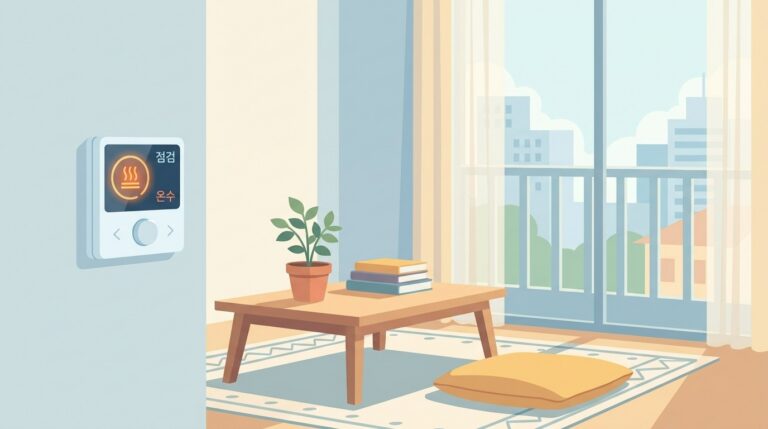
In a mild panic, you run to the small digital boiler remote panel on the living room wall. Instead of the friendly green light or steady temperature number, you see a blinking red light flashing an ominous code: ‘Er-02’ or ‘04’. The heating is dead, the hot water is gone, and you have work in an hour. What do you do?
If you have ever stared helplessly at that plastic wall controller, frantically googling in English while wrapped in three blankets, you are definitely not alone! Boiler troubles are the ultimate winter rite of passage for expats, exchange students, and long-term travelers living in Korean studio apartments (one-rooms). Calling a landlord (집주인) or a repair technician (기사님) can feel terrifying if you don’t know the exact phrasing. In this lesson, we will master the exact words you need to turn that blinking red error into a warm, toasty apartment before sundown.
Phase 2: Top 3 Core Expressions Deep-Dive
Here are the three life-saving expressions you must keep in your phone’s memo pad when your boiler acts up.
1. 보일러에 에러 코드가 뜨고 난방이 안 돼요. (Boilleo-e ereo kodeuga tteugo nanbangi an dwaeyo.)
- Pronunciation: Boil-luh-eh eh-ruh ko-deu-gah tteu-go nahn-bahng-ee ahn dweh-yo (Think of ‘tteu-go’ as a sharp, popping ‘t’ sound like ‘tt-go’)
- Meaning: Literal: “An error code is floating on the boiler and heating does not become.” / Actual Nuance: “An error code popped up on the boiler and neither the floor heating nor room heating is working.”
- K-Culture Moment: You will hear this exact exasperated line in almost every slice-of-life K-drama featuring a struggling twenty-something living in a rooftop room (oktapbang), desperately calling their landlord while wearing a padded parka indoors.
- Editor’s Insight: In Korean, when a message or alert shows up on an electronic screen, native speakers use the verb 뜨다 (tteuda), which literally means “to float” or “to rise.” Saying 에러 코드가 떴어요 sounds infinitely more natural than saying 에러가 나타났어요 (an error appeared).
- Situation Spectrum: Casual: ⚠️ (to friends) | Semi-formal: ✅ (to landlord) | Formal: ✅
- 🤔 Think About It: Notice how Korean uses the passive-friendly verb 안 돼요 (“it doesn’t work/happen”) rather than blaming a broken mechanism directly. Why do you think Korean communication prefers describing the state rather than pointing fingers?
2. 온수가 전혀 안 나와서 그러는데 와서 봐주실 수 있나요? (Onssuga jeonhyeo an nawaseo geureoneunde waseo bwajusil su innayo?)
- Pronunciation: Ohn-soo-gah juhn-hyuh ahn nah-wah-suh geu-ruhn-neun-deh wah-suh bwah-joo-shil soo eent-nah-yo?
- Meaning: Literal: “Hot water isn’t coming out at all, so that is why, could you please come and look?” / Actual Nuance: “Hot water isn’t coming out at all, so could you please drop by to inspect it?”
- K-Culture Moment: The magic connective ~아서/어서 그러는데 (-aseo/eoseo geureoneunde) is the holy grail of polite requests in Korean customer service and daily interactions. It softens an urgent demand into a reasonable explanation.
- Editor’s Insight: If you bluntly say 와서 보세요 (Come and look), it sounds like an aggressive command. Adding ~봐주실 수 있나요? (Could you look for me?) turns your plea into a humble, respectful request that landlords will happily jump to help solve.
- Situation Spectrum: Casual: 🚫 | Semi-formal: ✅ | Formal: ✅
- 🤔 Think About It: How does your native language cushion an urgent complaint? Do you apologize before asking, or do you state the problem outright?
3. 화면 사진 찍어서 문자로 보내드릴게요. (Hwamyeon sajin jjigeoseo munjaro bonaedeurilgeyo.)
- Pronunciation: Hwah-myuhn sah-jeen jjee-guh-suh moon-jah-ro boh-neh-deu-reel-geh-yo
- Meaning: Literal: “I will take a picture of the screen and send it to you by text.” / Actual Nuance: “I’ll snap a photo of the error display and text it over to you right away.”
- K-Culture Moment: Korean real estate culture runs on KakaoTalk and SMS photos. Landlords and repair technicians usually manage multiple units; texting a clear photo of the model number and blinking error saves 30 minutes of back-and-forth guessing.
- Editor’s Insight: Notice the ending ~ㄹ게요 (~l-geyo). This shows a polite personal commitment or promise to do something for the listener’s convenience. It projects quick cooperation.
- Situation Spectrum: Casual: ⚠️ | Semi-formal: ✅ | Formal: ✅
- 🤔 Think About It: In many Western countries, tenants wait for property managers through official email tickets. In Korea, quick SMS photo exchanges happen within minutes. How does this speed reflect the Palli-palli (fast-fast) culture?
Phase 3: Textbook Korean vs. Real Korean
Let’s compare stiff, robotic textbook translations with what native Koreans actually say in real life.
Situation 1: Reporting the boiler problem to your landlord
- 📖 교과서 한국어 (Textbook Korean):
“보일러 기기가 작동하지 않으니 신속히 수리해 주십시오.”
(The boiler device is not functioning, so please repair it promptly.) - 🗣️ 진짜 한국어 (Real Korean):
“사장님, 보일러에 빨간 불 들어오면서 난방이 아예 안 돼요 ㅠㅠ”
(Sajangnim, the boiler has a red light on and the heating isn’t working at all ㅠㅠ) - 💡 왜 다를까? (Why the difference?):
Textbooks teach imperative commands like ~해 주십시오. In real life, Korean tenants address their private landlords warmly as 사장님 (literally ‘boss’, used politely for business owners or property managers) and use expressive adverbs like 아예 (not at all) alongside the observable sign (빨간 불, red light).
Situation 2: Asking if a technician can visit today
- 📖 교과서 한국어 (Textbook Korean):
“금일 수리 기사님의 방문 일정을 예약할 수 있습니까?”
(Is it possible to schedule a visit by the repair technician today?) - 🗣️ 진짜 한국어 (Real Korean):
“혹시 기사님 오늘 바로 오실 수 있을까요? 너무 추워서요…”
(By any chance, could the technician come today? It’s just so cold…) - 💡 왜 다를까? (Why the difference?):
Starting your request with 혹시 (by any chance) acts as a verbal buffer. Ending with ~어서요 gives a soft reason (너무 추워서요, because it’s too cold) which naturally pulls sympathy and speeds up emergency visits without sounding rude.
Phase 4: K-Culture Deep Dive & Non-verbal Manners
4-1. Nunchi (눈치) & Gestures
When interacting with landlords or boiler repair technicians (기사님), non-verbal etiquette will get your radiator humming hours faster:
1. Always lead with evidence before calling: Before dialing the landlord, snap two photos: one close-up of the thermostat controller screen showing the error digits, and one of the boiler unit itself (usually in the utility veranda, showing the brand: Navien, Rinnai, or Kiturami).
2. The Polite Slipper Welcoming: When the technician arrives, immediately open the front door wide, bow slightly at 15 degrees, and point to the boiler location: “이쪽이에요! 고생 많으십니다” (It is this way! Thank you for your hard work). Offering a warm canned drink (like Bacchus or warm canned coffee from the convenience store) is the ultimate Korean hospitality move that guarantees they treat your repair with top priority!
4-2. Cultural Code: The Sacred Ondol (온돌)
Korea’s underfloor radiant heating (온돌, Ondol) is not just an appliance; it is an emotional pillar of Korean home life. Unlike Western radiators that circulate dry, warm air, Ondol heats the floor stones directly. Because Koreans historically sit, eat, and sleep directly on the floor, a freezing floor feels like an existential crisis.
During Siberian cold snaps in Seoul (한파, Hanpa), external boiler pipes can freeze solid (동파, Dongpa). When this happens, repair lines get backed up for days. Understanding that a broken boiler during sub-zero temperatures is treated as a top-priority home emergency by Korean building managers will help you navigate your repair with patience and mutual understanding.
Phase 5: Real-world Roleplay Scenario
Setting: Alex’s one-room apartment in Sinchon on a freezing Tuesday morning. The wall thermostat is blinking ’03’. Alex calls Landlord Mr. Kim.
- Alex: 여보세요, 사장님! 저 302호 알렉스인데요. 이른 시간에 죄송합니다.
(Yeoboseyo, sajangnim! Jeo sambaek-i-ho Alekkseu-inde-yo. Ireun sigane joesonghamnida.)
“Hello, Mr. Kim! This is Alex from room 302. I’m sorry for calling so early.”
🎭 [안절부절못하며 입김을 호호 불며 통화한다 / Pacing nervously, blowing warm breath into cold hands] -
Mr. Kim: 어, 알렉스 씨! 무슨 일 있어요?
(Eo, Alekkseu ssi! Museun il isseoyo?)
“Oh, Alex! What’s going on?”
🎭 [친절하지만 바쁜 목소리로 전화를 받는다 / Answers in a friendly but busy tone] -
Alex: 보일러 전원을 켰는데 화면에 ‘03’ 에러 코드가 뜨면서 온수랑 난방이 전혀 안 나와요.
(Boilleo jeonweoneul kyeonneunde hwamyeone ‘gong-sam’ ereo kodeuga tteumeonseo onssurang nanbangi jeonhyeo an nawaseoyo.)
“I turned on the boiler, but an error code ’03’ popped up on the screen and neither hot water nor heating works at all.”
🎭 [벽에 걸린 조절기를 손가락으로 가리키며 / Pointing at the wall panel] -
Mr. Kim: 아이고, 날씨가 영하 10도라 배관이 얼었나 보네. 혹시 온수 쪽으로 수도꼭지 돌리면 물은 나와요?
(Aigo, nalssiga yeong-ha sip-dora baegwani eoreonna bone. Hoksi onsu jjogeuro sudokkokji dollimyeon mureun nawayo?)
“Oh dear, it’s minus 10 outside so the pipes might have frozen. By any chance, if you turn the faucet toward hot water, does water come out at all?”
🎭 [걱정스러운 한숨을 쉬며 / Sighing with concern] -
Alex: 네, 찬물은 콸콸 나오는데 온수 쪽은 아예 물이 안 나와요.
(Ne, chanmureun kwalkwal naoneunde onsu jjogeun aye muri an nawayo.)
“Yes, cold water gushes out fine, but on the hot water side, no water comes out at all.”
🎭 [싱크대 수전을 만져보며 확인한다 / Checking the kitchen faucet] -
Mr. Kim: 그러면 온수 배관이 얼었네! 내가 지금 조절기 화면 사진 찍어서 문자로 보내줄 수 있어요?
(Geureomyeon onsu baegwani eoreonne! Naega jigeum jojeolgi hwamyeon sajin jjigeoseo munjaro bonaejul su isseoyo?)
“Then the hot water pipe is frozen! Can you snap a photo of the controller screen and text it to me?”
🎭 [안경을 고쳐 쓰며 받아적을 준비를 한다 / Adjusting glasses, ready to note it down] -
Alex: 네, 조절기랑 베란다 보일러 사진 찍어서 바로 보내드릴게요!
(Ne, jojeolgimrang beranda boilleo sajin jjigeoseo baro bonaedeurilgeyo!)
“Yes, I’ll take pictures of both the controller and the veranda boiler and send them right away!”
🎭 [스마트폰 카메라 앱을 켜며 / Opening the smartphone camera app] -
Mr. Kim: 그래요, 확인하고 바로 단골 수리 기사님 불러줄게요. 조금만 패딩 입고 기다려요!
(Geuraeyo, hwaginhago baro dangol suri gisanim bulleojulgeyo. Jogeumman paedang ipgo gidaryeoyo!)
“Alright, once I check it, I’ll call our regular repair technician immediately. Wear your winter padded jacket and wait a bit!”
🔀 Interactive Branching Choice
Suppose the landlord says he is out of town and cannot send anyone until tomorrow evening. How do you respond?
- Choice A: “너무 추운데 오늘 안 오시면 계약 해지할게요!” (It’s too cold, if you don’t come today I will break the lease!)
- Choice B: “사장님, 날씨가 너무 추워서 그런데 혹시 제가 직접 A/S 센터 불러도 비용 처리해 주실 수 있나요?” (Landlord, it is extremely cold, so by any chance, if I call the official service center directly, can you reimburse the cost?)
- Choice C: “알겠습니다. 그냥 내일까지 온수 안 쓰고 기다릴게요.” (Understood. I will just wait until tomorrow without using hot water.)
Feedback:
* Option A (Risk): Very confrontational! Threatening lease termination immediately damages goodwill, and legally in Korea, landlords have reasonable repair response windows.
* Option B (Best!): Proactive, respectful, and legally sound. Most Korean landlords are relieved if you arrange the technician yourself as long as you confirm reimbursement (비용 처리, biyong cheori) in advance.
* Option C (Bad): In -10°C weather, waiting 36 hours can cause boiler pipes to burst (배관 동파), resulting in thousands of dollars in water damage to the floor below.
Phase 6: 10-Second Emotion Shadowing Drill
Practice these lines out loud! Follow the pause markers (/) and match the emotional guide in brackets.
[🥶 오들오들 떨며 다급하게 / Shivering frantically]
보일러 전원을 켰는데 / 빨간 불이 깜빡거리면서 / 온수가 전혀 안 나와요!
(Boilleo jeonweoneul kyeonneunde / bpalgan buri kkamppak-georimyeonseo / onssuga jeonhyeo an nawayo!)-
[🙏 정중하고 간곡하게 / Politely and pleadingly]
방바닥이 너무 차가워서 그러는데 / 기사님 혹시 / 오늘 와주실 수 있나요?
(Bangbadagi neomu chagaweoseo geureoneunde / gisanim hoksi / oneul wajusil su innayo?) -
[💡 안도하며 싹싹하게 / Relieved and bright]
네 사장님! / 계량기랑 에러 코드 사진 / 지금 바로 문자로 보내드릴게요!
(Ne sajangnim! / gyeryang-girang ereo kodeu sajin / jigeum baro munjaro bonaedeurilgeyo!)
Phase 7: K-Culture Mini Dictionary
| Term (한글+로마자) | Meaning | Real-Life Application |
|---|---|---|
| 1. 온돌 (Ondol) | Korean Radiant Floor Heating | Don’t confuse it with room air (공기). The control button saying ‘난방’ heats the floor, while ‘온수’ heats your tap and shower water. |
| 2. 동파 (Dongpa) | Pipe Freezing & Bursting | The worst winter dread in Korea! When the temperature drops below -10°C, news bulletins urge everyone: “수도꼭지를 조금 열어 물을 똑똑 떨어뜨리세요” (Leave the tap slightly dripping). |
| 3. 외출 모드 (Oechul Mode) | “Away / Eco” Boiler Setting | When leaving your apartment for work or vacation during winter, NEVER turn the boiler completely off! Switch it to 외출 so it circulates warm water periodically to prevent pipes from freezing. |
| 4. A/S 기사님 (A-eseu Gisanim) | After-Service / Repair Technician | In Korea, repair technicians from major brands (Navien, Rinnai) are respectfully addressed as 기사님 (Master/Engineer). Always use this title rather than 아저씨. |
Phase 8: Traveler and Resident Survival Kit
Top 3 Emergency Boiler Phrases
- 에러 코드 사진 찍어뒀어요. (Ereo kodeu sajin jjigeodwosseoyo.) — “I already took a picture of the error code.”
Pro Tip: Have the photo ready before you make the phone call so you don’t scramble while speaking. - 배관이 얼어서 물이 아예 안 나오는 것 같아요. (Baegwani eoreoseo muri aye an naoneun geot gatayo.) — “I think the pipe froze because water isn’t coming out at all.”
- 수리비는 어떻게 정산하면 될까요? (Suribineun eotteoke jeongsanhamyeon doelkkayo.) — “How should we settle the repair bill?”
Pro Tip: By standard Korean rental law, repairs for natural wear or winter pipe freezing not caused by gross tenant negligence are covered by the building owner.
Editor’s Life Navigation Note
- Emergency Repair Search: If your landlord isn’t answering, open your Naver Map app and search for your boiler brand name followed by A/S: e.g., ‘경동나비엔 서비스센터’ (Kyungdong Navien Service Center) or ‘린나이 보일러 수리’ (Rinnai Boiler Repair). You can book online repairs 24/7!
Phase 9: “한 발 더 깊이” (Deep Cultural Thought)
In many individualistic housing cultures, property maintenance is purely transactional: you log an online ticket, wait for an automated dispatch, and maintain a formal distance. In Korea, residential buildings—especially multi-household villas (빌라) and studio units (원룸)—are tied closely to communal harmony. Landlords often live on the top floor of the same building.
When something breaks, framing your request with emotional resonance (“너무 추워서 감기 걸릴 것 같아요” – It’s so cold I think I’ll catch a cold) and immediate cooperation creates what Koreans call 정 (Jeong)—affectionate communal care. Treat your landlord not as an adversary landlord, but as a neighborhood elder helping you survive the harsh winter, and you’ll find repairmen knocking on your door within hours!
💬 Your Turn: Has your home heating ever broken down unexpectedly in another country? How would you handle communicating this problem across a language barrier? Share your thoughts below!
Phase 10: FAQ & Common Mistakes
Q: Who pays for the boiler repair in a Korean studio apartment?
A: Under standard Korean civil law, major facility breakdowns—including boiler malfunctions, pipe aging, and roof leaks—are the financial responsibility of the landlord (임대인). However, if the tenant turned off the heating completely during a sub-zero cold wave and caused the pipes to freeze solid, the tenant may be held partially liable. Always notify your landlord before authorizing expensive part replacements.
Q: What should I do immediately when an error code appears?
A: First, turn the main power button on the controller off, wait 10 seconds, and turn it back on (a soft reset fixes minor sensor glitches). If the code reappears, write down the numbers, take a photo, and check whether cold water flows from your tap. If cold water runs but hot water doesn’t, your hot water supply pipe is frozen.
Q: Can I thaw frozen boiler pipes myself with boiling water?
A: Never pour boiling water directly onto frozen plastic or copper boiler pipes! This can cause thermal shock and crack the pipes instantly. Instead, wrap the frozen pipes with warm damp towels and use a hairdryer on medium heat, or call a professional thawing service (해빙 기사님).
🚨 Common Mistakes Alert
- Mistake: Completely switching off the boiler when traveling during winter.
Correct Action: Always keep the boiler on 외출 (Away) mode or set the minimum temperature to 16°C–18°C. - Mistake: Using aggressive command verbs like “빨리 고쳐요!” (Fix it fast!).
Correct Action: Use polite explanatory phrasing: “보일러가 멈춰서 그러는데, 혹시 언제쯤 확인 가능하실까요?” - Mistake: Calling the technician without noting the boiler brand and model name.
Correct Action: The veranda boiler unit has a manufacturer sticker showing the exact model (e.g., NCB353). Check this first!
Phase 11: Action Missions
- 🥉 Bronze Level: Walk up to your wall thermostat right now. Identify the buttons for 전원 (Power), 난방 (Heating), 온수 (Hot Water), and 외출 (Away). Say each word out loud three times!
- 🥈 Silver Level: Imagine your hot water suddenly stops. Practice speaking the key phrase into your phone recorder: “사장님, 온수가 안 나와서 그러는데 한번 봐주실 수 있나요?”
- 🥇 Gold Level: Next time you see a delivery driver or maintenance technician in your hallway, give a warm bow and greet them with: “추운 날씨에 고생 많으십니다!” (Thank you for working hard in this cold weather!).
- 🎮 K-Culture Mission: Watch an episode of a Korean variety show or drama set in winter (like Reply 1988 or My Mister). Look for scenes where characters talk about warm blankets, heating pads (전기장판), or complaining about cold rooms!
Phase 12: Interactive Quiz Challenge
Test your real-world boiler survival instincts below!
1. Situational Judgment:
You wake up to error code ’01’ on your boiler panel. Which text message is best to send your landlord?
* A) “보일러 망가졌어요. 당장 새 걸로 바꿔주세요.”
* B) “사장님, 아침부터 보일러에 01번 에러가 뜨면서 온수가 안 나와요. 사진 보내드렸는데 확인 부탁드립니다!”
* C) “보일러 기계 수리가 불가능하니 법적 조치를 취하겠습니다.”
2. Fill-in-the-Blank:
겨울철에 집을 비울 때는 보일러를 끄지 말고 꼭 (_____) 모드로 설정해야 배관 동파를 막을 수 있어요.
(When leaving home in winter, you must set the boiler to [_____] mode instead of turning it off to prevent pipes from freezing.)
3. True or False:
In Korean, the term ‘난방’ refers strictly to heating tap water for your morning shower. (True / False)
Click here for answers and explanations!
1. Answer: B
Explanation: Option B clearly identifies the error code, states the specific symptom (온수가 안 나와요), mentions the attached photo, and maintains a warm, respectful tone (확인 부탁드립니다). Option A is rude, and Option C is needlessly aggressive.
2. Answer: 외출 (Oechul / Away)
Explanation: The 외출 모드 keeps the water temperature just above freezing to prevent costly pipe ruptures while saving electricity and gas.
3. Answer: False
Explanation: 난방 (Nanbang) refers to heating the floor and room space. Tap and shower water is called 온수 (Onsu)!







