

Phase 1: Empathy & Morning Routine Realities
안녕하세요! 매일한글 에디터입니다. (Hello! This is your Daily Hangul editor.)
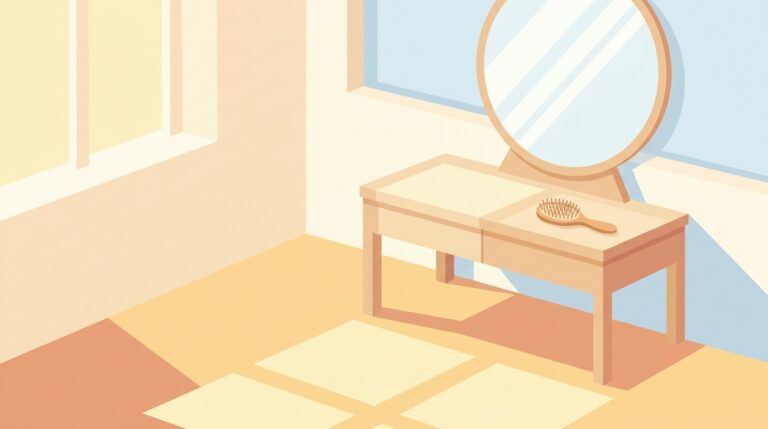
Picture this classic K-Drama opening: sunlight pours into a cozy Seoul studio apartment (원룸), the upbeat soundtrack begins, and our favorite character hops out of bed. They sit down at a compact wooden vanity, pick up a pastel hairbrush, and start getting ready for the day. But when you want to describe this simple everyday moment in Korean, your mind suddenly goes blank. Is it “look mirror”? How do you say “while doing something”? Why are there so many words for furniture and rooms?
Many of our beginner learners tell us: “I know how to say hello and thank you, but I feel completely stuck trying to describe what I do inside my own home every morning!” If that sounds familiar, don’t worry. Today’s guide is designed especially for A1 beginners. By the end of this lesson, you will comfortably name key bedroom items and naturally say: 거울을 보면서 머리를 빗어요 (I comb my hair while looking in the mirror). Let’s turn your daily morning routine into fluent, natural Korean!
Phase 2: Core Expressions Deep Dive
Here are the three foundational building blocks you need to master this topic.
1. 거울을 봐요 (Geoureul bwayo)
- Pronunciation: [Geoureul bwayo] (Sounds like: guh-ool-eul bwah-yo)
- Meaning: Literal: “Look at the mirror” | Actual Nuance: “Checking one’s appearance in the mirror”
- K-Culture Moment: Seen right before a K-Drama date or in a K-Pop idol’s dance practice studio where dancers check their lines.
- Editor’s Insight: In Korean, you don’t say “I look at myself in the mirror”; you simply say “I look at the mirror” (거울을 봐요). The context makes it obvious who you are checking!
- Situation Spectrum: Casual: ✅ | Semi-formal: ✅ | Formal: ⚠️
- 🤔 Think About It: In English, we focus on the reflection (“looking at myself”), whereas Korean focuses on the object facilitating the action (“looking at the mirror”). How does this shift your perspective?
2. 머리를 빗어요 (Meorireul biseoyo)
- Pronunciation: [Meorireul biseoyo] (Sounds like: muh-ree-reul bee-suh-yo)
- Meaning: Literal & Nuance: “I brush/comb my hair”
- K-Culture Moment: A warm scene where a parent gently brushes their child’s hair or someone fixing their bangs (앞머리) before leaving home.
- Editor’s Insight: The word 머리 (meori) means both “head” and “hair”. Don’t panic—nobody thinks you are brushing your skull! The verb 빗다 (bitda – to comb) clarifies that you are tending to your hair.
- Situation Spectrum: Casual: ✅ | Semi-formal: ✅ | Formal: ⚠️
- 🤔 Think About It: Grouping “head” and “hair” under one word reflects a holistic view of the body in Korean daily linguistics.
3. 거울을 보면서 머리를 빗어요 (Geoureul bomyeonseo meorireul biseoyo)
- Pronunciation: [Geoureul bomyeonseo meorireul biseoyo] (Sounds like: guh-ool-eul bo-myun-suh muh-ree-reul bee-suh-yo)
- Meaning: “I comb my hair while looking in the mirror”
- K-Culture Moment: Fast-paced morning scenes where characters talk on the phone with their best friend while prepping at the vanity.
- Editor’s Insight: The connector -(으)면서 (-(eu)myeonseo) is the ultimate multitasker grammar! Attach it to the verb stem to describe doing two actions at the exact same time.
- Situation Spectrum: Casual: ✅ | Semi-formal: ✅ | Formal: ✅
- 🤔 Think About It: Multitasking in morning routines is a global habit, but connecting verbs with -(으)면서 gives your Korean sentence instant natural rhythm.
Phase 3: Textbook Korean vs. Real Korean
Let’s compare stiff grammar-book lines with the lively phrases real Koreans speak every morning.
Situation 1: Checking yourself in the mirror
- 📖 교과서 한국어 (Textbook): 거울을 응시하며 머리를 빗습니다. (Geoureul eungshihamyeo meorireul bitseumnida. – I gaze at the mirror and brush hair.)
- 🗣️ 진짜 한국어 (Real-Life): 거울 보면서 머리 빗는 중이에요! (Geoul bomyeonseo meori binneun jung-ieyo! – I’m just combing my hair looking in the mirror!)
- 💡 왜 다를까? (Why is it different?): In casual spoken Korean, people often drop object markers like -을/를 and use lively aspect endings like -는 중이에요 (-ing / in the middle of) instead of stiff formal written words like “응시하다” (to gaze).
Situation 2: Telling someone you’re finishing up in front of the vanity
- 📖 교과서 한국어 (Textbook): 화장대에서 용모 단장을 마쳤습니다. (Hwajangdae-eseo yongmo danjang-eul machyeotseumnida. – I finished tidying my personal appearance at the dressing table.)
- 🗣️ 진짜 한국어 (Real-Life): 화장대 앞에서 머리만 빗고 나갈게! (Hwajangdae apeseo meoriman bitgo nagalge! – I’ll just brush my hair at the vanity and head out!)
- 💡 왜 다를까? (Why is it different?): Real conversations use clear, functional expressions. Stating the exact action (머리만 빗고 나갈게) sounds friendly and natural between roommates and friends.
Phase 4: K-Culture Deep Dive & Non-Verbal Manners
4-1. Nunchi (눈치) & Mirror Etiquette in Korea
In South Korea, looking neat and well-groomed (단정함, danjeongham) is considered a basic courtesy to others. You will notice mirrors everywhere: subway station pillars, elevator doors, and convenience store displays. While checking your bangs or wiping away a smudge in a public mirror is completely acceptable, pulling out a large brush to rigorously comb your hair in a crowded subway or dining room table lacks nunchi (social awareness). Hair grooming is strictly a private, bathroom, or vanity table ritual!
4-2. The Korean “One-Room” & Vanity Culture
Because studio apartments (원룸, won-room) are the staple living quarters for university students and young professionals in Seoul, furniture design is ingeniously compact. Most Korean homes feature a dedicated 화장대 (hwajangdae – vanity table) with hidden compartments and an attached LED mirror. You’ll also spot the famous round styling brush, known locally as a 롤빗 (rol-bit), which every Korean beauty enthusiast swears by for that effortlessly bouncy curtain bang look.
Phase 5: Real-Life Roleplay Scenario
Setting: Saturday morning, 10:00 AM. A sunny studio apartment in Hongdae. Sarah and her Korean roommate Minji are getting ready to meet friends for brunch.
- 민지 (Minji): 사라야, 홍대 갈 준비 다 했어? (Saraya, Hongdae gal junbi da haesseo? / Sarah, are you all ready to go to Hongdae?) 🎭 knocking gently on Sarah’s bedroom door
- 사라 (Sarah): 아직이요! 지금 거울을 보면서 머리를 빗고 있어요. (Ajig-iyo! Jigeum geoureul bomyeonseo meorireul bitgo isseoyo. / Not yet! I’m combing my hair right now while looking in the mirror.) 🎭 holding a brush while turning around
- 민지 (Minji): 방에 화장대 있어? 필요하면 내 헤어드라이어 써! (Bange hwajangdae isseo? Piryohamyeon nae heeodeuraiyeo sseo! / Do you have a vanity in your room? Use my hair dryer if you need it!) 🎭 pointing towards the shared table
- 사라 (Sarah): 네, 화장대 거울이 커서 보기 편해요! (Ne, hwajangdae geouri keoseo bogi pyeonhaeyo! / Yes, the mirror on the vanity is big so it’s easy to see!) 🎭 smiling into the mirror
- 민지 (Minji): 내 롤빗 빌려줄까? 앞머리 정리에 진짜 좋아. (Nae rolbit billyeojulkka? Ammeori jeongnie jinjja joa. / Want to borrow my roll brush? It’s really good for fixing bangs.) 🎭 holding out a round pink styling brush
- 사라 (Sarah): 고마워요! 이 빗으로 얼른 빗을게요. (Gomawoyo! I biseuro eolleun biseulgeyo. / Thank you! I will brush it quickly with this comb.) 🎭 receiving the brush with both hands
- 민지 (Minji): 천천히 해~ 나 거실 소파에 앉아서 기다릴게. (Cheoncheonhi hae~ Na geosil sopae anjaseo gidarilge. / Take your time~ I’ll wait sitting on the living room sofa.) 🎭 walking toward the living room couch
- 사라 (Sarah): 네, 5분 뒤에 거실로 나갈게요! (Ne, obun dwie geosillo nagalgeyo! / Okay, I’ll come out to the living room in 5 minutes!) 🎭 checking hair one final time in the mirror
🔀 Interactive Choice Point
Minji notices your hair and asks: “머리 다 빗었어?” (Meori da biseosseo? / Did you finish brushing your hair?) How do you respond?
- Choice A: “네, 거울 보면서 다 빗었어요!” (Ne, geoul bomyeonseo da biseosseoyo! / Yes, I brushed it all while looking in the mirror!)
- Feedback (Best!): Perfect! Accurate, polite, and uses today’s grammar flawlessly.
- Choice B: “싫어요! 저리 가요.” (Sireoyo! Jeori gayo. / I hate it! Go away.)
- Feedback (Bad): Extremely rude to a helpful friend or roommate. Avoid using this!
- Choice C: “머리를 때려요.” (Meorireul ttaeryeoyo. / I hit my head.)
- Feedback (Risk): Danger! “때리다” means to hit/strike. Mixing up 빗다 (bitda – to comb) with unrelated verbs will cause serious confusion!
Phase 6: 10-Second Emotion Shadowing Drill
Practice these lines out loud. Pause briefly at the slashes (/) and embody the emotion tags!
[😴 졸리고 나른하게 / Sleepy & slow]
거울을 / 보면서… / 머리를 / 빗어요.
(Geoureul / bomyeonseo… / meorireul / biseoyo.)-
[⚡ 바쁘고 서두르며 / Hurried & rushed]
거울 보면서 / 빨리 / 머리 빗고 나갈게!
(Geoul bomyeonseo / ppalli / meori bitgo nagalge!) -
[✨ 상쾌하고 자신감 넘치게 / Fresh & confident]
화장대 거울 보니까 / 오늘 머리 / 진짜 마음에 들어요!
(Hwajangdae geoul bonikka / oneul meori / jinjja maeume deureoyo!)
Phase 7: K-Culture Mini Dictionary
- 1. 거울 (Geoul) | Mirror | Essential furniture item in every Korean bedroom, bathroom, and entryway shoe cabinet (신발장).
- 2. 빗 (Bit) | Comb / Brush | Everyday grooming tool. Paired with “roll” to create 롤빗 (rol-bit), the iconic round styling brush.
- 3. 화장대 (Hwajangdae) | Dressing Table / Vanity | Composed of “화장” (makeup) and “대” (stand/table). The nerve center of morning skincare.
- 4. 방 (Bang) | Room | The core word for rooms in Korean. Combines into 안방 (master bedroom), 내 방 (my room), and entertainment hubs like 노래방 (karaoke room)!
Phase 8: Survival Kit for Travelers
Top 3 Survival Phrases
- 거울 어디에 있어요? (Geoul eodie isseoyo?) — “Where is the mirror?”
- Pro Tip: Useful in fitting rooms, clothing boutiques, and cafes across Seoul.
- 빗 하나만 빌려주실 수 있나요? (Bit hanaman billyeojusil su innayo?) — “Could you lend me a comb?”
- Pro Tip: Helpful at hotels, guesthouses, or hair salons.
- 화장실 거울 좀 봐도 될까요? (Hwajangsil geoul jom bwado doelkkayo?) — “May I check the restroom mirror?”
- Pro Tip: A polite way to ask restaurant staff if you can touch up your hair in their bathroom.
Editor’s Travel Note
Need emergency grooming gear in Korea? Head straight to Daiso! You can find sturdy vanity mirrors, portable pocket combs, and rollers for 1,000 to 3,000 KRW. Use the [Naver Map app store locator] to find the nearest multi-floor Daiso flagship in Myeongdong or Hongdae. Always keep a portable mini mirror in your daypack—it’s a staple Seoul travel habit!
Phase 9: “One Step Deeper” (Cultural Reflection)
In Korean society, looking into the mirror before stepping outside is not merely about vanity; it is an act of consideration for the community. Presenting a neat, orderly appearance (단정한 모습, danjeonghan moseup) signals respect to teachers, colleagues, and friends. By taking care of your hair and clothes, you communicate that you value the shared social space. Next time you stand before your vanity mirror, remember that you are participating in a cherished cultural norm of mutual consideration.
💬 Your Turn: What is the first thing you look for in your bedroom mirror every morning? Share your routine in the comments below!
Phase 10: FAQ & Avoiding Misunderstandings
Q: What is the difference between “빗” (noun) and “빗다” (verb)?
A: 빗 (bit) is the physical object (comb/hairbrush), while 빗다 (bitda) is the verb “to comb/brush”. When conjugated in polite present tense, it becomes 빗어요 (biseoyo).
Q: Can I use “-(으)면서” when two different people are doing things?
A: No! -(으)면서 requires the same subject for both actions. If you are looking in the mirror while you comb your hair, use it. If Minji is looking in the mirror while you comb your hair, use -는 동안 (neun dongan – while) instead.
Q: Does “머리를 감다” mean the same as “머리를 빗다”?
A: Not at all! 머리를 감다 (meorireul gamda) means to wash/shampoo your hair, whereas 머리를 빗다 (meorireul bitda) means to comb or brush it.
🚨 Common Mistakes Warning Board
- Confusing 거울 (mirror) with 겨울 (winter): Watch that vowel! “거울” has “ㅓ” (uh sound), while “겨울” has “ㅕ” (yeo sound). Don’t accidentally say you are looking at winter!
- Using “씻다” for hair: Beginners often say 머리를 씻어요, but in Korean, you “감아요” (wash hair), “씻어요” (wash hands/body), and “빗어요” (brush hair).
- Saying “헤어를 빗어요”: While the English loanword “헤어” exists in beauty salon names (e.g., OO 헤어숍), everyday conversation exclusively uses 머리 (meori).
Phase 11: Action Missions
- 🥉 Bronze Mission (Solo Drill): Stand in front of your bathroom or bedroom mirror tonight, pick up your comb, and say out loud three times: “거울을 보면서 머리를 빗어요!”
- 🥈 Silver Mission (Social Media): Post a short photo or story of your favorite mirror or hairbrush with the Korean caption: #거울 #머리빗기 #매일한글
- 🥇 Gold Mission (Real-Life Application): The next time you are getting ready with a friend or practicing Korean, tell them what you are doing in real time using the connector -(으)면서!
- 🎮 K-Culture Mission: Watch any modern K-Drama episode and spot at least one character sitting at a 화장대 (vanity) checking their mirror before going out!
Phase 12: Interactive Quiz Challenge
Test your knowledge with these three quick questions!
Q1. Situational Judgment: You are sitting in your bedroom getting ready. Your friend asks what you are doing. How do you say “I comb my hair while looking in the mirror”?
1. 거울을 보면서 밥을 먹어요.
2. 거울을 보면서 머리를 빗어요.
3. 겨울을 보면서 침대에 누워요.
Q2. Fill in the Blank:
화장대 앞에서 ________을(를) 보면서 머리를 정리해요. (mirror)
Q3. True or False:
In Korean, it is completely natural to say “머리를 빗어요” to mean brushing your hair, even though “머리” also means “head”.
👉 Click to view Answers & Explanations
- Q1 Answer: 2. 거울을 보면서 머리를 빗어요. (Option 1 means eating a meal; Option 3 means lying in bed looking at winter!)
- Q2 Answer: 거울 (Geoul). (At the vanity, you look into the mirror to tidy up your hair.)
- Q3 Answer: True! In Korean, context tells the listener whether 머리 refers to the physical head or the hair on it. When paired with 빗다 (to comb), it always means hair.







