

Master Korean Drinking Etiquette: How to Politely Say You Get Red Fast
Phase 1: Empathy (Real-Life K-Culture Story)
안녕하세요! 매일한글 에디터입니다.
Imagine this familiar scene from your favorite K-Drama: sizzling thick-cut pork belly (samgyeopsal) is roasting on the grill, laughter echoes across the table, and suddenly your friendly team manager reaches across with a chilled green bottle of soju. He holds it with two hands, smiling broadly: “One drink for our new friend!”
Your heart rate spikes. It’s not that you dislike social gatherings—it’s just that after taking literally half a glass of beer, your cheeks burn, your neck turns crimson, and people panic asking if you need an ambulance! The infamous “Asian Flush” strikes instantly. You want to honor Korean dining culture, match the lively energy, and connect with your peers, but you dread waking up with an allergic reaction or being labeled a party pooper.
Relax! You are not alone. Thousands of our Daily Hangul learners have shared this exact panic. The secret to surviving and enjoying Korean drinking culture (hwe-sik) isn’t forcing down alcohol—it’s knowing how to express your physical tolerance gracefully. Today, you will learn the exact native phrases that make your Korean companions smile, pour you soda with equal excitement, and say, “Don’t worry, let’s clink glasses together!”
Phase 2: Core 3 Expressions Deep Dive
Here are three essential A2-level sentences that will protect your liver while winning everyone’s hearts.
1. 저는 술을 잘 못 마셔요. (Jeoneun sureul jal mot masyeoyo.)
- Pronunciation: [Jeo-neun su-reul jal mot ma-syeo-yo] (Sounds like: “Juh-noon soo-reul jal mote mah-shuh-yo”)
- Meaning: Direct: “I do not drink alcohol well.” vs. Real Nuance: “I have low alcohol tolerance / I am not much of a drinker.”
- K-Culture Moment: Seen when the humble rookie in an office drama softly turns down endless shots poured by senior bosses.
- Editor’s Insight: Notice the phrase 잘 못 (jal mot = not well). Saying simply “안 마셔요” (an masyeoyo = I don’t drink) can sound blunt or rejecting. Adding jal mot frames it as a personal limitation rather than a refusal of company.
- Situation Spectrum: Casual: ✅ | Semi-formal: ✅ | Formal: ✅
- 🤔 Think About It: Why does Korean language prioritize expressing modesty and softening negative replies compared to straightforward Western directness?
2. 맥주 한 캔만 마셔도 얼굴이 빨개져요. (Maekju han kaenman masyeodo eolguri bpalgaejeoyo.)
- Pronunciation: [Maek-ju han kaen-man ma-syeo-do eol-gu-ri bpal-gae-jyeo-yo] (Sounds like: “Mack-joo hahn can-mahn mah-shuh-doe ul-goo-ree bbal-gae-jyuh-yo”)
- Meaning: Direct: “Even if I drink just one can of beer, my face becomes red.” vs. Real Nuance: “I get the Asian flush immediately, so please understand!”
- K-Culture Moment: A hilarious scene in campus romances where someone takes one sip, looks like a tomato, and everyone giggles protectively.
- Editor’s Insight: This is a magic shield phrase. In Korea, saying your face gets red visually explains your inability to process alcohol enzymes. Once locals hear this, nobody will pressure you to drink!
- Situation Spectrum: Casual: ✅ | Semi-formal: ✅ | Formal: ⚠️ (In very formal business banquets, replace with “체질상 술이 받지 않습니다” – My constitution does not accept alcohol.)
- 🤔 Think About It: In your native culture, do you explain your physical symptoms to decline food/drinks, or simply set personal boundaries?
3. 건배! / 짠! (Geonbae! / Jjan!)
- Pronunciation: [Geon-bae / Jjan] (Sounds like: “Gun-bae” / “Jzahn” like the crisp sound of colliding glasses)
- Meaning: Direct: “Dry the glass!” vs. Real Nuance: “Cheers!” / “Clink!”
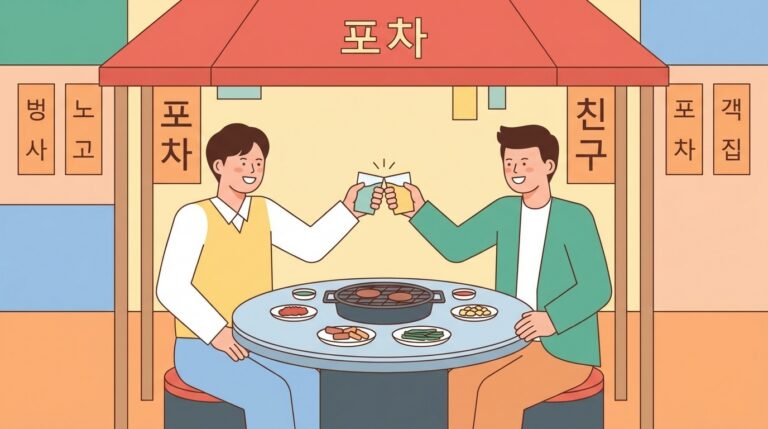
- K-Culture Moment: Friends clinking icy beer mugs or tiny soju glasses together at an outdoor tent street pub (pojangmacha).
- Editor’s Insight: 건배 (Geonbae) is standard for toasts, but in daily life among peers, Koreans love the onomatopoeia 짠 (Jjan). Even with water or Coca-Cola, saying Jjan! keeps the communal mood buzzing.
- Situation Spectrum:
- 건배: Casual: ✅ | Semi-formal: ✅ | Formal: ✅
- 짠: Casual: ✅ | Semi-formal: ⚠️ | Formal: 🚫
- 🤔 Think About It: Why do sounds like “clink” turn into social bonding words across human languages?
Phase 3: Textbook Korean vs. Real Korean
Let’s see how school textbook phrases differ from how real Koreans communicate around the barbecue table.
Situation 1: Explaining your alcohol intolerance
- 📖 교과서 한국어: “저는 알코올 분해 효소가 부족합니다.” (Jeoneun al-ko-ol bun-hae hyo-so-ga bu-jok-ham-ni-da. – “I am deficient in alcohol-decomposing enzymes.”)
- 🗣️ 진짜 한국어: “저 완전 알쓰예요!” (Jeo wan-jeon al-sseu-ye-yo! – “I’m a total lightweight!”) or “저 술 진짜 약해요.” (Jeo sul jin-jja yak-hae-yo. – “I am really weak with alcohol.”)
- 💡 왜 다를까?: Textbook expressions sound like a clinical laboratory report! Real Koreans use cute, self-deprecating slang like 알쓰 (al-sseu = lightweight) to break the ice and laugh it off.
Situation 2: Proposing a group toast
- 📖 교과서 한국어: “모두의 행복을 위하여 잔을 들어 올립시다.” (Mo-du-ui haeng-bo-geul wi-ha-yeo jan-eul deu-reo ol-lip-si-da. – “Let us raise our cups for everyone’s happiness.”)
- 🗣️ 진짜 한국어: “우리 다 같이 짠해요!” (U-ri da ga-chi jjan-hae-yo! – “Let’s all clink together!”)
- 💡 왜 다를까?: Formal toast declarations belong in high-profile banquets. Around barbecue tables and chicken pubs, a bright, friendly “Jjan-hae-yo!” feels infinitely more natural.
Phase 4: K-Culture Deep Dive & Non-Verbal Manners
4-1. Nunchi (눈치) & Table Gestures
Korean drinking etiquette isn’t about how much you drink; it’s about mutual respect shown through body language:
1. The Two-Hand Rule (두 손): When someone pours you a drink (or soda!), receive the cup using both hands. When pouring for an elder or colleague, hold the bottle with your right hand and lightly touch your right wrist or elbow with your left hand.
2. The Turn-Away Turn (고개 돌리기): When drinking in front of someone older or higher in hierarchy, politely turn your upper body and head sideways, covering your mouth slightly with your hand.
3. The Low Clink (잔 낮추기): When clinking glasses (짠), position the rim of your glass slightly lower than the senior person’s glass rim as a subtle gesture of humility.
4-2. Cultural Code Analysis: The Spirit of “Jeong” (정)
In dramas like Work Later, Drink Now (술꾼도시여자들), drinking is framed as bonding rather than intoxication. It is a shared emotional space where social masks come off. Koreans readily understand “Asian Flush” (알코올 홍조). As long as you keep your cup filled with cider, soda, or barley tea, participating in the toasts means you are fully part of the crew!
Phase 5: Real-World Roleplay Scenario
Setting: Golden Pig BBQ in Hongdae. Sizzling pork belly fills the room with smoky sweetness. Green bottles and chilled glasses crowd the table.
Characters: Manager Park (jovial team lead), Minji (supportive coworker), You (enthusiastic newcomer).
- Turn 1:
Manager Park: 🎭 Smiling widely while holding a cold bottle of beer
“우리 새 팀원 환영회니까 시원하게 한잔 받아!”
(Uri sae tim-won hwan-yeong-hoe-ni-kka si-won-ha-ge han-jan bad-a!)
“It’s our welcome dinner for our new teammate, so take a refreshing glass!” -
Turn 2:
You: 🎭 Holding your empty glass with both hands and bowing your head politely
“감사합니다! 그런데 저 술을 잘 못 마셔요.”
(Gam-sa-ham-ni-da! Geu-reon-de jeo su-reul jal mot ma-syeo-yo.)
“Thank you! But I can’t drink alcohol well.” -
Turn 3:
Minji: 🎭 Looking over with friendly curiosity
“어머, 정말요? 주량이 어떻게 돼요?”
(Eo-meo, jeong-mal-yo? Ju-ryang-i eo-tteo-ke dwae-yo?)
“Oh, really? What’s your alcohol tolerance like?” -
Turn 4:
You: 🎭 Shyly tapping your cheek with an honest smile
“저는 맥주 한 캔만 마셔도 얼굴이 빨개져요.”
(Jeo-neun maek-ju han kaen-man ma-syeo-do eol-gu-ri bpal-gae-jyeo-yo.)
“My face turns red even if I drink just one can of beer.” -
Turn 5:
Manager Park: 🎭 Nodding vigorously and putting down the beer bottle
“아, 그래? 그럼 무리하지 마! 사이다 시켜줄게.”
(A, geu-rae? Geu-reom mu-ri-ha-ji ma! Sa-i-da si-kyeo-jul-ge.)
“Ah, really? Then don’t push yourself! I’ll order Korean lemon cider for you.” -
Turn 6:
Minji: 🎭 Filling your glass with fizzy cider and smiling
“자, 사이다 채웠으니까 다 같이 짠해요!”
(Ja, sa-i-da chae-wo-sseu-ni-kka da ga-chi jjan-hae-yo!)
“There, cider is filled, so let’s all clink together!” -
Turn 7:
You: 🎭 Clinking your glass with both hands slightly below Manager Park’s rim
“네, 좋아요! 다 같이 짠!”
(Ne, jo-a-yo! Da ga-chi jjan!)
“Yes, sounds great! Cheers everyone!” -
Turn 8:
Manager Park: 🎭 Beaming with joy as glasses clink
“환영한다! 건배!”
(Hwan-yeong-han-da! Geon-bae!)
“Welcome aboard! Cheers!”
🔀 Interactive Choice Point: How would you react if offered another drink?
- Option A: Wave your hand dismissively and say “술 싫어요!” (I hate alcohol!)
- 🚫 Risk: Rejecting abruptly sounds harsh and breaks the celebratory mood.
- Option B: Drink the whole cup silently despite having an allergy.
- ⚠️ Bad: Dangerous for your health and creates unnecessary medical emergencies!
- Option C: Smile, touch your cheeks, and say “사이다로 짠할게요!” (I will toast with cider!)
- ✅ Best: Preserves the fun atmosphere while comfortably protecting your physical limits.
Phase 6: 10-Second Emotion Shadowing Drill
Practice these rhythm lines out loud! The slashes (/) indicate brief breathing pauses.
[🥺 Shy and modest]
저 / 술을 / 잘 못 마셔요. / 사이다 마셔도 될까요?
(Jeo / su-reul / jal mot ma-syeo-yo. / Sa-i-da ma-syeo-do doel-kka-yo?)
“I / cannot drink alcohol well. / May I drink cider instead?”-
[😊 Playful and vivid]
맥주 / 한 캔만 마셔도 / 얼굴이 / 빨개져요!
(Maek-ju / han kaen-man ma-syeo-do / eol-gu-ri / bpal-gae-jyeo-yo!)
“Even with / just one can of beer / my face / turns bright red!” -
[🍻 Energetic and cheerful]
우리 / 다 같이 / 시원하게 / 짠해요!
(U-ri / da ga-chi / si-won-ha-ge / jjan-hae-yo!)
“Let’s / all together / refreshingly / clink glasses!”
Phase 7: K-Culture Mini Dictionary
-
알쓰 (Al-sseu)
- Translation: Lightweight (slang)
- Usage: Short for 알코올 쓰레기 (alcohol lightweight/trash). Used with self-deprecating humor: “저 완전 알쓰예요!” (I’m a complete lightweight!).
- 짠 (Jjan)
- Translation: Clink / Cheers
- Usage: The energetic sound made when clinking glasses. Very natural among friends and colleagues of similar status.
- 회식 (Hwe-sik)
- Translation: After-work dinner gathering
- Usage: A core workplace cultural ritual where team members bond over barbecue, drinks, and casual conversation.
- 2차 (I-cha)
- Translation: Round Two / Second Venue
- Usage: After dinner, moving to a second location such as a pub (beer & fries), karaoke (noraebang), or coffee shop.
Phase 8: Survival Kit for Travelers
TOP 3 Emergency Phrases
- 사이다 한 병 주세요. (Sa-i-da han byeong ju-se-yo.)
- Pro Tip: In Korea, Saida refers to clear lemon-lime soda (like Chilsung Cider), not apple alcohol cider!
- 물 좀 더 주실 수 있나요? (Mul jom deo ju-sil su it-na-yo?)
- Pro Tip: Keep hydration high. If you need cold water, restaurants provide water bottles for free.
- 건배해요! (Geon-bae-hae-yo!)
- Pro Tip: Use this polite imperative when you want to initiate a toast with your dining partners.
Editor’s Travel Note
- Safe Late-Night Transit: When night outs end late, regular subways stop running around midnight. Be sure to check departure schedules and use the Kakao T app for safe taxi hailing rather than waving down cabs on the street. You can also monitor your journey route using the Naver Map navigation tool.
- Hangover Remedies: If you do drink a little, visit any 24-hour convenience store (CU, GS25, 7-Eleven) and grab a drink labeled 컨디션 (Condition) or herbal jelly 상쾌환 (Sang-kwae-hwan) right beside the cash register!
Phase 9: “One Step Deeper” (Cultural Reflection)
Traditional Korean drinking culture is not about personal indulgence; it is a ritual of collective harmony. Historically, drinking from the same circle represents lowering barriers and sharing unconditional empathy (Jeong). When you decline a drink in Korea, people don’t get disappointed because you aren’t drinking alcohol—they just don’t want you to feel left out of the shared rhythm. When you replace alcohol with cider or water and enthusiastically join the clinking of glasses, you achieve the exact same cultural intimacy!
💬 Your Turn: What is your favorite non-alcoholic beverage to order when your friends are drinking? Have you ever experienced an “Asian flush” moment? Share your story in the comments below!
Phase 10: FAQ & Avoiding Misunderstandings
Q: Is it disrespectful to refuse a drink from an older person or a boss in Korea?
A: Not at all, provided you handle it with good etiquette! Do not flatly push the glass away. Receive the poured glass politely with two hands, set it down gently on the table, explain with a smile: “저는 맥주 한 캔만 마셔도 얼굴이 빨개져요” (My face turns red even after one can of beer), and ask if you can toast with water or soda instead.
Q: Can I toast with plain water instead of alcohol?
A: Yes! While traditional superstition jokingly said toasting with water brings bad luck, modern Koreans do it all the time. To be extra courteous, you can say playfully: “물로 대신 짠할게요!” (I’ll clink with water instead!).
Q: What should I do if someone keeps offering me a drink repeatedly?
A: Touch your cheeks, smile apologetically, and say: “제가 체질상 술을 정말 못 마셔서요. 마음만 감사히 받겠습니다!” (My body cannot handle alcohol due to my constitution. I gratefully accept your kind intention!). This polite sentence settles the matter instantly.
🚨 Common Mistakes Board
- ❌ Mistake 1: Holding or clinking your glass with just one hand when someone senior is pouring.
- 👉 Correct Action: Always support your cup or your pouring forearm with your second hand.
- ❌ Mistake 2: Leaving your cup empty when everyone else toasts.
- 👉 Correct Action: Fill your glass with water, cola, or cider so you can actively participate in the clinking (짠).
- ❌ Mistake 3: Looking an older person straight in the eyes while drinking.
- 👉 Correct Action: Turn your head slightly away and drink discreetly.
Phase 11: Action Missions & Engagement
- 🥉 Bronze Mission (Solo Practice): Look into the mirror and practice saying: “저는 맥주 한 캔만 마셔도 얼굴이 빨개져요” with natural pronunciation and a warm smile 3 times.
- 🥈 Silver Mission (Social Sharing): Comment below or post on your social media answering: “What is your favorite Korean drinking toast phrase?” Tag #DailyHangul.
- 🥇 Gold Mission (Real Life Application): Next time you visit a Korean restaurant or eat with Korean friends, order a cider and confidently say: “다 같이 짠해요!” to initiate the table toast!
🎮 K-Culture Mission: Watch an episode of a recent K-Drama (like Business Proposal or Hospital Playlist). Spot a drinking scene and observe whether the characters use two hands to pour and receive drinks!
Phase 12: Interactive Quiz Challenge
Test your knowledge with these three practical questions!
Q1. Situational Judgment: Your Korean manager offers you a fresh glass of beer at dinner. You get allergic reactions from alcohol. What is the most polite response?
* A) “술 싫어해요. 가져가지 마세요.” (I hate alcohol. Don’t bring it.)
* B) Receive the glass with two hands and explain: “감사합니다! 그런데 저 맥주 한 캔만 마셔도 얼굴이 빨개져요. 사이다로 마셔도 될까요?”
* C) Pretend to drink, then dump the beer under the table.
Q2. Fill in the Blank: What is the popular sound Koreans say when clinking glasses informally?
* “우리 다 같이 ( )해요!”
Q3. True or False: When clinking glasses with someone older or senior in rank, you should hit your glass higher than theirs to show high energy.
* (True / False)
Click here to reveal the answers and explanations!
- Answer 1: B! Receiving the glass respectfully with two hands and openly explaining your low tolerance while suggesting a soda maintains social harmony without harming your health.
- Answer 2: 짠 (Jjan)! “우리 다 같이 짠해요!” means “Let’s all clink glasses together!”
- Answer 3: False! You should position the rim of your glass slightly lower than the senior person’s glass rim as a sign of respect and modesty.







