

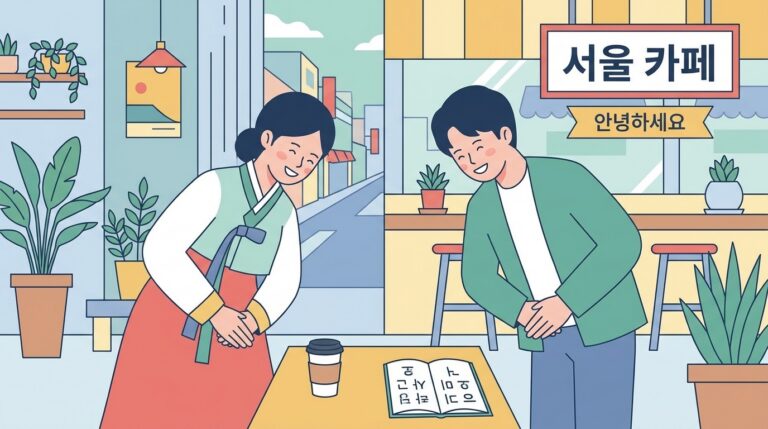
Phase 1: 공감 (Story-driven Opening)
안녕하세요! 매일한글 에디터입니다. Have you ever stood completely frozen in a bustling Seoul subway car after bumping someone’s elbow, your mind racing while you blurted out an awkward English apology? You are definitely not alone. Many of our beginner students tell us they hesitate because K-dramas show either intense, formal corporate bows or ultra-casual banter like mianhae. How do everyday locals actually smooth things over without sounding stiff or rude? That is where 미안해요 (Mianhaeyo) comes in. Learning this warm, polite phrase gives you an instant social superpower. Tested and praised by hundreds of our global learners, this guide will turn your awkward freezes into effortless, charming Korean etiquette.
Phase 2: 핵심 표현 3선 심층 분석
1. 미안해요 (Mianhaeyo)
- Pronunciation: Mianhaeyo (Sounds like “Mee-ahn-hae-yo”, rhymes with “see on hair yo”).
- Meaning: Literal: “My mind is not at ease” / Real Nuance: “I am sorry” (Friendly, polite, and considerate).
- K-Culture Moment: In relatable slice-of-life dramas like Hospital Playlist, friends and colleagues soften little everyday mistakes with a warm, sincere mianhaeyo over coffee.
- Editor’s Insight: This expression is conversational politeness at its best. It maintains respect through the honorific ending -yo (요) while preserving an approachable, human warmth.
- Situation Spectrum: Casual (✅) | Semi-formal (✅) | Formal (⚠️)
- 🤔 Think About It: In English, “I’m sorry” often focuses on personal regret, but mianhaeyo literally acknowledges that you’ve temporarily disturbed the other person’s peace of mind. Does this change how you view apologizing?
2. 죄송합니다 (Joesonghamnida)
- Pronunciation: Joesonghamnida (Sounds like “Jweh-song-hahm-nee-dah”).
- Meaning: Literal: “Feeling deep shame in my conscience” / Real Nuance: “I deeply apologize / I am very sorry” (Formal and highly respectful).
- K-Culture Moment: Watch any K-Drama board meeting or airport scene: whenever someone addresses a boss, a customer, or an elderly elder, 죄송합니다 is the default phrase used.
- Editor’s Insight: This is your ultimate safety net with strangers, taxi drivers, restaurant owners, and anyone older than you. When in doubt on the streets of Seoul, use this!
- Situation Spectrum: Casual (🚫) | Semi-formal (✅) | Formal (✅)
- 🤔 Think About It: Why does Korean culture reserve such distinct grammatical weight for seniority and public duty compared to Western conversational norms?
3. 잠시만요 (Jamsimanyo)
- Pronunciation: Jamsimanyo (Sounds like “Jahm-she-mahn-yo”).
- Meaning: Literal: “Just a moment” / Real Nuance: “Excuse me / Sorry, let me squeeze through!”
- K-Culture Moment: Stepping off the packed Line 2 train at Gangnam Station during morning rush hour—passengers constantly murmur jamsimanyo to slip through doors.
- Editor’s Insight: While not an apology for wrongdoing, it functions as a polite preemptive apology for entering someone’s personal physical space.
- Situation Spectrum: Casual (⚠️) | Semi-formal (✅) | Formal (✅)
- 🤔 Think About It: Notice how Korean speakers apologize before a physical inconvenience happens rather than waiting to say sorry afterwards.
Phase 3: 교과서 한국어 vs 진짜 한국어
Situation 1: Accidentally brushing shoulders on a busy sidewalk in Hongdae
- 📖 교과서 한국어: 대단히 실례했습니다. 용서해 주십시오. (Daedanhi sillyehaessumnida. Yongseohae jusipsio. / “I have been exceedingly discourteous. Please grant me forgiveness.”)
- 🗣️ 진짜 한국어: 앗, 죄송합니다! (At, joesonghamnida! / “Oops, so sorry!”) or 미안해요! (Mianhaeyo! / “Sorry!”)
- 💡 왜 다를까?: Traditional textbooks teach historical, ceremonial phrasing. On modern Korean streets, brevity paired with sincere vocal tone shows immediate care without being theatrically awkward.
Situation 2: Running 5 minutes late to meet your language exchange partner
- 📖 교과서 한국어: 지각하여 진심으로 사죄의 말씀을 올립니다. (Jigakhayeo jinsimeuro sajwoe-ui malsseum-eul ollimnida. / “I offer my earnest apologies for my tardiness.”)
- 🗣️ 진짜 한국어: 늦어서 미안해요! (Neujeoseo mianhaeyo! / “Sorry I’m late!”)
- 💡 왜 다를까?: Stiff corporate language between casual study partners builds an unnatural barrier. A warm 미안해요 keeps the mood friendly and relaxed.
Phase 4: K-Culture 딥다이브 & 비언어적 매너
4-1. 눈치 (Nunchi) & Gestures
An apology in Korea is delivered with your whole body, not just your lips. When delivering a polite apology:
* The Head Nod (목례 – Mok-rye): Dip your head and shoulders down about 15 to 30 degrees for half a second. A rigid upright spine makes an apology seem half-hearted.
* The Hand Cushion: When passing someone or apologizing for a minor inconvenience, gently place one hand across your stomach or near your chest. This non-verbally signals, “I am yielding space to you.”
* Eye Softening: Don’t maintain aggressive, direct eye contact while apologizing; cast your gaze slightly downward to show deference and humility.
4-2. 문화 코드 분석 (K-Culture Code)
In Korean food and cafe culture, dropping a spoon or asking staff for extra side dishes (banchan) is often preceded by a quick apology: 죄송한데요, 냅킨 좀 더 주실 수 있나요? (Joesonghandeyo, naepkin jom deo jusil su innayo? / “Excuse me, could we get some extra napkins?”). Koreans soften requests with apology markers because maintaining collective harmony (화합 – Hwahap) is valued above self-assertion.
Phase 5: 실전 롤플레이 시나리오
Setting: A stylish, minimalist cafe in Seongsu-dong. Sunlight streams through brick arches. You accidentally nudge the corner of another customer’s laptop table while carrying your iced latte.
Characters:
* Min (You): An enthusiastic beginner Korean learner.
* Sora (소라): A friendly local freelance designer working at the cafe.
- Turn 1 (Min): 앗! 죄송합니다! (At! Joesonghamnida!)
English: “Oops! I am so sorry!”
🎭 행동 지문: Quickly steadies the table with one hand and bows head slightly. -
Turn 2 (Sora): 아, 네! 괜찮아요. 커피 안 쏟았어요? (A, ne! Gwaenchanayo. Keopi an ssodasseoyo?)
English: “Oh, it’s totally okay! Did you not spill your coffee?”
🎭 행동 지문: Smiles warmly and glances at your latte cup. -
Turn 3 (Min): 네, 안 쏟았어요. 놀라게 해서 미안해요. (Ne, an ssodasseoyo. Nollage haeseo mianhaeyo.)
English: “Yes, I didn’t spill it. I’m sorry for startling you.”
🎭 행동 지문: Shows an apologetic, relieved smile. -
Turn 4 (Sora): 전혀 아니에요. 저도 짐이 너무 많았죠. (Jeonhyeo anieyo. Jeodo jimi neomu manatjyo.)
English: “Not at all. I had too many bags out anyway.”
🎭 행동 지문: Scoots her tote bag closer to clear the pathway. -
Turn 5 (Min): 배려해 주셔서 감사해요. (Baeryeohae jusyeoseo gamsahaeyo.)
English: “Thank you for being so understanding.”
🎭 행동 지문: Places one hand gently on chest with a small nod. -
Turn 6 (Sora): 한국어 잘하시네요! 커피 맛있게 드세요. (Hangugeo jalhasineyo! Keopi masitge deuseyo.)
English: “Your Korean is so good! Enjoy your coffee.”
🎭 행동 지문: Chuckles delightfully and points toward your seat. -
Turn 7 (Min): 감사합니다! 좋은 하루 보내세요. (Gamsahamnida! Joeun haru bonaeseyo.)
English: “Thank you! Have a wonderful day.”
🎭 행동 지문: Takes a seat with a proud, relaxed smile. -
Turn 8 (Sora): 네, 좋은 하루 되세요! (Ne, joeun haru doeseyo!)
English: “Yes, you have a great day too!”
🎭 행동 지문: Gives a cheerful little wave before returning to work.
🔀 인터랙티브 분기점 (What would you say next if you dropped a napkin on her bag?)
- Option A: “야, 미안해!” (Ya, mianhae! / “Hey, sorry!”)
- Feedback (Bad): 🚨 Danger! Dropping the polite suffix makes this sound disrespectful to a stranger, regardless of intent.
- Option B: “어머, 죄송해요! 바로 치워 드릴게요.” (Eomeo, joesonghaeyo! Baro chiwo deurilgeyo. / “Oh dear, I’m sorry! I’ll clean it up right away.”)
- Feedback (Best): 🌟 Perfect! Highly natural, polite, and displays quick consideration.
- Option C: “아무것도 아니에요.” (Amugeotdo anieyo. / “It is nothing.”)
- Feedback (Risk): ⚠️ Risky! Saying “it’s nothing” minimizes the other person’s belongings instead of showing empathy.
Phase 6: 10초 감정 섀도잉 드릴
Repeat these aloud using the rhythm marks (/ represents a micro-pause) and emotional guidance!
[🥺 진심으로 미안한 표정으로]
어머, / 늦어서 / 정말 미안해요!
(Eomeo, / neujeoseo / jeongmal mianhaeyo!)
“Oh gosh, / I am really / so sorry for being late!”-
[⚡ 살짝 당황하며 신속하게]
앗, / 발 밟아서 / 죄송합니다!
(At, / bal balbaseo / joesonghamnida!)
“Oops, / for stepping on your foot / I am so sorry!” -
[🚇 지하철 틈을 비집고 나가며 부드럽게]
잠시만요, / 먼저 내릴게요!
(Jamsimanyo, / meonjeo naerilgeyo!)
“Excuse me for a second, / I’m getting off first!”
Phase 7: K-Culture 미니 사전 (핵심 키워드 4선)
- 사과 (Sagwa): Apology (and Apple!). In Korea, giving an apple is a playful, endearing pun on offering a genuine apology (사과를 건네다).
- 눈치 (Nunchi): Intuitive social awareness. Knowing when to apologize before an uncomfortable situation escalates.
- 예의 (Yeeui): Propriety and good manners. Showing respect for personal boundaries in shared public spaces.
- 괜찮아요 (Gwaenchanayo): “It is okay / No problem.” The heartwarming response you will hear 99% of the time when you apologize politely!
Phase 8: 여행자를 위한 생존 키트
Survival Expressions TOP 3
- 미안해요 (Mianhaeyo)
Pronunciation: Mee-ahn-hae-yo
Pro Tip: Perfect when you bump into peers, clerks your age, or language buddies. - 죄송합니다 (Joesonghamnida)
Pronunciation: Jweh-song-hahm-nee-dah
Pro Tip: Say this to elders, cab drivers, and restaurant owners when you need help or make an accidental error. - 잠시만요 (Jamsimanyo)
Pronunciation: Jahm-she-mahn-yo
Pro Tip: Chant this softly when passing through crowded subway doors or night markets.
Editor’s Travel Note
Navigating Korea’s transit system is smooth when you’re prepared. Before hopping on the metro, make sure to install the official mobile transit app by checking the Naver Map Application on Google Play. When squeezing past standing passengers on the subway, don’t push silently; a simple 잠시만요 will magically open a pathway for you!
Phase 9: “한 발 더 깊이” (생각 질문)
In many Western cultures, apologizing can feel like an admission of legal fault or personal liability. In Korea, however, language is built on 우리 (Uri – “We/Us”) collective consciousness. Saying 미안해요 or 죄송합니다 is not necessarily a confession of guilt; rather, it is a generous social balm that restores peaceful balance to the collective space. By uttering these words, you are saying: “I care about your comfort as much as my own.”
💬 Your Turn: Does your native culture view apologizing as weakness or as polite strength? Share your thoughts in the comments below!
Phase 10: FAQ & 오해 방지 (FAQ Schema)
Q: Can I say “미안해 (Mianhae)” to friendly store clerks or waiters?
A: No! Dropping -yo makes it informal speech (반말 – banmal). Even if the clerk looks younger than you, speaking informally to strangers is considered rude. Always say 죄송합니다 or 미안해요.
Q: What is the exact difference between “미안해요” and “죄송해요”?
A: Both are polite! However, 죄송 (Joesong) stems from Sino-Korean roots conveying deeper reverence, whereas 미안 (Mian) is native and warmer. 죄송해요 or 죄송합니다 is safer for elders and service workers.
Q: What should I say when someone apologizes to me?
A: Simply smile and say: 괜찮아요! (Gwaenchanayo! – “It’s totally okay!”) with a light nod.
🚨 흔한 실수 (Common Mistakes) 경고판
- Mistake: Saying English “Sorry!” with an upright body.
Correct Action: Say 죄송합니다 (Joesonghamnida) while pairing it with a gentle 15-degree head bow. - Mistake: Using 미안해 (Mianhae) with older locals.
Correct Action: Always attach the polite -yo ending (미안해요) or elevate to 죄송합니다. - Mistake: Remaining silent when bumping someone because you are afraid of mispronouncing words.
Correct Action: Even a soft 앗, 죄송해요! creates immediate warmth and avoids misunderstandings.
Phase 11: 액션 미션 & 참여 유도
- 🥉 Bronze Mission: Stand in front of your mirror and practice the 15-degree bow while saying: “미안해요! (Mianhaeyo!)” 5 times.
- 🥈 Silver Mission: Record your voice practicing the Phase 6 Shadowing Drill and listen back to match the melody of natural Korean intonation.
- 🥇 Gold Mission: Next time you order at a Korean restaurant or talk to your Korean tutor, use 죄송한데요 or 미안해요 in context!
- 🎮 K-Culture Mission: Watch an episode of your favorite K-Drama this week. Count how many times the characters say 미안해, 미안해요, or 죄송합니다. Notice who is speaking to whom!
Phase 12: 인터랙티브 퀴즈 챌린지
1. Situational Judgment: You accidentally take someone else’s umbrella at a cafe entrance. The owner notices. What is the most polite and natural response?
(A) 밥 먹었어요? (Bap meogeosseoyo?)
(B) 앗, 죄송합니다! 제 것인 줄 알았어요. (At, joesonghamnida! Je geosin jul arasseoyo.)
(C) 미안해! (Mianhae!)
2. Fill-in-the-Blank: When you want to apologize politely to an acquaintance your age, you say:
늦어서 ________. (Neujeoseo ________. / “Sorry I’m late.”)
3. True or False: It is completely polite to use 미안해 (Mianhae) with an elderly taxi driver in Seoul.
👉 Click here to reveal the answers and explanations!
- Answer: (B)
Explanation: When dealing with a stranger in public, formal humility with 죄송합니다 is best! (A) means “Did you eat rice?”, and (C) is rude banmal. - Answer: 미안해요 (Mianhaeyo)
Explanation: Adding the honorific -yo creates the perfect balance of warmth and polite etiquette for peers. - Answer: False
Explanation: Never use 미안해 with elders or service professionals! You should always use 죄송합니다 (Joesonghamnida).







