

Playful Banter in Korea: When a Joke Strikes a Nerve (긁혔다, 팩폭, 킹받네)
Phase 1: 공감 (Story-Driven Opening)
안녕하세요! 매일한글 에디터입니다.
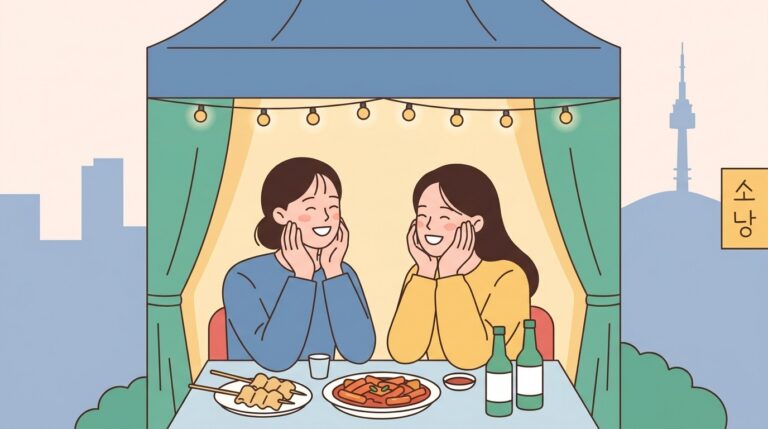
Picture this: You are sitting at a cozy outdoor pojangmacha in Hongdae with your close Korean friend, Minjun. The table is filled with spicy tteokbokki and sizzling fish cakes. You both are trading casual jokes, having the time of your lives. Then, Minjun complains for the tenth time this week about how he has zero time to go to the gym because he is “simply too busy with life.”
Without thinking, you playfully tease him: “야, 너 어제 유튜브 쇼츠 보느라 새벽 3시에 잤잖아? (Ya, neo eoje yutyubeu syocheu boneura saebyeok se-sie jatjana? / Hey, didn’t you stay up until 3 AM watching YouTube Shorts yesterday?)”
Suddenly, the laughter evaporates. Minjun’s smile freezes. He drops his chopsticks, squares his shoulders, and glares at you with total deadpan seriousness: “내가 언제 그랬어? 아니 진짜 어제는 과제 자료 조사였다니까? (Naega eonje geuraesseo? Ani jinjja eojeneun gwaje jaryo josayeotdanikka? / When did I do that? Seriously, I was researching for an assignment!)”
Your heart skips a beat. You only meant it as an innocent, passing jab, but his defensive reaction says otherwise. You wonder, Did I just cross an unspoken cultural boundary? Did I hurt his feelings?
Take a deep breath! You didn’t break your friendship—you simply witnessed a quintessential moment of modern Korean social banter. In Korean youth culture, when someone gets visibly defensive over a harmless truth bomb, locals say they got “scratched” (제대로 긁혔네!). Over my 10 years of coaching K-culture lovers and navigating local social circles, I’ve seen countless international friends freeze in panic right here. Mastering playful slang like 긁히다 (geulkhida), 팩폭 (paekpok), and 킹받네 (kingbanne) will help you transform awkward silence into explosive laughter, allowing you to bond with Koreans on a truly native wavelength.
Phase 2: 핵심 표현 3선 심층 분석 (Top 3 Expressions)
1. 긁혔어? / 제대로 긁혔네 (Geulkyeosseo? / Jedaero geulkyeotne)
- Pronunciation: [Geul-kyeot-seo? / Je-dae-ro geul-kyeot-ne] (Think of saying gulp without the ‘p’, followed immediately by yacht-suh).
- Meaning: Literally “Did it get scratched?” / “It got scratched for real.” Nuance-wise, it translates to “Did that hit a nerve?” or “Oh, you are definitely triggered!”
- K-Culture Moment: Seen constantly on Korean YouTube variety channels (like No Prepare or Psick Univ) whenever a guest furiously defends their fragile pride after being teased about their fashion sense or ex-partner.
- Editor’s Insight: This internet-born slang comes from the metaphor of someone’s fragile ego getting scratched like a car bumper. Use this only when your friend’s defensive reaction is noticeably disproportionate to your harmless joke.
- Situation Spectrum: Casual: ✅ | Semi-formal: ⚠️ | Formal: 🚫
- 🤔 Think About It: In English, we say “hit a nerve” or “salty.” Notice how Korean portrays the heart or pride as a smooth surface that visibly displays emotional scratches.
2. 팩폭 / 팩트 폭행 (Paekpok / Paekteu Pokhaeng)
- Pronunciation: [Paek-pok] (Sounds like pack-poke with snappy, short vowels).
- Meaning: Literal blend of “Fact” + “Assault / Violence” (팩트 폭행). Real nuance: “A savage reality check” or “Fact-bombing.”
- K-Culture Moment: In K-Dramas, when the blunt younger sister lists every single logical flaw in the romantic delusions of the main lead, leaving them utterly speechless.
- Editor’s Insight: Koreans value emotional sensitivity (jeong), so brutally honest statements feel like physical hits. Saying “팩폭 하지 마! (Paekpok haji ma! / Stop fact-bombing me!)” is a self-deprecating, cute way to surrender the argument.
- Situation Spectrum: Casual: ✅ | Semi-formal: ⚠️ | Formal: 🚫
- 🤔 Think About It: Why does Korean society categorize undeniable facts as “violence” in banter? It highlights how deeply Korean communication values face-saving and emotional harmony.
3. 킹받네 (Kingbanne)
- Pronunciation: [King-ban-ne] (Pronounce “King” as in English royalty, then bahn-nay with a nasal tone on ‘ne’).
- Meaning: Literal combination of English “King” (used as an intensifier meaning ‘extreme’) and 열받네 (yeolbanne, getting heated/annoyed). Real nuance: “This is so hilariously annoying!” or “I’m tilted!”
- K-Culture Moment: Widely popularized by webtoon creator and streamer Calmdown Man (침착맨). Whenever a friend smirks after winning a petty bet or making an absurd pun, you drop this line.
- Editor’s Insight: Unlike actual anger expressions, 킹받네 conveys affectionate irritation. If you are genuinely furious at someone, you never use this word. It is reserved exclusively for amusing frustration among friends.
- Situation Spectrum: Casual: ✅ | Semi-formal: 🚫 | Formal: 🚫
- 🤔 Think About It: Notice how English blends words like “rage-quit.” How does prefixing “King” to Korean verbs show the playful fusion of English loanwords in Gen-Z Korean slang?
Phase 3: 교과서 한국어 vs 진짜 한국어 (Textbook vs. Real Korean)
Situation 1: When your friend gets unexpectedly offended by your joke
- 📖 교과서 한국어: 제 농담 때문에 화가 나셨습니까? (Je nongdam ttaemune hwaga nasyeotseumnikka? / Did you get angry because of my joke?)
- 🗣️ 진짜 한국어: 헐, 너 설마 긁혔어? 장난인데 왜 정색해~ (Heol, neo seolma geulkyeosseo? Jangnan-inde wae jeongsaekhae~ / Whoa, did that actually hit a nerve? It was just a joke, why the serious face~)
- 💡 왜 다를까? Textbook phrases sound like an official police interrogation or customer apology. In peer relationships, asking if they “got scratched” playfully defuses the tension and invites them to laugh it off.
Situation 2: When someone hits you with an undeniable truth
- 📖 교과서 한국어: 당신의 말은 매우 직설적이고 정확하네요. (Dangsin-ui mareun maeu jikseoljeogigo jeonghwakhaniyo. / Your words are very direct and accurate.)
- 🗣️ 진짜 한국어: 와… 뼈 맞았어. 팩폭 멈춰! (Wa… ppyeo majasseo. Paekpok meomchwo! / Wow… that broke my bones. Stop the fact-bombing!)
- 💡 왜 다를까? Koreans love physical sensory metaphors. Saying “뼈 맞았다 (my bone was hit)” dramatizes the psychological sting with humor rather than cold logic.
Phase 4: K-Culture 딥다이브 & 비언어적 매너 (Culture Deep Dive)
4-1. 눈치 (Nunchi) & Body Language: Handling “정색” (Jeongsaek)
When a Korean friend suddenly puts on a stiff, poker-faced expression during banter, this is called 정색 (jeongsaek). If you see this:
1. Wave your hands slightly: Never point your finger directly at their chest. Make a two-handed fluttering motion downward to signal “take it easy.”
2. Soften your eye contact: Sustained direct eye contact while teasing feels confrontational. Tilt your head slightly, flash a gentle smirk, and soften your gaze.
3. Add the magical vocal tag: Say “에이~ 장난이지! (Ei~ jangnan-iji! / Aw come on, I’m totally kidding!)” with an elongated “에이~”.
4-2. Cultural Code: The Art of “Tiki-Taka” (티키타카)
In Korean society, real intimacy is proven through tiki-taka—rapid, rhythmic back-and-forth verbal sparring. When you drop high-honorific barriers and enter banmal (반말, casual speech), light teasing affirms that your friendship is strong enough to withstand a little friction. However, the golden rule of Korean banter is “선 넘지 않기” (not crossing the line). A jab should target habits, funny slip-ups, or petty quirks—never family, physical insecurities, or genuine financial struggles.
Phase 5: 실전 롤플레이 시나리오 (Roleplay Scenario)
- Setting: An aesthetic café in Seongsu-dong. Minho ordered a decaf iced Americano and a giant chocolate croissant while claiming he is on a strict low-sugar diet.
- Characters:
- You (B1 Korean Learner): Witty, observing friend.
- Minho (Korean University Friend): Proud, image-conscious, easily flustered.
— Dialogue Start —
- You: 🎭 Looking at the chocolate croissant with a mischievous grin
민호야, 너 오늘부터 다이어트한다고 하지 않았어?
(Minho-ya, neo oneulbuteo daieoteuhandago haji anhasseo? / Minho, didn’t you say you were starting your diet today?) -
Minho: 🎭 Freezes with fork halfway to mouth
아니거든? 뇌를 쓰려면 당분이 필요해서 딱 한 입만 먹는 거야!
(Anigeodeun? Noereul sseuryeomyeon dangbuni piryohaeseo ttak han ipman meongneun geoya! / No way! I just need sugar to use my brain, so I’m having just one bite!) -
You: 🎭 Smirking and leaning back in chair
한 입치고는 빵이 이미 반이나 사라졌는데? 완전 팩폭이지?
(Han ipchigoneun ppangi imi ban-ina sarajyeotneunde? Wanjeon paekpok-iji? / For just one bite, half the pastry is already gone? Total fact-bomb, right?) -
Minho: 🎭 Eyes widening, lowering voice defensively
야! 밥 대신 먹는 거거든? 밥 안 먹으면 살 안 쪄!
(Ya! Bap daesin meongneun geogeodeun? Bap an meogeumyeon sal an jjyeo! / Hey! I’m eating this instead of a meal! If you don’t eat rice, you don’t gain weight!) -
You: 🎭 Chuckling softly
헐, 표정 봐. 너 설마 제대로 긁혔어?
(Heol, pyojeong bwa. Neo seolma jedaero geulkyeosseo? / Whoa, look at your face. Did that actually hit a nerve?) -
Minho: 🎭 Pouting and waving fork aggressively
안 긁혔거든?! 아 진짜 너 표정 보니까 완전 킹받네!
(An geulkyeotgeodeun?! A jinjja neo pyojeong bonikka wanjeon kingbanne! / I didn’t get triggered, okay?! Ah seriously, seeing your face is so hilariously annoying!) -
You: 🎭 Warmly tapping the table
에이, 장난이야 장난! 맛있게 먹어, 내가 커피 살게.
(Ei, jangnan-iya jangnan! Mas-itge meogeo, naega keopi salge. / Aw, I’m just kidding! Enjoy it, coffee is on me.) -
Minho: 🎭 Instantly grinning
진짜지? 그럼 킹받은 거 취소!
(Jinjyaji? Geureom kingbadeun geo chwiso! / For real? Then my irritation is officially cancelled!)
— Dialogue End —
🔀 인터랙티브 분기점 (Interactive Choice)
If Minho suddenly looks truly hurt after line 5, what should you say?
- Choice A: “왜 그렇게 화를 내? 그냥 사실을 말한 것뿐인데.” (Why are you so mad? I just told the truth.)
- ❌ Bad: Cold and defensive. In Korean culture, prioritizing logical correctness over a friend’s feelings ruins the mood immediately.
- Choice B: “죄송합니다. 제가 실례를 범했습니다.” (I apologize. I committed a discourtesy.)
- ⚠️ Risk: Too hyper-formal for friends! It will create an uncomfortable distance and make him feel guilty for reacting.
- Choice C: “아 미안 미안! 내가 말이 좀 심했지? 장난이었어~” (Ah, sorry sorry! Did I go a bit too far? I was totally playing!)
- ✅ Best: Perfect emotional calibration. It acknowledges their reaction softly without awkward drama.
Phase 6: 10초 감정 섀도잉 드릴 (Shadowing Drill)
Practice reading these out loud with rhythm and breath control. Match the emotional tag!
[😏 능글맞고 장난스럽게 (Smug & Playful)]
너 설마 / 진짜 긁힌 거야? / 얼굴 완전 빨개졌는데?
(Neo seolma / jinjja geulkhin geoya? / eolgul wanjeon ppal-gae-jyeot-neunde?)
Pause briefly at/to let the tease land.-
[😫 억울하고 얄밉게 (Comically Annoyed)]
아 진짜… / 너 웃는 거 보니까 / 완전 킹받네!
(A jinjja… / neo unneun geo bonikka / wanjeon kingbanne!)
Stress ‘킹’ with a sharp, explosive burst. -
[😅 당황하며 손사래 치며 (Flustered & Pacifying)]
에이, 팩폭 아니야! / 장난인 거 알지? / 삐치지 마~
(Ei, paekpok aniya! / jangnan-in geo alji? / ppichiji ma~)
Elongate the ending ‘마~’ with affectionate warmth.
Phase 7: K-Culture 미니 사전 (Mini Dictionary)
- 긁히다 (Geulkhida) | To be triggered / To get one’s pride scratched
- Used when someone exhibits a defensive overreaction to harmless banter.
- 팩폭 (Paekpok) | Fact-bombing / Savage truth
- Short for 팩트 폭행; pointing out indisputable reality that leaves someone speechless.
- 킹받다 / 킹받네 (Kingbatda / Kingbanne) | Playfully infuriating / Tilted
- A slang compound expressing comic exasperation at someone’s teasing or lucky break.
- 정색하다 (Jeongsaekhada) | To suddenly turn deadpan / To get serious
- The physical act of instantly dropping a smile to adopt a stern, chilly facial expression.
Phase 8: 여행자를 위한 생존 키트 (Traveler’s Survival Kit)
Top 3 Survival Phrases
- 장난이에요! (Jangnan-ieyo!) | I’m just joking!
- Pro Tip: Keep this locked and loaded whenever you accidentally say something slightly too blunt.
- 선 넘지 마~ (Seon neomji ma~) | Don’t cross the line~
- Pro Tip: Say this with a half-smile if your Korean friend starts teasing you about something you feel uncomfortable discussing.
- 뼈 맞았어요 (Ppyeo majasseoyo) | That hit me right in the bone (Too real).
- Pro Tip: Use this when a Korean friend gives you honest travel advice that destroys your unrealistic itinerary.
Editor’s Travel Note
When hanging out with local friends in vibrant nightlife districts like Euljiro or Yeonnam-dong, navigating spontaneous venue changes requires swift teamwork. Always make sure to check route updates together on the 네이버 지도 앱 다운로드 page to avoid getting lost between barbecue spots!
Phase 9: “한 발 더 깊이” (Cultural Essay)
In Western cultures, deep respect is frequently demonstrated through maintaining consistent personal space and politeness. In Korea, however, true intimacy often begins where polite honorifics end. Engaging in gentle paekpok and calling each other kingbanne is a subtle cultural confirmation: “Our relationship is strong enough that small truths won’t break us.” It is a testament to trust, wrapped in the protective fabric of communal humor.
💬 Your Turn: Have you ever accidentally said something to a friend that unexpectedly struck a nerve? What did you say to smooth it over? Drop your story in the comments below!
Phase 10: FAQ & 오해 방지 (FAQ Schema)
Q: Can I use “긁혔어?” to my university professor or workplace boss?
A: Absolutely not! 긁히다 is deeply informal internet slang. Using it with a superior or senior colleague (seonbae) will make you sound disrespectful and insolent. Stick to standard formal phrases like “기분 상하게 해드렸다면 죄송합니다 (I apologize if I upset you).”
Q: What is the difference between 킹받네 and 진짜 화나 (I’m really angry)?
A: 진짜 화나 indicates genuine anger, emotional distress, or conflict. In contrast, 킹받네 is inherently playful; it signals that you are annoyed by something petty or funny, and there is zero real hostility behind it.
Q: How do I know if my friend is jokingly ‘정색’ or genuinely mad?
A: Look at their posture and following silence. If they break eye contact, turn quiet for more than 10 seconds, or stop participating in the conversation, they are genuinely hurt. If they exaggerate their stiffness and keep talking back fast, it’s just theatrical banter!
🚨 흔한 실수 (Common Mistakes) 경고판
- Mistake: Using “킹받네” during a serious argument or workplace dispute.
- Correct Action: Only use it when the atmosphere is light and comedic.
- Mistake: Repeating “긁혔네~” over and over when your friend is clearly uncomfortable.
- Correct Action: Stop immediately, drop the banter tone, and give a sincere “장난이었어, 미안해.”
- Mistake: Translating “fact-bomb” literally into formal writing.
- Correct Action: 팩폭 is colloquial slang; in essays or presentations, use “객관적인 사실 지적” (pointing out objective facts).
Phase 11: 액션 미션 & 참여 유도 (Action Missions)
- 🥉 Bronze Mission (Solo Practice): Practice the Phase 6 Shadowing Drill 3 times in front of a mirror, focusing on smiling while saying “너 설마 긁혔어?”.
- 🥈 Silver Mission (Social Media): Post a funny photo of your burnt toast or spilled coffee on Instagram Stories with the caption: “아침부터 완전 킹받네 ㅠㅠ”.
- 🥇 Gold Mission (Real Life): The next time your Korean friend dramatically denies a light tease, whisper playfully: “제대로 긁혔네~” and see their reaction!
- 🎮 K-Culture Mission: Watch an episode of a Korean variety show on YouTube (e.g., Gym Jong Kook or Workman) and listen for the audio subtitles featuring 킹받 or 긁.
Phase 12: 인터랙티브 퀴즈 챌린지 (Interactive Quiz)
Test your mastery of Korean playful banter!
1. Situation Judgment: Your friend proudly claims they never spend money impulsively, but their bag is full of brand-new Pop Mart blind boxes. What is the most natural native reaction?
* A) 기분이 매우 상하셨겠어요.
* B) 와, 대단한 사실 폭행입니다.
* C) 팩폭 한마디 해도 돼? 너 방금 결제한 건 뭐야?
2. Fill in the Blank: When someone is playfully annoyed by an absurd pun, they say: “아 진짜 표정 킹_____!”
3. True or False: Saying “제대로 긁혔네” is appropriate during a formal business meeting when an opposing client gets defensive.
👉 Click here to reveal the answers and explanations!
- Answer: C
- Explanation: C blends natural banter rhythm with polite cheekiness among close friends.
- Answer: 받네 (킹받네)
- Explanation: 킹받네 is the set expression for being hilariously exasperated.
- Answer: False
- Explanation: 긁히다 is Gen-Z internet slang and is strictly taboo in formal or corporate environments.
- Explanation: 긁히다 is Gen-Z internet slang and is strictly taboo in formal or corporate environments.







