

Phase 1: Empathy (Story-Driven Opening)
안녕하세요! 매일한글 에디터입니다.
Picture this: It is 1:30 AM on a Tuesday night. You are tucked under your duvet, frantically scrolling through the newest chapter of your favorite Korean fantasy romance webtoon on your phone. For the past twenty chapters, the deceitful villainess has spread venomous lies, framing the kind-hearted protagonist, stealing her rightful inheritance, and humiliating her in front of high society. Your chest literally hurts. You feel an agonizing, suffocating tightness in your throat—what Koreans call feeling like you have swallowed a dry roasted sweet potato without water.
Then, suddenly—BAM! The male lead reveals magical recording crystals, strips the villainess of her noble title, and throws her into the dungeon all within three glorious panels. The protagonist turns around with a cool smirk and drops an icy one-liner.
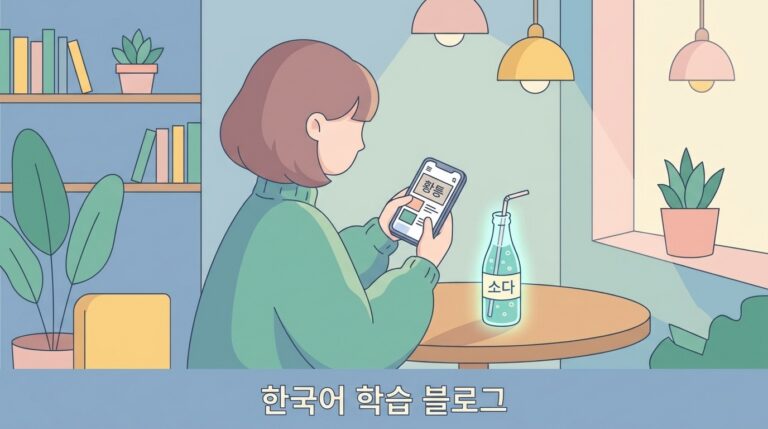
You let out an audible sigh of sweet relief, feeling an icy, fizzy wave of joy wash over your brain. You scroll down straight to the comment section, and hundreds of Korean readers are chanting the exact same thing: “와, 진짜 역대급 사이다 전개! 속이 다 뻥 뚫리네!” (Wa, jinjja yeokdaegeup saida jeongae! Sogi da ppeong ttulline! – Wow, this is a legendary cider plot development! My chest feels completely cleared!).
If you have ever tried translating Korean web novel discussions, you have probably wondered: Why on earth are these readers constantly talking about fizzy lemon-lime soda and roasted sweet potatoes? Today, we are cracking open the fascinating cultural lexicon of Korean webtoons and web novels. Based on real feedback from intermediate learners who love K-webtoons, this guide will help you unpack “사이다” (Cider) pacing, villain retribution, and how to express pure cathartic satisfaction like a native speaker.
Phase 2: Deep Dive into 3 Core Expressions
1. 사이다 전개 (Sa-i-da jeon-gae)
- Pronunciation: [Sa-i-da jeon-gae] (Sounds like sah-ee-dah jun-geh)
- Meaning: Literally “Cider development/pacing.” In real context, it means a fast-paced, cathartic narrative progression where conflicts resolve swiftly and villains face instant, satisfying justice without lingering frustration.
- K-Culture Moment: Used by millions of readers every day on KakaoPage and Naver Webtoon comments whenever an overpowered protagonist humiliates an annoying antagonist in record time.
- Editor’s Insight: In South Korea, “사이다” (Cider) refers to clear, carbonated lemon-lime soft drinks (like Chilsung Cider), not alcoholic apple cider. The carbonation popping in your mouth and throat symbolizes blowing away emotional blockage.
- Situation Spectrum: Casual ✅ | Semi-formal ⚠️ | Formal 🚫
- 🤔 Think About It: Does your native culture compare emotional narrative relief to physical food and drink digestion sensations? Why do you think fizzy soda became Korea’s ultimate metaphor for emotional justice?
2. 고구마 먹은 것 같다 (Go-gu-ma meog-eun geot gat-da)
- Pronunciation: [Go-gu-ma meo-geun geot gat-da] (Sounds like goh-goo-mah muh-geun gut gat-dah)
- Meaning: Literally “Feels like having eaten a dry sweet potato.” Nuance: Describing a suffocating, frustrating situation or a dragging storyline where misunderstandings drag on endlessly without resolution.
- K-Culture Moment: When a protagonist hesitates to defend themselves or stays passive while being framed for ten consecutive chapters, readers comment: “작가님, 고구마 그만 먹이고 사이다 좀 주세요!” (Author-nim, stop feeding us sweet potatoes and give us some cider!).
- Editor’s Insight: Korean roasted sweet potatoes are famously dense, starchy, and dry when swallowed without kimchi or a drink. Koreans map this physical feeling of tightness directly onto emotional and mental frustration.
- Situation Spectrum: Casual ✅ | Semi-formal ⚠️ | Formal 🚫
- 🤔 Think About It: What food or sensory metaphor does your native language use when someone is moving too slowly or bottling up their frustration?
3. 참교육하다 (Cham-gyo-yuk-ha-da)
- Pronunciation: [Cham-gyo-yook-ha-da] (Sounds like chahm-gyoh-yook-hah-dah)
- Meaning: Literally “To provide true education.” Nuance: Administering a harsh, thoroughly deserved lesson, beating, or verbal smackdown to an arrogant bully or villain.
- K-Culture Moment: Commonly titled in webtoon chapter reviews or YouTube recap thumbnails: “일진들 참교육하는 먼치킨 주인공” (Overpowered protagonist giving true education to school bullies).
- Editor’s Insight: While “참교육” historically meant genuine, moral education in academic contexts, internet slang ironically inverted it to mean completely humiliating someone who had it coming.
- Situation Spectrum: Casual ✅ | Semi-formal 🚫 | Formal 🚫
- 🤔 Think About It: Why does modern internet culture enjoy framing physical or verbal revenge as an educational act? What does this say about moral retribution?
Phase 3: Textbook Korean vs. Real Korean
Situation 1: Expressing satisfaction after a conflict gets resolved
- 📖 교과서 한국어: 문제가 순조롭고 만족스럽게 해결되었습니다. (Mun-je-ga sun-jo-rop-go man-jok-seu-reop-ge hae-gyeol-doe-eot-seum-ni-da.) — The problem has been resolved smoothly and satisfactorily.
- 🗣️ 진짜 한국어: 와, 완전 사이다! 속이 다 후련하네요. (Wa, wan-jeon sa-i-da! Sog-i da hu-ryeon-ha-ne-yo.) — Wow, total cider! My whole chest feels completely unburdened.
- 💡 왜 다를까? Textbook Korean treats conflict resolution as an objective, dry procedure. Native speakers, however, view it as an emotional catharsis and rely on physical relief idioms like “속이 후련하다” (my insides feel light and cleared).
Situation 2: Warning a friend about an excruciatingly slow, frustrating story arc
- 📖 교과서 한국어: 이 소설은 사건의 전개 속도가 다소 느리고 답답합니다. (I so-seol-eun sa-geon-ui jeon-gae sok-do-ga da-so neu-ri-go dap-dap-ham-ni-da.) — This novel’s plot development is rather slow and frustrating.
- 🗣️ 진짜 한국어: 초반에 고구마 구간 기니까 댓글 보면서 버티세요. (Cho-ban-e go-gu-ma gu-gan gi-ni-kka daet-geul bo-myeon-seo beo-ti-se-yo.) — The sweet potato section is long in the beginning, so endure it while reading the comments.
- 💡 왜 다를까? Digital serial fiction consumers have established precise community markers like “고구마 구간” (sweet potato phase) to warn fellow binge-readers where emotional friction peaks before retribution.
Phase 4: K-Culture Deep Dive & Non-Verbal Manners
4-1. Nunchi & Physical Gestures
When Koreans talk about “고구마” (frustration), notice their hands. They will typically ball their fist and gently thump their upper sternum twice while letting out a sharp puff of air through pursed lips. This gesture communicates dap-dap-ham (답답함, feeling stifled).
Conversely, when delivering the verdict “완전 사이다!” (Total cider!), people spread both palms outward from their chest or clap their hands once with wide, sparkling eyes. It mirrors a cork flying off a bottle or fresh air sweeping into a stuffy room. If you use “사이다” in conversation without smiling or relaxing your shoulders, the punchy cathartic nuance falls completely flat!
4-2. The Cultural Code: “Ppalli-Ppalli” Meets Digital Dopamine
Why did tropes like 회빙환 (Regression, Possession, Reincarnation) and 먼치킨 (Overpowered Protagonist) come to dominate South Korea’s webtoon and web novel ecosystem?
It connects directly to Korea’s ultra-fast-paced modern society. In an intense daily environment of competition, studying, and overtime work, readers do not want to spend their precious commuting subway ride enduring chapters of unfair suffering. If a hero suffers unfair treatment for more than three episodes without fighting back, readers drop the series immediately, calling it a “고구마 폭탄” (sweet potato bomb).
Koreans crave quick, tangible justice. Protagonists who carry the memories of their past life (회귀), possess the body of a noble villainess (빙의), or awaken God-tier magic powers (먼치킨) skip the agonizing training arcs and immediately serve “사이다” to anyone who dares cross them.
Phase 5: Real Roleplay Scenario
Setting: You are chilling on cozy beanbags at a graphic novel café in Hongdae with your Korean friend Minho (민호), an avid web novel addict.
- 민호: 너 이번에 나온 판타지 신작 웹툰 봤어? 주인공 집안 망하게 만든 악역 드디어 나왔잖아.
(Neo i-beon-e na-on pan-ta-ji sin-jak wep-tun bwa-sseo? Ju-in-gong jib-an mang-ha-ge man-deun ak-yeok deu-di-eo na-wat-jan-a.)
Did you read that new fantasy webtoon release? The villain who ruined the hero’s family finally showed up. -
You: 🎭 (Gently thumping your chest with a pained expression)
아, 10화까지 봤는데 악역 때문에 진짜 고구마 100개 먹은 줄 알았어.
(A, sip-hwa-kka-ji bwan-neun-de ak-yeok ddae-mun-e jin-jja go-gu-ma baek-gae meo-geun jul ar-a-sseo.)
Ah, I read up to episode 10, and because of that villain, I literally felt like I ate 100 sweet potatoes. -
민호: 인정! 나도 보다가 답답해서 하차할 뻔했잖아. 그런데 12화 봤어?
(In-jeong! Na-do bo-da-ga dap-dap-hae-seo ha-cha-hal ppeon-haet-jan-a. Geu-reon-de sip-i-hwa bwa-sseo?)
Totally agree! I almost dropped it too because it was so frustrating. But did you see episode 12? -
You: 🎭 (Shaking head with curious eyes)
아직 안 봤는데, 주인공이 또 당해?
(A-jik an bwan-neun-de, ju-in-gong-i tto dang-hae?)
Not yet, does the main character get pushed around again? -
민호: 🎭 (Leaning in excitedly with a grin)
아니! 주인공이 각성해서 마법으로 그 악역 한 방에 참교육해 버려!
(A-ni! Ju-in-gong-i gak-seong-hae-seo ma-beop-eu-ro geu ak-yeok han bang-e cham-gyo-yuk-hae beo-ryeo!)
No! The main character awakens and utterly re-educates that villain in one blow with magic! -
You: 🎭 (Clapping hands in pure relief)
진짜? 드디어 사이다 전개 시작되는 거야?
(Jin-jja? Deu-di-eo sa-i-da jeon-gae si-jak-doe-neun geo-ya?)
Really? Is the cider plot finally starting? -
민호: 응! 속이 다 뻥 뚫리더라. 오늘 밤에 무조건 쿠키 구워서 달려.
(Eung! Sog-i da ppeong ttul-li-deo-ra. O-neul bam-e mu-jo-geon ku-ki gu-wo-seo dal-lyeo.)
Yeah! It cleared out my chest completely. You definitely have to bake cookies (buy paid tokens) and binge it tonight. -
You: 🎭 (Laughing, nodding enthusiastically)
알겠어. 당장 결제해서 봐야겠다!
(Al-get-seo. Dang-jang gyeol-je-hae-seo bwa-ya-get-da!)
Got it. I’m paying and reading it immediately!
🔀 Interactive Choice Point
Imagine Minho just told you the villain was utterly ruined in one single stroke. What do you reply?
- Option A: “와, 진짜 사이다 전개네요! 속이 뻥 뚫려요!” (Wa, jinjja saida jeongaeneyo! Sogi ppeong ttullyeoyo!)
- Option B: “왜 그렇게 폭력적이에요? 도덕적으로 설득해야죠.” (Wae geureoke pokryeokjeogieyo? Dodeokjeogeuro seoldeukhaeyajyo.)
- Option C: “참교육이라는 말은 국립국어원 표준어가 아니에요.” (Chamgyoyuk-iraneun mareun gungnipgugeowon pyojuneoga anieyo.)
Feedback:
* Option A (Best Choice): Perfect! You matched his excitement using authentic webtoon fandom slang. Minho will instantly beam and offer more recommendations.
* Option B (Bad Choice): Buzzkill! Questioning the ethics of a cathartic fantasy revenge scene will make your friend think you hate fun.
* Option C (Risk Choice): Overly academic! Pointing out standard dictionary regulations in casual conversation will immediately freeze the friendly atmosphere.
Phase 6: 10-Second Emotion Shadowing Drill
Practice these lines out loud. Respect the pause marks (/) and embody the emotional milestones!
[😤 Frustrated & tapping chest]
고구마 100개 먹은 것처럼 / 속이 너무 답답해요!
(Go-gu-ma baek-gae meo-geun geot-cheo-reom / sog-i neo-mu dap-dap-hae-yo!)
Like I ate 100 sweet potatoes / my chest feels so stifled!-
[🤩 Exhilarated & triumphant]
악역을 단번에 처치하다니, / 완전 사이다 전개예요!
(Ak-yeok-eul dan-beon-e cheo-chi-ha-da-ni, / wan-jeon sa-i-da jeon-gae-ye-yo!)
To take down the villain in one stroke, / this is complete cider plot pacing! -
[😏 Cheeky & vindictive]
선 넘은 악플러들, / 이번에 제대로 참교육 당했네.
(Seon neo-meun ak-peul-leo-deul, / i-beon-e je-dae-ro cham-gyo-yuk dang-haen-ne.)
Those malicious commenters who crossed the line, / they got properly educated this time around.
Phase 7: K-Culture Mini Dictionary
-
회빙환 (Hoe-bing-hwan)
- Translation: Regression, Possession, Reincarnation.
- Usage: An abbreviation for 회귀 (returning in time), 빙의 (possessing someone else’s body), and 환생 (being reborn into a new life). These three tropes serve as the absolute foundation of contemporary Korean fantasy storytelling.
- 먼치킨 (Meon-chi-kin)
- Translation: Overpowered (OP) character.
- Usage: Derived originally from tabletop RPG jargon, it describes a protagonist so overwhelmingly strong or cunning that normal conflicts are trivialized, guaranteeing frequent “saida” moments.
- 하차하다 (Ha-cha-ha-da)
- Translation: To drop a series / To alight from a vehicle.
- Usage: Literally “to step off a bus or train,” readers use it when giving up on a webtoon because the plot turned too frustrating: “고구마가 너무 심해서 하차합니다” (Dropping this series because the sweet potato is too severe).
- 쿠키를 굽다 (Ku-ki-reul gup-da)
- Translation: Baking cookies.
- Usage: Slang for purchasing Naver Webtoon’s digital currency (“Cookies”) to unlock advance chapters before their weekly free release.
Phase 8: Traveler’s Survival Kit
Top 3 Survival Phrases for Webtoon Lovers in Korea
- “요즘 가장 인기 있는 사이다 웹툰 추천해 주실 수 있나요?”
(Yo-jeum ga-jang in-gi it-neun sa-i-da wep-tun chu-cheon-hae ju-sil su it-na-yo?)
Can you recommend the most popular cider webtoon these days?
Pro Tip: Use this at comic book cafés or Kyobo Bookstore graphic novel sections. -
“이 웹툰 단행본은 몇 층에 있어요?”
(I wep-tun dan-haeng-bon-eun myeot cheung-e it-seo-yo?)
On which floor are the physical book volumes of this webtoon located? -
“웹툰 굿즈 팝업스토어 대기 번호는 어디서 받나요?”
(Wep-tun gut-jeu pap-eop-seu-to-eo dae-gi beon-ho-neun eo-di-seo ban-na-yo?)
Where do I get a waiting ticket for the webtoon merchandise pop-up store?
Editor’s Travel Note
If you are traveling in Seoul, do not miss the vibrant manhwa cafés (만화카페) like Beoltoon (벌툰) in Hongdae or Gangnam. You can kick back in private honeycomb booths, order crispy tteokbokki and iced tea, and read volumes for hours. To read online while taking the subway, explore the official platform via the Naver Webtoon app on Google Play. You can pay seamlessly for advance chapters using domestic prepaid transit cards or foreign credit cards via localized checkout options.
Phase 9: “One Step Deeper” (Critical Reflection)
The global popularity of “사이다” (cider) storytelling reveals an intriguing psychological landscape in contemporary Korea. In reality, modern life frequently feels like an endless “고구마” (sweet potato) loop—bureaucracy is slow, housing and career competition is fierce, and bad actors rarely receive instant, poetic karma.
By immersing themselves in stories where moral boundaries are crystal clear and villains face instantaneous retribution without endless bureaucratic courtroom delays, readers experience an emotional release that real life rarely affords. The Korean language has codified this need for swift moral balance into everyday idioms.
💬 Your Turn: Have you ever watched a drama or read a webtoon where you desperately screamed for “사이다”? Share the title and the most frustrating moment in the comments below!
Phase 10: FAQ & Avoiding Misunderstandings
Q: Can I use “사이다” during a serious business meeting?
A: Not recommended. While “사이다 발언” (a refreshing, blunt remark) occasionally appears in formal political journalism, using “사이다” in corporate presentations sounds overly colloquial. Instead, use professional alternatives like “명쾌한 해결책” (a lucid, clear solution) or “직관적인 설명” (an intuitive explanation).
Q: Does “사이다 전개” only apply to fantasy and action genres?
A: Not at all! It is frequently used in modern office dramas, romance novels, and revenge thrillers. For example, when a hardworking subordinate boldly exposes an abusive manager’s embezzlement in front of the CEO, fans celebrate that scene as the pinnacle of “사이다 전개.”
Q: What is the opposite of an overpowered (먼치킨) character in Korean webtoons?
A: A protagonist who struggles painfully, makes poor decisions, and slowly grows through trauma is often dubbed “성장형 주인공” (growth-type lead) or, pejoratively, “발암 캐릭터” (a character so frustrating they induce cancer-like stress). Readers who dislike slow growth will often warn others before starting.
🚨 Common Mistakes Warning Board
- Mistake 1: Ordering “사이다” at a Korean restaurant and expecting hard alcoholic apple cider.
- Correct Action: Remember that “사이다” in Korea is carbonated lemon-lime soda. If you want hard apple cider, ask specifically for “사과 발효주” or imported cider brands.
- Mistake 2: Calling someone a “참교육자” (true educator) when you actually mean to compliment their teaching skills.
- Correct Action: In modern slang, “참교육” implies severe physical or social punishment of a wrongdoer. If praising a respected teacher, say “훌륭한 선생님” (a wonderful teacher).
- Mistake 3: Using “고구마예요” directly to an elder or boss to mean “You are boring/slow.”
- Correct Action: Saying someone is “고구마 같다” is deeply informal and insulting. Keep this phrase strictly between close peers or when critiquing fictional characters.
Phase 11: Action Missions
- 🥉 Bronze Level (Solo Practice): Read one Korean webtoon chapter on Naver Webtoon. Find a scene where a conflict is resolved and say out loud: “완전 사이다 전개네!” with accurate intonation.
- 🥈 Silver Level (Community Sharing): Leave a comment on your favorite webtoon platform or social media describing a frustrating plot point using “고구마 구간” or a satisfying retribution scene using “참교육.”
- 🥇 Gold Level (Real-Life Application): During your next casual chat with a Korean friend, use “완전 사이다였어!” when recounting a real-life story where someone stood up to an annoying person.
- 🎮 K-Culture Mission: Go to the top-ranking webtoon on Naver Webtoon on Sunday night. Scroll through the top 5 upvoted comments (“베댓”). Spot how many times the words “사이다”, “고구마”, or “참교육” appear!
Phase 12: Interactive Quiz Challenge
Test your grasp of Korean webtoon tropes! Click each toggle to reveal the correct answer and cultural context.
1. Situational Judgment:
Your friend is agonizing over a slow-moving historical drama where the heroine has been falsely accused of treason for 15 episodes. Which phrase captures her state of mind best?
* (A) “먼치킨이라서 너무 흥미진진해!”
* (B) “고구마 100개 먹은 것처럼 속이 답답해!”
* (C) “완전 사이다 전개라서 후련해!”
Click to view answer and explanation
Correct Answer: (B)
Explanation: Feeling like you have swallowed 100 sweet potatoes without a drink perfectly captures the suffocating frustration of prolonged injustice in a story.
2. Fill-in-the-Blank:
주인공이 악당을 단 한 번의 펀치로 쓰러뜨려서 시청자들에게 통쾌함을 주는 빠른 스토리 진행을 (________) 전개라고 부른다.
(Ju-in-gong-i ak-dang-eul dan han beon-ui peon-chi-ro sseu-reo-tteu-ryeo-seo si-cheong-ja-deul-e-ge tong-kwae-ham-eul ju-neun ppa-reun seu-to-ri jin-haeng-eul [________] jeon-gae-ra-go bu-reun-da.)
Click to view answer and explanation
Correct Answer: 사이다 (Sa-i-da)
Explanation: Fast narrative pacing that swiftly eliminates villains and provides instant catharsis is termed “사이다 전개” (Cider plot development).
3. True or False Culture Check:
The slang “참교육” (true education) is an honorific term used primarily to show profound respect to distinguished university professors.
Click to view answer and explanation
Correct Answer: False
Explanation: In modern web culture and colloquial slang, “참교육” is used sarcastically to describe giving an arrogant bully or villain a well-deserved beating or public humiliation.







